
Market Report · May 18, 2026

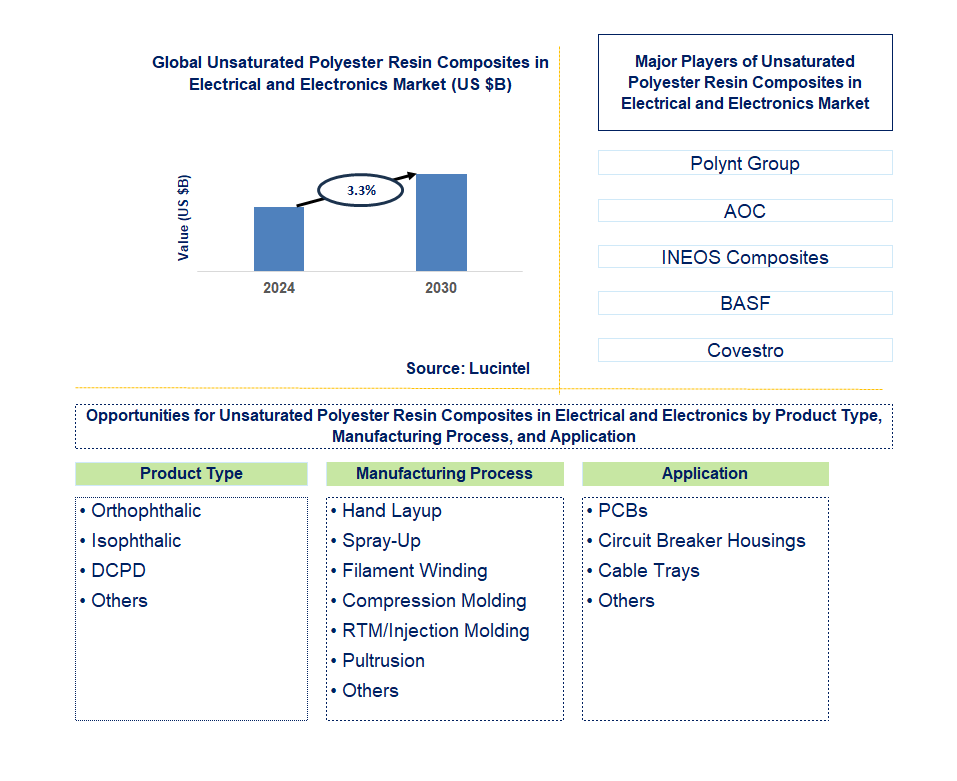
Key data points: The growth forecast = 3.3% annually for the next 6 years. Scroll below to get more insights. This market report covers trends, opportunities, and forecasts in the global unsaturated polyester resin composites in electrical and electronics market to 2030 by product type (orthophthalic, isophthalic, DCPD, and others), manufacturing process (hand layup, spray-up, filament winding, compression molding, RTM/injection molding, pultrusion, and others), application (PCBs, circuit breaker housings, cable trays, and others), and region (North America, Europe, Asia Pacific, and the Rest of the World)
We'll send your sample report shortly.
• Lucintel forecasts that, within the manufacturing process category, hand layup will remain the largest segment over the forecast period.
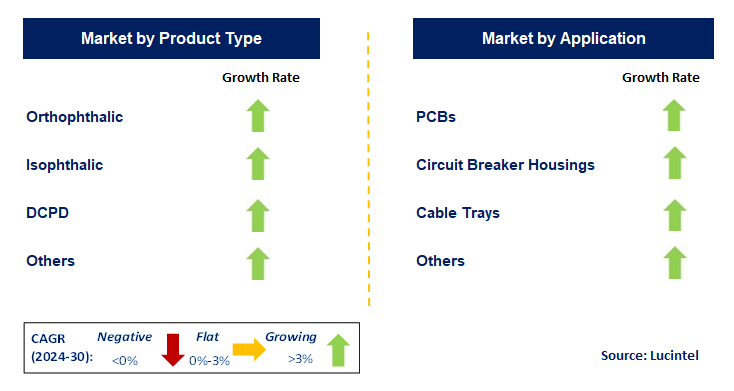
• Within the application category, cable tray is expected to witness the highest growth.
• In terms of regions, APAC is expected to witness highest growth over the forecast period. A more than 150-page report is developed to help in your business decisions.
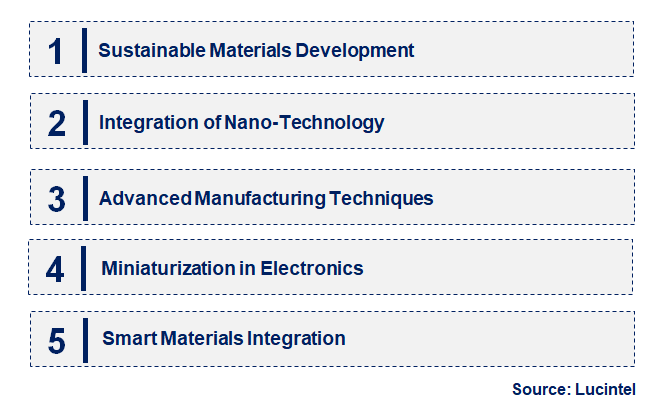
• Sustainable Materials Development: The increasing focus on sustainability has resulted in the creation of green UPR composites, which are bio-based. Manufacturers are now more inclined towards low-emission and recyclable materials due to stringent environmental regulations and the growing demand from green consumers. This trend mitigates environmental impact and increases the appeal of UPR composites in the market.
• Integration of Nanotechnology: The incorporation of nano-additives in UPR composites is enhancing their mechanical properties, electrical insulation, and thermal conductivity. This trend benefits industries requiring high performance in small sizes, such as electronic devices and automotive applications. Spinel metal and structural-thermal change technologies are advancing nanostructured composite materials and upper technologies.
• Advanced Manufacturing Techniques: Techniques like 3D printing and automated bundling are transforming UPR composite fabrication. These methods enable greater flexibility, quicker sample turnover, and reduced material wastage, shortening production times and increasing product efficiency. These technologies enhance the marketability of UPR composites.
• Miniaturization in Electronics: The trend of creating smaller devices has increased the need for lightweight, high-performance materials. UPR composites are increasingly used in compact structures where weight and dimensions are critical, especially in consumer electronics, automotive, and IoT devices.
• Smart Materials Integration: Advancements in smart composites enable UPR materials to interact with their environment, responding to changes in temperature or humidity. Such materials add value to electronic devices by making them more efficient. Smart materials are revolutionizing applications like electronic systems and packaging processes. These trends are uniting to reshape the UPR composites industry in the electrical and electronics sectors, emphasizing sustainability, innovation, and enhanced functionality.
• Bio-based UPR Formulations: The introduction of bio-based UPR formulations addresses environmental conservation while meeting regulatory requirements for low emissions without compromising performance. This aligns with global sustainability trends, creating market opportunities for manufacturers.
• Nano-additives for Enhanced Performance: The incorporation of nano-additives improves thermal conductivity and electrical insulation, enabling UPR composites to meet the high standards of modern electronics, including consumer devices and automotive parts.
• 3D Printing Capabilities: The adoption of 3D printing technology in UPR composite manufacturing allows for efficient prototyping and customization. Manufacturers can create complex shapes and reduce the time to market, benefiting the electrical and electronics domains where innovative designs are crucial.
• Enhanced Flame Retardancy: Innovations in UPR polymers offer increased fire protection for electrical applications. These materials meet global fire regulations, making them suitable for insulation and electrical appliance casings.
• Sustainability Factors: The emphasis on recycling and waste reduction is driving the UPR composites market. Incorporating recycled UPR materials into new products helps manufacturers reduce raw material costs and address sustainability concerns. These developments are enhancing the performance of UPR composites, making them favorable for various electrical and electronics applications.
• Consumer Electronics: The demand for lightweight, strong materials in consumer electronics creates significant potential for UPR composites. These materials enhance product performance and efficiency with superior mechanical and thermal properties.
• Automotive Industry: The automotive industry’s shift toward electric vehicles (EVs) and lightweight designs drives the use of UPR composites for insulation and structural components. These materials are also valuable for wind turbine manufacturers due to their lightweight properties, which reduce fuel consumption and emissions.
• Telecommunications Equipment: The development of 5G networks and other telecommunication infrastructure increases the demand for UPR composites. These materials are used in protective housing and circuit boards designed for demanding environments.
• Renewable Energy Applications: UPR composites are increasingly used in renewable energy equipment such as solar panels and wind turbines due to their lightweight and corrosion-resistant properties, which align with the needs of alternative energy sources.
• Industrial Equipment: The demand for strong, durable materials in industrial equipment creates opportunities for UPR composites. These materials are suitable for manufacturing and automation environments requiring toughness and reliability. These growth opportunities underscore the relevance of UPR composites in the electrical and electronics sectors.
• Increasing Need for Lightweight Materials: Lightweight materials are in high demand for electronics and automotive applications, enhancing performance, fuel economy, and user satisfaction. UPR composites fulfill these requirements.
• Technological Advancements: Innovations like nanotechnology and smart materials expand the applications of UPR composites, enabling manufacturers to meet industry demands.
• Sustainability Focus: The growing emphasis on sustainability drives the adoption of green UPR composites, which comply with environmental regulations and support recycling initiatives.
• Expansion of the Electronics Market: The rapid growth of the electronics market, particularly in consumer electronics and automotive applications, increases the demand for high-performance materials.
• Government Initiatives and Regulations: Policies promoting sustainable materials and technological advancements encourage UPR composite adoption. Challenges in the unsaturated polyester resin composites in electrical and electronics market are:
• Price Volatility of Raw Materials: Fluctuating raw material prices impact production costs and profitability. Manufacturers must address these challenges to maintain quality and competitiveness.
• Competition from Alternative Materials: The emergence of alternative materials like thermoplastics poses a challenge to UPR composites. Manufacturers must innovate to enhance performance and maintain market share.
• Regulatory Compliance: Meeting safety and environmental standards requires significant investment in research and development, potentially constraining innovation and market entry. While technological innovations drive demand for UPR composites, challenges like raw material costs and competition require strategic solutions to optimize growth opportunities.
• Polynt Group
• AOC
• INEOS Composites
• BASF
• Covestro
• Xinyang Technology Group
• Tianhe Resin Company
• Orthophthalic
• Isophthalic
• DCPD
• Others
• Hand Layup
• Spray-Up
• Filament Winding
• Compression Molding
• RTM/Injection Molding
• Pultrusion
• Others
• PCBs
• Circuit Breaker Housings
• Cable Trays
• Others
• North America
• Europe
• Asia Pacific
• The Rest of the World
• United States: The U.S. focuses on improving UPR composites’ thermal stability and fire resistance. Developments in 3D printing enable rapid production of specialized electronic devices.
• China: China’s advanced manufacturing infrastructure supports innovations like nano-additives and green chemistry in UPR composites. The growing EV market increases demand for lightweight, high-performance materials.
• Germany: Germany emphasizes high-performance applications in automotive and industrial sectors. Partnerships between academia and industry drive advancements, including recycled UPR composites to meet EU regulations.
• India: India’s expanding electronics industry uses cost-effective UPR composites for insulation and circuit boards. The renewable energy sector creates additional growth opportunities for UPR composites in solar panels and wind turbines.
• Japan: Japan leads in miniaturization and high-performance UPR composites for electronic packaging. Innovations in smart materials enhance consumer electronics and IoT devices.


• Polynt Group
• AOC
• INEOS Composites
• BASF
• Covestro
• Xinyang Technology Group
• Tianhe Resin Company Q5. Which unsaturated polyester resin composites in electrical and electronics market segment will be the largest in future? Answer: Lucintel forecasts that hand layup will remain the largest segment over the forecast period. Q6. In unsaturated polyester resin composites in electrical and electronics market, which region is expected to be the largest in next 6 years? Answer: APAC is expected to witness highest growth over the forecast period. Q.7 Do we receive customization in this report? Answer: Yes, Lucintel provides 10% customization without any additional cost.


Choose a license that fits your team. Instant PDF delivery.
Prices exclude taxes. Instant delivery. Custom licensing available on request.
Market Report · May 18, 2026
Market Report · May 16, 2026
Market Report · May 16, 2026
Trusted partner for strategic intelligence and business growth


Receive a complimentary market analysis tailored to your industry. Our analysts will identify key growth opportunities and competitive dynamics specific to your business.

Market size, growth rate, and key trend analysis for your specific sector.

Top competitor positioning and market share analysis.

Strategic recommendations backed by data-driven insights.
Get curated market intelligence and competitive moves straight to your inbox.
By subscribing, you agree to receive our monthly insights. Unsubscribe anytime.
Receive a complimentary market analysis tailored to your industry. Our analysts will identify key growth opportunities and competitive dynamics specific to your business.
Market size, growth rate, and key trend analysis for your specific sector.
Top competitor positioning and market share analysis.
Strategic recommendations backed by data-driven insights.
Get curated market intelligence, emerging trends, and competitive moves straight to your inbox each month.
By subscribing, you agree to receive our monthly insights. Unsubscribe anytime.
We'll send your sample report shortly.