
Market Report · July 31, 2026

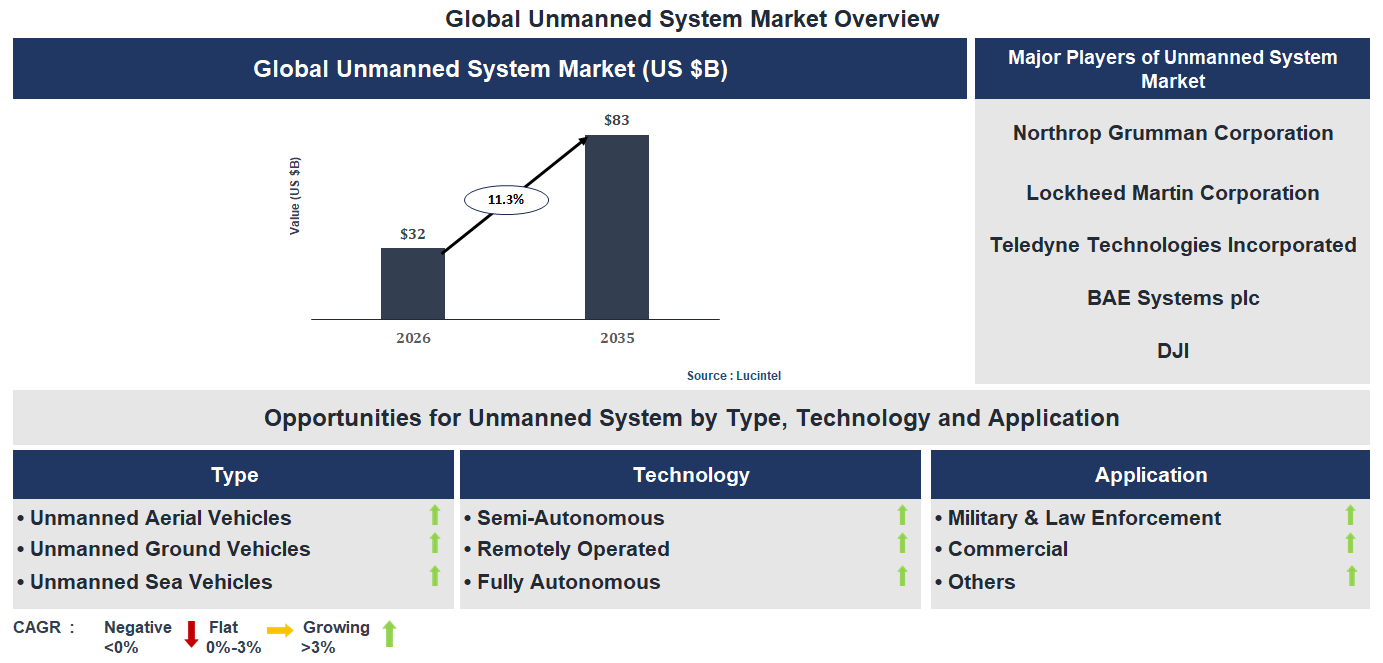
Key data points: The market size in 2035 = $83 billion, growth forecast = 11.3% annually for the next 8 years. Scroll below to get more insights. This market report covers trends, opportunities and forecasts in unmanned system market to 2035 by type (unmanned aerial vehicles, unmanned ground vehicles, and unmanned sea vehicles), technology (semi-autonomous, remotely operated, and fully autonomous), application (military & law enforcement, commercial, and others), and region (North America, Europe, Asia Pacific, and the Rest of the World)
We'll send your sample report shortly.
• Lucintel forecasts that, within the type category, unmanned aerial vehicle is expected to witness the highest growth over the forecast period.
• Within the application category, commercial is expected to witness higher growth.
• In terms of region, North America is expected to witness the highest growth over the forecast period. Gain valuable insights for your business decisions with our comprehensive 150+ page report. Sample figures with some insights are shown below.
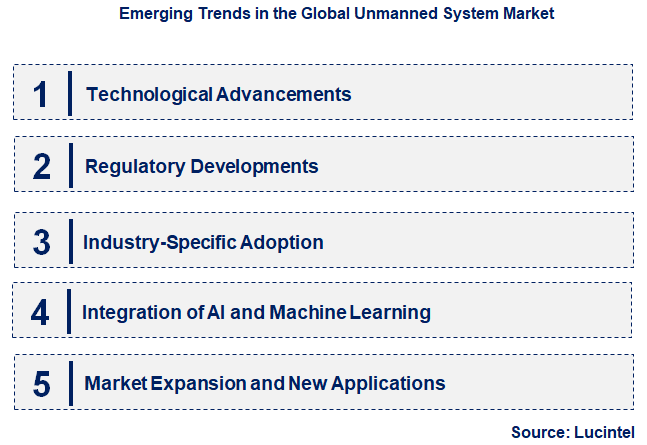
• Technological Advancements: Rapid innovation in AI, sensors, and battery technology is enhancing unmanned system capabilities. These improvements enable longer flight times, better navigation, and more autonomous decision-making, making systems more reliable and versatile. As technology progresses, unmanned systems are becoming increasingly sophisticated, capable of performing complex tasks across various environments. This trend is driving market growth by expanding application possibilities and reducing operational costs, ultimately making unmanned systems more accessible and attractive to a broader range of industries.
• Regulatory Developments: Governments and regulatory bodies are establishing frameworks to govern the use of unmanned systems. These regulations aim to ensure safety, privacy, and security while fostering innovation. Evolving policies are facilitating commercial deployment by providing clarity and standardization, which encourages investment and adoption. However, regulatory hurdles remain a challenge, requiring continuous updates to keep pace with technological advancements. The development of comprehensive regulations is critical for sustainable market growth and for building public trust in unmanned system applications.
• Industry-Specific Adoption: Different sectors are increasingly integrating unmanned systems tailored to their unique needs. In agriculture, drones are used for crop monitoring and spraying; in logistics, autonomous vehicles optimize delivery; in defense, unmanned aerial vehicles (UAVs) enhance surveillance and combat capabilities. This sector-specific adoption accelerates market expansion by demonstrating tangible benefits and ROI. As industries recognize the value of unmanned systems, demand is expected to grow, prompting further customization and innovation to meet specific operational requirements.
• Integration of AI and Machine Learning: The incorporation of AI and machine learning algorithms is revolutionizing unmanned system functionalities. These technologies enable systems to learn from data, improve decision-making, and operate with minimal human intervention. Enhanced autonomy and adaptability lead to increased efficiency and safety. This integration is particularly impactful in complex environments where real-time decision-making is critical. As AI becomes more sophisticated, unmanned systems will become smarter, opening new possibilities for automation and reducing reliance on human operators, thus transforming operational paradigms across industries.
• Market Expansion and New Applications: The market is witnessing diversification with new applications emerging beyond traditional sectors. Unmanned systems are being explored for disaster management, environmental monitoring, infrastructure inspection, and even entertainment. This expansion broadens the market scope and creates new revenue streams. As awareness and technological capabilities grow, more innovative use cases are likely to develop, further fueling market growth. This trend signifies a shift from niche to mainstream adoption, making unmanned systems integral to various societal and economic functions. These trends are collectively reshaping the unmanned system market by driving technological innovation, fostering regulatory clarity, expanding industry-specific applications, integrating advanced AI capabilities, and broadening market scope. This evolution is leading to more efficient, autonomous, and versatile systems that are poised to revolutionize multiple sectors and redefine operational standards worldwide.
• Technological Advancements in Autonomous Navigation: The development of sophisticated sensors and AI algorithms is enabling unmanned systems to navigate complex environments more accurately. This progress enhances operational safety and expands application possibilities in sectors like delivery, agriculture, and surveillance. Improved autonomy reduces reliance on human intervention, lowering operational costs and increasing efficiency. As these technologies mature, they are expected to drive widespread adoption and open new markets for unmanned systems.
• Integration of Artificial Intelligence for Enhanced Decision-Making: AI integration is revolutionizing unmanned system capabilities by enabling real-time data processing, predictive analytics, and autonomous decision-making. This advancement improves system responsiveness and adaptability in dynamic environments, crucial for defense, disaster management, and commercial applications. AI-driven systems can perform complex tasks with minimal human oversight, increasing operational efficiency and safety. The ongoing development of AI algorithms is set to further expand the scope and sophistication of unmanned systems.
• Growing Adoption in Agriculture and Logistics Sectors: Unmanned systems are increasingly used in precision agriculture for crop monitoring, spraying, and soil analysis, boosting productivity and resource management. Similarly, logistics companies are deploying drones and autonomous vehicles for last-mile delivery, reducing costs and delivery times. These sectors benefit from improved accuracy, safety, and operational efficiency. The expanding use of unmanned systems in these industries is expected to significantly influence market growth and reshape traditional practices.
• Regulatory Frameworks and Safety Standards Development: Governments and industry bodies are establishing comprehensive regulations and safety standards to facilitate safe deployment of unmanned systems. Clear guidelines help mitigate risks, foster public trust, and promote innovation. Regulatory clarity accelerates market entry for new products and encourages investment. As standards evolve, they will shape the deployment strategies and operational limits of unmanned systems, ensuring sustainable growth and widespread acceptance across sectors.
• Enhanced System Capabilities and Payload Integration: Advances in hardware design, battery technology, and payload options are increasing the versatility of unmanned systems. Enhanced payload capacities enable applications such as aerial photography, environmental monitoring, and cargo delivery. Improved endurance and stability allow for longer missions and broader operational scopes. These technological improvements are expanding the functional range of unmanned systems, making them more attractive for commercial and industrial use, and driving market expansion. These recent developments are significantly transforming the unmanned system market by improving technological capabilities, expanding application areas, and establishing regulatory frameworks. The integration of AI, enhanced safety standards, and increased payload capacities are driving innovation and adoption across multiple sectors. As a result, the market is poised for sustained growth, offering new opportunities for stakeholders and reshaping industries through increased efficiency, safety, and operational scope.
• Integration of AI and Machine Learning for Autonomous Operations: Incorporating AI and machine learning into unmanned systems enhances their autonomy, decision-making, and operational efficiency. This integration allows systems to adapt to complex environments, improve navigation, and perform tasks with minimal human intervention. As AI technology advances, unmanned systems become more reliable and versatile, opening new applications in defense, agriculture, and logistics. Companies investing in AI-driven solutions can gain competitive advantages and meet growing demand for intelligent unmanned systems.
• Expansion of Unmanned Aerial Vehicles (UAVs) in Commercial Applications: UAVs are increasingly used beyond military and defense, finding applications in agriculture, surveying, delivery, and media. The development of lightweight, high-capacity drones with extended flight times enables diverse commercial uses. Regulatory support and technological improvements are facilitating broader adoption. This expansion offers opportunities for manufacturers and service providers to develop specialized UAVs, create new revenue streams, and address unmet needs in various industries.
• Growth of Unmanned Ground and Underwater Vehicles for Industrial Use: Unmanned ground vehicles (UGVs) and underwater vehicles (UUVs) are gaining traction in sectors like mining, oil & gas, and environmental monitoring. These systems perform hazardous tasks, reduce human risk, and improve operational efficiency. Advances in sensor technology, durability, and control systems are expanding their capabilities. The market growth is driven by increasing demand for automation in challenging environments, providing opportunities for innovation and strategic partnerships in industrial sectors.
• Increasing Adoption of Unmanned Systems for Security and Surveillance: Governments and private entities are deploying unmanned systems for border security, infrastructure monitoring, and disaster management. These systems offer real-time data collection, enhanced situational awareness, and cost-effective surveillance solutions. Technological improvements in sensors, data analytics, and communication systems are boosting their effectiveness. The rising need for security and safety measures across sectors creates significant opportunities for companies to develop advanced unmanned surveillance solutions.
• Rising Investment in Unmanned System Research and Development: Significant funding from governments, private investors, and industry players is fueling innovation in unmanned systems. R&D efforts focus on improving system capabilities, battery life, payload capacity, and interoperability. This investment accelerates technological breakthroughs, reduces costs, and enables new applications. As R&D intensifies, the market is poised for rapid evolution, with emerging solutions addressing complex challenges and expanding the scope of unmanned system deployment across multiple sectors. These growth opportunities are poised to significantly influence the unmanned system market, fostering innovation, expanding application areas, and driving industry growth. Strategic focus on technological integration, expanding applications, and increased investments will shape the future landscape, offering substantial benefits for stakeholders and accelerating market maturity.
• Technological Innovation: The continuous development of advanced sensors, AI, and autonomous navigation systems enhances the capabilities of unmanned systems, making them more reliable and versatile. These innovations enable applications across defense, agriculture, logistics, and surveillance, expanding market reach. As technology becomes more affordable and scalable, adoption accelerates, fostering market growth and opening new avenues for research and development.
• Increasing Defense and Security Spending: Governments worldwide are investing heavily in unmanned aerial vehicles (UAVs), unmanned ground vehicles (UGVs), and maritime systems for surveillance, reconnaissance, and combat operations. This surge in defense budgets is driven by geopolitical tensions and the need for cost-effective, efficient military solutions. Such investments boost demand for advanced unmanned systems, stimulating industry growth and technological progress.
• Commercialization and Industrial Adoption: The commercial sector is increasingly adopting unmanned systems for delivery services, agriculture, infrastructure inspection, and environmental monitoring. Companies recognize the efficiency, safety, and cost savings these systems offer, leading to widespread deployment. This trend is supported by regulatory easing in some regions and technological maturity, which together drive market expansion into new industries.
• Regulatory Developments and Standardization: Evolving regulations and standards are facilitating the safe integration of unmanned systems into civilian airspace and other environments. Governments and international bodies are establishing frameworks for certification, operation, and data security, which reduce barriers to market entry. These regulatory advancements foster confidence among users and investors, accelerating adoption and innovation. The challenges in the unmanned system market are:
• Regulatory and Legal Barriers: Despite progress, inconsistent regulations across regions create uncertainty for manufacturers and operators. Restrictions on flight zones, licensing requirements, and privacy laws can delay deployment and increase compliance costs. Navigating these complex legal landscapes hampers rapid market expansion and necessitates ongoing engagement with policymakers.
• Cybersecurity Threats: Unmanned systems are vulnerable to hacking, data breaches, and malicious interference, which can compromise safety and operational integrity. As reliance on these systems grows, so does the risk of cyberattacks, necessitating robust security protocols. Addressing these threats requires significant investment in cybersecurity measures, which can increase costs and complicate deployment.
• Ethical and Privacy Concerns: The widespread use of unmanned systems raises ethical questions related to surveillance, data collection, and autonomous decision-making. Public apprehension and legal restrictions concerning privacy rights can limit deployment, especially in sensitive areas. Balancing technological benefits with societal concerns remains a critical challenge for industry stakeholders. The unmanned system market is driven by rapid technological innovation, increased defense and commercial demand, and supportive regulatory developments. However, challenges such as regulatory inconsistencies, cybersecurity risks, and ethical issues pose significant hurdles. These factors collectively shape the market’s trajectory, requiring stakeholders to innovate responsibly, navigate legal complexities, and address societal concerns. Successfully managing these drivers and challenges will determine the pace and scope of future growth, influencing the market’s evolution and its contribution to various sectors worldwide.
• Northrop Grumman Corporation
• Lockheed Martin Corporation
• Teledyne Technologies Incorporated
• BAE Systems plc
• DJI
• Thales Group
• Israel Aerospace Industries
• Boeing
• General Dynamics Corporation
• Textron Inc.
• Unmanned Aerial Vehicles
• Unmanned Ground Vehicles
• Unmanned Sea Vehicles
• Semi-Autonomous
• Remotely Operated
• Fully Autonomous
• Military & Law Enforcement
• Commercial
• Others
• North America
• Europe
• Asia Pacific
• The Rest of the World
• United States: The US leads in unmanned system innovation, with significant investments in military drone technology, autonomous vehicles, and commercial drone applications. Recent developments include advancements in AI-powered autonomous systems, increased integration of unmanned systems in defense strategies, and expanding commercial drone delivery networks. The Federal Aviation Administration (FAA) has introduced new regulations to facilitate commercial drone operations, fostering industry growth. Additionally, US tech giants are pioneering in autonomous vehicle research, pushing the boundaries of safety and efficiency. The US remains a global leader in unmanned system R&D, with numerous startups and established firms driving innovation.
• China: China has rapidly advanced its unmanned system capabilities, focusing on military, surveillance, and commercial sectors. Recent developments include the deployment of domestically produced military drones with enhanced endurance and payload capacity, and the expansion of urban drone delivery trials. The government has prioritized unmanned system innovation through strategic initiatives like "Made in China 2025," supporting domestic companies in developing autonomous technologies. Chinese firms are also investing in AI integration for improved autonomy and operational efficiency. The country aims to become a global leader in unmanned systems, emphasizing both military dominance and commercial applications such as logistics and agriculture.
• Germany: Germany is emphasizing the integration of unmanned systems within its industrial and defense sectors, with a focus on safety, regulation, and technological innovation. Recent developments include the certification of autonomous drones for commercial use, particularly in infrastructure inspection and environmental monitoring. The country is also investing in collaborative projects to develop hybrid manned-unmanned systems for defense and civil applications. Germany’s strong industrial base supports the development of advanced sensors, AI, and communication systems for unmanned platforms. Regulatory frameworks are evolving to balance innovation with safety, positioning Germany as a key player in European unmanned system development.
• India: India is rapidly expanding its unmanned system capabilities, driven by defense needs and commercial opportunities. Recent developments include the induction of indigenous military drones with enhanced surveillance and combat capabilities, and the launch of drone corridors for commercial delivery and agricultural use. The government has introduced policies to promote drone manufacturing and usage, including the Drone Rules 2021, which streamline licensing and operational procedures. Indian startups and defense agencies are collaborating to develop autonomous systems tailored to regional needs, such as border surveillance and disaster management. The country aims to become a significant player in the unmanned system market through innovation and strategic partnerships.
• Japan: Japan is focusing on the integration of unmanned systems into its aging infrastructure and disaster response strategies. Recent developments include the deployment of autonomous robots for disaster relief, and the development of unmanned aerial vehicles (UAVs) for infrastructure inspection. Japan’s emphasis on safety and reliability has led to rigorous testing and certification processes for commercial unmanned systems. The government is promoting industry-academic collaborations to advance AI and sensor technologies. Japan also invests in maritime unmanned systems for security and environmental monitoring. The country aims to leverage unmanned technology to address societal challenges and enhance its technological competitiveness globally.


• Northrop Grumman Corporation
• Lockheed Martin Corporation
• Teledyne Technologies Incorporated
• BAE Systems plc
• DJI
• Thales Group
• Israel Aerospace Industries
• Boeing
• General Dynamics Corporation
• Textron Inc. Q6. Which unmanned system market segment will be the largest in future? Answer: Lucintel forecasts that, within the type category, unmanned aerial vehicle is expected to witness the highest growth over the forecast period. Q7. In unmanned system market, which region is expected to be the largest in next 8 years? Answer: In terms of region, North America is expected to witness the highest growth over the forecast period. Q8. Do we receive customization in this report? Answer: Yes, Lucintel provides 10% customization without any additional cost.


Choose a license that fits your team. Instant PDF delivery.
Prices exclude taxes. Instant delivery. Custom licensing available on request.
Market Report · July 31, 2026
Market Report · July 31, 2026
Market Report · July 31, 2026
Trusted partner for strategic intelligence and business growth


Receive a complimentary market analysis tailored to your industry. Our analysts will identify key growth opportunities and competitive dynamics specific to your business.

Market size, growth rate, and key trend analysis for your specific sector.

Top competitor positioning and market share analysis.

Strategic recommendations backed by data-driven insights.
Get curated market intelligence and competitive moves straight to your inbox.
By subscribing, you agree to receive our monthly insights. Unsubscribe anytime.
Receive a complimentary market analysis tailored to your industry. Our analysts will identify key growth opportunities and competitive dynamics specific to your business.
Market size, growth rate, and key trend analysis for your specific sector.
Top competitor positioning and market share analysis.
Strategic recommendations backed by data-driven insights.
Get curated market intelligence, emerging trends, and competitive moves straight to your inbox each month.
By subscribing, you agree to receive our monthly insights. Unsubscribe anytime.
We'll send your sample report shortly.