
Report Feature
Unmanned Aerial Vehicle Ignition System Market Trends and Forecast
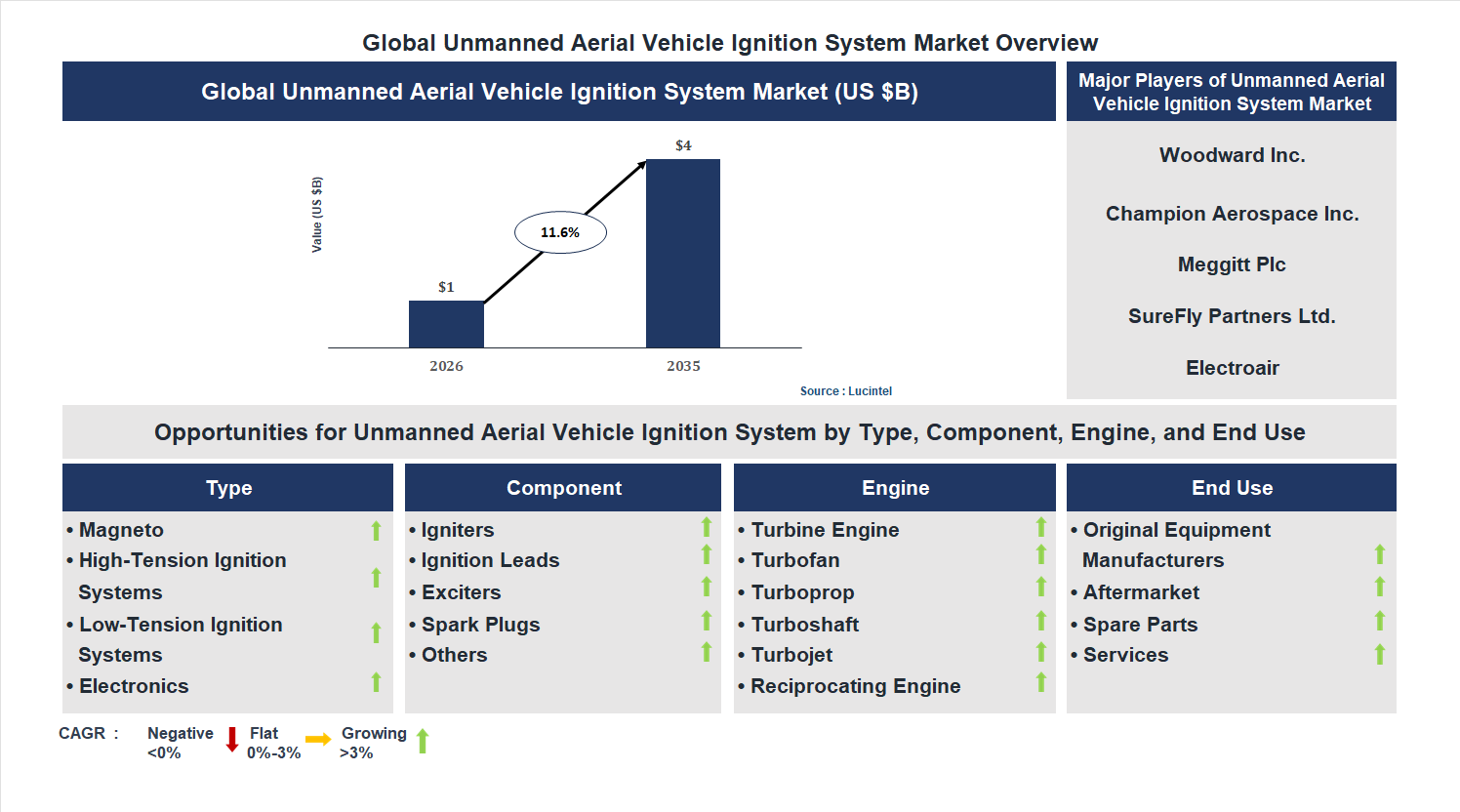
The future of the global unmanned aerial vehicle ignition system market looks promising with opportunities in the turbine engine, turbofan, turboprop, turboshaft, turbojet, and reciprocating engine markets. The global unmanned aerial vehicle ignition system market is expected to reach an estimated $4 billion by 2035 with a CAGR of 11.6% from 2026 to 2035. The major drivers for this market are the increasing demand unmanned aerial vehicle systems, the rising adoption advanced propulsion technologies, and the growing investment defense surveillance capabilities.• Lucintel forecasts that, within the type category, electronics is expected to witness the highest growth over the forecast period.
• Within the engine category, turboshaft is expected to witness the highest growth.
• In terms of region, APAC is expected to witness the highest growth over the forecast period. Gain valuable insights for your business decisions with our comprehensive 150+ page report. Sample figures with some insights are shown below.
Emerging Trends in the Unmanned Aerial Vehicle Ignition System Market
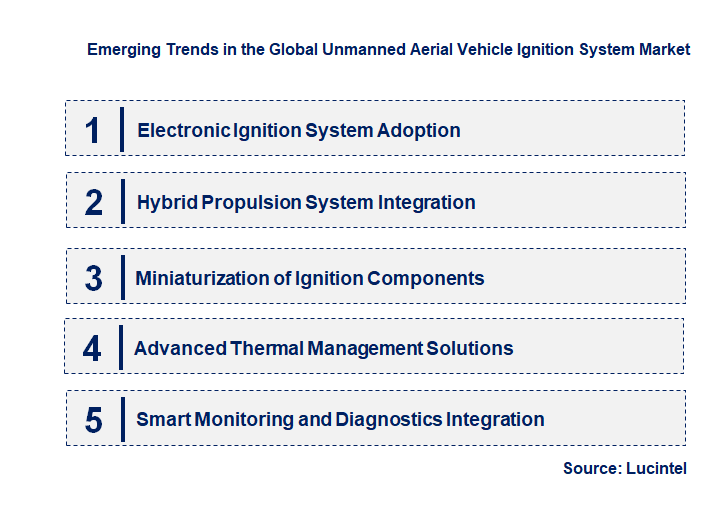
The unmanned aerial vehicle ignition system market is evolving alongside advancements in propulsion technologies and increasing demand for efficient drone operations. As UAV applications diversify, ignition systems are becoming more sophisticated, supporting improved engine performance, reduced emissions, and enhanced reliability. These trends reflect a shift toward smarter and more adaptable propulsion solutions.• Electronic Ignition System Adoption: Transition from mechanical to electronic ignition systems is enhancing precision and reliability. These systems provide better control over ignition timing and improve engine efficiency across UAV applications.
• Hybrid Propulsion System Integration: Growing adoption of hybrid propulsion technologies is influencing ignition system design. These systems support seamless operation between different power sources, improving overall performance and operational flexibility.
• Miniaturization Of Ignition Components: Demand for lightweight UAVs is driving development of compact ignition systems. Smaller components enable efficient integration without compromising performance, supporting diverse UAV designs.
• Advanced Thermal Management Solutions: Ignition systems are being designed to operate efficiently under varying temperature conditions. Improved thermal management enhances durability and ensures consistent performance during extended missions.
• Smart Monitoring And Diagnostics Integration: Integration of monitoring capabilities into ignition systems allows real-time performance tracking. These systems support predictive maintenance and improve operational reliability across UAV fleets. These emerging trends are transforming ignition systems into intelligent and efficient components of UAV propulsion. Continuous innovation is enabling improved performance, adaptability, and reliability, supporting the growing complexity of UAV operations across multiple sectors.
Recent Developments in the Unmanned Aerial Vehicle Ignition System Market
The unmanned aerial vehicle ignition system market is experiencing continuous innovation driven by advancements in propulsion and control technologies. Developments are focused on improving efficiency, reliability, and integration capabilities. These changes are enabling better performance across a wide range of UAV applications, from small drones to larger unmanned systems.• Advanced Electronic Ignition Design: Development of refined electronic ignition systems is improving engine responsiveness and efficiency. These systems enable precise control and consistent performance across different operating conditions.
• Integration With Autonomous Flight Systems: Ignition systems are being integrated with advanced control units to support autonomous operations. This integration enhances coordination between propulsion and flight management systems.
• Lightweight Component Development: Focus on reducing component weight is supporting improved UAV efficiency. Lightweight ignition systems contribute to better fuel utilization and extended operational capabilities.
• Enhanced Durability And Reliability: Development of robust ignition systems ensures consistent performance under demanding conditions. These systems are designed to withstand environmental stress and operational variability.
• Improved Fuel Efficiency Technologies: Ignition system advancements are contributing to optimized fuel combustion. This supports efficient energy utilization and improved overall UAV performance. These developments are strengthening the performance and reliability of UAV ignition systems. Continuous innovation is enabling better integration with advanced propulsion and control technologies, supporting the evolving needs of UAV applications.
Strategic Growth Opportunities in the Unmanned Aerial Vehicle Ignition System Market
The unmanned aerial vehicle ignition system market presents strong growth opportunities as drone applications expand across multiple industries. Increasing demand for efficient propulsion systems is creating opportunities for innovation and market expansion. Stakeholders are focusing on specialized applications to address evolving operational requirements.• Defense UAV Applications Expansion: Increasing use of UAVs in defense operations is driving demand for reliable ignition systems. These systems support mission-critical performance and operational efficiency.
• Commercial Drone Delivery Systems Growth: Expansion of drone-based delivery services is creating demand for efficient propulsion technologies. Ignition systems play a key role in ensuring reliable operations.
• Industrial Inspection UAV Usage: Growth in industrial inspection applications is driving adoption of advanced UAV systems. Reliable ignition systems support consistent performance in challenging environments.
• Agricultural Drone Technology Expansion: Increasing use of drones in agriculture is creating demand for efficient and durable ignition systems. These systems support extended operations in field conditions.
• Emergency Response UAV Deployment: UAVs are increasingly used in emergency response operations. Reliable ignition systems ensure consistent performance in critical situations. Strategic growth opportunities are expanding across diverse UAV applications. Focus on efficient propulsion and reliable ignition systems is supporting broader adoption and innovation in the market.
Unmanned Aerial Vehicle Ignition System Market Driver and Challenges
The unmanned aerial vehicle ignition system market is influenced by technological advancements, economic factors, and regulatory considerations. These elements drive innovation while also presenting challenges that impact development and adoption across different UAV applications. The factors responsible for driving the unmanned aerial vehicle ignition system market include:• Increasing UAV Adoption Across Industries: Growing use of UAVs in various sectors is driving demand for reliable ignition systems. This supports expansion of the overall market.
• Advancements In Propulsion Technologies: Continuous innovation in propulsion systems is influencing ignition system development. These advancements improve efficiency and performance.
• Demand For Fuel Efficiency Optimization: Need for efficient energy utilization is driving development of advanced ignition systems. These systems support improved fuel combustion.
• Growth In Autonomous UAV Operations: Increasing adoption of autonomous drones is driving demand for integrated and reliable ignition systems. These systems support seamless operations.
• Expansion Of Commercial Drone Applications: Growth in commercial drone usage is creating demand for efficient propulsion components. Ignition systems play a key role in supporting these applications. The challenges facing the unmanned aerial vehicle ignition system market include:
• High Development And Integration Costs: Designing advanced ignition systems requires significant investment in technology and integration. This can limit adoption.
• Regulatory Compliance Requirements: UAV systems must meet strict regulatory standards, impacting development and deployment processes.
• Technical Complexity In System Integration: Integrating ignition systems with advanced UAV platforms presents challenges due to system complexity. The unmanned aerial vehicle ignition system market is shaped by strong growth drivers alongside technical and regulatory challenges. While increasing adoption and technological advancements support expansion, addressing cost and integration complexities remains essential for sustained market development.
List of Unmanned Aerial Vehicle Ignition System Companies
Companies in the market compete on the basis of product quality offered. Major players in this market focus on expanding their manufacturing facilities, R&D investments, infrastructural development, and leverage integration opportunities across the value chain. With these strategies unmanned aerial vehicle ignition system companies cater increasing demand, ensure competitive effectiveness, develop innovative products & technologies, reduce production costs, and expand their customer base. Some of the unmanned aerial vehicle ignition system companies profiled in this report include-• Woodward Inc.
• Champion Aerospace Inc.
• Meggitt Plc
• SureFly Partners Ltd.
• Electroair
• Unison LLC
• TransDigm Group Inc.
• Kelly Aerospace Inc.
• G3I
• Sky Dynamics
Unmanned Aerial Vehicle Ignition System Market by Segment
The study includes a forecast for the global unmanned aerial vehicle ignition system market by type, component, engine, end use, and region.Unmanned Aerial Vehicle Ignition System Market by Type [Value from 2019 to 2035]:
• Magneto
• High-Tension Ignition Systems
• Low-Tension Ignition Systems
• Electronics
Unmanned Aerial Vehicle Ignition System Market by Component [Value from 2019 to 2035]:
• Igniters
• Ignition Leads
• Exciters
• Spark Plugs
• Others
Unmanned Aerial Vehicle Ignition System Market by Engine [Value from 2019 to 2035]:
• Turbine Engine
• Turbofan
• Turboprop
• Turboshaft
• Turbojet
• Reciprocating Engine
Unmanned Aerial Vehicle Ignition System Market by End Use [Value from 2019 to 2035]:
• Original Equipment Manufacturers
• Aftermarket
• Spare Parts
• Services
Unmanned Aerial Vehicle Ignition System Market by Region [Value from 2019 to 2035]:
• North America
• Europe
• Asia Pacific
• The Rest of the World
Country Wise Outlook for the Unmanned Aerial Vehicle Ignition System Market
The unmanned aerial vehicle ignition system market is advancing rapidly as drone applications expand across defense, commercial, and industrial sectors. Reliable ignition systems are critical for engine performance, fuel efficiency, and operational safety. Countries are investing in advanced propulsion technologies, hybrid systems, and localized manufacturing capabilities to enhance UAV reliability and endurance in diverse mission environments.• United States: The market is driven by strong defense and commercial drone ecosystems focusing on advanced propulsion reliability. Developments emphasize electronic ignition systems for improved engine efficiency and reduced maintenance. Integration with hybrid propulsion technologies and autonomous flight systems is enhancing operational consistency across long-endurance and mission-critical UAV platforms.
• China: Rapid expansion in UAV manufacturing is accelerating demand for efficient ignition systems. Developments focus on cost-effective, domestically produced ignition components integrated into a wide range of drones. Emphasis on scalability and performance optimization supports applications across surveillance, logistics, and industrial operations within a highly competitive domestic ecosystem.
• Germany: Engineering precision is shaping developments in high-performance ignition systems for UAVs. Focus areas include compact designs, fuel efficiency, and integration with advanced propulsion units. Developments support industrial and defense UAV applications, with emphasis on reliability and compatibility with environmentally efficient engine technologies.
• India: Growing domestic UAV production is driving demand for locally manufactured ignition systems. Developments include adoption of electronic ignition technologies and integration into indigenous drone platforms. Government initiatives are supporting innovation in propulsion systems, enhancing reliability and reducing dependence on imported components.
• Japan: Technological advancements focus on compact and efficient ignition systems for lightweight UAVs. Developments emphasize precision engineering and integration with advanced control systems. Applications are expanding across industrial inspection, surveillance, and disaster management, supported by strong emphasis on reliability and performance optimization.

Features of the Global Unmanned Aerial Vehicle Ignition System Market
Market Size Estimates: Unmanned aerial vehicle ignition system market size estimation in terms of value ($B). Trend and Forecast Analysis: Market trends (2019 to 2025) and forecast (2026 to 2035) by various segments and regions. Segmentation Analysis: Unmanned aerial vehicle ignition system market size by various segments, such as by type, component, engine, end use, and region in terms of value ($B). Regional Analysis: Unmanned aerial vehicle ignition system market breakdown by North America, Europe, Asia Pacific, and Rest of the World. Growth Opportunities: Analysis of growth opportunities in different types, components, engines, end uses, and regions for the unmanned aerial vehicle ignition system market. Strategic Analysis: This includes M&A, new product development, and competitive landscape of the unmanned aerial vehicle ignition system market. Analysis of competitive intensity of the industry based on Porter’s Five Forces model.
FAQ
Q1. What is the unmanned aerial vehicle ignition system market size? Answer: The global unmanned aerial vehicle ignition system market is expected to reach an estimated $4 billion by 2035. Q2. What is the growth forecast for unmanned aerial vehicle ignition system market? Answer: The global unmanned aerial vehicle ignition system market is expected to grow with a CAGR of 11.6% from 2026 to 2035. Q3. What are the major drivers influencing the growth of the unmanned aerial vehicle ignition system market? Answer: The major drivers for this market are the increasing demand unmanned aerial vehicle systems, the rising adoption advanced propulsion technologies, and the growing investment defense surveillance capabilities. Q4. What are the major segments for unmanned aerial vehicle ignition system market? Answer: The future of the unmanned aerial vehicle ignition system market looks promising with opportunities in the turbine engine, turbofan, turboprop, turboshaft, turbojet, and reciprocating engine markets. Q5. Who are the key unmanned aerial vehicle ignition system market companies? Answer: Some of the key unmanned aerial vehicle ignition system companies are as follows:• Woodward Inc.
• Champion Aerospace Inc.
• Meggitt Plc
• SureFly Partners Ltd.
• Electroair
• Unison LLC
• TransDigm Group Inc.
• Kelly Aerospace Inc.
• G3I
• Sky Dynamics Q6. Which unmanned aerial vehicle ignition system market segment will be the largest in future? Answer: Lucintel forecasts that, within the type category, electronics is expected to witness the highest growth over the forecast period. Q7. In unmanned aerial vehicle ignition system market, which region is expected to be the largest in next 8 years? Answer: In terms of region, APAC is expected to witness the highest growth over the forecast period. Q8. Do we receive customization in this report? Answer: Yes, Lucintel provides 10% customization without any additional cost.
Table of Contents
List of Figures
List of Tables
Methodology
- In-depth interviews of the major players in this market
- Detailed secondary research from competitors’ financial statements and published data
- Extensive searches of published works, market, and database information pertaining to industry news, company press releases, and customer intentions
- A compilation of the experiences, judgments, and insights of Lucintel’s professionals, who have analyzed and tracked this market over the years.


Buy Now
Choose a license that fits your team. Instant PDF delivery.
Prices exclude taxes. Instant delivery. Custom licensing available on request.
Key Questions
- • What are some of the most promising, high-growth opportunities for the unmanned aerial vehicle ignition system market by type (magneto, high-tension ignition systems, low-tension ignition systems, and electronics), component (igniters, ignition leads, exciters, spark plugs, and others), engine (turbine engine, turbofan, turboprop, turboshaft, turbojet, and reciprocating engine), end use (original equipment manufacturers, aftermarket, spare parts, and services), and region (North America, Europe, Asia Pacific, and the Rest of the World)?
- • Which segments will grow at a faster pace and why?
- • Which region will grow at a faster pace and why?
- • What are the key factors affecting market dynamics? What are the key challenges and business risks in this market?
- • What are the business risks and competitive threats in this market?
- • What are the emerging trends in this market and the reasons behind them?
- • What are some of the changing demands of customers in the market?
- • What are the new developments in the market? Which companies are leading these developments?
- • Who are the major players in this market? What strategic initiatives are key players pursuing for business growth?
- • What are some of the competing products in this market and how big of a threat do they pose for loss of market share by material or product substitution?
- • What M&A activity has occurred in the last 5 years and what has its impact been on the industry? For any questions related to Unmanned Aerial Vehicle Ignition System Market, Unmanned Aerial Vehicle Ignition System Market Size, Unmanned Aerial Vehicle Ignition System Market Growth, Unmanned Aerial Vehicle Ignition System Market Analysis, Unmanned Aerial Vehicle Ignition System Market Report, Unmanned Aerial Vehicle Ignition System Market Share, Unmanned Aerial Vehicle Ignition System Market Trends, Unmanned Aerial Vehicle Ignition System Market Forecast, Unmanned Aerial Vehicle Ignition System Companies, write Lucintel analyst at email: helpdesk@lucintel.com. We will be glad to get back to you soon.


