
Market Report · July 29, 2026

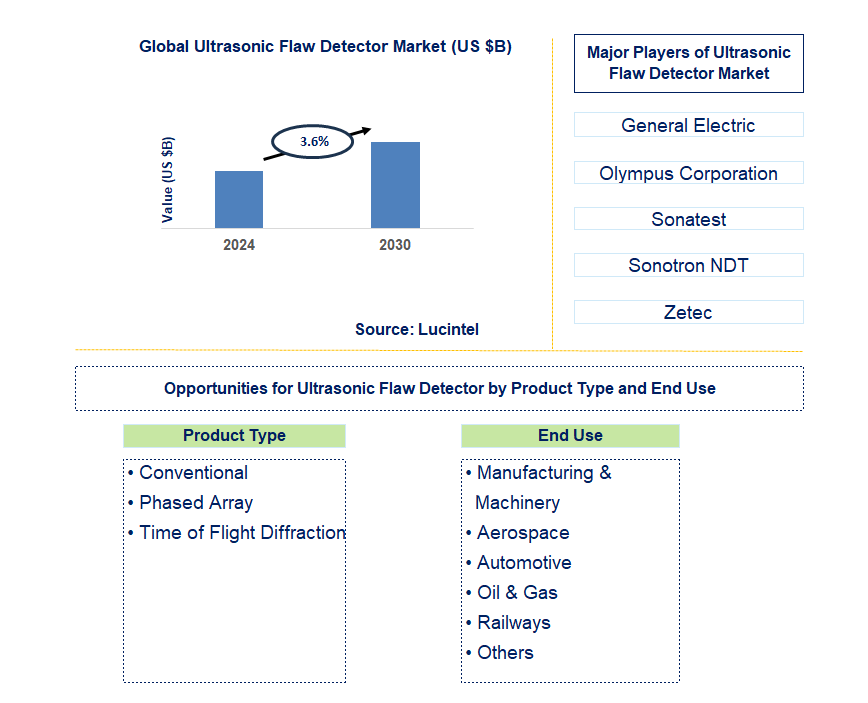
Key data points: The growth forecast = 3.6% annually next 6 years. Scroll below to get more insights. This market report covers trends, opportunities, and forecast in the global ultrasonic flaw detector market to 2030 by product type (conventional, phased array, and time of flight diffraction), end use (manufacturing & machinery, aerospace, automotive, oil & gas, railways, and others), and region (North America, Europe, Asia Pacific, and the Rest of the World)
We'll send your sample report shortly.
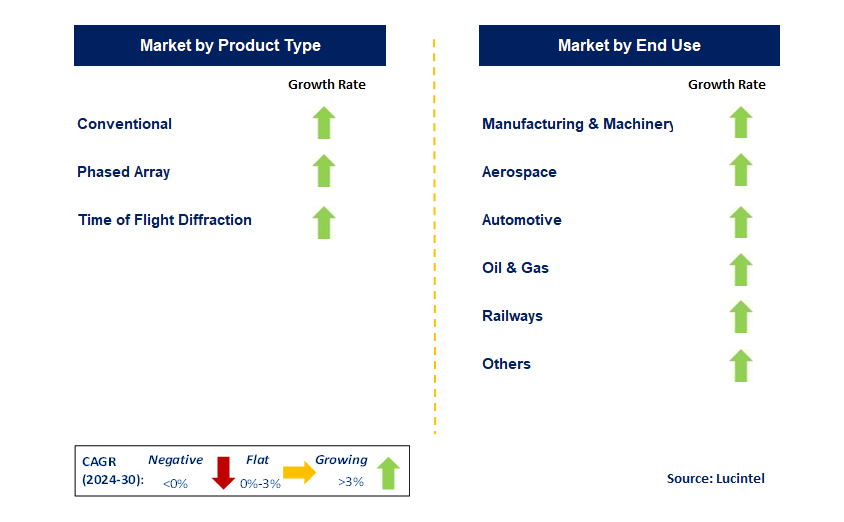
• Lucintel forecasts that conventional is expected to witness highest growth over the forecast period.
• Within this market, oil & gas is expected to witness highest growth over the forecast period.
• Europe is expected to witness highest growth over the forecast period due to high levels of industrialization in developed nations. A more than 150-page report is developed to help in your business decisions.
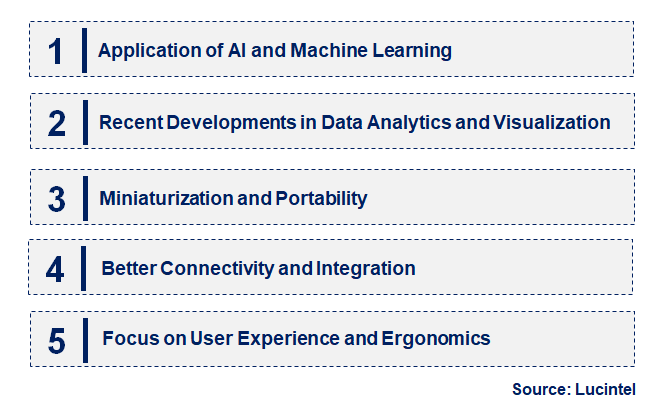
• Application of AI and Machine Learning: Ultrasonic flaw detectors are revolutionizing the way flaw detection is carried on by leveraging the usage of AI and machine learning algorithms. Besides the aid of deterministic analysis and classification of defects, these technologies lower the likelihood of errors by reducing dependency on manual interpretation. Complex flaws that might go unnoticed through more conventional means can be identified, thus increasing efficiency in inspection overall.
• Recent Developments in Data Analytics and Visualization: Ultrasonic flaw detectors are becoming more sophisticated with the integration of the latest data analytics and visualization tools. Results can be analyzed in much more detailed inspection data, potentially increasing insight and improving the readability of complex data. Visualization capabilities are improved to make it easier for users to quickly find potential issues that require faster resolution. This helps with effective maintenance practices and general decision-making.
• Miniaturization and Portability: There is a growing demand to miniaturize ultrasonic flaw detectors in order to make them more portable and user-friendly. More compact designs that do not compromise functionality have also emerged in order to make them easier to handle and use for many field applications. Portability is particularly useful in using these instruments during inspections in remote or inaccessible environments.
• Better Connectivity and Integration: Ultrasonic flaw detectors are coming to be better equipped with connectivity features such as Wi-Fi, Bluetooth, and IoT. These developments enable direct data transfer, remote diagnosis, and integration with other inspection systems. Better workflow is achieved by an improved flow; hence, it means that a more comprehensive data management and collaboration is possible.
• Focus on User Experience and Ergonomics: The makers are also emphasizing improving the user experience and ergonomics of ultrasonic flaw detectors. In new designs, intuitive interfaces, ergonomic handles, and lightweight materials improve usability and significantly reduce operator fatigue, creating more efficient inspections and greater user satisfaction. Trends emerging in the ultrasonic flaw detector market include AI integration, advanced data analytics, and enhanced portability, which now drive innovation, improve functionality, and enhance a wide range of applications within several industries.
• High-resolution digital imaging: Modern ultrasonic flaw detectors implement the latest advances in digital imaging technologies, including higher resolution and clearer visibility in defect imaging. The better the quality of image obtained from flaw detectors, the more accurate and effective flaw detection. This utility is beneficial to the aerospace and other manufacturing sectors that operate correctly with inspections.
• AI-Powered Defect Analysis: The employment of AI with ultrasonic flaw detectors is considered one of the most important breakthroughs. With AI algorithms, it becomes easier to automatically identify and classify flaws, thereby reducing human error and speeding up inspection processes. This becomes particularly helpful in complex, high-stakes inspections where accuracy is the only thing that matters.
• Portable and Rugged Designs: Advances in designs have led to the introduction of more portable and rugged ultrasonic flaw detectors. The latest designs come well within the general expectations regarding ruggedness as well as portability; they can be handled, and even transported through sometimes very rough environments like construction sites and rail yards, for field inspections.
• Real-time data transmission: New ultrasonic flaw detectors are provided with real-time data transmission. This feature allows the sharing and analysis of inspection results directly for the sake of immediate decisions and for better workflow management. The remote diagnostics and instant responses associated with the real-time data are important features of the ultrasonic flaw detectors.
• Improved Battery Life and Power Efficiency: Advances in battery technology have made ultrasonic flaw detectors have longer-lasting and more power-efficient batteries. Extended battery life means devices can stay longer in the field without frequent recharging, and thus ensure reliability and usability in extended inspections. Current and future competitive analysis in profiles ultrasonic flaw detector, improvements in digital imaging and integration with AI are leading to huge performance and usability improvements. This allows making the ultrasonic flaw detectors better, more portable, and user-friendly for all industries to fulfill their new requirements.
• Among the growth industries are Aerospace Industry: The aerospace industry is one of the major growth opportunities with very high quality and safety requirements. For aircraft components and structures, ultrasonic flaw detectors are absolutely necessary. Advancements that give greater accuracy and reduce time for inspections will lead to promising adoption in this in-demand industry.
• Oil and Gas Sector: This sector requires reliable pipeline inspection tools and machinery inspection tools. Portable ultrasonic flaw detectors with ruggedness and high performance in harsh environments may meet the requirements of this sector. Growth opportunities may exist in advanced solutions for preventive maintenance and safety inspections.
• Manufacturing and Automotive: In manufacturing and in automotive industries, ultrasonic flaw detectors play a critical role in ensuring quality and integrity. Opportunities for building the detectors more automatic with more enhanced data analysis capabilities exist to improve quality control while making the production process more efficient and effective.
• Infrastructure and Construction: The ultrasonic flaw detectors shall be used for welds and material evaluation in buildings and bridges that constitute the infrastructure and construction. The opportunities would be increased by development of more cost-effective and portable solutions meeting field inspection and maintenance needs in large-scale construction projects.
• Energy Sector: This area encompasses nuclear and renewable sources, presenting an opportunity area for ultrasonic flaw detectors in the inspection of key components. Advanced detectors with high resolution imaging and real-time data capabilities are likely to enhance safety and efficiency in energy production and maintenance. The requirements of such industries as aerospace, oil and gas, manufacturing, construction, and energy open the doors for strategic growth in the ultrasonic flaw detector market. Companies can gain the emerging trend in these applications to enhance their position in the market.
• General Electric
• Olympus Corporation
• Sonatest
• Sonotron NDT
• Zetec
• Kropus
• Hitachi Power Solutions
• Conventional
• Phased Array
• Time of Flight Diffraction
• Manufacturing & Machinery
• Aerospace
• Automotive
• Oil & Gas
• Railways
• Others
• North America
• Europe
• Asia Pacific
• The Rest of the World
• United States: The most recent trends in ultrasonic flaw detectors in the United States include better digital imaging and real-time analysis. There is a strong trend toward the integration of AI for the purposes of automated defect recognition and better usability of the instrument. These innovations will enhance the accuracy of detection while greatly simplifying the inspection process, thereby addressing the specific needs of both aerospace and energy industries.
• China: Compared to the previous years, the market is growing fast because of increasing industrialization and project development. Some of the more recent ones are the design of more portable and rugged ultrasonic flaw detectors, for use in more rugged environments. Chinese manufacturers also work to ensure solutions are cost-effective with high performance to make advanced inspection technology more accessible to a larger number of industries.
• Germany: High-precision and innovation are the best words that could be used in describing ultrasonic flaw detectors in Germany. With new developments which include advanced signal processing algorithms and imaging along with high resolutions, these meet high stringent quality standards, which applications such as automotive and manufacturing require, making NDT more effective.
• India: In India, the emphasis has been on developing cheap ultrasonic flaw detectors for the growing industrial sectors. The latest innovations are rugged for versatility in application and provide better features that would help analyze data effectively. All these are directed at enhancing efficiency and safety levels in construction and railways, among others.
• Japan: The ultrasonic flaw detector marketplace in Japan is dominated with the integration of new technologies, such as AI and IoT, in ultrasonic flaw detectors. The newest models are designed to function with high-order data analytics and connectivity features for immediate monitoring and remote diagnostic capabilities. This trend supports Japan's emphasis on precision engineering and advanced manufacturing technologies.


• General Electric
• Olympus Corporation
• Sonatest
• Sonotron NDT
• Zetec
• Kropus
• Hitachi Power Solutions Q5. Which ultrasonic flaw detector market segment will be the largest in future? Answer: Lucintel forecasts that conventional is expected to witness highest growth over the forecast period. Q6. In ultrasonic flaw detector market, which region is expected to be the largest in next 6 years? Answer: Europe is expected to witness highest growth over the forecast period due to high levels of industrialization in developed nations. Q.7 Do we receive customization in this report? Answer: Yes, Lucintel provides 10% customization without any additional cost.


Choose a license that fits your team. Instant PDF delivery.
Prices exclude taxes. Instant delivery. Custom licensing available on request.
Market Report · July 29, 2026
Market Report · July 20, 2026
Market Report · July 20, 2026
Trusted partner for strategic intelligence and business growth


Receive a complimentary market analysis tailored to your industry. Our analysts will identify key growth opportunities and competitive dynamics specific to your business.

Market size, growth rate, and key trend analysis for your specific sector.

Top competitor positioning and market share analysis.

Strategic recommendations backed by data-driven insights.
Get curated market intelligence and competitive moves straight to your inbox.
By subscribing, you agree to receive our monthly insights. Unsubscribe anytime.
Receive a complimentary market analysis tailored to your industry. Our analysts will identify key growth opportunities and competitive dynamics specific to your business.
Market size, growth rate, and key trend analysis for your specific sector.
Top competitor positioning and market share analysis.
Strategic recommendations backed by data-driven insights.
Get curated market intelligence, emerging trends, and competitive moves straight to your inbox each month.
By subscribing, you agree to receive our monthly insights. Unsubscribe anytime.
We'll send your sample report shortly.