
Report Feature
Ultrasonic Cleaning Trends and Forecast
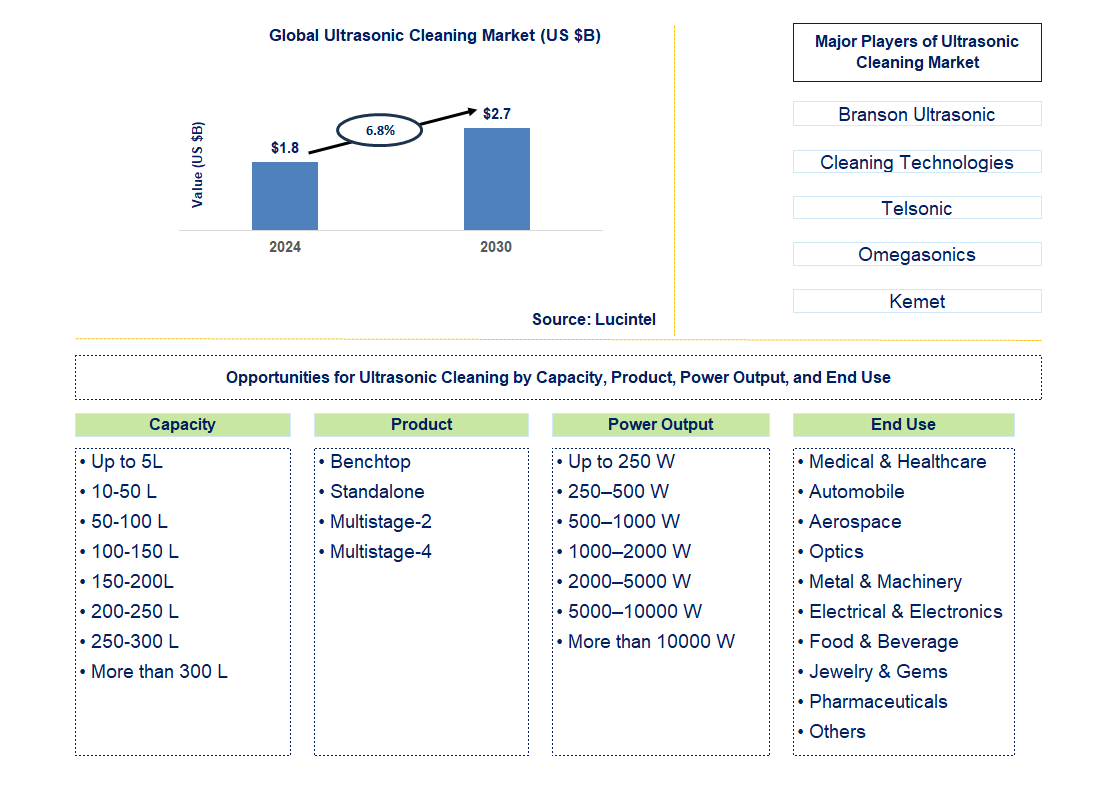
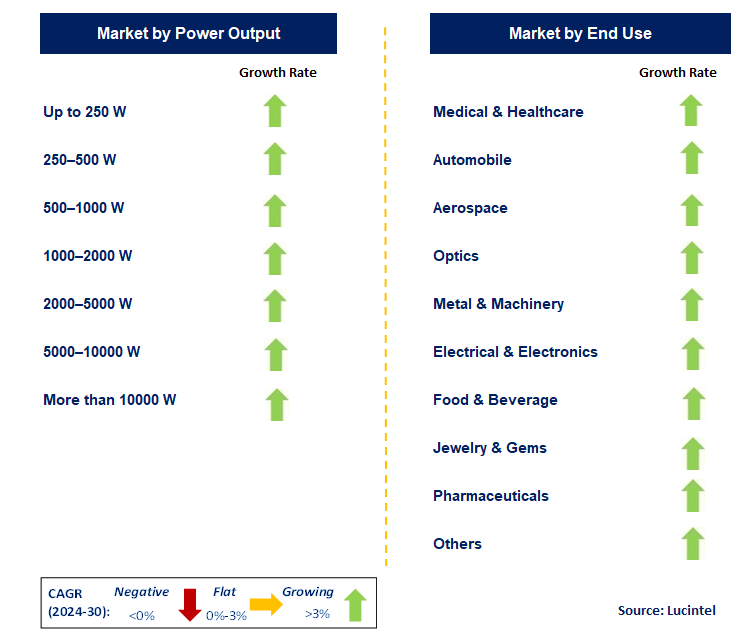
The future of the global ultrasonic cleaning market looks promising with opportunities in the medical & healthcare, automobile, aerospace, optics, metal & machinery, electrical & electronics, food & beverage, jewelry & gems, and pharmaceuticals markets. The global ultrasonic cleaning market is expected to reach an estimated $2.7 billion by 2030 with a CAGR of 6.8% from 2024 to 2030. The major drivers for this market are growing industrialization and growth in the number of manufacturing industries, increase in shift toward smart factories and industry 4.0, as well as, rising usage of smart cleaning devices & equipment.• Lucintel forecast that 1000–2000 w is expected to witness the highest growth over the forecast period due to growing adoption in precision cleaning applications for automotive, aerospace, and food & beverage verticals.
• Through this market, food & beverages will remain the largest segment because the food residues, oils, and pathogens can all be safely and effectively removed from processing equipment, utensils, and packing materials with the use of ultrasonic cleaning technology, and maintaining elevated standards of hygiene and sanitation is crucial in the food manufacturing process to guarantee the safety and excellence of the final product.
• North America is expected to witness the highest growth over the forecast period due to earliest adoption of advanced technologies, rising presence of prominent market players, and stringent regulatory standards in the region, particularly in healthcare and food production. A more than 150-page report is developed to help in your business decisions.
Emerging Trends in the Ultrasonic Cleaning Market
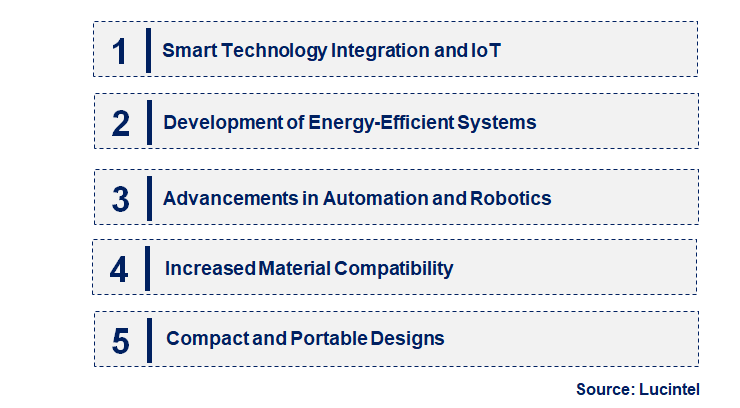
The technological advancements and evolution of industry requirements have turned the course of the ultrasonic cleaning market upside down. Increased automation, energy efficiency, and enhanced capability development are some of the trends that will continue to shape the future of ultrasonic cleaning applications.• Smart Technology Integration and IoT: Smart ultrasonic cleaning now uses Internet of Things technology that enables remote monitoring and control. Integration provides real-time cleaning process data, enhances system diagnostics, and enhances general operational efficiency by allowing predictive maintenance.
• Development of Energy-Efficient Systems: There is an increasing interest in energy efficiency within ultrasonic cleaning systems. Designs that are able to save power without affecting the cleaning performance provide further contribution towards cost savings and environmental sustainability in those applications where these systems find employment.
• Advancements in Automation and Robotics: Automation and robotics are increasingly being integrated into ultrasonic cleaning systems, allowing for appropriate, repeated cleaning processes that require very little, if any, human intervention. These serve to improve productivity and reduce operational labor in industries and laboratories.
• Increased Material Compatibility: Newer developments within ultrasonic cleaning technologies continue to increase the envelope of material compatibility. Development has focused on ultrasonic cleaning systems capable of cleaning a wider range of materials, including sensitive or complex components, without damage-a continuing expansion in the use of ultrasonic cleaning.
• Compact and Portable Designs: Compact and portable designs are increasingly gaining popularity in the market regarding ultrasonic cleaning units. Such designs provide flexibility and ease in conducting a wide range of cleaning jobs both industrially and for consumers. These emerging trends are fostering technology integration, energy efficiency, automation, and material compatibility, thereby remodeling the ultrasonic cleaning market. The need to adopt smart systems, energy-efficient design, and compact solution is driving innovation and increasing the scope of ultrasonic cleaning applications.
Recent Developments in the Ultrasonic Cleaning Market
Recent key developments in ultrasonic cleaning reflect innovations that work towards enhancement of performance, efficiency, and applicability. The improvements are trending in the market by offering better cleaning capability and catering to a variety of needs for different industries.• Introduction of High-Frequency Ultrasonic Systems: New ultrasonic cleaning systems run at higher frequencies, hence offering higher precision and efficiency. These can clean finer details and more sensitive parts and, therefore, are ideal for applications that demand high levels of cleanliness and precision.
• Energy-Efficient Designs: The latest developments in energy-efficient ultrasonic cleaning systems focus on minimizing power consumption without compromising their effectiveness. Such innovations contribute to reducing operational costs and protecting the environment-which is a growing demand today.
• Integration of Smart Sensors and Monitoring: The integration of smart sensors into the ultrasonic cleaners makes them enable real-time monitoring and analytics. Indeed, this kind of technology would be a great insight into the processes of cleaning and give one better control of predictive maintenance for improved cleaning outcomes.
• Growth of Compact and Portable Units: The growth of compact and portable ultrasonic cleaning units is for applications ranging from small-scale and mobile cleaning. These units give flexibility, convenience for industrial application, and consumer needs.
• Better Compatibility with a Wide Range of Materials: Recent advances have involved ultrasonic cleaning systems that can handle a wider range of materials. Innovation in this area allows sensitive or complex components to be cleaned without damage, extending the applicability of the technology. These emerging trends are encircling growth in the ultrasonic cleaning marketplace by scaling system performance, effectiveness, and adaptability. High-frequency technology, energy efficiency, smart monitoring, and material compatibility development drives progress and broadens the scope of applications in ultrasonic cleaning.
Strategic Growth Opportunities for Ultrasonic Cleaning Market
Key opportunities for strategic growth are opening in various applications for ultrasonic cleaning, depending on the demand from technology and industries. These developments indicate further expansion of market presence to meet a greater range of cleaning challenges.• Expansion into Industrial and Manufacturing Sectors: Other directions for growth lie in using advanced ultrasonic cleaning solutions in targeting industrial and manufacturing sectors. The significantly enhanced efficiency and effectiveness of cleaning complex and high-precision components assure very substantial opportunities in market expansion.
• Custom Development for Healthcare and Laboratories: Both the healthcare and laboratory industries represent custom ultrasonic cleaning solution development. Tailoring systems against specific cleanliness standards and requirements can address unique challenges and support high-demand environments.
• Integrating Ultrasonic Cleaning into the Automotive and Aerospace Industry: Only a few areas of growth for ultrasonic cleaning systems include the automotive and aerospace industries, which need advanced cleaning to guarantee their precision components and operational reliability.
• Eco-Friendly and Energy-Efficient Solutions: The demand in the market is pressing hard for eco-friendly and energy-efficient ultrasonic cleaning systems. Developing solutions with minimal environmental impact and reducing operation costs will be one step toward global sustainability but also will give an edge in the competition.
• Adoption of Portable and Compact Designs for Consumer Applications: The portable and compact ultrasonic cleaning units market is expanding. These designs cater to consumer applications, including small-scale and home use, providing versatility and convenience in response to various cleaning needs. Opportunities for growth in strategic ultrasonic cleaning are prompted through the advancement of technology, specifically based on industry needs and the call for sustainable development. Increased entry into industry-related sectors, offering customized solutions to healthcare, and taking consideration in design for environmental concerns will be imperative to realize the market potential and meet various cleaning challenges.
Ultrasonic Cleaning Market Driver and Challenges
The growth of the ultrasonic cleaning market is influenced by drivers and challenges in many ways, given the pace at which technology is advancing, along with economic considerations and regulatory requirements. Understanding these elements will be the key to comprehend the dynamics of the market and capitalizing on all growth opportunities. The factors responsible for driving the ultrasonic cleaning market include: 1. Technological Advancements for Enhanced Cleaning Efficiency: The market is seeing increased growth due to innovations in ultrasonic cleaning technology such as high-frequency systems and new materials. These developments further enhance the precision, effectiveness, and applicability to various industrial and consumer applications. 2. Growing Demand for Precise Cleaning: With the growing demands for precision cleaning in the electronics, healthcare, and aerospace industries, the demand for ultrasonic cleaning solutions increases in direct proportion. These systems are much more capable of removing contaminants from delicate and complex parts. 3. Environmental Sustainability: The increasing focus on greener and more energy-efficient cleaning solutions promotes the growth of ultrasonic systems. Energy-efficient inventions reduce environmental deterioration, therefore partially meeting some global sustainability goals, which makes them appealing to environmentally conscious consumers. 4. Expanding Industrial and Consumer Applications: The versatility of ultrasonic cleaning systems fosters their adoption across various industries: manufacturing, automotive, and healthcare. A wide range of applications has contributed to market growth and innovation. 5. Integration of Smart Technology and Automation: The integration of smart sensors and automation in ultrasonic cleaning systems promotes efficiency in operation and management. Real-time monitoring and control further enhance performance and lessen the interference of human contact. Challenges in the ultrasonic cleaning market are: 1. High Initial Investment Costs: Advanced ultrasonic cleaning systems are highly costly to invest in, which may be a stumbling block to its growth, mainly among small and medium-sized enterprises. High initial investments with a cost of maintenance may further affect the market's growth. 2. System Integration and Maintenance Complexity: The integration of ultrasonic cleaning systems into current processes is complex, as is their maintenance. Their operation requires a specialist knowledge and technical support system to avoid some basic pitfalls that can lead to ultrasonic cleaning system downtime. 3. Regulatory and Environmental Compliance: Maintaining regulatory and environmental standards concerning ultrasonic cleaning systems is difficult. In order to follow strict regulations, one must make continuous adaptations and investments in technology and practices. 4. Limited Awareness of Benefits in Some Sectors: In some industries, knowledge of the benefits and potential applications of ultrasonic cleaning may be limited. The benefits of these systems will need to be raised and promoted for market development. 5. Rapid Technologies Change/Innovation: The rate of technological change puts pressure on the manufacturers to keep up with it. The process of keeping abreast of innovations and integrating new technologies into existing systems requires continuous investment and evolution. Major drivers and challenges in the ultrasonic cleaning market pertain to the need for technological innovation, cost management, and adherence to regulations. Drivers involve those in technological advancement, increased demand for precision cleaning, and sustainability, whereas major challenges involve costs, integration complexity, and regulations.List of Ultrasonic Cleaning Companies
Companies in the market compete on the basis of product quality offered. Major players in this market focus on expanding their manufacturing facilities, R&D investments, infrastructural development, and leverage integration opportunities across the value chain. With these strategies ultrasonic cleaning companies cater increasing demand, ensure competitive effectiveness, develop innovative products & technologies, reduce production costs, and expand their customer base. Some of the ultrasonic cleaning companies profiled in this report include-• Branson Ultrasonic
• Cleaning Technologies
• Telsonic
• Omegasonics
• Kemet
• Morantz Ultrasonics
• Mettler Electronics
• SharperTek
• Blue Wave Ultrasonics
• Crest Ultrasonics
Ultrasonic Cleaning by Segment
The study includes a forecast for the global ultrasonic cleaning by capacity, product, power output, end use, and regionUltrasonic Cleaning Market by Capacity [Analysis by Value from 2018 to 2030]:
• Up to 5L
• 10-50 L
• 50-100 L
• 100-150 L
• 150-200L
• 200-250 L
• 250-300 L
• More than 300 L
Ultrasonic Cleaning Market by Product [Analysis by Value from 2018 to 2030]:
• Benchtop
• Standalone
• Multistage-2
• Multistage-4
Ultrasonic Cleaning Market by Power Output [Analysis by Value from 2018 to 2030]:
• Up to 250 W
• 250–500 W
• 500–1000 W
• 1000–2000 W
• 2000–5000 W
• 5000–10000 W
Ultrasonic Cleaning Market by End Use [Analysis by Value from 2018 to 2030]:
• Medical & Healthcare
• Automobile
• Aerospace
• Optics
• Metal & Machinery
• Electrical & Electronics
• Food & Beverage
• Jewelry & Gems
• Pharmaceuticals
• Others
Ultrasonic Cleaning Market by Region [Analysis by Value from 2018 to 2030]:
• North America
• Europe
• Asia Pacific
• The Rest of the World
Country Wise Outlook for the Ultrasonic Cleaning Market
Major players in the market are expanding their operations and forming strategic partnerships to strengthen their positions. Below image highlights recent developments by major ultrasonic cleaning systems producers in key regions: the USA, China, India, Japan, and Germany• United States: In the United States, innovations in ultrasonic cleaning lie in high-frequency ultrasonic systems and units for better precision and efficiency in cleaning. New technologies in this field involve making energy-saving reductions and integrating automated features to make operation easier and enable better integration with industrial processes.
• China: Ultrasonic cleaning systems in China grow, with rising focus on affordable and scalable cleaning. Recent innovations include an inexpensive ultrasonic cleaning model serving a variety of application platforms from industrial to consumer products by introducing further development in increasing system reliability and reducing its maintenance
• Germany: With all these developments, it is expected that Germany will continue to drive the technology advancements in ultrasonic cleaning systems, including advanced sensors and intelligent technologies. Examples of such systems include real-time monitoring systems with data analytics for improving cleaning outcomes and process control, enabling enhanced diagnostics and maintenance of the system.
• India: Recent development in India is related to energy-efficient ultrasonic cleaning systems for diversified applications. Compact and portable units have been developed for small-scale applications, and systems offering higher performance at lower operational costs have been developed to share the cleaning demands of the growing industrial sector.
• Japan: Developments related to ultrasonic cleaning in Japan are targeted at providing higher levels of automation through the introduction of AI and robotics. The integration of robotic handling with intelligent cleaning algorithms in the new systems offers higher precision and efficiency with lesser human touch and operational errors.

Features of the Global Ultrasonic Cleaning Market
Market Size Estimates: Ultrasonic cleaning market size estimation in terms of value ($B). Trend and Forecast Analysis: Market trends (2018 to 2023) and forecast (2024 to 2030) by various segments and regions. Segmentation Analysis: Ultrasonic cleaning market size by various segments, such as by capacity, product, power output, end use, and region in terms of value ($B). Regional Analysis: Ultrasonic cleaning market breakdown by North America, Europe, Asia Pacific, and Rest of the World. Growth Opportunities: Analysis of growth opportunities in different capacity, product, power output, end use, and regions for the ultrasonic cleaning market. Strategic Analysis: This includes M&A, new product development, and competitive landscape of the ultrasonic cleaning market. Analysis of competitive intensity of the industry based on Porter’s Five Forces model.If you are looking to expand your business in this market or adjacent markets, then contact us. We have done hundreds of strategic consulting projects in market entry, opportunity screening, due diligence, supply chain analysis, M & A, and more.

FAQ
Q.1 What is the ultrasonic cleaning market size? Answer: The global ultrasonic cleaning market is expected to reach an estimated $2.7 billion by 2030. Q.2 What is the growth forecast for ultrasonic cleaning market? Answer: The global ultrasonic cleaning market is expected to grow with a CAGR of 6.8% from 2024 to 2030. Q.3 What are the major drivers influencing the growth of the ultrasonic cleaning market? Answer: The major drivers for this market are growing industrialization and growth in the number of manufacturing industries, increase in shift toward smart factories and industry 4.0, as well as, rising usage of smart cleaning devices & equipment. Q4. What are the major segments for ultrasonic cleaning market? Answer: The future of the global ultrasonic cleaning market looks promising with opportunities in the medical & healthcare, automobile, aerospace, optics, metal & machinery, electrical & electronics, food & beverage, jewelry & gems, and pharmaceuticals markets. Q5. Who are the key ultrasonic cleaning market companies? Answer: Some of the key ultrasonic cleaning companies are as follows:• Branson Ultrasonic
• Cleaning Technologies
• Telsonic
• Omegasonics
• Kemet
• Morantz Ultrasonics
• Mettler Electronics
• SharperTek
• Blue Wave Ultrasonics
• Crest Ultrasonics Q6. Which ultrasonic cleaning market segment will be the largest in future? Answer: Lucintel forecast that 1000–2000 w is expected to witness the highest growth over the forecast period due to growing adoption in precision cleaning applications for automotive, aerospace, and food & beverage verticals. Q7. In ultrasonic cleaning market, which region is expected to be the largest in next 5 years? Answer: North America is expected to witness the highest growth over the forecast period due to earliest adoption of advanced technologies, rising presence of prominent market players, and stringent regulatory standards in the region, particularly in healthcare and food production. Q.8 Do we receive customization in this report? Answer: Yes, Lucintel provides 10% customization without any additional cost.
Table of Contents
Methodology
- In-depth interviews of the major players in this market
- Detailed secondary research from competitors’ financial statements and published data
- Extensive searches of published works, market, and database information pertaining to industry news, company press releases, and customer intentions
- A compilation of the experiences, judgments, and insights of Lucintel’s professionals, who have analyzed and tracked this market over the years.


Buy Now
Choose a license that fits your team. Instant PDF delivery.
Prices exclude taxes. Instant delivery. Custom licensing available on request.
Key Questions
- • What are some of the most promising, high-growth opportunities for the ultrasonic cleaning market by capacity (up to 5l, 10-50 l, 50-100 l,100-150 l, 150-200l, 200-250 l, 250-300 l, and more than 300 l), product (benchtop, standalone, multistage-2, and multistage-4), power output (up to 250 w, 250–500 w, 500–1000 w, 1000–2000 w, 2000–5000 w, 5000–10000 w, and more than 10000 w), end use (medical & healthcare, automobile, aerospace, optics, metal & machinery, electrical & electronics, food & beverage, jewelry & gems, pharmaceuticals, and others), and region (North America, Europe, Asia Pacific, and the Rest of the World)?
- • Which segments will grow at a faster pace and why?
- • Which region will grow at a faster pace and why?
- • What are the key factors affecting market dynamics? What are the key challenges and business risks in this market?
- • What are the business risks and competitive threats in this market?
- • What are the emerging trends in this market and the reasons behind them?
- • What are some of the changing demands of customers in the market?
- • What are the new developments in the market? Which companies are leading these developments?
- • Who are the major players in this market? What strategic initiatives are key players pursuing for business growth?
- • What are some of the competing products in this market and how big of a threat do they pose for loss of market share by material or product substitution?
- • What M&A activity has occurred in the last 5 years and what has its impact been on the industry? For any questions related to ultrasonic cleaning market or related to ultrasonic cleaning companies, ultrasonic cleaning market size, ultrasonic cleaning market share, ultrasonic cleaning market growth, ultrasonic cleaning market research, write Lucintel analyst at email: helpdesk@lucintel.com we will be glad to get back to you soon.


