
Ultra Low Phase Noise RF Signal Generator Market Trends and Forecast
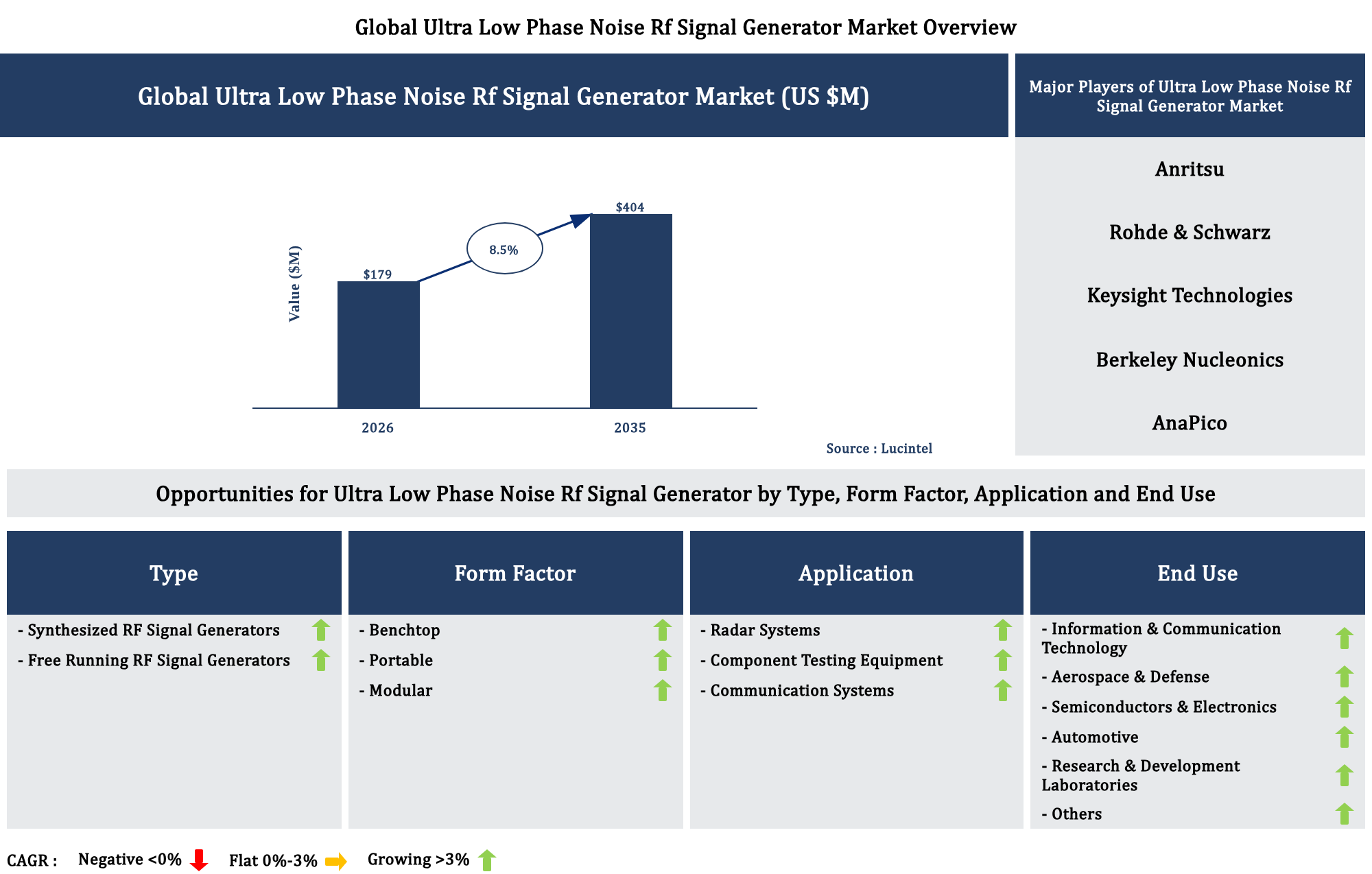
The future of the global ultra low phase noise rf signal generator market looks promising with opportunities in the information & communication technology, aerospace & defense, semiconductors & electronic, automotive, and research & development laboratory markets. The global ultra low phase noise rf signal generator market is expected to reach an estimated $404 million by 2035 with a CAGR of 8.5% from 2026 to 2035. The major drivers for this market are the increasing demand for high-frequency communication systems, the rising adoption of 5g & advanced wireless technology, and the growing demand for high-performance electronic devices.
• Lucintel forecasts that, within the type category, synthesized RF signal generator is expected to witness higher growth over the forecast period.
• Within the end use category, information & communication technology is expected to witness the highest growth.
• In terms of region, APAC is expected to witness the highest growth over the forecast period.
Gain valuable insights for your business decisions with our comprehensive 150+ page report. Sample figures with some insights are shown below.
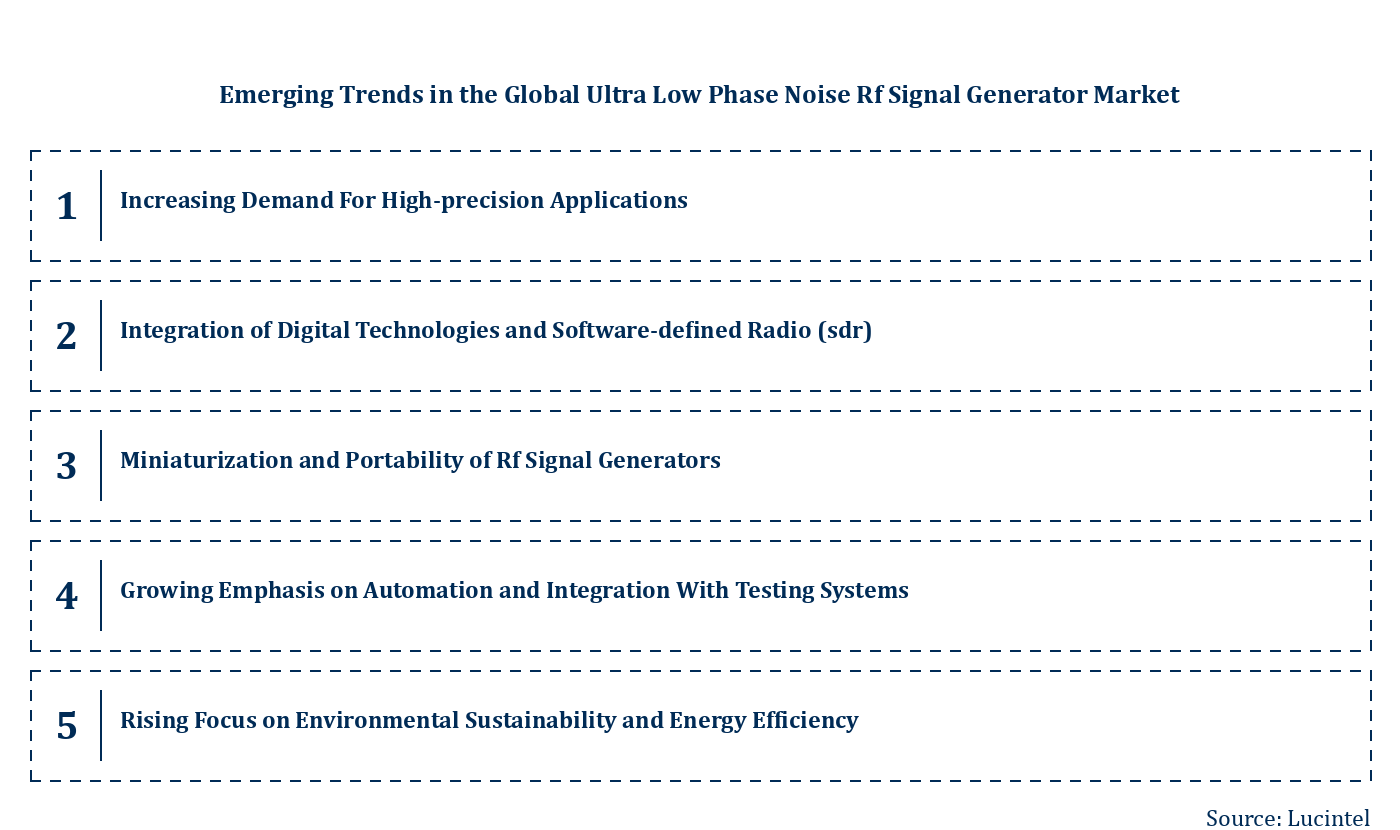
Emerging Trends in the Ultra Low Phase Noise RF Signal Generator Market
The ultra low phase noise RF signal generator market is experiencing rapid evolution driven by technological advancements and increasing demand across telecommunications, aerospace, defense, and research sectors. As industries push for higher precision and stability in signal generation, market players are innovating to meet these needs. Emerging trends are shaping the future landscape, influencing product development, market strategies, and application scopes. These developments are not only enhancing performance but also expanding the market‘s reach into new sectors, fostering competition, and encouraging innovation. Understanding these key trends is essential for stakeholders aiming to capitalize on the market‘s growth potential and technological advancements.
• Increasing Demand for High-Precision Applications: The need for ultra low phase noise RF signal generators is rising in sectors such as 5G, satellite communications, and radar systems. These applications require highly stable and precise signals to ensure optimal performance, leading to a surge in demand. Manufacturers are focusing on developing generators with lower phase noise levels to meet these stringent requirements, which enhances signal clarity, reduces interference, and improves overall system reliability. This trend is driving innovation and expanding the market scope into advanced communication and defense systems.
• Integration of Digital Technologies and Software-Defined Radio (SDR): The adoption of digital technologies and SDR is transforming RF signal generator design. These advancements enable greater flexibility, programmability, and ease of use, allowing users to customize signals for specific applications. Software-based control systems facilitate rapid updates and calibration, reducing downtime and operational costs. This integration enhances performance, supports complex testing scenarios, and broadens application possibilities, making ultra low phase noise RF generators more accessible and versatile across various industries.
• Miniaturization and Portability of RF Signal Generators: Market players are focusing on reducing the size and weight of RF signal generators without compromising performance. Miniaturized, portable devices are increasingly in demand for field testing, on-site maintenance, and mobile applications. Advances in component technology and design are enabling compact yet highly capable generators, which improve operational flexibility and reduce logistical challenges. This trend is particularly impactful in defense, aerospace, and remote research environments, where portability is crucial for real-time testing and deployment.
• Growing Emphasis on Automation and Integration with Testing Systems: Automation features are becoming standard in ultra low phase noise RF signal generators. Automated calibration, testing, and data logging streamline workflows, reduce human error, and increase efficiency. Integration with broader testing and measurement systems allows for seamless operation within complex testing environments. This trend enhances productivity, ensures consistent performance, and supports large-scale manufacturing and research activities, making RF signal generators more compatible with modern automated testing ecosystems.
• Rising Focus on Environmental Sustainability and Energy Efficiency: Manufacturers are increasingly prioritizing eco-friendly designs and energy-efficient components. Reducing power consumption and minimizing environmental impact are becoming key differentiators in the market. Innovations include improved thermal management, energy-efficient circuitry, and sustainable manufacturing practices. This trend aligns with global sustainability goals and appeals to environmentally conscious customers, while also reducing operational costs. As regulations tighten, energy-efficient RF generators are expected to gain a competitive edge, influencing product development and market strategies.
These emerging trends are significantly reshaping the ultra low phase noise RF signal generator market by enhancing device performance, expanding application areas, and promoting sustainable practices. The integration of digital technologies, miniaturization, automation, and sustainability initiatives are collectively driving innovation, increasing market competitiveness, and opening new opportunities for growth across various high-tech industries.
Recent Development in the Ultra Low Phase Noise RF Signal Generator Market
The ultra low phase noise RF signal generator market is experiencing rapid advancements driven by increasing demand for high-precision testing in telecommunications, aerospace, and defense sectors. Innovations in signal stability, miniaturization, and integration are expanding application scopes. Market players are investing heavily in R&D to develop generators with lower noise floors and higher frequency ranges. These developments are shaping the future landscape, offering enhanced performance, reliability, and versatility, which are crucial for emerging technologies like 5G, satellite communications, and radar systems.
• Growth in 5G and Satellite Communications: The demand for ultra-low phase noise RF signal generators is surging due to the expansion of 5G networks and satellite communication systems. These generators enable precise testing and calibration, ensuring signal integrity and performance. As 5G infrastructure grows globally, the need for high-quality testing equipment increases, driving market growth. This trend also supports the development of advanced communication devices, fostering innovation and competitiveness in the telecom industry.
• Technological Advancements in Noise Reduction: Recent innovations focus on reducing phase noise through improved oscillator designs and advanced filtering techniques. These technological improvements result in generators with unprecedented stability and lower noise floors, essential for sensitive applications. The impact is significant, as it enhances measurement accuracy and system reliability. Such advancements are attracting investments from defense and aerospace sectors, where precision is critical, thereby expanding market opportunities and encouraging further R&D
• Miniaturization and Integration of Signal Generators: The trend toward compact, integrated RF signal generators is driven by the need for portability and ease of use in field testing and laboratory environments. These miniaturized devices offer comparable performance to larger systems, reducing costs and space requirements. Their adoption accelerates testing processes and enables deployment in remote or constrained locations. This development broadens application possibilities, including mobile testing units and embedded systems, fueling market expansion and technological innovation.
• Increasing Focus on Customization and Software Control: The market is witnessing a shift toward customizable signal generators with advanced software interfaces. These allow users to tailor signal parameters and automate testing procedures, improving efficiency and accuracy. Software control also facilitates remote operation and integration with other testing equipment. This flexibility is vital for complex testing environments, making these generators more versatile and user-friendly. The trend enhances customer satisfaction and opens new avenues for market growth, especially in research and development sectors.
• Rising Investment in R&D for Higher Frequency Ranges: Companies are investing heavily in research to develop RF generators capable of operating at higher frequencies with ultra-low phase noise. These advancements support emerging applications like 6G, quantum computing, and high-frequency radar. The impact is profound, as it pushes the boundaries of current technology, enabling new capabilities and improved system performance. Increased R&D activity fosters innovation, attracts new customers, and sustains competitive advantage, ultimately driving the market toward more sophisticated and versatile solutions.
The overall impact of these developments is a dynamic, expanding market characterized by enhanced performance, greater application diversity, and increased technological innovation. These trends are positioning the ultra low phase noise RF signal generator market for sustained growth, driven by evolving industry needs and emerging technological frontiers.
Strategic Growth Opportunities in the Ultra Low Phase Noise RF Signal Generator Market
The ultra low phase noise RF signal generator market is experiencing rapid expansion driven by increasing demand for high-precision testing, communication systems, and aerospace applications. Technological advancements and the need for enhanced signal stability are fueling innovation and market penetration across various industries. Companies are investing heavily in R&D to develop more reliable, compact, and versatile generators. This growth presents significant opportunities for market players to capture new segments, improve product offerings, and establish strategic partnerships, ultimately shaping the future landscape of high-performance RF signal generation.
• Growing Demand for High-Precision Testing in Telecommunications and Aerospace Sectors: The need for ultra low phase noise RF signal generators is rising as industries require highly stable signals for testing and calibration of advanced communication systems, satellite equipment, and radar systems. This demand is driven by the increasing complexity of modern electronic devices and the need for accurate, reliable measurements. As a result, manufacturers are focusing on developing generators with superior phase noise performance to meet stringent industry standards, expanding market opportunities.
• Increasing Adoption of RF Signal Generators in 5G and Next-Generation Wireless Networks: The rollout of 5G technology necessitates ultra low phase noise RF signal generators for network testing, device calibration, and signal integrity verification. These generators enable precise simulation of real-world conditions, ensuring optimal network performance. The growing deployment of 5G infrastructure worldwide is expected to significantly boost demand, encouraging innovation in generator design and fostering collaborations between technology providers and telecom operators.
• Rising Importance of Aerospace and Defense Applications Requiring Stable RF Signals: Aerospace and defense sectors demand ultra low phase noise RF generators for applications such as satellite communication, missile guidance, and radar systems. The critical need for signal stability and minimal interference in these high-stakes environments drives market growth. Governments and defense agencies are investing in advanced RF testing equipment, prompting manufacturers to develop specialized generators that meet rigorous military standards, thereby expanding the market scope.
• Technological Advancements Leading to more Compact and Versatile RF Generators: Innovations in semiconductor technology and miniaturization are enabling the development of smaller, more portable ultra low phase noise RF signal generators. These advancements facilitate easier integration into various testing setups and field applications, broadening their usability. Enhanced features such as multi-frequency operation and digital control further increase versatility, attracting a wider customer base across research labs, manufacturing, and service providers, thus fueling market expansion.
• Increasing Focus on Automation and Integration with Digital Systems for Improved Efficiency: The integration of RF signal generators with automated testing platforms and digital control systems is transforming the market. Automated calibration, remote operation, and real-time data analysis improve efficiency and reduce human error. This trend aligns with Industry 4.0 initiatives, encouraging manufacturers to develop intelligent, networked generators. The demand for seamless integration and automation is expected to drive innovation, making ultra low phase noise RF generators more accessible and efficient for diverse applications.
The overall market outlook is positively influenced by these growth opportunities, promising enhanced technological capabilities, broader application scope, and increased competitiveness. As industries continue to demand higher precision and stability, the market for ultra low phase noise RF signal generators is poised for sustained growth, innovation, and strategic development, shaping the future of high-performance RF testing and communication systems.
Ultra Low Phase Noise RF Signal Generator Market Driver and Challenges
The ultra low phase noise RF signal generator market is influenced by a variety of technological, economic, and regulatory factors. Rapid advancements in communication technologies, such as 5G and satellite communications, demand highly stable and precise RF signal sources. Economic growth in emerging markets fuels demand for sophisticated testing and measurement equipment, while regulatory standards for electromagnetic compatibility and signal integrity shape product development. Additionally, increasing investments in defense, aerospace, and research sectors drive innovation and market expansion. However, the market also faces challenges related to technological complexity, high costs, and evolving regulatory landscapes, which can impact growth trajectories and competitive dynamics.
The factors responsible for driving the ultra low phase noise RF signal generator market include:
• Technological Advancements: Rapid innovations in RF component design and signal processing enable the development of generators with ultra-low phase noise, essential for high-precision applications. These advancements improve signal stability, reduce interference, and support emerging technologies like 5G, satellite communications, and radar systems. As technology progresses, manufacturers can offer more sophisticated, reliable, and compact solutions, fueling market growth and expanding application areas.
• Growing Demand in Telecommunications: The expansion of 5G networks and the need for high-frequency, high-precision testing equipment are major drivers. Ultra low phase noise RF generators are critical for testing and calibrating communication devices, ensuring signal integrity and performance. The increasing deployment of wireless infrastructure worldwide necessitates advanced testing tools, thereby boosting market demand and encouraging innovation in generator design.
• Defense and Aerospace Sector Expansion: The defense industry’s focus on secure, reliable communication and radar systems drives demand for ultra-low phase noise RF generators. These generators are vital for military communication, missile guidance, and space exploration applications, where signal stability is paramount. Growing defense budgets and technological modernization initiatives globally contribute significantly to market expansion.
• Regulatory and Standardization Pressures: Stringent regulations regarding electromagnetic emissions and signal quality compel manufacturers to develop generators that meet high standards. Compliance with international standards such as MIL-STD and IEEE ensures market acceptance and opens new opportunities. These regulatory frameworks push innovation and quality improvements, fostering a competitive environment.
• Investment in Research and Development: Increased R&D spending by key players aims to enhance generator performance, reduce costs, and develop new features. This focus on innovation leads to improved phase noise characteristics, broader frequency ranges, and better integration capabilities. R&D investments also facilitate the development of portable and user-friendly solutions, broadening market reach and application scope.
The challenges facing the ultra low phase noise RF signal generator market include:
• High Cost of Advanced Technology: Developing ultra low phase noise RF generators involves complex engineering, expensive components, and rigorous testing, resulting in high production costs. These costs can limit affordability for smaller organizations and restrict widespread adoption, especially in cost-sensitive markets. Additionally, ongoing maintenance and calibration expenses further impact total cost of ownership, posing barriers to market penetration.
• Technological Complexity and Integration Difficulties: Achieving ultra-low phase noise performance requires sophisticated design and precise manufacturing processes. Integrating these generators into existing systems can be challenging due to compatibility issues and the need for specialized expertise. This complexity can lead to longer development cycles, increased time-to-market, and higher training requirements for end-users.
• Evolving Regulatory Landscape: Rapid changes in international standards and regulations related to electromagnetic compatibility and signal integrity can create compliance challenges. Manufacturers must continuously update their products to meet new requirements, incurring additional costs and development delays. Navigating diverse regulatory environments across regions adds complexity and can hinder market expansion.
The ultra low phase noise RF signal generator market is driven by technological innovation, expanding telecommunications, defense sector growth, regulatory standards, and increased R&D investments. However, high costs, technological complexity, and regulatory challenges pose significant hurdles. These factors collectively influence market dynamics, requiring stakeholders to balance innovation with cost management and regulatory compliance. Overall, the market‘s growth prospects remain strong, provided companies can effectively address these challenges through strategic investments and technological advancements.
List of Ultra Low Phase Noise RF Signal Generator Companies
Companies in the market compete on the basis of product quality offered. Major players in this market focus on expanding their manufacturing facilities, R&D investments, infrastructural development, and leverage integration opportunities across the value chain. With these strategies ultra low phase noise rf signal generator companies cater increasing demand, ensure competitive effectiveness, develop innovative products & technologies, reduce production costs, and expand their customer base. Some of the ultra low phase noise rf signal generator companies profiled in this report include-
• Anritsu
• Rohde & Schwarz
• Keysight Technologies
• Berkeley Nucleonics
• AnaPico
Ultra Low Phase Noise RF Signal Generator Market by Segment
The study includes a forecast for the global ultra low phase noise rf signal generator market by type, form factor, application, end use, and region.
Ultra Low Phase Noise RF Signal Generator Market by Type [Value from 2019 to 2035]:
• Synthesized RF Signal Generators
• Free Running RF Signal Generators
Ultra Low Phase Noise RF Signal Generator Market by Form Factor [Value from 2019 to 2035]:
• Benchtop
• Portable
• Modular
Ultra Low Phase Noise RF Signal Generator Market by Application [Value from 2019 to 2035]:
• Radar Systems
• Component Testing Equipment
• Communication Systems
Ultra Low Phase Noise RF Signal Generator Market by End Use [Value from 2019 to 2035]:
• Information & Communication Technology
• Aerospace & Defense
• Semiconductors & Electronics
• Automotive
• Research & Development Laboratories
• Others
Ultra Low Phase Noise RF Signal Generator Market by Region [Value from 2019 to 2035]:
• North America
• Europe
• Asia Pacific
• The Rest of the World
Country Wise Outlook for the Ultra Low Phase Noise RF Signal Generator Market
The ultra low phase noise RF signal generator market is experiencing rapid growth driven by advancements in telecommunications, aerospace, defense, and scientific research. As industries demand higher precision and stability in RF signals, key markets are investing heavily in innovative technologies to enhance performance, reduce noise, and expand application scopes. This evolution is influenced by technological breakthroughs, increased R&D activities, and global collaborations. Countries are competing to lead in this high-precision segment, with strategic initiatives aimed at strengthening their technological capabilities and market share. The following summarizes recent developments in the United States, China, Germany, India, and Japan.
• United States: The US market has seen significant investments in research and development, leading to the launch of next-generation RF signal generators with ultra-low phase noise capabilities. Major players are collaborating with government agencies to develop advanced defense and aerospace applications, emphasizing miniaturization and integration of AI for smarter signal generation. The US also focuses on expanding its manufacturing base to meet rising domestic demand and maintain technological leadership.
• China: China has rapidly advanced in the ultra-low phase noise RF signal generator sector through substantial government funding and strategic industry partnerships. Chinese firms are developing cost-effective, high-performance generators to serve telecommunications and 5G infrastructure. The country is also investing in indigenous innovation to reduce reliance on foreign technology, aiming to become a global leader in high-precision RF solutions.
• Germany: Germany‘s market is characterized by its strong focus on precision engineering and high-quality manufacturing. Companies are innovating in the development of ultra-low phase noise RF generators tailored for scientific research and industrial applications. Germany is also emphasizing sustainable manufacturing practices and integrating Industry 4.0 technologies to enhance product performance and reliability.
• India: India is witnessing rapid growth driven by increased adoption of RF technology in telecommunications, defense, and scientific research. Domestic companies are investing in R&D to develop affordable, high-performance RF signal generators with ultra-low phase noise. The government’s initiatives to promote innovation and manufacturing are further boosting market expansion and technological capabilities.
• Japan: Japan maintains a strong position in the ultra-low phase noise RF signal generator market through its focus on high-precision, reliable products for aerospace and scientific applications. Japanese firms are integrating advanced materials and quantum technologies to improve signal stability. The country is also investing in collaborative research projects to stay at the forefront of RF technology innovation.
Features of the Global Ultra Low Phase Noise RF Signal Generator Market
Market Size Estimates: Ultra low phase noise rf signal generator market size estimation in terms of value ($M).
Trend and Forecast Analysis: Market trends (2019 to 2025) and forecast (2026 to 2035) by various segments and regions.
Segmentation Analysis: Ultra low phase noise rf signal generator market size by various segments, such as by type, form factor, application, end use, and region in terms of value ($M).
Regional Analysis: Ultra low phase noise rf signal generator market breakdown by North America, Europe, Asia Pacific, and Rest of the World.
Growth Opportunities: Analysis of growth opportunities in different type, form factor, application, end use, and regions for the ultra low phase noise rf signal generator market.
Strategic Analysis: This includes M&A, new product development, and competitive landscape of the ultra low phase noise rf signal generator market.
Analysis of competitive intensity of the industry based on Porter’s Five Forces model.
FAQ
Q1. What is the ultra low phase noise rf signal generator market size?
Answer: The global ultra low phase noise rf signal generator market is expected to reach an estimated $404 million by 2035.
Q2. What is the growth forecast for ultra low phase noise rf signal generator market?
Answer: The global ultra low phase noise rf signal generator market is expected to grow with a CAGR of 8.5% from 2026 to 2035.
Q3. What are the major drivers influencing the growth of the ultra low phase noise rf signal generator market?
Answer: The major drivers for this market are the increasing demand for high-frequency communication systems, the rising adoption of 5g & advanced wireless technology, and the growing demand for high-performance electronic devices.
Q4. What are the major segments for ultra low phase noise rf signal generator market?
Answer: The future of the ultra low phase noise rf signal generator market looks promising with opportunities in the information & communication technology, aerospace & defense, semiconductors & electronic, automotive, and research & development laboratory markets.
Q5. Who are the key ultra low phase noise rf signal generator market companies?
Answer: Some of the key ultra low phase noise rf signal generator companies are as follows:
• Anritsu
• Rohde & Schwarz
• Keysight Technologies
• Berkeley Nucleonics
• AnaPico
Q6. Which ultra low phase noise rf signal generator market segment will be the largest in future?
Answer: Lucintel forecasts that, within the type category, synthesized RF signal generator is expected to witness higher growth over the forecast period.
Q7. In ultra low phase noise rf signal generator market, which region is expected to be the largest in next 8 years?
Answer: In terms of region, APAC is expected to witness the highest growth over the forecast period.
Q8. Do we receive customization in this report?
Answer: Yes, Lucintel provides 10% customization without any additional cost.
This report answers following 11 key questions:
Q.1. What are some of the most promising, high-growth opportunities for the ultra low phase noise rf signal generator market by type (synthesized rf signal generators and free running rf signal generators), form factor (benchtop, portable, and modular), application (radar systems, component testing equipment, and communication systems), end use (information & communication technology, aerospace & defense, semiconductors & electronics, automotive, research & development laboratories, and others), and region (North America, Europe, Asia Pacific, and the Rest of the World)?
Q.2. Which segments will grow at a faster pace and why?
Q.3. Which region will grow at a faster pace and why?
Q.4. What are the key factors affecting market dynamics? What are the key challenges and business risks in this market?
Q.5. What are the business risks and competitive threats in this market?
Q.6. What are the emerging trends in this market and the reasons behind them?
Q.7. What are some of the changing demands of customers in the market?
Q.8. What are the new developments in the market? Which companies are leading these developments?
Q.9. Who are the major players in this market? What strategic initiatives are key players pursuing for business growth?
Q.10. What are some of the competing products in this market and how big of a threat do they pose for loss of market share by material or product substitution?
Q.11. What M&A activity has occurred in the last 7 years and what has its impact been on the industry?
For any questions related to Ultra Low Phase Noise RF Signal Generator Market, Ultra Low Phase Noise RF Signal Generator Market Size, Ultra Low Phase Noise RF Signal Generator Market Growth, Ultra Low Phase Noise RF Signal Generator Market Analysis, Ultra Low Phase Noise RF Signal Generator Market Report, Ultra Low Phase Noise RF Signal Generator Market Share, Ultra Low Phase Noise RF Signal Generator Market Trends, Ultra Low Phase Noise RF Signal Generator Market Forecast, Ultra Low Phase Noise RF Signal Generator Companies, write Lucintel analyst at email: helpdesk@lucintel.com. We will be glad to get back to you soon.