
Report Feature
UHF RFID Tag Chip Market Trends and Forecast
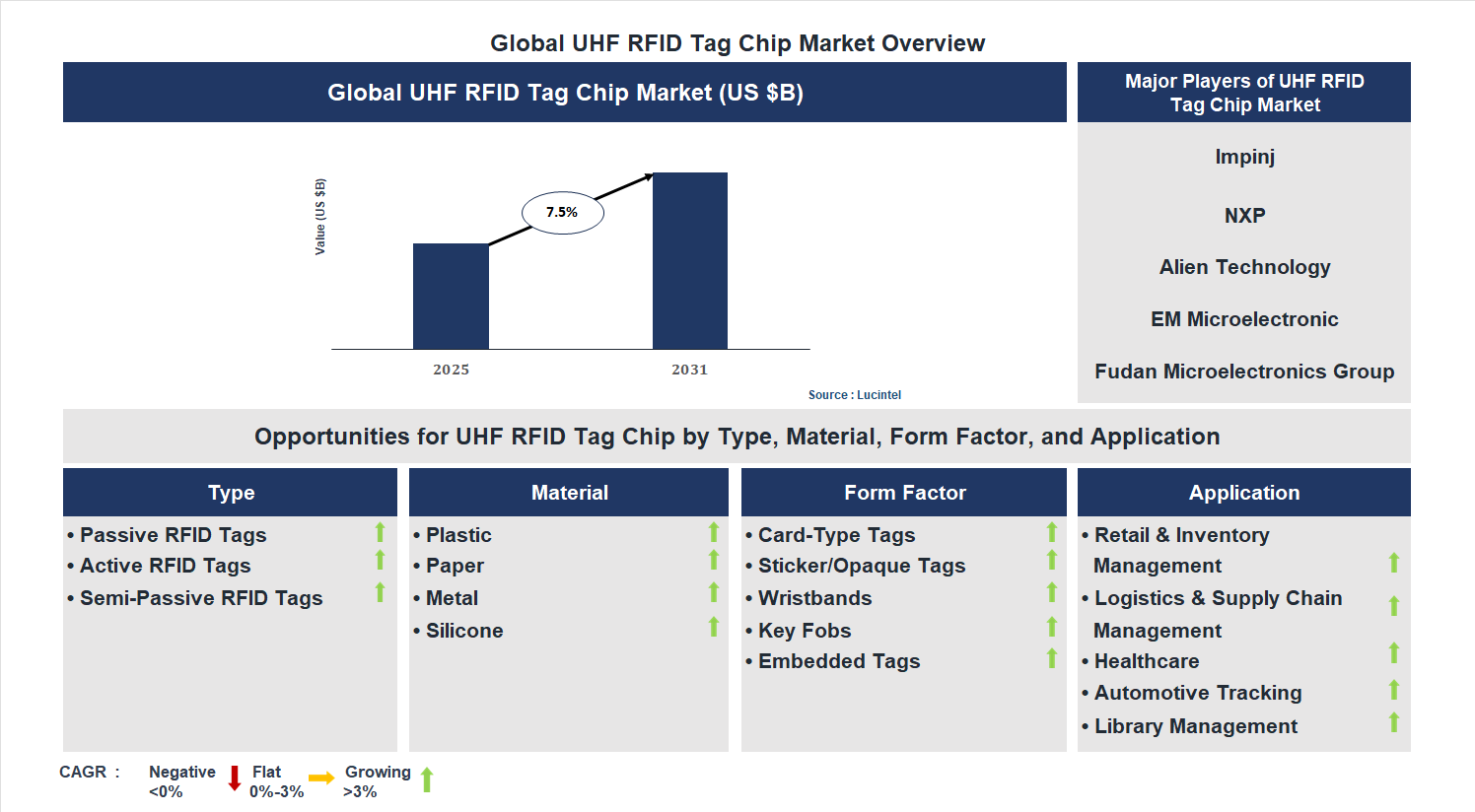
The future of the global UHF RFID tag chip market looks promising with opportunities in the retail & inventory management, logistics & supply chain management, healthcare, automotive tracking, and library management markets. The global UHF RFID tag chip market is expected to grow with a CAGR of 7.5% from 2025 to 2031. The major drivers for this market are the increasing demand for supply chain automation, the rising adoption in inventory & asset tracking, and the growing use in logistics & retail sectors.• Lucintel forecasts that, within the type category, active RFID tag is expected to witness the highest growth over the forecast period.
• Within the application category, logistics & supply chain management is expected to witness the highest growth.
• In terms of region, APAC is expected to witness the highest growth over the forecast period. Gain valuable insights for your business decisions with our comprehensive 150+ page report. Sample figures with some insights are shown below.
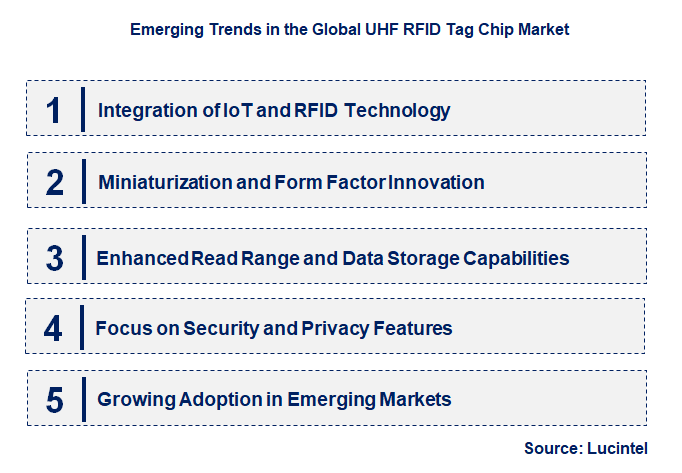
Emerging Trends in the UHF RFID Tag Chip Market
The UHF RFID tag chip market is experiencing rapid growth driven by technological advancements, increasing adoption across various industries, and the need for efficient tracking and data management solutions. As businesses seek to optimize supply chains, inventory management, and asset tracking, the market is evolving with innovative chip designs, enhanced performance, and broader applications. These developments are not only expanding the market size but also transforming how organizations implement RFID technology to improve operational efficiency and customer experience. The following key trends highlight the major shifts shaping the future of the UHF RFID tag chip market.• Integration of IoT and RFID Technology: The convergence of IoT and RFID is enabling smarter, interconnected systems. UHF RFID tags are now integrated with IoT platforms, allowing real-time data collection, analysis, and automation. This trend enhances supply chain visibility, asset management, and inventory accuracy. It also facilitates predictive maintenance and improved decision-making. As IoT adoption accelerates, RFID chips are becoming more intelligent, versatile, and capable of supporting complex applications, thereby expanding their market reach and utility.
• Miniaturization and Form Factor Innovation: Advances in semiconductor technology are leading to smaller, more flexible RFID chips. These miniaturized tags can be embedded into a wider range of products, including wearable devices, packaging, and small assets. The trend improves usability and aesthetic appeal while maintaining performance. Miniaturization also reduces costs and enables mass production, making RFID solutions more accessible across industries such as retail, healthcare, and logistics. This innovation is crucial for expanding RFID deployment in space-constrained environments.
• Enhanced Read Range and Data Storage Capabilities: Manufacturers are developing RFID chips with longer read ranges and increased data storage capacity. These improvements allow for more efficient tracking of high-value or large-volume assets over greater distances. Enhanced read range reduces the need for multiple readers, lowering infrastructure costs. Increased data capacity supports complex information storage directly on the tag, facilitating better asset management and traceability. These advancements are critical for applications requiring high accuracy and extensive data, such as supply chain management and industrial automation.
• Focus on Security and Privacy Features: As RFID technology becomes more pervasive, concerns over data security and privacy are rising. Market players are incorporating advanced encryption, authentication protocols, and secure data transmission features into RFID chips. This focus ensures sensitive information remains protected against unauthorized access and tampering. Enhanced security measures are vital for applications in healthcare, government, and financial sectors, where data integrity is paramount. The emphasis on security is fostering greater trust and wider adoption of RFID technology in sensitive environments.
• Growing Adoption in Emerging Markets: Developing regions are increasingly adopting UHF RFID technology to modernize their supply chains and improve operational efficiency. Governments and private enterprises are investing in RFID infrastructure to enhance logistics, retail, and manufacturing sectors. This trend is driven by the need for transparency, reduced theft, and improved inventory management. As infrastructure and awareness improve, the market is expected to see significant growth in these regions. The expansion into emerging markets is broadening the global footprint of RFID technology and creating new opportunities for manufacturers and solution providers. In summary, these trends are collectively reshaping the UHF RFID tag chip market by making RFID solutions more intelligent, compact, secure, and accessible. The integration with IoT, miniaturization, enhanced capabilities, security focus, and expansion into emerging markets are driving innovation and market growth. These developments are enabling organizations across industries to leverage RFID technology more effectively, leading to increased efficiency, transparency, and competitive advantage in a rapidly evolving digital landscape.
Recent Development in the UHF RFID Tag Chip Market
The UHF RFID tag chip market has experienced significant growth driven by technological advancements, increasing adoption across various industries, and the need for efficient tracking and identification solutions. As businesses seek to optimize supply chain management, inventory control, and asset tracking, the market is evolving rapidly. Innovations in chip design, miniaturization, and cost reduction are making UHF RFID tags more accessible and versatile. Additionally, the expansion into new sectors such as healthcare, retail, and logistics is fueling demand. These developments are shaping the future landscape of the market, creating opportunities for manufacturers and end-users alike.• Technological Advancements: Enhanced chip performance and increased read range are improving reliability and efficiency, leading to broader application possibilities and higher adoption rates across industries.
• Miniaturization of Chips: Smaller, more compact RFID tags are enabling integration into a wider array of products and assets, facilitating seamless tracking without compromising space or design.
• Cost Reduction: Manufacturing innovations and economies of scale are lowering production costs, making RFID tags more affordable for small and medium-sized enterprises, thus expanding market reach.
• Industry Diversification: Growing adoption in healthcare, retail, and logistics sectors is diversifying the market, driving demand for specialized tags tailored to specific industry needs.
• Regulatory and Standardization Initiatives: Implementation of global standards and regulations is promoting interoperability and boosting confidence among users, accelerating market growth. In summary, these developments are collectively enhancing the capabilities, affordability, and applicability of UHF RFID tags. The market is becoming more dynamic, with increased adoption driven by technological improvements and expanding industry applications. This evolution is expected to sustain growth, foster innovation, and open new opportunities for stakeholders in the UHF RFID tag chip market.
Strategic Growth Opportunities in the UHF RFID Tag Chip Market
The UHF RFID tag chip market is experiencing rapid expansion driven by technological advancements and increasing adoption across various industries. As businesses seek efficient tracking and data management solutions, the market presents numerous growth opportunities. These developments are shaping the future landscape, enabling enhanced operational efficiency, improved supply chain visibility, and innovative product applications. Key growth opportunities span multiple sectors, reflecting the versatility and increasing importance of UHF RFID technology. Understanding these opportunities helps stakeholders capitalize on emerging trends and maintain competitive advantage in this dynamic market environment.• Expansion in Retail Sector: Increased adoption of UHF RFID tags for inventory management and theft prevention enhances supply chain accuracy and customer experience, leading to higher sales and reduced losses.
• Healthcare Industry Integration: Implementation of RFID tags for patient tracking, asset management, and medication verification improves safety, reduces errors, and streamlines hospital operations.
• Logistics and Supply Chain Optimization: Use of RFID tags for real-time tracking of goods accelerates delivery times, reduces theft, and enhances inventory accuracy, boosting overall efficiency.
• Automotive Industry Applications: Deployment of RFID tags for vehicle identification, parts tracking, and maintenance history improves manufacturing processes and after-sales services.
• Agriculture and Livestock Monitoring: RFID technology enables precise tracking of livestock and crop management, increasing productivity and ensuring better resource utilization. These growth opportunities are significantly impacting the UHF RFID tag chip market by driving demand, fostering innovation, and expanding application scope. As industries increasingly recognize RFIDs benefits, market growth accelerates, leading to broader adoption and technological advancements. This evolution ultimately enhances operational efficiencies, reduces costs, and opens new revenue streams for stakeholders across sectors.
UHF RFID Tag Chip Market Driver and Challenges
The UHF RFID tag chip market is influenced by a variety of technological, economic, and regulatory factors that shape its growth trajectory. Advances in RFID technology, increasing adoption across industries, and evolving regulatory standards are key drivers. Simultaneously, challenges such as high implementation costs, privacy concerns, and technological limitations pose significant hurdles. Understanding these drivers and challenges is essential for stakeholders to navigate the market effectively and capitalize on emerging opportunities while addressing potential risks. The factors responsible for driving the UHF RFID tag chip market include:-• Technological Innovation: The continuous development of more efficient, smaller, and cost-effective RFID chips enhances their applicability across diverse sectors. Innovations such as improved read ranges, better durability, and integration with IoT devices expand market potential. These technological advancements enable industries like retail, logistics, and healthcare to implement RFID solutions more effectively, driving demand and fostering market growth.
• Growing Adoption in Retail and Supply Chain Management: Retailers and logistics companies increasingly rely on RFID tags for inventory management, theft prevention, and real-time tracking. The ability to streamline operations, reduce errors, and improve customer experience makes RFID technology indispensable. This widespread adoption accelerates market expansion as businesses seek to leverage RFID for competitive advantage.
• Regulatory Support and Standardization: Governments and industry bodies are establishing standards and regulations that promote RFID deployment. Initiatives aimed at enhancing supply chain transparency, security, and anti-counterfeiting measures encourage organizations to adopt RFID solutions. Regulatory support provides a conducive environment for market growth by ensuring interoperability and fostering trust among users.
• Cost Reduction and Economies of Scale: As production volumes increase, the cost of RFID chips decreases, making them more accessible to small and medium enterprises. Economies of scale, coupled with technological improvements, lower overall costs, thereby expanding the market. Cost-effective solutions enable broader adoption across various sectors, including agriculture, manufacturing, and healthcare. The challenges in the UHF RFID tag chip market are:
• High Implementation and Maintenance Costs: Despite decreasing chip prices, the overall cost of deploying RFID systems—including infrastructure, tags, and integration—remains significant. Small and medium-sized enterprises often find these costs prohibitive, limiting widespread adoption. Additionally, ongoing maintenance and system upgrades add to the financial burden, potentially slowing market growth.
• Privacy and Security Concerns: The proliferation of RFID tags raises concerns about data privacy and security. Unauthorized scanning and data breaches can compromise sensitive information, leading to consumer mistrust and regulatory scrutiny. Addressing these concerns requires robust security protocols, which can increase complexity and costs, posing a challenge to market expansion.
• Technological Limitations and Interference: RFID systems face technical challenges such as signal interference from metals, liquids, and other electronic devices. These limitations can affect read accuracy and reliability, especially in complex environments. Overcoming these technical barriers requires further innovation, which may delay adoption and impact market growth. In summary, the UHF RFID tag chip market is driven by rapid technological advancements, increasing industry adoption, supportive regulations, and cost reductions. However, high deployment costs, privacy issues, and technical limitations present significant challenges. These factors collectively influence the markets growth potential, requiring stakeholders to innovate and strategize effectively. Addressing challenges while leveraging drivers will be crucial for sustained expansion and competitive advantage in this evolving landscape.
List of UHF RFID Tag Chip Companies
Companies in the market compete on the basis of product quality offered. Major players in this market focus on expanding their manufacturing facilities, R&D investments, infrastructural development, and leverage integration opportunities across the value chain. With these strategies UHF RFID tag chip companies cater increasing demand, ensure competitive effectiveness, develop innovative products & technologies, reduce production costs, and expand their customer base. Some of the UHF RFID tag chip companies profiled in this report include-• Impinj
• NXP
• Alien Technology
• EM Microelectronic
• Fudan Microelectronics Group
• Huada Semiconductor
• Kiloway
• Invengo Information Technology
• Shanghai Quanray Electronics
• ZSM Electronics
UHF RFID Tag Chip Market by Segment
The study includes a forecast for the global UHF RFID tag chip market by type, material, form factor, application, and region.UHF RFID Tag Chip Market by Type [Value from 2019 to 2031]:
• Passive RFID Tags
• Active RFID Tags
• Semi-Passive RFID Tags
UHF RFID Tag Chip Market by Material [Value from 2019 to 2031]:
• Plastic
• Paper
• Metal
• Silicone
UHF RFID Tag Chip Market by Form Factor [Value from 2019 to 2031]:
• Card-Type Tags
• Sticker/Opaque Tags
• Wristbands
• Key Fobs
• Embedded Tags
UHF RFID Tag Chip Market by Application [Value from 2019 to 2031]:
• Retail & Inventory Management
• Logistics & Supply Chain Management
• Healthcare
• Automotive Tracking
• Library Management
UHF RFID Tag Chip Market by Region [Value from 2019 to 2031]:
• North America
• Europe
• Asia Pacific
• The Rest of the World
Country Wise Outlook for the UHF RFID Tag Chip Market
The UHF RFID tag chip market has experienced significant growth driven by technological advancements, increasing adoption across various industries, and expanding applications in supply chain management, retail, healthcare, and logistics. As industries seek more efficient tracking and data collection solutions, key players are innovating to improve chip performance, reduce costs, and enhance compatibility with existing systems. The market dynamics vary across regions, influenced by technological infrastructure, regulatory policies, and industry demand. Understanding regional developments provides insight into the global trajectory of UHF RFID technology and its potential for future expansion.• United States: The UHF RFID tag chip market in the United States has seen rapid growth due to widespread adoption in retail, healthcare, and logistics sectors. Major companies are investing in R&D to develop more durable, high-performance chips with better read ranges. The U.S. government’s initiatives to improve supply chain transparency and security have further boosted market demand. Additionally, advancements in IoT integration are enabling smarter inventory management solutions, fostering innovation and competitive growth within the industry.
• China: China is experiencing a surge in UHF RFID chip adoption driven by government policies promoting smart manufacturing and supply chain modernization. The country’s focus on industrial automation and e-commerce expansion has increased demand for efficient tracking solutions. Local manufacturers are investing heavily in R&D to produce cost-effective chips with enhanced read accuracy and durability. The rapid expansion of logistics networks and retail chains has also contributed to market growth, positioning China as a key player in the global RFID ecosystem.
• Germany: Germany’s market is characterized by a focus on industrial applications, particularly in automotive manufacturing and logistics. The country emphasizes high-quality, reliable RFID chips that meet strict European standards. Innovations in chip miniaturization and energy efficiency are prominent, supporting integration into complex industrial environments. Germany’s strong emphasis on Industry 4.0 initiatives has driven demand for advanced RFID solutions that facilitate automation, real-time data collection, and supply chain optimization.
• India: The Indian UHF RFID tag chip market is witnessing rapid growth due to increasing adoption in retail, agriculture, and government projects aimed at improving supply chain efficiency. The government’s initiatives like Digital India and Make in India are encouraging local manufacturing and deployment of RFID technology. Cost-effective chips and scalable solutions are in high demand to cater to the large and diverse market. The expansion of logistics infrastructure and retail chains is further propelling market growth, with a focus on affordable, reliable RFID solutions.
• Japan: Japan’s market is driven by technological innovation and a focus on high-performance RFID chips for industrial and healthcare applications. The country’s emphasis on quality and reliability has led to the development of advanced chips with superior read ranges and durability. Japan is also exploring RFID integration with IoT and AI for smart manufacturing and healthcare monitoring. The strong presence of electronics and automation industries supports ongoing R&D efforts, positioning Japan as a leader in high-end RFID chip technology.

Features of the Global UHF RFID Tag Chip Market
Market Size Estimates: UHF RFID tag chip market size estimation in terms of value ($B). Trend and Forecast Analysis: Market trends (2019 to 2024) and forecast (2025 to 2031) by various segments and regions. Segmentation Analysis: UHF RFID tag chip market size by various segments, such as by type, material, form factor, application, and region in terms of value ($B). Regional Analysis: UHF RFID tag chip market breakdown by North America, Europe, Asia Pacific, and Rest of the World. Growth Opportunities: Analysis of growth opportunities in different types, materials, form factors, applications, and regions for the UHF RFID tag chip market. Strategic Analysis: This includes M&A, new product development, and competitive landscape of the UHF RFID tag chip market. Analysis of competitive intensity of the industry based on Porter’s Five Forces model.
FAQ
Q1. What is the growth forecast for UHF RFID tag chip market? Answer: The global UHF RFID tag chip market is expected to grow with a CAGR of 7.5% from 2025 to 2031. Q2. What are the major drivers influencing the growth of the UHF RFID tag chip market? Answer: The major drivers for this market are the increasing demand for supply chain automation, the rising adoption in inventory & asset tracking, and the growing use in logistics & retail sectors. Q3. What are the major segments for UHF RFID tag chip market? Answer: The future of the UHF RFID tag chip market looks promising with opportunities in the retail & inventory management, logistics & supply chain management, healthcare, automotive tracking, and library management markets. Q4. Who are the key UHF RFID tag chip market companies? Answer: Some of the key UHF RFID tag chip companies are as follows:• Impinj
• NXP
• Alien Technology
• EM Microelectronic
• Fudan Microelectronics Group
• Huada Semiconductor
• Kiloway
• Invengo Information Technology
• Shanghai Quanray Electronics
• ZSM Electronics Q5. Which UHF RFID tag chip market segment will be the largest in future? Answer: Lucintel forecasts that, within the type category, active RFID tag is expected to witness the highest growth over the forecast period. Q6. In UHF RFID tag chip market, which region is expected to be the largest in next 5 years? Answer: In terms of region, APAC is expected to witness the highest growth over the forecast period. Q7. Do we receive customization in this report? Answer: Yes, Lucintel provides 10% customization without any additional cost.
Table of Contents
List of Figures
List of Tables
Methodology
- In-depth interviews of the major players in this market
- Detailed secondary research from competitors’ financial statements and published data
- Extensive searches of published works, market, and database information pertaining to industry news, company press releases, and customer intentions
- A compilation of the experiences, judgments, and insights of Lucintel’s professionals, who have analyzed and tracked this market over the years.


Buy Now
Choose a license that fits your team. Instant PDF delivery.
Prices exclude taxes. Instant delivery. Custom licensing available on request.
Key Questions
- • What are some of the most promising, high-growth opportunities for the UHF RFID tag chip market by type (passive RFID tags, active RFID tags, and semi-passive RFID tags), material (plastic, paper, metal, and silicone), form factor (card-type tags, sticker/opaque tags, wristbands, key fobs, and embedded tags), application (retail & inventory management, logistics & supply chain management, healthcare, automotive tracking, and library management), and region (North America, Europe, Asia Pacific, and the Rest of the World)?
- • Which segments will grow at a faster pace and why?
- • Which region will grow at a faster pace and why?
- • What are the key factors affecting market dynamics? What are the key challenges and business risks in this market?
- • What are the business risks and competitive threats in this market?
- • What are the emerging trends in this market and the reasons behind them?
- • What are some of the changing demands of customers in the market?
- • What are the new developments in the market? Which companies are leading these developments?
- • Who are the major players in this market? What strategic initiatives are key players pursuing for business growth?
- • What are some of the competing products in this market and how big of a threat do they pose for loss of market share by material or product substitution?
- • What M&A activity has occurred in the last 5 years and what has its impact been on the industry? For any questions related to UHF RFID Tag Chip Market, UHF RFID Tag Chip Market Size, UHF RFID Tag Chip Market Growth, UHF RFID Tag Chip Market Analysis, UHF RFID Tag Chip Market Report, UHF RFID Tag Chip Market Share, UHF RFID Tag Chip Market Trends, UHF RFID Tag Chip Market Forecast, UHF RFID Tag Chip Companies, write Lucintel analyst at email: helpdesk@lucintel.com. We will be glad to get back to you soon.


