
Report Feature
UAV Parachute Market Trends and Forecast
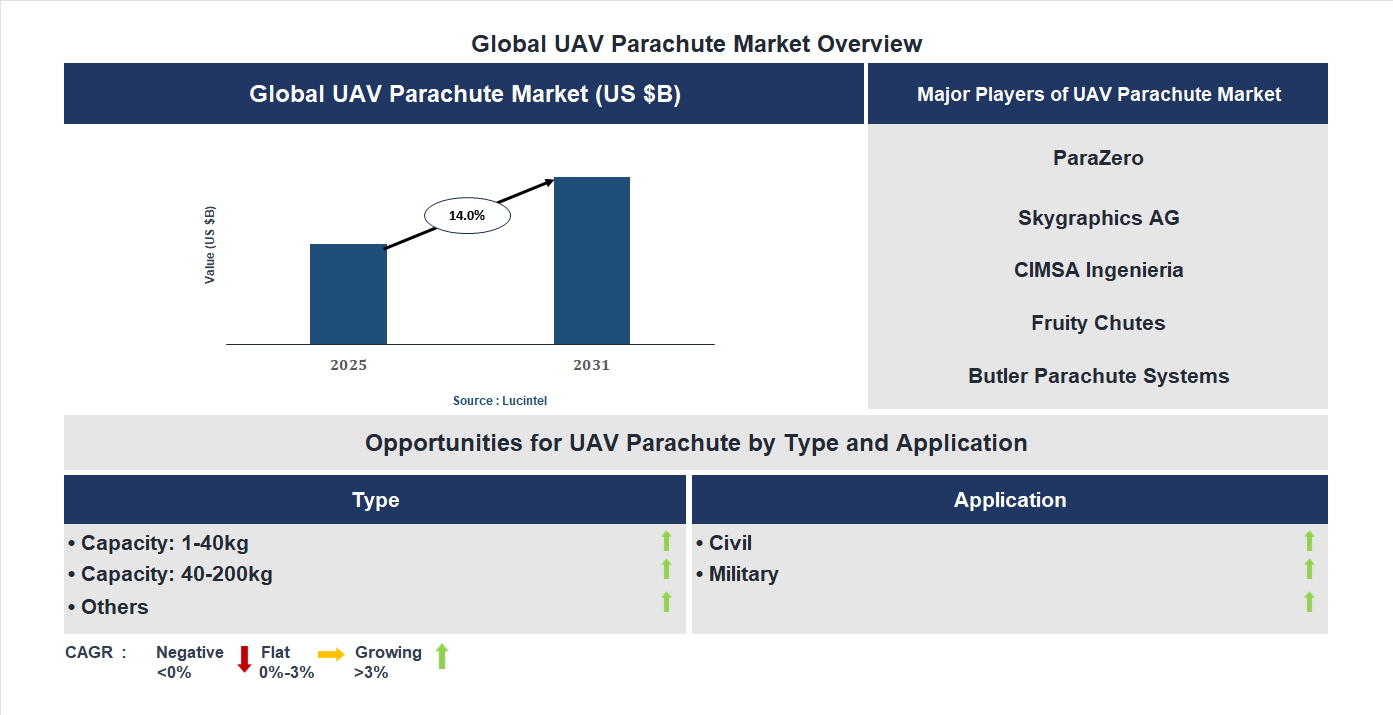
The future of the global UAV parachute market looks promising with opportunities in the civil and military markets. The global UAV parachute market is expected to grow with a CAGR of 14% from 2025 to 2031. The major drivers for this market are the increasing deployment of UAVs for commercial operations, the rising regulatory emphasis on drone safety, and the growing demand for fail safe recovery systems.• Lucintel forecasts that, within the type category, capacity: 1-40kg is expected to witness higher growth over the forecast period.
• Within the application category, civil is expected to witness higher growth.
• In terms of region, APAC is expected to witness the highest growth over the forecast period. Gain valuable insights for your business decisions with our comprehensive 150+ page report. Sample figures with some insights are shown below.
Emerging Trends in the UAV Parachute Market
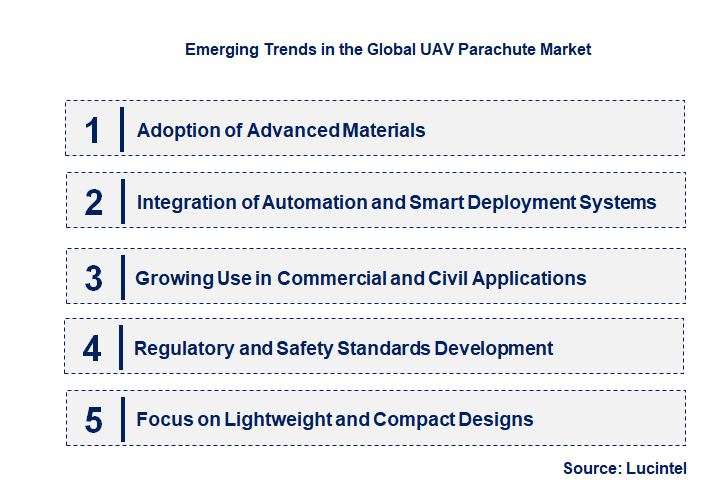
The UAV parachute market is experiencing rapid growth driven by increasing demand for safety, advanced technology integration, and expanding applications across various sectors. As unmanned aerial vehicles (UAVs) become more prevalent in military, commercial, and recreational domains, the need for reliable safety mechanisms like parachutes is rising. Innovations in materials, automation, and deployment systems are shaping the future of this market. These developments are not only enhancing safety standards but also broadening the scope of UAV operations, making them more versatile and secure. The following key trends highlight the transformative changes currently underway in the UAV parachute industry.• Adoption of Advanced Materials: The market is shifting towards lightweight, durable, and high-strength materials such as Kevlar and carbon fiber composites. These materials improve parachute performance by reducing weight while increasing strength and reliability. This trend enhances UAV safety during critical operations, especially in high-altitude or high-speed scenarios. The use of advanced materials also extends the lifespan of parachutes, reducing maintenance costs and increasing operational efficiency. As material technology advances, parachutes are becoming more resilient, adaptable, and suitable for a wider range of UAV sizes and applications.
• Integration of Automation and Smart Deployment Systems: Modern UAV parachutes are increasingly equipped with automated deployment mechanisms that activate during emergencies or system failures. These smart systems utilize sensors, GPS, and real-time data analytics to determine the optimal deployment timing, ensuring rapid and reliable parachute activation. This automation minimizes human error and enhances safety, especially in complex or unpredictable environments. The integration of IoT and AI technologies is further enabling predictive maintenance and real-time monitoring, which improves overall system reliability and reduces downtime, making UAV operations safer and more efficient.
• Growing Use in Commercial and Civil Applications: Beyond military and defense, UAV parachutes are gaining traction in commercial sectors such as logistics, agriculture, and infrastructure inspection. In logistics, parachutes enable safe delivery of packages in remote or inaccessible areas. In agriculture, they assist in crop monitoring and spraying by ensuring UAV safety during high-altitude flights. Civil applications include disaster management and search-and-rescue missions, where parachutes provide safe recovery options. This diversification is expanding market opportunities, encouraging innovation, and driving demand for versatile, reliable parachute systems tailored to various commercial needs.
• Regulatory and Safety Standards Development: As UAV operations increase, regulatory bodies are establishing comprehensive safety standards and certification protocols for parachute systems. These standards aim to ensure consistent quality, reliability, and safety across the industry. Manufacturers are investing in rigorous testing, certification processes, and compliance measures to meet evolving regulations. The development of standardized safety protocols fosters market confidence, encourages adoption, and facilitates integration of parachutes into commercial UAV operations. This trend underscores the importance of safety in expanding UAV deployment across sensitive and regulated environments.
• Focus on Lightweight and Compact Designs: The demand for smaller, lightweight parachutes is rising to accommodate mini and micro UAVs used in surveillance, research, and recreational activities. These compact designs do not compromise safety but are easier to install and deploy, especially in space-constrained UAVs. Innovations in folding techniques and material technology enable the creation of highly portable parachutes that can be quickly packed and deployed. This trend enhances the versatility of UAVs, allowing them to operate in diverse environments and applications while maintaining safety standards. It also reduces overall system weight, contributing to longer flight times and improved performance. In summary, these trends are collectively reshaping the UAV parachute market by making safety systems more reliable, versatile, and integrated with cutting-edge technology. They are expanding the applications of UAVs across various sectors, fostering innovation, and setting new standards for safety and performance. As these developments continue, the market is poised for significant growth, driven by increasing demand for secure, efficient, and adaptable UAV operations worldwide.
Recent Development in the UAV Parachute Market
The UAV parachute market has experienced significant growth driven by increasing demand for safety, security, and operational efficiency in various sectors such as defense, commercial, and recreational. Technological advancements, regulatory changes, and rising adoption of unmanned aerial vehicles (UAVs) have contributed to this expansion. As UAVs become more integral to surveillance, delivery, and rescue operations, the need for reliable parachute systems has become critical. Market players are innovating to improve parachute performance, integration, and ease of use. These developments are shaping the future landscape of UAV safety solutions, making the market more dynamic and competitive.• Technological Innovations: Development of smart parachutes with automatic deployment and real-time monitoring has enhanced UAV safety, reducing damage during crashes and increasing operational reliability.
• Regulatory Frameworks: Governments and aviation authorities are establishing stricter safety standards and regulations for UAV operations, driving demand for certified parachute systems to ensure compliance and safety.
• Material Advancements: Introduction of lightweight, durable materials such as high-strength fabrics and composites has improved parachute performance, enabling longer flight times and better crash protection.
• Market Expansion: Growing adoption of UAVs across commercial sectors like agriculture, logistics, and media has expanded the market for parachute systems, creating new opportunities and increasing competition.
• Integration with Autonomous Systems: The integration of parachutes with autonomous UAVs and AI-driven deployment systems has improved response times and deployment accuracy, boosting overall safety and operational efficiency. These developments are collectively transforming the UAV parachute market by enhancing safety, expanding application scope, and fostering innovation. The market is becoming more robust, with increased adoption driven by regulatory compliance and technological progress, ultimately supporting the growth of UAV operations across multiple industries.
Strategic Growth Opportunities in the UAV Parachute Market
The UAV parachute market is experiencing rapid growth driven by increasing demand for safety, reliability, and operational efficiency in various applications. As unmanned aerial vehicles become integral to sectors such as defense, agriculture, and logistics, the need for advanced parachute systems to ensure safe landings and minimize damage is rising. Technological innovations and regulatory developments are further propelling this market forward. Key growth opportunities across different applications are shaping the future landscape, offering significant potential for manufacturers and stakeholders to capitalize on emerging trends and expand their market presence.• Defense and Military: Enhanced safety protocols drive demand for reliable parachute systems to ensure personnel and equipment safety during UAV operations, boosting market growth in defense applications.
• Commercial Logistics: The rise of drone delivery services necessitates advanced parachutes for safe package landing, creating opportunities for innovation and market expansion in logistics.
• Agriculture: UAVs used for crop monitoring and spraying benefit from parachutes that enable safe landings after missions, supporting sustainable farming practices and market growth.
• Emergency Response: Parachutes facilitate rapid deployment and safe landing of UAVs in disaster zones, improving response efficiency and opening new avenues in emergency management.
• Recreational and Sports: Growing popularity of drone racing and recreational UAVs increases demand for lightweight, high-performance parachutes, fostering niche market development. These growth opportunities are significantly impacting the UAV parachute market by diversifying application areas, encouraging technological advancements, and expanding market size. As industries recognize the importance of safety and operational efficiency, the market is poised for sustained growth, innovation, and increased competitiveness.
UAV Parachute Market Driver and Challenges
The UAV parachute market is influenced by a variety of technological, economic, and regulatory factors that shape its growth and development. Advances in drone technology and safety systems are driving demand for reliable parachute solutions. Economic factors such as increasing investments in defense, commercial, and humanitarian sectors are expanding market opportunities. Regulatory frameworks aimed at ensuring safety and compliance are also impacting product development and adoption. Additionally, technological innovations in materials and deployment mechanisms are enhancing parachute performance. However, the market faces challenges related to regulatory restrictions, technological limitations, and high costs, which could hinder widespread adoption. Understanding these drivers and challenges is essential for stakeholders to navigate the evolving landscape effectively. The factors responsible for driving the UAV parachute market include:• Technological Advancements: The continuous development of lightweight, durable materials and automated deployment systems has significantly improved parachute reliability and safety. These innovations enable UAVs to operate in complex environments, reducing risks of damage or loss. Enhanced sensor integration and real-time deployment mechanisms have made parachutes more responsive and adaptable, encouraging adoption across military, commercial, and emergency services. As technology progresses, the market is expected to see increased demand for sophisticated parachute systems that can cater to diverse UAV applications, thereby fueling growth.
• Growing Defense and Military Spending: Governments worldwide are increasing their investments in defense and surveillance capabilities, which directly impacts the UAV market. Parachute systems are critical for safe recovery and deployment of military UAVs, especially in hostile or remote environments. The need for reliable safety mechanisms to prevent UAV loss during missions has led to higher adoption rates. This trend is further supported by the rising use of UAVs for border security, reconnaissance, and tactical operations, making parachute systems an essential component, thus propelling market expansion.
• Expansion in Commercial and Civil Applications: The commercial sector is witnessing rapid growth in UAV usage for agriculture, infrastructure inspection, delivery services, and media coverage. These applications demand high safety standards, including effective parachute systems for emergency landings or crash mitigation. The increasing adoption of UAVs in civil industries is creating new opportunities for parachute manufacturers to develop specialized solutions. This diversification of applications is broadening the market scope and driving demand for innovative parachute technologies tailored to various commercial needs.
• Regulatory and Safety Standards: Governments and aviation authorities are establishing stringent safety regulations for UAV operations to prevent accidents and ensure public safety. These regulations often mandate the use of safety features like parachutes, especially for commercial and industrial UAVs operating in populated areas. Compliance with these standards encourages manufacturers to integrate parachute systems into their UAV designs, thereby boosting market growth. Moreover, regulatory support for safety innovations fosters confidence among users and investors, further accelerating market development. The challenges facing this UAV parachute market include:
• Regulatory Restrictions and Compliance: While regulations aim to enhance safety, they can also impose restrictions that limit UAV operations and the deployment of parachute systems. Varying standards across regions create complexities for manufacturers trying to develop universally compliant products. Navigating these regulatory landscapes requires significant investment in certification processes, which can delay product launches and increase costs. Additionally, evolving regulations may impose new requirements, necessitating continuous product modifications, thereby hindering rapid market growth.
• Technological Limitations and Reliability Concerns: Despite advancements, ensuring the consistent performance of parachute systems in diverse environmental conditions remains challenging. Factors such as high winds, turbulence, or rapid UAV descent can compromise deployment accuracy and effectiveness. Reliability issues can lead to UAV damage or loss, undermining user confidence. Overcoming these technical hurdles requires ongoing research and development, which can be costly and time-consuming. The perception of technological inadequacy may restrain market expansion, especially in critical applications like defense and emergency response.
• High Cost of Advanced Parachute Systems: Developing and manufacturing sophisticated parachute systems involves significant expenses related to materials, testing, and certification. These costs translate into higher prices for end-users, potentially limiting adoption among cost-sensitive sectors. Small or emerging UAV operators may find it difficult to justify the investment, restricting market penetration. Additionally, the need for regular maintenance and replacement parts further adds to the total cost of ownership. Price sensitivity could slow down market growth, especially in regions with limited budgets for safety enhancements. In summary, the UAV parachute market is shaped by technological innovations, increased defense and commercial demand, and evolving safety regulations. However, regulatory complexities, technical reliability issues, and high costs pose significant challenges. These factors collectively influence the pace and scope of market growth. While opportunities for expansion are substantial, addressing these challenges is crucial for sustainable development. Stakeholders must focus on technological improvements, regulatory compliance, and cost-effective solutions to capitalize on emerging opportunities and ensure long-term market stability.
List of UAV Parachute Companies
Companies in the market compete on the basis of product quality offered. Major players in this market focus on expanding their manufacturing facilities, R&D investments, infrastructural development, and leverage integration opportunities across the value chain. With these strategies UAV parachute companies cater increasing demand, ensure competitive effectiveness, develop innovative products & technologies, reduce production costs, and expand their customer base. Some of the UAV parachute companies profiled in this report include-• ParaZero
• Skygraphics AG
• CIMSA Ingenieria
• Fruity Chutes
• Butler Parachute Systems
• Mars Parachutes
• Indemnis
• Opale Parachutes
• Drone Rescue Systems GmbH
• Galaxy GRS
UAV Parachute Market by Segment
The study includes a forecast for the global UAV parachute market by type, application, and region.UAV Parachute Market by Type [Value from 2019 to 2031]:
• Capacity: 1-40kg
• Capacity: 40-200kg
• Others
UAV Parachute Market by Application [Value from 2019 to 2031]:
• Civil
• Military
UAV Parachute Market by Region [Value from 2019 to 2031]:
• North America
• Europe
• Asia Pacific
• The Rest of the World
Country Wise Outlook for the UAV Parachute Market
The UAV parachute market has experienced significant growth driven by increasing drone usage across various sectors, including military, commercial, and recreational applications. Technological advancements, regulatory changes, and rising safety concerns have spurred innovation and market expansion globally. Countries are investing in research and development to improve parachute deployment systems, enhance safety features, and adapt to evolving drone regulations. The competitive landscape is also shifting as new players enter the market, fostering innovation and diversification. This dynamic environment reflects the growing importance of reliable safety solutions for unmanned aerial vehicles in different regions, shaping future market trends and opportunities.• United States: The US market has seen rapid adoption of UAV parachutes, driven by military and commercial drone applications. Innovations include automated deployment systems and lightweight materials, improving safety and efficiency. Regulatory frameworks are evolving to accommodate commercial drone operations, encouraging market growth. Major players are investing in R&D to develop advanced parachute systems that meet strict safety standards, with increased focus on urban air mobility and delivery services. The US government also funds research to enhance drone safety, further boosting market development.
• China: China’s UAV parachute market is expanding due to the booming drone manufacturing industry and government support for drone technology. Companies are focusing on cost-effective, reliable parachute systems suitable for various drone sizes and applications. The market benefits from increased military drone deployments and commercial uses such as agriculture and surveillance. Innovations include integrated deployment mechanisms and improved durability. Regulatory policies are gradually being refined to ensure safety standards, fostering a conducive environment for market growth and technological advancements.
• Germany: Germany’s market emphasizes high-quality, safety-certified parachute systems for both military and civilian drones. The country’s focus on precision engineering and safety standards has led to the development of sophisticated deployment mechanisms. The market is driven by strict regulations and a strong aerospace sector, with companies investing in research to improve reliability and ease of use. Germany also collaborates with European partners to harmonize safety standards, promoting cross-border trade and innovation in UAV parachute solutions.
• India: India’s UAV parachute market is emerging rapidly, supported by government initiatives to promote drone technology for agriculture, defense, and disaster management. Local manufacturers are developing affordable, lightweight parachute systems tailored for small and medium-sized drones. The market is witnessing increased adoption of safety features to meet regulatory requirements. The government’s focus on self-reliance and innovation is encouraging startups and established firms to invest in advanced deployment systems, aiming to enhance drone safety and operational efficiency.
• Japan: Japan’s market is characterized by advanced technological integration and stringent safety standards. The country is investing in research to develop highly reliable parachute systems suitable for both military and commercial drones. Innovations include smart deployment mechanisms and materials that withstand harsh environments. Japan’s focus on robotics and automation influences UAV parachute designs, aiming for seamless integration with drone systems. Regulatory frameworks are strict, but they foster high-quality, safety-compliant solutions, positioning Japan as a leader in innovative UAV safety technology.

Features of the Global UAV Parachute Market
Market Size Estimates: UAV parachute market size estimation in terms of value ($B). Trend and Forecast Analysis: Market trends (2019 to 2024) and forecast (2025 to 2031) by various segments and regions. Segmentation Analysis: UAV parachute market size by type, application, and region in terms of value ($B). Regional Analysis: UAV parachute market breakdown by North America, Europe, Asia Pacific, and Rest of the World. Growth Opportunities: Analysis of growth opportunities in different types, applications, and regions for the UAV parachute market. Strategic Analysis: This includes M&A, new product development, and competitive landscape of the UAV parachute market. Analysis of competitive intensity of the industry based on Porter’s Five Forces model.
FAQ
Q1. What is the growth forecast for UAV parachute market? Answer: The global UAV parachute market is expected to grow with a CAGR of 14% from 2025 to 2031. Q2. What are the major drivers influencing the growth of the UAV parachute market? Answer: The major drivers for this market are the increasing deployment of UAVs for commercial operations, the rising regulatory emphasis on drone safety, and the growing demand for fail safe recovery systems. Q3. What are the major segments for UAV parachute market? Answer: The future of the UAV parachute market looks promising with opportunities in the civil and military markets. Q4. Who are the key UAV parachute market companies? Answer: Some of the key UAV parachute companies are as follows:• ParaZero
• Skygraphics AG
• CIMSA Ingenieria
• Fruity Chutes
• Butler Parachute Systems
• Mars Parachutes
• Indemnis
• Opale Parachutes
• Drone Rescue Systems GmbH
• Galaxy GRS Q5. Which UAV parachute market segment will be the largest in future? Answer: Lucintel forecasts that, within the type category, capacity: 1-40kg is expected to witness higher growth over the forecast period. Q6. In UAV parachute market, which region is expected to be the largest in next 5 years? Answer: In terms of region, APAC is expected to witness the highest growth over the forecast period. Q7. Do we receive customization in this report? Answer: Yes, Lucintel provides 10% customization without any additional cost.
Table of Contents
List of Figures
List of Tables
Methodology
- In-depth interviews of the major players in this market
- Detailed secondary research from competitors’ financial statements and published data
- Extensive searches of published works, market, and database information pertaining to industry news, company press releases, and customer intentions
- A compilation of the experiences, judgments, and insights of Lucintel’s professionals, who have analyzed and tracked this market over the years.


Buy Now
Choose a license that fits your team. Instant PDF delivery.
Prices exclude taxes. Instant delivery. Custom licensing available on request.
Key Questions
- • What are some of the most promising, high-growth opportunities for the UAV parachute market by type (capacity: 1-40kg, capacity: 40-200kg, and others), application (civil and military), and region (North America, Europe, Asia Pacific, and the Rest of the World)?
- • Which segments will grow at a faster pace and why?
- • Which region will grow at a faster pace and why?
- • What are the key factors affecting market dynamics? What are the key challenges and business risks in this market?
- • What are the business risks and competitive threats in this market?
- • What are the emerging trends in this market and the reasons behind them?
- • What are some of the changing demands of customers in the market?
- • What are the new developments in the market? Which companies are leading these developments?
- • Who are the major players in this market? What strategic initiatives are key players pursuing for business growth?
- • What are some of the competing products in this market and how big of a threat do they pose for loss of market share by material or product substitution?
- • What M&A activity has occurred in the last 5 years and what has its impact been on the industry? For any questions related to UAV Parachute Market, UAV Parachute Market Size, UAV Parachute Market Growth, UAV Parachute Market Analysis, UAV Parachute Market Report, UAV Parachute Market Share, UAV Parachute Market Trends, UAV Parachute Market Forecast, UAV Parachute Companies, write Lucintel analyst at email: helpdesk@lucintel.com. We will be glad to get back to you soon.


