
Market Report · July 29, 2026

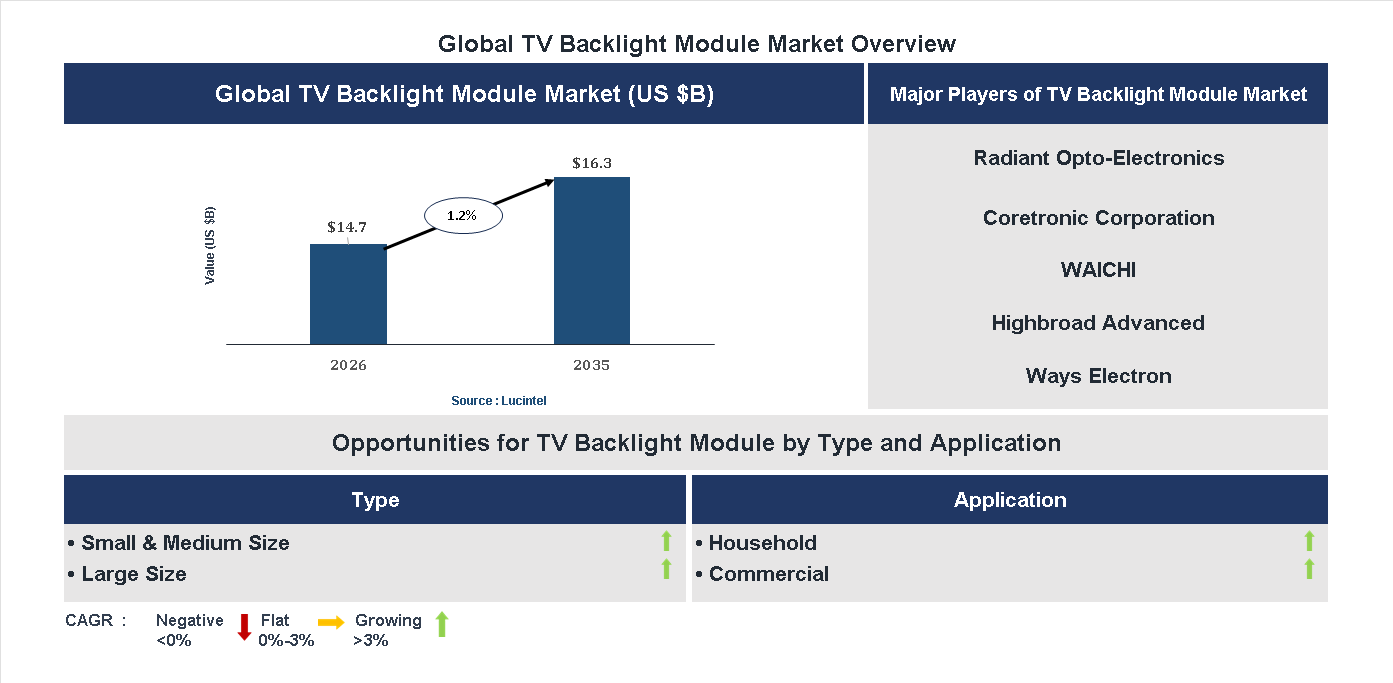
Key data points: The market size in 2035 = $16.3 billion, growth forecast = 1.2% annually for the next 8 years. Scroll below to get more insights. This market report covers trends, opportunities and forecasts in TV backlight module market to 2035 by type (small & medium size and large size), application (household and commercial), and region (North America, Europe, Asia Pacific, and the Rest of the World)
We'll send your sample report shortly.
• Lucintel forecasts that, within the type category, large size is expected to witness higher growth over the forecast period.
• Within the application category, household is expected to witness the highest growth.
• In terms of region, APAC is expected to witness the highest growth over the forecast period. Gain valuable insights for your business decisions with our comprehensive 150+ page report. Sample figures with some insights are shown below.
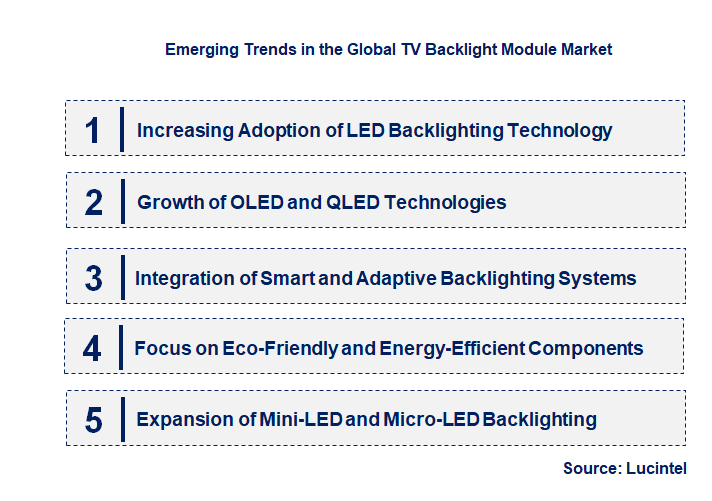
• Increasing Adoption of LED Backlighting Technology: LED backlights are becoming the standard due to their energy efficiency, longer lifespan, and superior brightness. This trend is driven by consumer demand for brighter, more vibrant displays and regulatory pressures for energy conservation. Manufacturers are investing heavily in LED technology to improve color accuracy and reduce power consumption, which enhances overall TV performance and aligns with sustainability goals. The shift from traditional CCFL backlights to LED modules is significantly expanding the market size and innovation opportunities.
• Growth of OLED and QLED Technologies: OLED and QLED backlighting solutions are gaining popularity for their ability to deliver better contrast, deeper blacks, and wider viewing angles. These advanced technologies are pushing the boundaries of display quality, appealing to premium consumers. The integration of these backlighting modules requires specialized components, which are driving innovation and competition among suppliers. As demand for high-end TVs increases, the market for OLED and QLED backlight modules is expected to grow substantially, influencing overall market dynamics and pricing strategies.
• Integration of Smart and Adaptive Backlighting Systems: Smart backlighting modules equipped with sensors and AI algorithms are emerging to optimize picture quality based on ambient lighting and content type. These adaptive systems enhance viewer experience by adjusting brightness and contrast in real-time, reducing eye strain, and conserving energy. The integration of IoT and AI technologies is also enabling remote diagnostics and maintenance, reducing downtime. This trend is transforming traditional backlight modules into intelligent components, creating new revenue streams and competitive advantages for manufacturers.
• Focus on Eco-Friendly and Energy-Efficient Components: Environmental concerns and energy regulations are prompting manufacturers to develop eco-friendly backlight modules. This includes using recyclable materials, reducing hazardous substances, and improving energy efficiency. Such initiatives not only meet regulatory standards but also appeal to environmentally conscious consumers. The adoption of green manufacturing practices is fostering innovation in materials and design, leading to more sustainable products. This trend is expected to drive market growth by aligning with global sustainability goals and consumer preferences for eco-friendly electronics.
• Expansion of Mini-LED and Micro-LED Backlighting Solutions: Mini-LED and Micro-LED technologies are revolutionizing backlighting by offering higher brightness, better contrast, and thinner designs. These solutions are particularly popular in premium and large-screen TVs, providing superior picture quality. The manufacturing complexity and higher costs are challenges, but ongoing technological improvements are reducing these barriers. The adoption of Mini-LED and Micro-LED backlights is expected to significantly influence the high-end segment of the market, fostering innovation and creating new opportunities for manufacturers and suppliers. In summary, these trends are collectively reshaping the TV backlight module market by driving technological innovation, enhancing product quality, and aligning with sustainability and consumer preferences. As a result, the market is becoming more competitive, with increased focus on high-performance, eco-friendly, and intelligent backlighting solutions, ultimately elevating the overall viewing experience.
• Growing Demand for Energy-Efficient Backlight Modules: Increasing consumer awareness and regulatory standards are pushing manufacturers to develop energy-efficient backlight solutions. LED technology advancements have enabled lower power consumption, longer lifespan, and better brightness control. This shift not only reduces operational costs but also aligns with global sustainability goals. As a result, manufacturers are investing heavily in R&D to innovate and meet the rising demand for eco-friendly, energy-saving backlight modules, thereby expanding market opportunities and driving industry growth.
• Technological Advancements in LED Backlighting: Innovations such as mini-LED and micro-LED technology are revolutionizing backlight modules by offering superior brightness, contrast, and color accuracy. These advancements enhance picture quality, making TVs more appealing to consumers. The integration of these technologies has led to thinner, more flexible displays, opening new avenues for product design. Companies adopting these innovations are gaining competitive advantages, which accelerates market expansion and encourages further R&D investments in next-generation backlighting solutions.
• Rising Adoption of Smart and OLED TVs: The increasing popularity of smart TVs and OLED displays is significantly impacting the backlight module market. These advanced TVs require specialized backlighting solutions to support high dynamic range and better contrast ratios. The demand for premium viewing experiences is prompting manufacturers to develop compatible backlight modules that cater to these high-end devices. This trend is expanding the market scope, encouraging innovation, and fostering collaborations between component suppliers and TV manufacturers to meet evolving consumer preferences.
• Expansion of Distribution Channels and Strategic Collaborations: Market players are focusing on expanding their distribution networks globally to reach a broader customer base. Strategic partnerships with OEMs and retailers are facilitating faster product deployment and increased market penetration. These collaborations enable companies to leverage each others strengths, share technological expertise, and reduce time-to-market. As a result, the market is witnessing increased competition, improved product availability, and accelerated growth, benefiting both manufacturers and consumers through a wider range of options and innovations.
• Impact of COVID-19 and Supply Chain Optimization: The pandemic disrupted supply chains but also prompted companies to optimize logistics and diversify sourcing strategies. This has led to increased focus on local manufacturing and inventory management to ensure a steady supply. The crisis accelerated digital transformation and automation in production processes, improving efficiency. These adaptations have strengthened market resilience, reduced costs, and enhanced product innovation. Consequently, the market is becoming more agile, with improved capacity to meet rising demand and sustain growth despite global uncertainties. The overall impact of these developments is a more dynamic, innovative, and competitive TV backlight module market. Enhanced technological capabilities, sustainability focus, and expanded distribution channels are driving growth, improving product quality, and meeting evolving consumer demands. These factors collectively foster a robust industry poised for continued expansion and technological leadership.
• Increasing Demand for Ultra-High Definition and OLED TVs: The rising popularity of 4K, 8K, and OLED TVs is fueling the need for advanced backlighting modules that support superior contrast, brightness, and color accuracy. Manufacturers are focusing on developing backlight solutions that enhance picture quality while maintaining energy efficiency. This trend is driven by consumer desire for immersive viewing experiences and the growing adoption of premium television models, creating substantial growth opportunities for backlight module providers.
• Adoption of Energy-Efficient and Eco-Friendly Backlighting Technologies: As environmental concerns grow, there is a significant shift toward energy-efficient backlighting solutions such as LED and OLED technologies. These innovations reduce power consumption and extend product lifespan, aligning with global sustainability goals. Companies investing in eco-friendly materials and manufacturing processes can capitalize on regulatory incentives and consumer preferences for greener products, thereby expanding their market presence and driving overall industry growth.
• Expansion of Smart and Connected TV Markets: The surge in smart TV adoption is creating demand for backlight modules that support advanced features like HDR, high refresh rates, and seamless connectivity. These modules must integrate with sophisticated display technologies to deliver enhanced user experiences. Manufacturers are developing customizable and adaptive backlighting solutions to meet the needs of connected devices, opening new avenues for innovation and revenue generation within the rapidly growing smart TV segment.
• Growth in Gaming and Curved Display Applications: The gaming industry’s expansion and the popularity of curved and ultra-wide displays are driving demand for specialized backlighting modules that support high refresh rates and vivid visuals. These applications require precise and uniform lighting to optimize gaming performance and visual appeal. Companies focusing on developing flexible, high-performance backlight solutions tailored for gaming monitors and curved screens can tap into lucrative markets and meet the evolving needs of gamers and display manufacturers.
• Technological Innovations in Flexible and Thin Backlight Modules: The development of flexible, slim, and lightweight backlighting solutions is enabling new form factors for TVs, including ultra-thin and curved designs. These innovations improve aesthetic appeal and enable integration into a broader range of display products. Investment in R&D for flexible backlight technologies offers competitive advantages, allowing manufacturers to differentiate their products and cater to consumer demand for sleek, modern television designs, thereby fostering market expansion. In conclusion, these growth opportunities are poised to significantly influence the TV backlight module market by driving innovation, enhancing product performance, and meeting the evolving demands of consumers and manufacturers. Embracing these trends will enable industry players to strengthen their market positions and capitalize on emerging segments, ensuring sustained growth and technological leadership in the competitive landscape.
• Technological Innovation: The continuous evolution of display technologies, such as OLED and LED, has significantly enhanced backlight module performance. Innovations like mini-LED and micro-LED are improving brightness, contrast, and energy efficiency, which attract consumers seeking superior visual experiences. Manufacturers investing in R&D to develop thinner, more efficient backlight modules are gaining a competitive edge. These technological advancements are also enabling the production of larger, more immersive screens, further fueling market growth. As display quality becomes a key differentiator, the demand for advanced backlight modules is expected to rise steadily, supporting the overall expansion of the market.
• Increasing Consumer Demand for High-Quality Visuals: Consumers worldwide are prioritizing high-definition, vibrant, and energy-efficient displays, driving the demand for advanced backlight modules. The rise of 4K and 8K TVs, along with HDR technology, necessitates backlight solutions that can deliver enhanced brightness and color accuracy. This trend is particularly prominent in developing regions where rising disposable incomes enable consumers to upgrade to premium TVs. The desire for immersive viewing experiences in home entertainment systems is pushing manufacturers to adopt sophisticated backlight modules, thereby expanding market opportunities.
• Growth of Smart and IoT-Enabled TVs: The integration of smart features and Internet of Things (IoT) capabilities in televisions is transforming the market landscape. Smart TVs require backlight modules that support higher resolution and better contrast to complement their advanced functionalities. The demand for energy-efficient, slim, and lightweight backlight solutions aligns with the trend toward sleek, aesthetically appealing designs. As consumers increasingly prefer connected devices, manufacturers are investing in backlight technologies that enhance user experience, which in turn propels market growth and innovation.
• Rising Adoption of Energy-Efficient and Eco-Friendly Backlight Modules: Regulatory pressures and consumer awareness about energy conservation are prompting manufacturers to develop environmentally friendly backlight solutions. The shift toward LED-based modules, which consume less power and have a longer lifespan, is a key driver. Governments worldwide are implementing standards to reduce energy consumption, encouraging industry players to innovate in energy-efficient backlighting. This trend not only helps companies comply with regulations but also appeals to eco-conscious consumers, thereby expanding the market for sustainable backlight modules.
• Expansion in Emerging Markets: Rapid urbanization, increasing disposable incomes, and growing consumer electronics markets in regions like Asia-Pacific and Latin America are fueling demand for televisions. As these markets mature, consumers seek higher-quality displays, prompting manufacturers to invest in advanced backlight modules. Local manufacturing and supply chain development further reduce costs and improve availability, supporting market growth. The expanding middle class and rising adoption of smart and large-screen TVs in these regions present significant opportunities for market players to capture new customer segments and increase sales. The challenges facing this TV Backlight Module Market include:-
• Price Competition and Cost Pressures: Intense competition among manufacturers leads to price wars, which can erode profit margins. The high costs associated with developing advanced backlight technologies, such as mini-LED and micro-LED, pose financial challenges, especially for smaller players. Additionally, fluctuations in raw material prices, such as LEDs and semiconductor components, can impact production costs. Companies must balance innovation with cost management to remain competitive, which can hinder rapid market expansion and limit investment in new technologies.
• Rapid Technological Obsolescence: The fast-paced nature of display technology means that backlight modules can quickly become outdated. Manufacturers face pressure to continuously innovate to meet evolving consumer preferences, which can lead to increased R&D expenses and inventory risks. The rapid obsolescence also results in shorter product life cycles, making it challenging for companies to recover investments and maintain profitability. Staying ahead of technological trends is crucial but resource-intensive.
• Regulatory and Environmental Challenges: Stringent regulations related to energy efficiency, hazardous substances, and environmental impact can complicate product development and manufacturing processes. Compliance costs may increase, and companies might need to redesign products to meet new standards, delaying time-to-market. Additionally, disposal and recycling regulations for electronic waste pose environmental concerns, requiring sustainable practices that can add to operational costs. Navigating these regulatory landscapes is essential but can be complex and resource-consuming. In summary, the TV backlight module market is driven by technological innovations, rising consumer expectations, and regulatory shifts toward sustainability. However, it faces challenges such as price competition, rapid technological changes, and regulatory compliance. These factors collectively influence market dynamics, requiring companies to innovate strategically while managing costs and regulatory risks. Overall, the markets growth potential remains strong, provided stakeholders adapt effectively to these evolving drivers and challenges, ensuring continued innovation and competitiveness in a rapidly changing environment.
• Radiant Opto-Electronics
• Coretronic Corporation
• WAICHI
• Highbroad Advanced
• Ways Electron
• Small & Medium Size
• Large Size
• Household
• Commercial
• North America
• Europe
• Asia Pacific
• The Rest of the World
• United States: The US market has seen increased adoption of OLED and LED backlight technologies, driven by consumer demand for high-quality displays. Major manufacturers are investing in R&D to develop energy-efficient and environmentally friendly modules. The rise of smart TVs with integrated backlighting systems has further boosted market growth. Additionally, supply chain disruptions have prompted local companies to diversify sourcing strategies, emphasizing domestic manufacturing. The US government’s focus on sustainability has also led to innovations in recyclable backlight components, aligning industry practices with environmental standards.
• China: China remains the largest producer and consumer of TV backlight modules, with rapid technological advancements and mass production capabilities. The market has shifted towards mini-LED and micro-LED backlighting solutions, offering superior contrast and brightness. Chinese companies are expanding their global footprint through strategic partnerships and exports. The government’s support for high-tech manufacturing and innovation has accelerated the development of advanced backlight modules. Moreover, the push for 8K and 4K TVs has increased demand for high-performance backlighting systems, fostering competitive pricing and product diversification within the country.
• Germany: Germany’s market is characterized by a focus on high-end, premium TV backlight modules, emphasizing quality and durability. The country’s strong industrial base and technological expertise have led to innovations in energy-efficient and long-lasting backlighting solutions. German manufacturers are also investing in sustainable materials and eco-friendly production processes to meet stringent EU regulations. The demand for luxury and professional-grade displays in commercial applications has driven the development of specialized backlight modules. Additionally, collaborations with research institutions are fostering advancements in adaptive and intelligent backlighting technologies.
• India: The Indian market is witnessing rapid growth due to increasing consumer electronics penetration and affordability of smart TVs. Local manufacturers are expanding their product portfolios with cost-effective backlight modules that cater to the growing middle class. The market is also seeing a shift towards LED backlighting, driven by energy efficiency and lower costs. Government initiatives promoting digital infrastructure and smart city projects are expected to further boost demand. Import restrictions and tariffs are encouraging domestic production, while technological upgrades are enabling Indian companies to compete in the global supply chain.
• Japan: Japan’s market is focused on high-quality, innovative backlight solutions for premium and professional displays. Japanese firms are pioneering advancements in mini-LED and OLED backlighting technologies, emphasizing precision and energy efficiency. The country’s strong R&D ecosystem supports the development of smart and adaptive backlighting systems for next-generation TVs. Japan also emphasizes sustainability, integrating eco-friendly materials and manufacturing practices. The demand for high-end consumer electronics and professional displays continues to drive innovation, with a focus on enhancing visual performance and energy savings in the competitive global market.


• Radiant Opto-Electronics
• Coretronic Corporation
• WAICHI
• Highbroad Advanced
• Ways Electron Q6. Which TV backlight module market segment will be the largest in future? Answer: Lucintel forecasts that, within the type category, large size is expected to witness higher growth over the forecast period. Q7. In TV backlight module market, which region is expected to be the largest in next 5 years? Answer: In terms of region, APAC is expected to witness the highest growth over the forecast period. Q8. Do we receive customization in this report? Answer: Yes, Lucintel provides 10% customization without any additional cost.


Choose a license that fits your team. Instant PDF delivery.
Prices exclude taxes. Instant delivery. Custom licensing available on request.
Market Report · July 29, 2026
Market Report · July 20, 2026
Market Report · July 20, 2026
Trusted partner for strategic intelligence and business growth


Receive a complimentary market analysis tailored to your industry. Our analysts will identify key growth opportunities and competitive dynamics specific to your business.

Market size, growth rate, and key trend analysis for your specific sector.

Top competitor positioning and market share analysis.

Strategic recommendations backed by data-driven insights.
Get curated market intelligence and competitive moves straight to your inbox.
By subscribing, you agree to receive our monthly insights. Unsubscribe anytime.
Receive a complimentary market analysis tailored to your industry. Our analysts will identify key growth opportunities and competitive dynamics specific to your business.
Market size, growth rate, and key trend analysis for your specific sector.
Top competitor positioning and market share analysis.
Strategic recommendations backed by data-driven insights.
Get curated market intelligence, emerging trends, and competitive moves straight to your inbox each month.
By subscribing, you agree to receive our monthly insights. Unsubscribe anytime.
We'll send your sample report shortly.