
Report Feature
Turboexpander Market Trends and Forecast
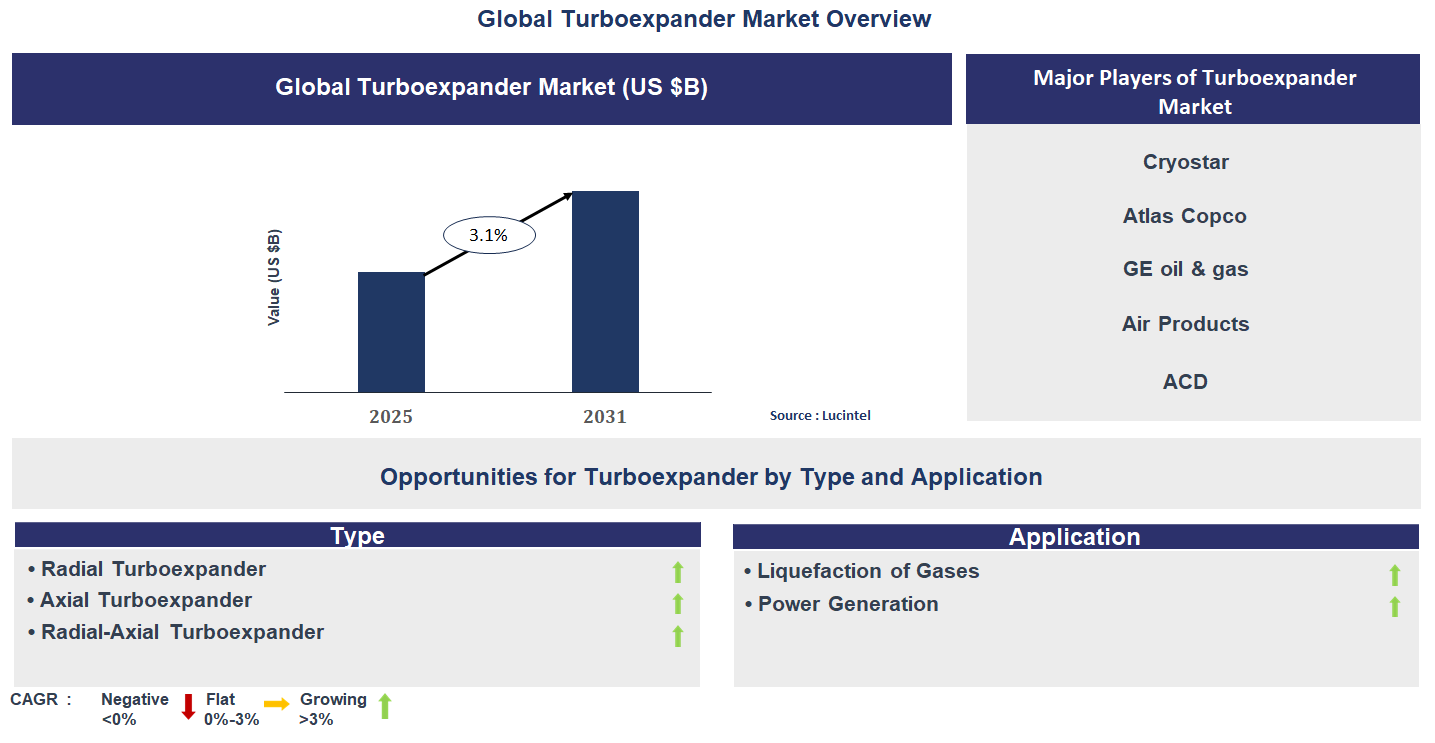
The future of the global turboexpander market looks promising with opportunities in the liquefaction of gas and power generation markets. The global turboexpander market is expected to grow with a CAGR of 3.1% from 2025 to 2031. The major drivers for this market are the increasing demand for energy-efficient solutions, the rising need for natural gas processing, and the growing adoption of cryogenic technologies.• Lucintel forecasts that, within the type category, radial turboexpander is expected to witness the highest growth over the forecast period.
• Within the application category, liquefaction of gas is expected to witness higher growth.
• In terms of region, APAC is expected to witness the highest growth over the forecast period. Gain valuable insights for your business decisions with our comprehensive 150+ page report. Sample figures with some insights are shown below.
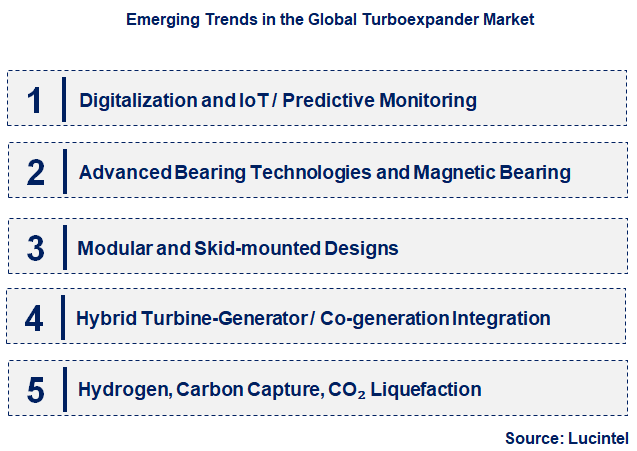
Emerging Trends in the Turboexpander Market
The market for turboexpander is transforming fast under the impetus of energy transition, digitalization, requirements for greater thermodynamic efficiency, scalability, and new end-use applications such as hydrogen and carbon capture. With industrial factories looking to minimize waste and optimize process economics, turboexpanders are no longer engineering afterthoughts but integral parts of energy systems. Some of the key trends are redefining design, operation, and supply of turboexpanders. Following are five significant emerging trends and their implications.• Digitalization and IoT / Predictive Monitoring: Turboexpanders are increasingly incorporating sensors and connectivity to monitor in real time, diagnose, and perform predictive maintenance. These digital capabilities enable early detection of anomalies (vibration, temperature, imbalance), performance optimization, and lower unplanned downtime. Connecting cloud analytics and AI models provides operators with intelligence on efficiency, degradation patterns, and maintenance planning.
• Advanced Bearing Technologies and Magnetic Bearing: Magnetic bearings (hybrid or active) are increasingly being used in high-speed expansion turbines as they minimize friction, do away with conventional lubrication, and enhance dynamic response. For instance, L.A. Turbine introduced an AMB (Active Magnetic Bearing) turboexpander-compressor for gas processing applications. These bearing systems entail fewer maintenance demands, more fluid rotation, and greater operational flexibility, particularly in cryogenic and low-temperature environments.
• Modular and Skid-mounted Designs: Compact, modular, and skid-mounted turboexpander packages are increasingly popular, saving installation time and on-site customization. Such configurations enable prefabricated packages to be installed faster, particularly in remote areas or small-scale gas plants. Compact skids minimize civil works, piping complexity, and commissioning risk. In developing economies or brownfield revamps, modularity is a major driver.
• Hybrid Turbine-Generator / Co-generation Integration: In order to achieve maximum energy recovery, turboexpanders are becoming paired directly with generators or incorporated into combined cycles. Hybrid modules for expansion and power generation enable the capture of electrical energy from pressure reduction of gas streams or waste energy flows.
• Hydrogen, Carbon Capture, CO₂ Liquefaction: Aside from mainstream oil & gas, newer applications are propelling demand for turboexpanders. In industrial gas systems, hydrogen liquefaction, carbon capture & storage (CCS), and CO₂ liquefaction, expansion turbines play a pivotal role in cooling, pressure drop conversion, and energy recovery. With these industries expanding, turboexpanders are required to meet evolving gas chemistries, safety protocols, and cyclic operation regimes. Collectively, these trends—digitalization, high-end bearings, modularization, combined generation, and new market domains—are revolutionizing turboexpanders from niche mechanical devices into intelligent, adaptive, and multifunctional energy devices. They enable increased reliability, reduced maintenance, more rapid deployment, and expansion into new energy value chains. The market for turboexpanders is transforming from incremental improvement to system-level innovation, widening its applicability in emerging industrial and clean energy systems.
Recent Development in the Turboexpander Market
Some of the recent developments stand out for their implications in remaking the competitive and technical balance in the turboexpander space. The developments are indicative of strategic corporate actions, new product offerings, expansion into services, and integration and application-focused innovations. Five developments below are particularly significant for the future direction of the market.• Acquisition of Nikkisos turboexpander division by Air Liquide: In November 2024, Air Liquide finalized the acquisition of Nikkiso Cryogenic Industries turboexpander business unit to enhance Air Liquides cryogenic and gas processing abilities Fortune Business Insights. With this merger, Air Liquides capability in providing complete liquefaction, expansion, and cold‑energy recovery systems is enhanced and it has access to technology, service channels, and product offerings of Nikkiso.
• Introduction of AMB-based turboexpander by L.A. Turbine: Also in 2024, L.A. Turbine launched a turboexpander‑compressor unit featuring active magnetic bearings to deliver better performance in LNG and natural gas liquid (NGL) processing applications Fortune Business Insights. This reflects growing usage of magnetic bearing technology on expansion machines for greater reliability, reduced maintenance, and dynamic load management.
• Expansion of regional service and maintenance centers: Roto flow made public announcements of new service centers in Asia and the Middle East to enable LNG and petrochemical operations, lowering turnaround time and enhancing local support for turboexpander maintenance. This extends the worldwide service reach and reduces logistical hurdles in outlying or high-demand areas.
• Integration with hydrogen and clean energy pilot projects: GE Vern ova’s hybrid turboexpander-generator module for hydrogen liquefiers (Europe) is a manifestation of the way turboexpanders are being customized today for low-carbon infrastructure applications precisionbusinessinsights.com. These pilot installations signal moves toward wider adoption in hydrogen and CO₂ systems. These innovations—strategic acquisition, new magnetic-bearing product offerings, service coverage extension, integration into hydrogen initiatives, and compact modular strategies—emphasize the way the turboexpander market is changing quickly. Companies are heading in the direction of more intelligent, more serviceable, and more application‑spectrum products. The market dynamics are changing: suppliers that merge technical innovation, robust service presence, and transition to emerging energy arenas will most likely drive this change.
Strategic Growth Opportunities in the Turboexpander Market
With the turboexpander market in its maturity and connecting with energy transition markets, strategic expansion is a matter of moving into adjacent and new applications. Such opportunities are not just present in conventional gas processing but also in hydrogen, carbon capture, industrial gases, cryogenics, and waste energy recovery. Vendors that tailor their designs, services, and business models to these applications can monetize new streams of revenues and diversify risk. Following are five main application areas with significant growth prospects.• LNG and Natural Gas Liquefaction & NGL Recovery: This is the main opportunity for turboexpanders. With increasing demand for LNG worldwide and gas plants needing more efficient NGL recovery, there is pressure to utilize high-efficiency expanders. New LNG export terminals, small-scale liquefiers, and revamping of old plants are the major targets. Turboexpanders can recover energy and lower operating costs and form the heart of cost-competitive gas processing systems.
• Hydrogen Liquefaction / Green Hydrogen Infrastructure: As the push toward hydrogen economies grows, turboexpanders are key in cryogenic hydrogen liquefaction. They manage expansion cooling and pressure reductions in hydrogen loops. As green hydrogen production grows, the need for reliable expanders appropriate for hydrogen characteristics (low density, high purity) will increase. This is high-value, high-tech, a high-margin niche that is perfectly positioned for premium suppliers.
• Carbon Capture, Utilization & Storage: In carbon capture processes, turboexpander technology can find applications in compressing and expanding CO₂ streams (or capturing and liquefying CO₂). Expansion serves to lower temperature and recover energy. As industrial and power locations increasingly implement carbon capture, expanders that are suitable for CO₂ (variable density, multi-phase characteristics) will be in increasing demand. This provides a new vertical application area.
• Industrial Gas & Cryogenic Processing: In air separation, gas separation (oxygen, nitrogen), argon, and specialty gas manufacture industries, turboexpanders find application for separation and cooling. With increased demand for industrial gases (for electronics, semiconductors, medical gases), efficient expanders in those cryogenic facilities are a need. High-end suppliers are preferred under the design constraints (stability, purity).
• Waste Energy Recovery & Industrial Process Integration: High-pressure waste gas streams (e.g. refineries, chemical plants, petrochemical complexes) can recover energy that would otherwise be lost in throttling or expansion through the use of turboexpanders. Adding expanders to existing plants through retrofitting can reduce net energy use and emissions. This is particularly strong in industrial economies that are mature and are looking for efficiency improvements without complete overhauls. These application areas—LNG/NGL processing, hydrogen liquefaction, CO₂ capture, industrial gas cryogenics, and waste energy recovery—provide the most promising levers of growth for turboexpander technology. The capacity to engineer to varied gas chemistries, accommodate variable operation regimes, and offer maintenance and service will distinguish winners. Turboexpander companies that position themselves with evolving infrastructure (hydrogen, CCS) as energy transition gains momentum will open up new markets beyond traditional gas markets.
Turboexpander Market Driver and Challenges
Turboexpander markets are driven by a combination of technology, regulation, economic, and market factors. Drivers including the drive towards energy efficiency, expansion in LNG and hydrogen infrastructure, and digitalization drive demand. However, challenges—complexity, high capital expense, gas chemistry limitations, and slim margins—restrict adoption. The balancing of innovation, reliability, and overall cost is paramount. The following are five main drivers and three main challenges, each described in order to shed light on their significance for market players. The factors responsible for driving the turboexpander market include: 1. Requirement for energy recovery and efficiency gain: Gas plants and industries more and more focus on minimizing energy losses. Turboexpanders enable recovery of mechanical work from pressure let-downs or high-pressure gas streams, enhancing the overall process efficiency. This driver supports most greenfield and retrofit projects in petrochemicals, oil & gas, industrial gas, and LNG industries. 2. Expansion of LNG, hydrogen, and clean energy infrastructure: The growth in world LNG capacity, along with early-stage hydrogen liquefaction and CO₂ management projects, creates new opportunities for turboexpanders. With growth in hydrogen and CCS, new uses for expansion turbines in low-carbon systems emerge. This driver increases the addressable market beyond traditional gas. 3. Regulations and emissions limits: Stricter environmental regulations force companies to reduce waste, flare less, and refine process designs. Turboexpanders facilitate improved resource use and decreased per-unit greenhouse emissions. Carbon efficiency incentives or mandates can catalyze uptake in regulated sectors. 4. Digitalization and advanced control / monitoring: Sensor, IoT, AI, and control system advancements improve turboexpander performance, predictive maintenance, and reliability. These enable reduced downtime, longer component lifespan, and greater justification for investing in premium expanders over less-complex throttling systems. 5. Modular, prefabricated deployment models: The move towards modular skids or packaged systems reduces installation risk, site complexity, and accelerates deployment. This increases the availability of turboexpanders to mid-scale projects or retrofits where customization hurdles were previously too high. Challenges in the turboexpander market are: 1. High capital and precision engineering cost: Turboexpanders are sophisticated, precision machines that demand high-quality components, close tolerances, specialty manufacturing, and quality control. The initial cost is a major obstacle, particularly for small-scale applications, and payback times may be long. 2. Gas chemistry, multiphase flow, and design constraints: Various gases (e.g. CO₂, mixed hydrocarbons, hydrogen, CO₂ mixtures) have specific thermodynamic and mechanical challenges. Handling two-phase flow, condensation, corrosion, or gas impurities complicates design, operation, and maintenance. 3. Balance of service accessibility, complexity of maintenance, and lifecycle risk: High skill is needed to maintain, balance, service bearings, and operate turboexpanders cryogenically. Remote sites have difficulty accessing skilled maintenance staff or replacement spares. Lifecycle reliability is paramount—breakdowns are expensive and inconvenient. The market for turboexpander is at the crossroads of legacy gas processing and new low-carbon energy infrastructure. Drivers like efficiency imperatives, LNG and hydrogen expansion, regulatory push, digitalization, and modular deployment enable robust growth. Nevertheless, high cost, tough gas chemistry, and service complexity are key restraints. To win in this space requires engineering excellence, profound domain knowledge of gas behavior, solid service networks, and lean modular solutions. Market leaders will most probably be those able to integrate innovation, manufacturability, and operational dependability in several gas and low-carbon environments.List of Turboexpander Companies
Companies in the market compete on the basis of product quality offered. Major players in this market focus on expanding their manufacturing facilities, R&D investments, infrastructural development, and leverage integration opportunities across the value chain. With these strategies turboexpander companies cater increasing demand, ensure competitive effectiveness, develop innovative products & technologies, reduce production costs, and expand their customer base. Some of the turboexpander companies profiled in this report include-• Cryostar
• Atlas Copco
• GE oil & gas
• Air Products
• ACD
• L.A. Turbine
• Turbogaz
• Samsung
• RMG
• Hangyang Group
Turboexpander Market by Segment
The study includes a forecast for the global turboexpander market by type, application, and region.Turboexpander Market by Type [Value from 2019 to 2031]:
• Radial Turboexpander
• Axial Turboexpander
• Radial-Axial Turboexpander
Turboexpander Market by Application [Value from 2019 to 2031]:
• Liquefaction of Gases
• Power Generation
Turboexpander Market by Region [Value from 2019 to 2031]:
• North America
• Europe
• Asia Pacific
• The Rest of the World
Country Wise Outlook for the Turboexpander Market
Turboexpander play a significant role in cryogenic, liquefaction, energy recovery, and gas separation processes. They recover work from high‑pressure gaseous streams by expanding them, lowering temperature, and, in many cases, powering compressors or generators. The worlds demand for energy efficiency, LNG, hydrogen, carbon capture, and industrial gas processing is driving renewed interest in turboexpanders. Recent trends mirror progress in materials, digitalization, modularity, new business models, and geographic extension of service networks.• United States: Turboexpander installations remain highly associated with LNG, natural gas processing, and energy recovery schemes in the U.S. The U.S. is estimated to reach ~USD 494.25 million by 2030 from its market share of North America (having had ~74.3% share in 2022). Major developments encompass the introduction of high-efficiency turboexpanders (such as with active magnetic bearings) by L.A. Turbine and strategic purchases, including Air Liquides purchase of Nikkisos turboexpander business later in 2024, to expand cryogenic and LNG competencies.
• China: China is growing its application of turboexpanders in LNG, petrochemicals, and gas processing as it develops natural gas infrastructure and broadens its energy mix. China holds the largest share in the Asia-Pacific region turboexpander market and is likely to continue growing, its market size reaching ~USD 137 million by 2028 in Asia Pacific segments. Chinese companies are investing in local production of high-precision components, enhancing manufacturing of radial and axial turboexpanders, and increasing service / maintenance capacity on a regional basis. The drive towards cleaner fuels, emission control, and energy recovery in industry groups is stimulating demand for turboexpanders in energy recovery and gas separation operations.
• Germany: The market for turboexpanders in Germany is more specialty-oriented and associated with industrial gas, chemical processing, and energy recovery in heavy industry. German engineering companies are developing efficiency optimization, cryogenic and corrosive environment-resistant materials, and integration with automation and Industry 4.0 solutions. Germany also requires turboexpanders in carbon capture and utilization (CCU) applications and waste heat recovery systems. Germanys strict environmental laws compel customers to employ energy recovery technology, which prefers turboexpanders in process plants and industrial gas streams.
• India: Indias turboexpander market remains nascent but shows increasing prospects as India builds out its gas infrastructure, petrochemicals capacity, and LNG supply chain. India will grow at a CAGR of ~5.4 % in Asia-Pacific from 2022 to 2028 in turboexpander demand. Recent advancements consist of growing investments in petrochemical complexes, LNG import terminals, and gas pipelines which might need turboexpanders for energy recovery, separation of NGL, or gas expansion. Domestic service providers and manufacturers are increasingly coming into the market, usually under collaboration or licensing arrangements with international companies to develop technical expertise.
• Japan: Japans growth of turboexpander markets is more restrained in comparison with energy majors, but strategically significant as a result of Japans import dependence on energy and its high-tech engineering foundation. Japan will likely experience ~4.0 % CAGR in turboexpander demand throughout the next decade. Japanese companies emphasize small, high-efficiency size, reliability, and integration with hydrogen infrastructure and cryogenic systems. Japans expansion into hydrogen, liquefied technologies, and industrial gas uses provides niche opportunity for turboexpanders. Developments in bearings, materials, and modular construction are of most interest in the Japanese environment.

Features of the Global Turboexpander Market
Market Size Estimates: Turboexpander market size estimation in terms of value ($B). Trend and Forecast Analysis: Market trends (2019 to 2024) and forecast (2025 to 2031) by various segments and regions. Segmentation Analysis: Turboexpander market size by type, application, and region in terms of value ($B). Regional Analysis: Turboexpander market breakdown by North America, Europe, Asia Pacific, and Rest of the World. Growth Opportunities: Analysis of growth opportunities in different types, applications, and regions for the turboexpander market. Strategic Analysis: This includes M&A, new product development, and competitive landscape of the turboexpander market. Analysis of competitive intensity of the industry based on Porter’s Five Forces model.
FAQ
Q1. What is the growth forecast for turboexpander market? Answer: The global turboexpander market is expected to grow with a CAGR of 3.1% from 2025 to 2031. Q2. What are the major drivers influencing the growth of the turboexpander market? Answer: The major drivers for this market are the increasing demand for energy-efficient solutions, the rising need for natural gas processing, and the growing adoption of cryogenic technologies. Q3. What are the major segments for turboexpander market? Answer: The future of the turboexpander market looks promising with opportunities in the liquefaction of gas and power generation markets. Q4. Who are the key turboexpander market companies? Answer: Some of the key turboexpander companies are as follows:• Cryostar
• Atlas Copco
• GE oil & gas
• Air Products
• ACD
• L.A. Turbine
• Turbogaz
• Samsung
• RMG
• Hangyang Group Q5. Which turboexpander market segment will be the largest in future? Answer: Lucintel forecasts that, within the type category, radial turboexpander is expected to witness the highest growth over the forecast period. Q6. In turboexpander market, which region is expected to be the largest in next 5 years? Answer: In terms of region, APAC is expected to witness the highest growth over the forecast period. Q7. Do we receive customization in this report? Answer: Yes, Lucintel provides 10% customization without any additional cost.
Table of Contents
List of Figures
List of Tables
Methodology
- In-depth interviews of the major players in this market
- Detailed secondary research from competitors’ financial statements and published data
- Extensive searches of published works, market, and database information pertaining to industry news, company press releases, and customer intentions
- A compilation of the experiences, judgments, and insights of Lucintel’s professionals, who have analyzed and tracked this market over the years.


Buy Now
Choose a license that fits your team. Instant PDF delivery.
Prices exclude taxes. Instant delivery. Custom licensing available on request.
Key Questions
- • What are some of the most promising, high-growth opportunities for the turboexpander market by type (radial turboexpander, axial turboexpander, and radial-axial turboexpander), application (liquefaction of gases and power generation), and region (North America, Europe, Asia Pacific, and the Rest of the World)?
- • Which segments will grow at a faster pace and why?
- • Which region will grow at a faster pace and why?
- • What are the key factors affecting market dynamics? What are the key challenges and business risks in this market?
- • What are the business risks and competitive threats in this market?
- • What are the emerging trends in this market and the reasons behind them?
- • What are some of the changing demands of customers in the market?
- • What are the new developments in the market? Which companies are leading these developments?
- • Who are the major players in this market? What strategic initiatives are key players pursuing for business growth?
- • What are some of the competing products in this market and how big of a threat do they pose for loss of market share by material or product substitution?
- • What M&A activity has occurred in the last 5 years and what has its impact been on the industry? For any questions related to Turboexpander Market, Turboexpander Market Size, Turboexpander Market Growth, Turboexpander Market Analysis, Turboexpander Market Report, Turboexpander Market Share, Turboexpander Market Trends, Turboexpander Market Forecast, Turboexpander Companies, write Lucintel analyst at email: helpdesk@lucintel.com. We will be glad to get back to you soon.


