
Market Report · July 29, 2026

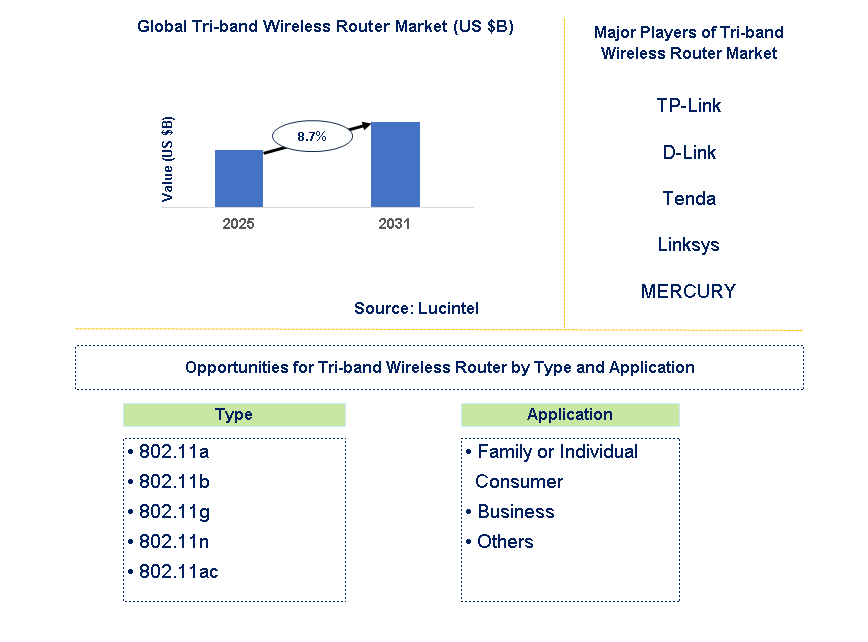
Key data points: The growth forecast = 8.7% annually for the next 7 years. Scroll below to get more insights. This market report covers Trends, opportunities and forecasts in tri-band wireless router market to 2031 by type (802.11a, 802.11b, 802.11g, 802.11n, and 802.11ac), application (family or individual consumer, business, and others), and region (North America, Europe, Asia Pacific, and the Rest of the World)
We'll send your sample report shortly.
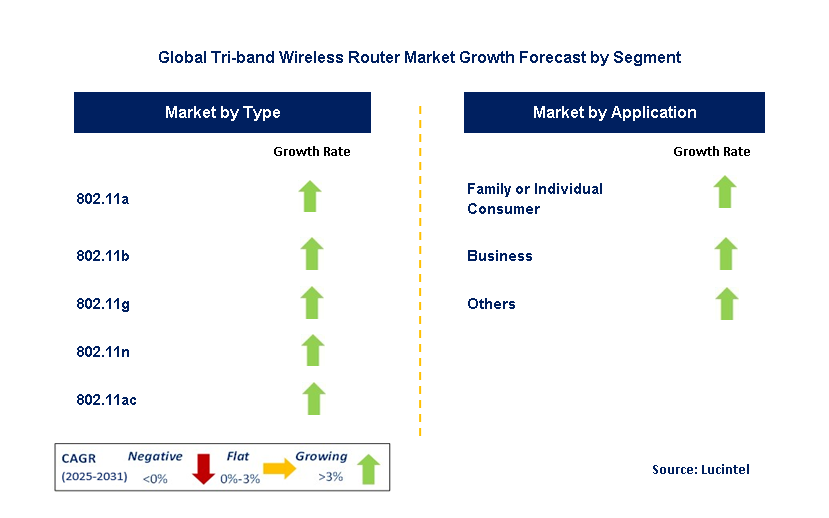
• Lucintel forecasts that, within the type category, 802.11ac is expected to witness the highest growth over the forecast period due to its ability to support higher speeds.
• Within the application category, business is expected to witness higher growth.
• In terms of region, North America is expected to witness the highest growth over the forecast period due to a region's developed technological infrastructure.
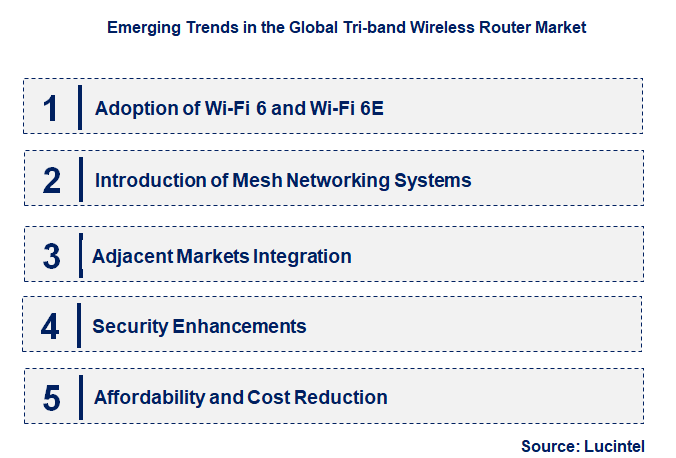
• Adoption of Wi-Fi 6 and Wi-Fi 6E: One of the most important trends in the tri-band router market is increasing adoption of Wi-Fi 6 and Wi-Fi 6E. These have faster speeds, lower latency, and also manage higher numbers of devices concurrently connected to the network more efficiently. Wi-Fi 6E utilizes the 6GHz band, which is another addition, as it improves the range of spectrum that is available which means better and quicker connection with lesser chances of disconnections. With increasing business and consumer expectations with regard to performance, it is likely that the adoption of Wi-Fi 6 and Wi-Fi 6E, in combination with tri-band routers, will become the norm therefore increasing the level of market tend technological advancement.
• Introduction of Mesh Networking Systems: The integration of mesh networking systems is gaining remarkable attention in the tri-band wireless router sector. Mesh systems utilize several nodes to improve Wi-Fi coverage while providing seamless connectivity across the home or office. This technology is crucial for larger spaces or congested locations. To meet the increasing demand of the users for better coverage and reliability, manufacturers are integrating mesh networking features into Tri-band routers to provide uninterrupted internet access, which has become a notable trend in the sector.
• Adjacent Markets Integration: If there is remarkable growth in the adoption of smart home devices, the demand for tri-band wireless routers will surely increase. These routers can withstand the required bandwidth and stability necessary for supporting several other devices such as, security cameras, thermostats, lights, and voice assistants. Special features that cater to smart homes like voice control, automation, and heightened security features are now being incorporated into Tri-band routers. This trend is likely to become stronger as more consumers adopt smart home technology increasing the scope of tri-band wireless routers further.
• Security Enhancements: The use and concern of cyber-security is on the rise, meaning there are more devices connected on a network. Manufacturers are now putting extra effort in enhancing the security features of tri-band wireless routers. Users are now more protected from cyber threats with the advanced security protocols, including WPA3 encryption, secure VPN connections, and integrated firewalls. The routers provide security to cyber users along with ensuring that their networks do not get compromised. The tri-band wireless router market is using better equipment due to the necessity for data privacy and network protection increasing immensely.
• Affordability and Cost Reduction: The demand for tri-band routers is on the rise, allowing wide access to individuals at different levels. Other manufacturers are also trying to keep up and working on lowering the production costs. For example, using cheaper components and making their manufacturing processes more efficient help to reduce the production costs. Additionally, in developing regions, there is a large base of consumers who are looking for affordable high performance routers, meaning these tri-band routers coming at lower prices is able to make them even more accessible. These changes are forecasted to enable more tri-band routers to be available in a bigger span of regions and thus, making them more affordable should drive their usage. In Conclusion, emerging trends like the adoption of Wi-Fi 6 and Wi-Fi 6E, mesh networking smart home integration, advanced security measures, and low-cost routers are set to transform the tri-band wireless router market. These changes will lead to further technological improvements alongside escalating consumer expectations and performance as well as broaden the market for quality routers.
• Integration of Wi-Fi 6 Technology: The integration of Wi-Fi 6 in Tri-band Routers is one of the most notable developments in the market. Tri-band routers now have a more appealing feature for consumers and businesses seeking high speed networking solutions. Wi-Fi 6 came as a standard attribute on modern Tri-band routers which greatly increased its adoption and router performance. Tri-band routers have become more desirable in the market because of the increased growth spearheaded by Wi-Fi 6 technology, which has now formed its own sets of standards.
• Expansion of Mesh Networking Systems: The innovation in mesh networking systems has further stimulated the tri-band wireless router market. The introduction of multiple router devices creates a mesh network enabling better internet coverage in larger regions. These new features have resulted in the development of mesh enabled Tri-band routers that provide seamless and strong internet coverage over greater distances. Mesh systems are widely adopted in larger residential houses and commercial buildings which need reliable, high speed internet coverage in multiple rooms and floors.
• Prioritize Compatibility with Smart Homes: The rise of smart home infrastructure has caused a spike in the demand of tri-band wireless routers that are compatible with multiple connected devices. Companies have emphasized the design of the routers around smart home ecosystems, which include smart thermostats, lights, security cameras, and voice assistants. These advanced features help in market growth because consumers opt for higher quality routers that can multitask and cater to numerous smart devices simultaneously, without compromising the speed and reliability of the internet connection.
• Improvement in Security Features: Cybersecurity threats have increased in number and severity over the years, which has caused manufacturers to focus on improving the security features of tri-band wireless routers. Newer models are now offering basic features such as WPA3 encryption, VPN support, and firewalls being integrated into new models. These new features that tri-band routers integrated have improved protection for users making them more appealing to consumers concerned with online security, thus increasing the market growth. Manufacturers are constantly working within this realm to mitigate the changing and developing cyber security threats.
• Introduction of Affordable Models: To meet growing demand, manufacturers have started using cost effective components to produce affordable tri-band wireless routers. This makes high performance networking product available to a wider audience. This change is especially beneficial for developing economical markets where people want quality routers and are willing to pay for it, but at lower prices. Integration of Wi-Fi 6 technology, improved security features, enhanced smart home compatibility, proliferation of mesh systems, and introduction of low priced models all serve to complement one another and collectively shape the market for tri-band wireless routers. All of these innovations are adding growth, making Tri-band routers effective and appealing and at the same time more accessible to the general audience.
• Smart Homes: The adoption of smart home devices has grown tremendously. With this increasing consumer integration of several connected devices, the performance and capabilities of the routers are becoming essentials that need refreshment. Smart homes are most ideally supported by tri-band routers due their highly capable ability to combat multiple devices at once, which require high bandwidth along with stable connections. This creates a chance to mark the extent to which products specifically for smart home ecosystems can be developed.
• Small and Medium-Sized Enterprises: As small and medium-sized enterprises continue to grow, their connectivity needs have led to the adoption of Tri-band routers. With the integration of more IoT-enabled devices and an increased reliance on high-speed internet for business operations, the need for high performance routers is on the rise. Tri-band routers are perfectly suited for SMEs as they can simultaneously operate multiple devices and perform well in challenging environments. Manufacturers can focus this market segment with reasonably priced but effective Tri-band routers that fit the requirements of SME sector.
• Gaming and Streaming Applications: The advent of online gaming coupled with 4K/8K video streaming has opened new avenues for the growth of Tri-band routers. These applications not only require high speed internet but also have low tolerance for latency hence Tri-band routers are becoming the preferred choice for gamers and streamers. This market segment can be captured as the demand for low latency gaming and seamless streaming increases by designing specialized routers that optimize gaming and streaming experiences.
• Healthcare Services and Telemedicine: The healthcare industry, particularly telemedicine, is using the high-speed internet more frequently for consultations, remote diagnostics, and patient monitoring. These uses are suited for tri-band routers since they can maintain stable and high-speed connections to multiple devices simultaneously. The increased telemedicine and remote healthcare services has created an opening for tri-band router manufacturers to produce specialized solutions that meet the needs of healthcare providers and patients.
• Public and Commercial Wi-Fi: The use of the internet in public locations like cafes, shops, and airports is increasing, thus creating a need for tri-band routers. These routers are needed because all public networks generate high traffic and need seamless connectivity to many devices at the same time. This addresses the need of manufacturers to formulate a bid that would provide these routers to these locations using tri-band routers focusing on speed, coverage and reliability for public comps. The strategically underserved segments within the tri-band wireless router market include smart homes, gaming and streaming, healthcare, public Wi-Fi, and small to medium enterprises. With these gaps create an opportunity for manufacturers to capture those markets, widen their scope of solutions, and respond to the growing need for dependable and high-speed internet.
• TP-Link
• D-Link
• Tenda
• Linksys
• MERCURY
• Netgear
• Huawei
• Xiaomi
• Eero
• 802.11a
• 802.11b
• 802.11g
• 802.11n
• 802.11ac
• Family or Individual Consumer
• Business
• Others
• North America
• Europe
• Asia Pacific
• The Rest of the World
• United States: In the US, the bandwidth demands for smart homes and offices have widened the scope of business for the tri-band routers even more, thus aiding the growth of the tri-band wireless router market. The current use of streaming and gaming in 4K and 8K, along with remote work, has pushed the need for these types of routers even further. These bandwidth heavy applications have made multiple competitors incorporate the tri-band solution into their routers. Advanced models that incorporate Wi-Fi 6 for increased speeds and lower latency are also being introduced by many leading companies. Furthermore, the growing metropolitan areas being served through fiber optic broadband are now creating a newer demand for capable networking solutions along with the existing ones.
• China: The development of smart cities and the rise of new technologies has led to significant progress in the tri-band wireless router market in China. There has been an upsurge in the demand for advanced wireless networks due to the influx of connected devices, like smart appliances, IoT systems, and surveillance cameras. In China, consumers and businesses alike are starting to favor more cost efficient and high performing Tri-band routers. Furthermore, the growing 5G networks in China will likely create a surge in demand for high speed, Tri-band routers.
• Germany: There is an increase in demand for wireless tri-band routers in Germany due to the high-speed residential and commercial connectivity. The increased use of IoT and smart home devices in industries has caused a surge in the demand for fast, reliable internet and, as a result, Tri-band routers. Additionally, the digitization and Industry 4.0 initiatives are aiding in market growth. In Germany, there is also significant investment geared towards the implementation of high speed Wi-Fi 6 Mesh networking in tri-band routers to satisfy the hyper demand for seamless network performance.
• India: The market for tri-band wireless routers is transforming due to increases in digital infrastructure and internet access in India. The increasing use of the internet for education, remote working, and entertainment is increasing the need for faster and more dependable internet, causing an uptick in the usage of tri-band routers. Furthermore, the growing e-commerce industry in the nation and the adoption of smart homes is additional market growth factors. Indian customers are shifting to the middle class and are in search of cost-effective but highly efficient routers, which is being met by manufacturers introducing low-cost tri-band enabled routers.
• Japan: The wireless router market in Japan is being influenced by the country's adoption of new technologies and having an already established high-speed internet. Aid through the adoption of 5G networks along with the increase in usage of connected devices for both personal and business purposes is driving the demand for tri-band routers. Japanese manufacturers are concentrating on routers that facilitate high internet speeds and other functionalities like mesh networking and robust security features. Moreover, the rise of smart homes and IoT devices in Japan is further increasing the need for effective and dependable wireless networks, which stimulates growth in the Tri-band router market.


• TP-Link
• D-Link
• Tenda
• Linksys
• MERCURY
• Netgear
• Huawei
• Xiaomi
• Eero
• Google Q5. Which tri-band wireless router market segment will be the largest in future? Answer: Lucintel forecasts that, within the type category, 802.11ac is expected to witness the highest growth over the forecast period due to its ability to support higher speeds. Q6. In tri-band wireless router market, which region is expected to be the largest in next 5 years? Answer: In terms of region, North America is expected to witness the highest growth over the forecast period due to a region's developed technological infrastructure. Q7. Do we receive customization in this report? Answer: Yes, Lucintel provides 10% customization without any additional cost.


Choose a license that fits your team. Instant PDF delivery.
Prices exclude taxes. Instant delivery. Custom licensing available on request.
Market Report · July 29, 2026
Market Report · July 20, 2026
Market Report · July 20, 2026
Trusted partner for strategic intelligence and business growth


Receive a complimentary market analysis tailored to your industry. Our analysts will identify key growth opportunities and competitive dynamics specific to your business.

Market size, growth rate, and key trend analysis for your specific sector.

Top competitor positioning and market share analysis.

Strategic recommendations backed by data-driven insights.
Get curated market intelligence and competitive moves straight to your inbox.
By subscribing, you agree to receive our monthly insights. Unsubscribe anytime.
Receive a complimentary market analysis tailored to your industry. Our analysts will identify key growth opportunities and competitive dynamics specific to your business.
Market size, growth rate, and key trend analysis for your specific sector.
Top competitor positioning and market share analysis.
Strategic recommendations backed by data-driven insights.
Get curated market intelligence, emerging trends, and competitive moves straight to your inbox each month.
By subscribing, you agree to receive our monthly insights. Unsubscribe anytime.
We'll send your sample report shortly.