
Report Feature
Tree and Lawn Care Service Market Trends and Forecast
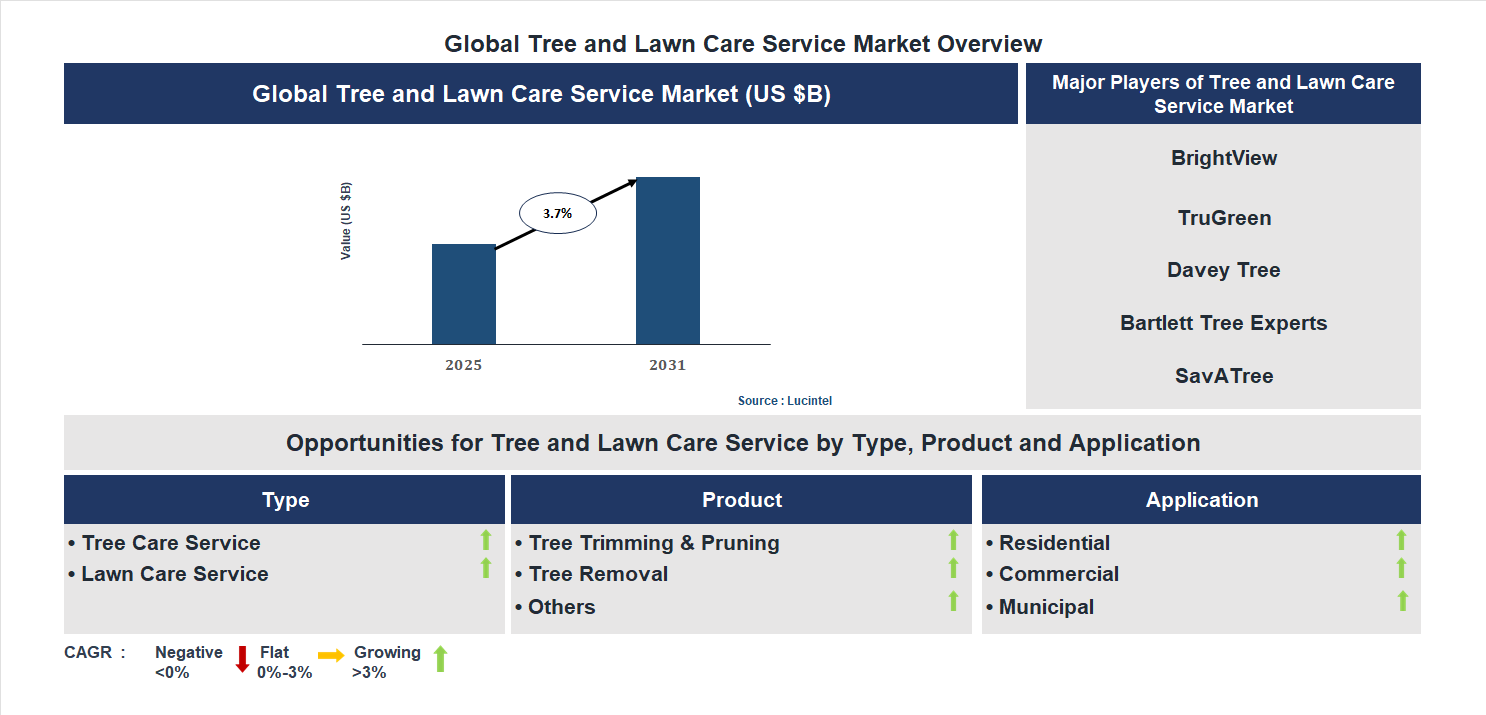
The future of the global tree and lawn care service market looks promising with opportunities in the residential, commercial, and municipal markets. The global tree and lawn care service market is expected to grow with a CAGR of 3.7% from 2025 to 2031. The major drivers for this market are the increasing demand for residential landscaping maintenance, the rising awareness of sustainable tree care practices, and the growing adoption of automated lawn care equipment.• Lucintel forecasts that, within the type category, lawn care service is expected to witness higher growth over the forecast period.
• Within the application category, residential is expected to witness the highest growth.
• In terms of region, APAC is expected to witness the highest growth over the forecast period. Gain valuable insights for your business decisions with our comprehensive 150+ page report. Sample figures with some insights are shown below.
Emerging Trends in the Tree and Lawn Care Service Market
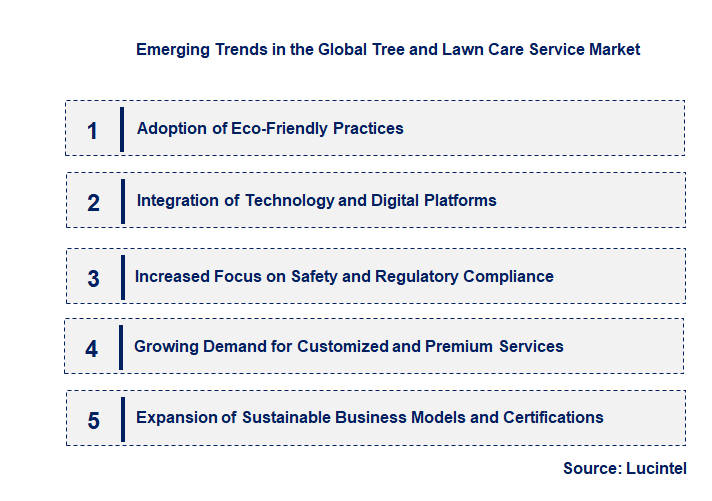
The tree and lawn care service market is experiencing rapid evolution driven by technological advancements, changing consumer preferences, and increasing environmental awareness. As urbanization continues and homeowners seek sustainable solutions, the industry is adapting to meet these demands. Innovations in equipment, eco-friendly practices, and digital marketing are transforming how services are delivered and perceived. Additionally, regulatory changes and a focus on health and safety are shaping operational standards. These emerging trends are not only enhancing service quality but also expanding market opportunities, making the industry more competitive and sustainable in the long term.• Adoption of Eco-Friendly Practices: Growing environmental consciousness among consumers is prompting service providers to adopt sustainable methods. This includes using organic fertilizers, eco-friendly pesticides, and water-efficient irrigation systems. Such practices reduce environmental impact and appeal to eco-conscious clients, thereby increasing customer loyalty and market share. Companies investing in green solutions are also gaining regulatory advantages and positive brand recognition, which are crucial in a competitive landscape. This trend encourages industry-wide shifts toward more sustainable and responsible service delivery.
• Integration of Technology and Digital Platforms: The use of digital tools such as online booking, scheduling apps, and customer management software is streamlining operations. Mobile apps enable real-time communication, service tracking, and instant payments, enhancing customer experience. Additionally, drone technology is being explored for aerial inspections and health assessments of trees, improving accuracy and efficiency. These technological integrations reduce operational costs, improve service quality, and attract tech-savvy customers. As digital adoption accelerates, companies that leverage these tools are gaining a competitive edge in the market.
• Increased Focus on Safety and Regulatory Compliance: Heightened safety standards and stricter regulations are shaping industry practices. Service providers are investing in safety training, protective equipment, and compliance protocols to mitigate risks. This focus reduces accidents and liability, ensuring safer work environments for employees and clients. Regulatory adherence also enhances credibility and trustworthiness, which are vital for customer retention. As safety becomes a priority, companies that proactively implement compliance measures are better positioned to avoid penalties and build a reputable brand.
• Growing Demand for Customized and Premium Services: Consumers are seeking tailored solutions that meet specific landscape needs, such as specialty pruning, pest management, or landscape design. Premium services often command higher prices and attract affluent clients. Companies are offering personalized consultations, eco-friendly options, and innovative landscaping designs to differentiate themselves. This trend reflects a shift toward value-added services that emphasize quality and uniqueness. As customer expectations evolve, providers offering customized solutions are capturing higher market segments and increasing profitability.
• Expansion of Sustainable Business Models and Certifications: Certification programs like ISA (International Society of Arboriculture) and eco-labels are gaining importance. These credentials demonstrate expertise and commitment to sustainable practices, influencing customer choices. Businesses are also adopting sustainable business models that emphasize resource efficiency and community engagement. This trend enhances brand reputation, attracts environmentally conscious clients, and aligns with regulatory incentives. As sustainability becomes a market differentiator, companies with recognized certifications and sustainable practices are gaining a competitive advantage and fostering long-term growth. In summary, these trends are fundamentally reshaping the tree and lawn care service market by promoting sustainability, technological innovation, safety, customization, and certification. They are driving industry standards upward, expanding market opportunities, and aligning services with evolving consumer values. As a result, the market is becoming more competitive, environmentally responsible, and customer-centric, ensuring its resilience and growth in the coming years.
Recent Development in the Tree and Lawn Care Service Market
The tree and lawn care service market is experiencing rapid growth driven by increasing urbanization, rising awareness of environmental sustainability, and a growing demand for aesthetic outdoor spaces. Technological advancements and eco-friendly practices are transforming service delivery, creating new opportunities for businesses. Consumers are seeking reliable, efficient, and sustainable solutions, prompting companies to innovate and expand their offerings. These developments are shaping the future landscape of the industry, making it more competitive and customer-centric.• Growing Urbanization and Residential Development: The expansion of urban areas and residential complexes is fueling demand for professional tree and lawn care services. As property owners prioritize outdoor aesthetics and safety, there is an increased need for regular maintenance, landscaping, and tree health management. This trend is expected to continue, providing consistent growth opportunities for service providers. The market benefits from increased consumer spending on outdoor improvements, leading to higher revenue and employment in the sector.
• Adoption of Eco-Friendly and Sustainable Practices: The shift towards environmentally sustainable practices is significantly impacting the industry. Companies are adopting organic fertilizers, eco-friendly pest control, and water-efficient irrigation systems. This not only reduces environmental impact but also appeals to eco-conscious consumers. The emphasis on sustainability enhances brand reputation and compliance with regulations, opening new market segments. As awareness grows, demand for green services is expected to rise, fostering innovation and competitive differentiation.
• Integration of Technology and Automation: Technological advancements such as drone inspections, GPS routing, and automated equipment are revolutionizing service delivery. These tools improve efficiency, accuracy, and safety, reducing operational costs. Customers benefit from faster, more reliable services, and companies can expand their service areas. The integration of technology also enables better data collection for maintenance planning and environmental monitoring, positioning the industry for smarter, more sustainable growth.
• Expansion of Commercial and Public Sector Contracts: Governments and commercial entities are increasing investments in landscape management for parks, campuses, and public spaces. This diversification of client base offers stable revenue streams and long-term contracts. Enhanced focus on urban green spaces and environmental conservation drives demand for professional services. Companies expanding into this sector can leverage their expertise to secure lucrative projects, boosting overall industry growth and creating employment opportunities.
• Rising Consumer Preference for Professional Services: Consumers are increasingly opting for professional tree and lawn care services over DIY approaches due to safety, quality, and time-saving benefits. This trend is driven by busy lifestyles and awareness of proper maintenance techniques. Service providers are capitalizing on this by offering customized packages and subscription models. The growing preference for professional care enhances market stability, encourages innovation, and fosters customer loyalty, ultimately expanding the industry’s reach and profitability. The overall impact of these developments is a dynamic, innovative, and sustainable market that offers significant growth opportunities. Increased demand across residential, commercial, and public sectors is driving industry expansion. Adoption of eco-friendly practices and technology enhances service quality and operational efficiency. As consumer preferences shift towards professional and sustainable solutions, the market is poised for continued robust growth, benefiting businesses and consumers alike.
Strategic Growth Opportunities in the Tree and Lawn Care Service Market
The tree and lawn care service market is experiencing significant growth driven by increasing urbanization, rising awareness of environmental sustainability, and a growing demand for aesthetic outdoor spaces. Technological advancements and eco-friendly practices are shaping service offerings, while consumer preferences shift towards professional and reliable providers. Market players are expanding their service portfolios and geographic reach to capitalize on emerging opportunities. This dynamic landscape presents numerous avenues for strategic growth, innovation, and competitive differentiation, making it essential for companies to identify and leverage key opportunities effectively.• Expansion Into Eco-Friendly and Sustainable Services: The increasing consumer focus on environmental sustainability is driving demand for eco-friendly tree and lawn care solutions. Companies are adopting organic fertilizers, biodegradable products, and sustainable practices to meet this demand. This shift not only enhances brand reputation but also attracts environmentally conscious clients. Investing in green technologies and educating customers about eco-friendly benefits can differentiate providers in a competitive market, fostering long-term growth and loyalty.
• Adoption of Advanced Technology for Service Efficiency: Integrating technology such as drone inspections, GPS routing, and automated scheduling enhances operational efficiency and service quality. These innovations reduce costs, improve precision, and enable real-time monitoring of tree health and lawn conditions. Companies leveraging such tools can deliver faster, more accurate services, leading to increased customer satisfaction. Embracing digital transformation is crucial for staying competitive and scaling operations effectively in a rapidly evolving market.
• Diversification of Service Offerings to Include Landscape Design: Expanding beyond basic tree and lawn care to include landscape design and maintenance creates new revenue streams. Offering comprehensive outdoor solutions appeals to residential and commercial clients seeking one-stop services. This diversification enhances customer retention and attracts higher-value projects. Developing skilled teams and strategic partnerships in landscape architecture can position companies as full-service outdoor providers, fostering sustained growth and market share expansion.
• Geographic Expansion into Emerging Markets: Entering underserved or emerging regions presents significant growth opportunities due to rising urban development and increasing disposable incomes. Tailoring services to local preferences and establishing local presence can capture new customer bases. Strategic expansion involves understanding regional regulations, climate conditions, and cultural preferences. This approach enables companies to tap into high-growth markets, diversify revenue streams, and establish a competitive foothold in areas with limited existing service providers.
• Emphasis on Professionalism and Certification to Build Trust: Increasing consumer awareness about safety, quality, and environmental impact emphasizes the importance of certified and professionally trained staff. Companies investing in certifications, ongoing training, and safety standards can differentiate themselves through credibility and trustworthiness. This focus on professionalism attracts discerning clients and reduces liability risks. Building a reputation for quality and safety is essential for long-term success and market leadership in a competitive landscape. The overall market outlook is positively influenced by these strategic growth opportunities, enabling companies to innovate, expand, and strengthen their market position. Embracing sustainability, technology, diversification, geographic expansion, and professionalism will drive resilience and profitability. As consumer preferences evolve, proactive adaptation to these opportunities will be critical for sustained success and leadership in the tree and lawn care service market.
Tree and Lawn Care Service Market Driver and Challenges
The tree and lawn care service market is influenced by a variety of technological, economic, and regulatory factors that shape its growth and sustainability. Advances in equipment and eco-friendly practices drive innovation, while economic conditions affect consumer spending and investment in landscaping. Regulatory policies concerning environmental protection and pesticide use also play a significant role in shaping operational standards. Additionally, demographic shifts and urbanization influence demand patterns. Navigating these drivers and challenges is essential for market players to capitalize on opportunities and mitigate risks, ensuring long-term growth and competitiveness in this evolving industry. The factors responsible for driving the tree and lawn care service market include:-• Technological Advancements: The integration of innovative tools and equipment, such as drone surveillance, GPS mapping, and eco-friendly chemicals, enhances service efficiency and quality. These technologies reduce labor costs, improve precision, and enable better resource management, attracting more customers seeking reliable and sustainable services. As technology continues to evolve, companies that adopt these innovations can differentiate themselves, expand their service offerings, and increase market share, fostering overall industry growth.
• Rising Consumer Awareness and Eco-Friendly Practices: Increasing awareness about environmental sustainability and the health benefits of green spaces encourages consumers to opt for eco-friendly lawn and tree care services. The demand for organic fertilizers, biodegradable pesticides, and sustainable landscaping practices is rising. This shift not only aligns with regulatory trends but also appeals to environmentally conscious clients, expanding the customer base. Companies adopting green practices can enhance their brand reputation and gain a competitive edge, fueling market expansion.
• Urbanization and Real Estate Development: Rapid urban growth and real estate development lead to increased demand for landscaping and tree care services in residential, commercial, and public spaces. As urban areas expand, the need for maintaining green spaces, parks, and recreational areas becomes critical. This trend creates a steady demand for professional tree and lawn care services, supporting industry growth. Developers and municipalities seek reliable service providers to enhance property aesthetics and comply with environmental regulations, further driving market opportunities.
• Economic Growth and Disposable Income: Economic stability and growth increase consumers disposable income, enabling more frequent and higher-quality tree and lawn care services. As households and businesses invest in property beautification, the market experiences increased demand. Additionally, favorable economic conditions encourage investment in commercial landscaping projects, public parks, and corporate campuses. This financial capacity boosts service providers revenues and encourages expansion, contributing positively to the overall market outlook.
• Regulatory Environment and Standards: Stringent regulations concerning pesticide use, environmental protection, and safety standards influence operational practices within the industry. Compliance with these regulations requires investment in training, equipment, and eco-friendly products, which can increase costs but also elevate service quality. Regulatory frameworks aim to promote sustainable practices, ensuring long-term industry viability. Companies that proactively adapt to these standards can avoid penalties, build trust with clients, and access new markets, thereby fostering industry stability and growth. The challenges facing this tree and lawn care service market include:-
• Regulatory Compliance and Environmental Restrictions: Navigating complex regulations related to pesticide application, waste disposal, and environmental protection poses significant challenges. Non-compliance can lead to hefty fines, legal actions, and damage to reputation. Staying updated with evolving policies requires continuous training and investment, increasing operational costs. Additionally, restrictions on certain chemicals may limit service options, forcing companies to innovate or seek alternative solutions, which can impact profitability and service delivery.
• Seasonal Variability and Weather Dependence: The industry is highly dependent on weather conditions, with peak demand during spring and summer months. Unpredictable weather patterns, such as droughts, storms, or excessive rainfall, can disrupt schedules, delay projects, and reduce revenue. Seasonal fluctuations also affect workforce planning and inventory management. Companies must develop strategies to manage these variations, such as diversifying services or expanding into related areas, to maintain steady cash flow and operational stability.
• Skilled Workforce Shortage: The industry faces a shortage of trained and certified professionals capable of delivering high-quality services. This challenge is compounded by the physically demanding nature of the work and the need for specialized knowledge in pest management, pruning, and safety protocols. A lack of skilled labor can lead to reduced service quality, increased training costs, and delays in project completion. Addressing this issue requires investment in workforce development, competitive wages, and attractive work environments to attract and retain talent. In summary, the tree and lawn care service market is shaped by technological innovations, environmental awareness, urbanization, economic growth, and regulatory standards. While these drivers present opportunities for expansion and differentiation, challenges such as regulatory compliance, seasonal variability, and workforce shortages pose risks that require strategic management. Overall, the industry’s future depends on its ability to adapt to these dynamic factors, leveraging technological and sustainable practices to sustain growth and meet evolving customer demands.
List of Tree and Lawn Care Service Companies
Companies in the market compete on the basis of product quality offered. Major players in this market focus on expanding their manufacturing facilities, R&D investments, infrastructural development, and leverage integration opportunities across the value chain. With these strategies tree and lawn care service companies cater increasing demand, ensure competitive effectiveness, develop innovative products & technologies, reduce production costs, and expand their customer base. Some of the tree and lawn care service companies profiled in this report include-• BrightView
• TruGreen
• Davey Tree
• Bartlett Tree Experts
• SavATree
• Yellowstone Landscape
• Ruppert Landscape
• Mariani Premier Group
• HeartLand
• Monarch Landscape Companies
Tree and Lawn Care Service Market by Segment
The study includes a forecast for the global tree and lawn care service market by type, product, application, and region.Tree and Lawn Care Service Market by Type [Value from 2019 to 2031]:
• Tree Care Service
• Lawn Care Service
Tree and Lawn Care Service Market by Product [Value from 2019 to 2031]:
• Tree Trimming & Pruning
• Tree Removal
• Others
Tree and Lawn Care Service Market by Application [Value from 2019 to 2031]:
• Residential
• Commercial
• Municipal
Tree and Lawn Care Service Market by Region [Value from 2019 to 2031]:
• North America
• Europe
• Asia Pacific
• The Rest of the World
Country Wise Outlook for the Tree and Lawn Care Service Market
The tree and lawn care service market has experienced significant growth driven by increasing urbanization, rising awareness of environmental sustainability, and a growing demand for aesthetic outdoor spaces. Technological advancements, such as eco-friendly equipment and digital scheduling platforms, have further transformed the industry. Governments and consumers are prioritizing sustainable practices, leading to innovations in pest control and tree health management. The markets evolution reflects broader trends in landscaping, environmental conservation, and consumer preferences for personalized outdoor maintenance. These developments vary across regions, influenced by local regulations, climate conditions, and economic factors, shaping the future landscape of tree and lawn care services globally.• United States: The US market has seen a surge in eco-friendly and organic lawn care products, with increased adoption of smart technology for scheduling and monitoring. There is a rising demand for sustainable practices, including water conservation and pesticide reduction. The industry is also witnessing consolidation, with larger firms expanding through acquisitions. Urban areas focus on green infrastructure projects, boosting service opportunities. Additionally, labor shortages are prompting automation and training initiatives to attract skilled workers. Overall, the US market emphasizes sustainability, technology integration, and service diversification.
• China: Chinas market is rapidly expanding due to urban development and increasing middle-class disposable income. There is a growing preference for professional landscaping and tree care services to enhance urban aesthetics. Government initiatives promote green spaces and environmental protection, supporting industry growth. Technological adoption includes drone-based monitoring and eco-friendly equipment. Local companies are expanding their service portfolios to include pest management and tree health diagnostics. The market is also influenced by rising awareness of environmental issues, leading to more sustainable practices. Overall, China’s market is characterized by rapid growth, technological innovation, and a focus on urban greening.
• Germany: The German market emphasizes sustainability and eco-conscious practices, driven by strict environmental regulations. There is a strong focus on organic lawn care and integrated pest management. Technological innovations include precision equipment and digital management tools for efficient service delivery. The industry benefits from high consumer awareness and demand for quality, eco-friendly services. Urban green space maintenance is a priority, with government support for sustainable landscaping projects. Skilled labor shortages are addressed through specialized training programs. Overall, Germany’s market is marked by a commitment to environmental standards and technological sophistication.
• India: The Indian market is experiencing rapid growth due to urbanization, increasing disposable income, and a rising middle class seeking aesthetic outdoor spaces. There is a shift towards professional lawn and tree care services, with a focus on pest control and disease management. The industry is adopting eco-friendly practices amid rising environmental awareness. Local companies are expanding service offerings to include landscape design and maintenance. Government initiatives promoting urban greenery and sustainable development further support growth. Challenges include skilled labor shortages and climate variability, but technological adoption is gradually increasing. Overall, India’s market is expanding with a focus on quality and sustainability.
• Japan: Japan’s market is characterized by high technological integration and eco-friendly practices. The industry emphasizes sustainable landscaping, water conservation, and pest control. Advanced tools, such as robotic mowers and drone monitoring, are increasingly used. Consumer demand for aesthetically pleasing and environmentally responsible services is high. Urban green space management is a key focus, supported by government policies. Skilled labor shortages are mitigated through training and automation. The market also sees a trend toward organic and chemical-free lawn care. Overall, Japan’s market combines technological innovation with a strong commitment to environmental sustainability.

Features of the Global Tree and Lawn Care Service Market
Market Size Estimates: Tree and lawn care service market size estimation in terms of value ($B). Trend and Forecast Analysis: Market trends (2019 to 2024) and forecast (2025 to 2031) by various segments and regions. Segmentation Analysis: Tree and lawn care service market size by type, product, application, and region in terms of value ($B). Regional Analysis: Tree and lawn care service market breakdown by North America, Europe, Asia Pacific, and Rest of the World. Growth Opportunities: Analysis of growth opportunities in different types, products, applications, and regions for the tree and lawn care service market. Strategic Analysis: This includes M&A, new product development, and competitive landscape of the tree and lawn care service market. Analysis of competitive intensity of the industry based on Porter’s Five Forces model.
FAQ
Q1. What is the growth forecast for tree and lawn care service market? Answer: The global tree and lawn care service market is expected to grow with a CAGR of 3.7% from 2025 to 2031. Q2. What are the major drivers influencing the growth of the tree and lawn care service market? Answer: The major drivers for this market are the increasing demand for residential landscaping maintenance, the rising awareness of sustainable tree care practices, and the growing adoption of automated lawn care equipment. Q3. What are the major segments for tree and lawn care service market? Answer: The future of the tree and lawn care service market looks promising with opportunities in the residential, commercial, and municipal markets. Q4. Who are the key tree and lawn care service market companies? Answer: Some of the key tree and lawn care service companies are as follows:• BrightView
• TruGreen
• Davey Tree
• Bartlett Tree Experts
• SavATree
• Yellowstone Landscape
• Ruppert Landscape
• Mariani Premier Group
• HeartLand
• Monarch Landscape Companies Q5. Which tree and lawn care service market segment will be the largest in future? Answer: Lucintel forecasts that, within the type category, lawn care service is expected to witness higher growth over the forecast period. Q6. In tree and lawn care service market, which region is expected to be the largest in next 5 years? Answer: In terms of region, APAC is expected to witness the highest growth over the forecast period. Q7. Do we receive customization in this report? Answer: Yes, Lucintel provides 10% customization without any additional cost.
Table of Contents
List of Figures
List of Tables
Methodology
- In-depth interviews of the major players in this market
- Detailed secondary research from competitors’ financial statements and published data
- Extensive searches of published works, market, and database information pertaining to industry news, company press releases, and customer intentions
- A compilation of the experiences, judgments, and insights of Lucintel’s professionals, who have analyzed and tracked this market over the years.


Buy Now
Choose a license that fits your team. Instant PDF delivery.
Prices exclude taxes. Instant delivery. Custom licensing available on request.
Key Questions
- • What are some of the most promising, high-growth opportunities for the tree and lawn care service market by type (tree care service and lawn care service), product (tree trimming & pruning, tree removal, and others), application (residential, commercial, and municipal), and region (North America, Europe, Asia Pacific, and the Rest of the World)?
- • Which segments will grow at a faster pace and why?
- • Which region will grow at a faster pace and why?
- • What are the key factors affecting market dynamics? What are the key challenges and business risks in this market?
- • What are the business risks and competitive threats in this market?
- • What are the emerging trends in this market and the reasons behind them?
- • What are some of the changing demands of customers in the market?
- • What are the new developments in the market? Which companies are leading these developments?
- • Who are the major players in this market? What strategic initiatives are key players pursuing for business growth?
- • What are some of the competing products in this market and how big of a threat do they pose for loss of market share by material or product substitution?
- • What M&A activity has occurred in the last 6 years and what has its impact been on the industry? For any questions related to Tree and Lawn Care Service Market, Tree and Lawn Care Service Market Size, Tree and Lawn Care Service Market Growth, Tree and Lawn Care Service Market Analysis, Tree and Lawn Care Service Market Report, Tree and Lawn Care Service Market Share, Tree and Lawn Care Service Market Trends, Tree and Lawn Care Service Market Forecast, Tree and Lawn Care Service Companies, write Lucintel analyst at email: helpdesk@lucintel.com. We will be glad to get back to you soon.


