
Market Report · July 29, 2026

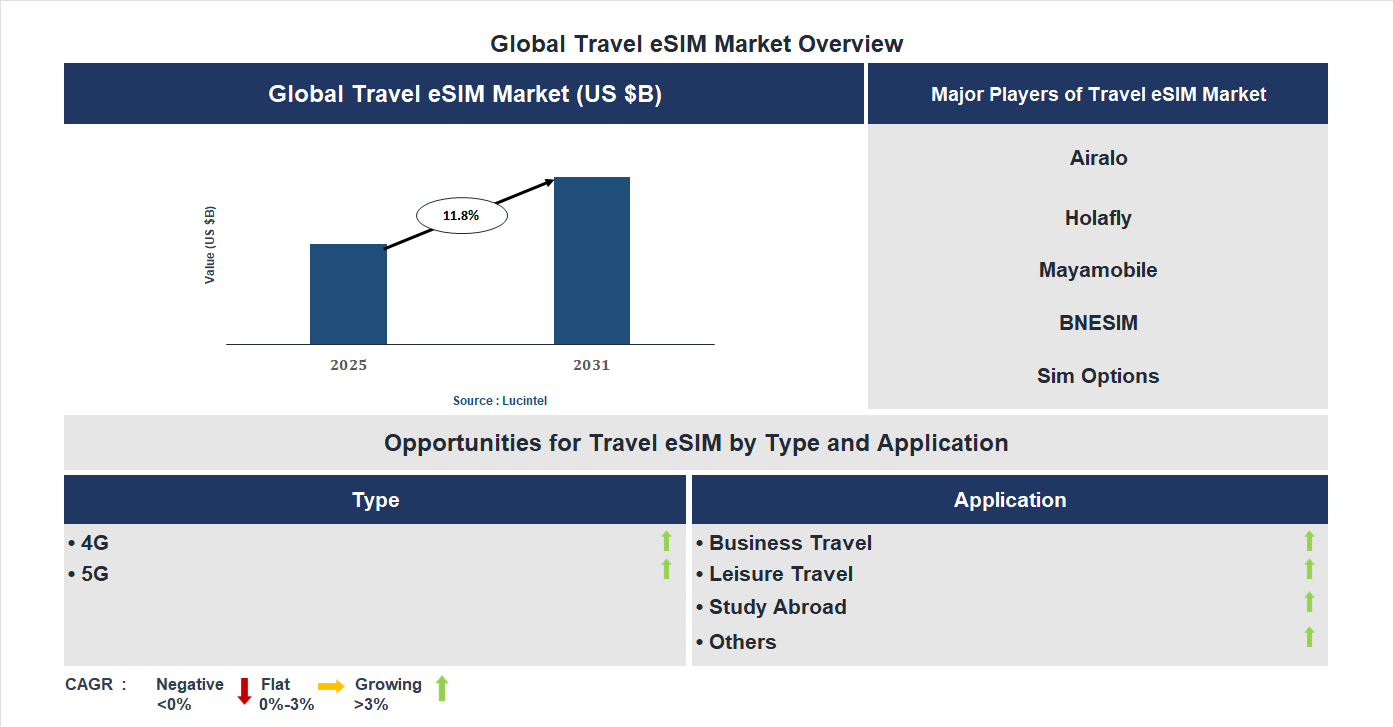
Key data points: The growth forecast = 11.8% annually for the next 7 years. Scroll below to get more insights. This market report covers trends, opportunities and forecasts in travel eSIM market to 2031 by type (4g and 5g), application (business travel, leisure travel, study abroad, and others), and region (North America, Europe, Asia Pacific, and the Rest of the World)
We'll send your sample report shortly.
• Lucintel forecasts that, within the type category, 5g is expected to witness higher growth over the forecast period.
• Within the application category, business travel is expected to witness the highest growth.
• In terms of region, APAC is expected to witness the highest growth over the forecast period. Gain valuable insights for your business decisions with our comprehensive 150+ page report. Sample figures with some insights are shown below.
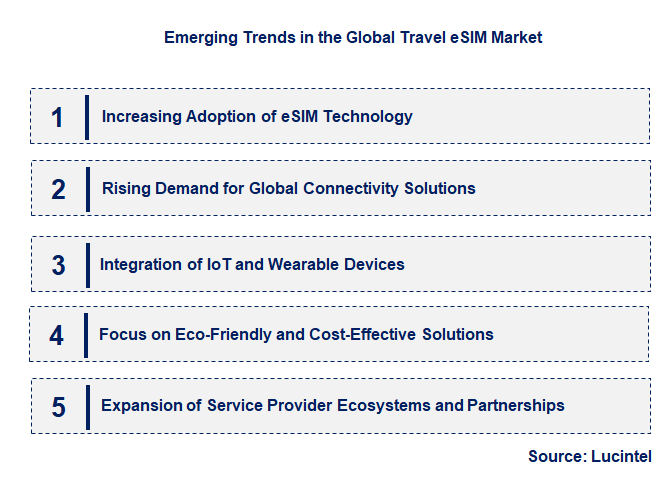
• Increasing Adoption of eSIM Technology: The widespread integration of eSIMs in smartphones and devices is accelerating market growth. Consumers prefer eSIMs for their convenience, as they eliminate the need for physical SIM cards and allow multiple profiles on a single device. This trend is supported by major device manufacturers incorporating eSIM support, making it easier for travelers to switch carriers and plans without changing physical SIMs. The ease of activation and management via apps further boosts adoption, leading to a more connected and flexible travel experience.
• Rising Demand for Global Connectivity Solutions: Travelers increasingly seek comprehensive connectivity options that work seamlessly across multiple countries. Service providers are responding by offering global or multi-country eSIM plans, which eliminate the need for multiple SIM cards and roaming charges. This trend enhances convenience and cost savings for travelers, especially those on frequent international trips. The demand for such solutions is driven by the growth of remote work, digital nomadism, and international tourism, prompting providers to develop tailored plans that cater to diverse travel needs.
• Integration of IoT and Wearable Devices: The proliferation of IoT devices and wearables is expanding the scope of the travel eSIM market. Devices such as smartwatches, fitness trackers, and connected cars require reliable, always-on connectivity, which eSIMs can provide efficiently. This integration allows travelers to stay connected without carrying multiple devices or SIM cards. It also opens new revenue streams for service providers by offering specialized plans for IoT and wearable devices. The trend enhances the overall travel experience by enabling real-time data sharing, navigation, and communication across various devices.
• Focus on Eco-Friendly and Cost-Effective Solutions: Environmental concerns and cost efficiency are driving the adoption of eSIMs over traditional SIM cards. eSIMs reduce plastic waste and packaging associated with physical SIM cards, aligning with sustainability goals. Additionally, they enable travelers to compare and select cost-effective plans instantly, avoiding expensive roaming charges. Service providers are promoting eco-friendly practices by offering digital onboarding and management, which further appeals to environmentally conscious consumers. This trend not only benefits the environment but also enhances customer satisfaction through transparent and flexible pricing options.
• Expansion of Service Provider Ecosystems and Partnerships: The market is witnessing increased collaborations between telecom operators, device manufacturers, and technology providers. These partnerships facilitate the development of integrated solutions, expanding the availability and functionality of eSIM services. Such collaborations enable providers to offer tailored plans, seamless activation, and better coverage options, thereby improving user experience. The expansion of ecosystems also encourages innovation, such as embedded eSIMs in rental cars, hotel devices, and other travel-related services. This interconnected approach is reshaping the market landscape by creating a more comprehensive and accessible connectivity environment for travelers. In summary, these trends are collectively transforming the travel eSIM market by making connectivity more flexible, affordable, and environmentally sustainable. They are driving innovation, expanding service options, and enhancing the overall travel experience, ultimately reshaping how travelers stay connected worldwide.
• Expansion of Network Coverage: Major telecom providers are partnering with global networks to offer broader coverage, ensuring travelers stay connected in more destinations. This enhances user confidence and reduces connectivity issues abroad, boosting market growth and customer satisfaction.
• Introduction of Flexible Data Plans: Providers are launching customizable and pay-as-you-go data plans tailored for travelers. This flexibility attracts more users by offering cost-effective options, increasing adoption rates and market penetration.
• Device Compatibility Improvements: Manufacturers are integrating eSIM technology into a wider range of devices, including budget smartphones and wearables. This broadens the market base and encourages more consumers to adopt eSIM solutions for travel.
• Strategic Partnerships and Collaborations: Telecom companies are forming alliances with travel agencies, airlines, and tech firms to promote eSIM adoption. These collaborations facilitate seamless integration and expand market reach, accelerating growth.
• Regulatory and Standardization Initiatives: Governments and industry bodies are establishing standards and regulations for eSIM technology, ensuring security and interoperability. This fosters consumer trust and encourages wider adoption across regions. In summary, these developments are significantly impacting the travel eSIM market by enhancing connectivity, offering more flexible options, and expanding device compatibility. Strategic partnerships and regulatory support are further driving growth, making eSIMs a preferred choice for modern travelers. The market is becoming more competitive, accessible, and customer-centric, promising sustained expansion in the coming years.
• Tourism Industry: Enhanced Customer Experience : eSIMs enable tourists to access local networks instantly, reducing roaming costs and improving connectivity, which enhances overall travel experience and satisfaction.
• Business Travel: Cost Efficiency and Flexibility : Business travelers benefit from eSIMs by avoiding high roaming charges and gaining the flexibility to switch plans easily, increasing productivity and reducing travel expenses.
• Remote Work and Digital Nomads: Seamless Connectivity Solutions : The rise of remote work drives demand for reliable, flexible connectivity options, with eSIMs providing instant access to multiple networks worldwide, supporting remote professionals.
• Expatriates and Long-term Travelers: Simplified Management : eSIM technology simplifies the management of multiple subscriptions for expatriates, offering convenience and cost savings while maintaining continuous connectivity.
• Adventure and Eco-Tourism: Rugged and Flexible Connectivity : Adventure tourism benefits from durable, easy-to-activate eSIMs that provide reliable connectivity in remote locations, enhancing safety and communication for travelers. In summary, these growth opportunities are significantly impacting the travel eSIM market by expanding its reach across diverse applications. They enable providers to offer tailored, cost-effective, and flexible solutions that meet evolving traveler needs. As a result, market growth accelerates, driven by increased adoption in tourism, business, remote work, expatriate communities, and adventure tourism, shaping a more connected and efficient global travel ecosystem.
• Technological Advancements: The rapid evolution of mobile technology and the proliferation of compatible devices have significantly contributed to the growth of the travel eSIM market. eSIM technology allows travelers to switch carriers without changing physical SIM cards, offering convenience and flexibility. The integration of eSIMs into smartphones, tablets, and wearables has expanded their adoption, enabling seamless global connectivity. Moreover, improvements in network infrastructure, such as 5G deployment, enhance the user experience, making eSIMs more attractive for international travelers. These technological innovations reduce costs and improve service quality, encouraging both consumers and service providers to adopt eSIM solutions, thus fueling market growth.
• Increasing International Travel: The surge in international travel, driven by globalization, business expansion, and tourism, is a major driver for the travel eSIM market. Travelers seek cost-effective, easy-to-use solutions for staying connected across borders. eSIMs eliminate the need for multiple physical SIM cards, simplifying the process of switching networks in different countries. This convenience appeals to frequent travelers, digital nomads, and expatriates. The rise in travel agencies and online booking platforms also promotes awareness and adoption of eSIM technology. As global travel continues to grow, the demand for flexible, affordable connectivity solutions like eSIMs is expected to increase, further expanding the market.
• Growing Smartphone Penetration and Digitalization: The widespread adoption of smartphones and the ongoing digital transformation are key factors driving the travel eSIM market. Smartphones are essential tools for travelers, providing access to maps, booking apps, and communication platforms. The integration of eSIM technology into smartphones enhances user convenience by enabling instant activation and switching between carriers without physical SIM swaps. As smartphone penetration reaches saturation in many regions, the potential customer base for eSIMs expands. Additionally, digitalization initiatives by governments and telecom operators promote eSIM adoption by streamlining activation processes and offering digital plans, thus supporting market growth.
• Regulatory Support and Policy Frameworks: Favorable regulatory environments and supportive policies are crucial for the expansion of the travel eSIM market. Governments and telecom authorities are increasingly recognizing the benefits of eSIM technology, leading to the development of standards and regulations that facilitate its adoption. Policies that promote digital innovation, reduce barriers to switching carriers, and ensure data security encourage both providers and consumers to embrace eSIM solutions. Additionally, international cooperation on roaming agreements and data privacy regulations influence market dynamics. A clear and supportive regulatory framework reduces uncertainties, accelerates deployment, and boosts consumer confidence, thereby driving market growth. The challenges facing this travel eSIM market include:-
• Technological Limitations: Despite advancements, technological challenges such as compatibility issues across devices and networks can hinder eSIM adoption. Not all devices support eSIM technology, especially older models, limiting market reach. Network interoperability and the need for widespread infrastructure upgrades pose additional hurdles. Moreover, the complexity of managing multiple profiles and ensuring seamless switching can impact user experience. These technological limitations may slow down adoption rates, especially in regions with less developed telecom infrastructure, thereby constraining market growth.
• Regulatory and Legal Barriers: The travel eSIM market faces regulatory challenges related to data privacy, security, and cross-border policies. Different countries have varying regulations concerning telecommunications and data handling, complicating international deployment. Licensing requirements, restrictions on remote SIM provisioning, and compliance costs can delay market entry and expansion. Additionally, concerns over security and fraud prevention may lead to stringent regulations, creating barriers for new entrants. Navigating this complex regulatory landscape requires significant investment and strategic planning, which can impede rapid growth and innovation in the market.
• Security and Privacy Concerns: As eSIM technology involves digital profiles and remote provisioning, security and privacy issues are prominent challenges. Risks of hacking, unauthorized access, and data breaches threaten user trust and adoption. Ensuring secure activation, profile management, and data transmission is critical but complex. Privacy concerns related to tracking and data sharing also impact consumer confidence. Addressing these issues requires robust security protocols and compliance with data protection laws, which can increase costs and operational complexity. Failure to adequately mitigate security risks could hamper market expansion and consumer acceptance. In summary, the travel eSIM market is driven by technological innovations, increasing global travel, smartphone proliferation, and supportive regulatory frameworks. However, technological limitations, regulatory barriers, and security concerns pose significant challenges. The interplay of these factors will shape the market’s trajectory, requiring stakeholders to innovate and adapt strategically. Overall, the market holds substantial growth potential, provided these challenges are effectively managed, enabling seamless, secure, and widespread adoption of eSIM technology for travelers worldwide.
• Airalo
• Holafly
• Mayamobile
• BNESIM
• Sim Options
• Airhub
• TravelSim
• Matrix Cellular
• GIGAGO
• OneSimCard
• 4G
• 5G
• Business Travel
• Leisure Travel
• Study Abroad
• Others
• North America
• Europe
• Asia Pacific
• The Rest of the World
• United States: The US market has seen rapid adoption of eSIM technology, driven by major telecom providers expanding their eSIM offerings and partnerships with international carriers. Innovations include integrated plans for travelers and increased focus on IoT applications, boosting overall market growth. Regulatory support and consumer awareness have also contributed to a surge in eSIM adoption among frequent travelers and businesses.
• China: China has made significant strides in eSIM adoption, primarily through domestic telecom giants like China Mobile, China Unicom, and China Telecom. The government’s push for 5G infrastructure has facilitated faster deployment of eSIM-enabled devices. The market is also witnessing increased integration with mobile payment systems and smart devices, further accelerating adoption among tech-savvy consumers.
• Germany: Germany's market is characterized by a strong regulatory framework supporting eSIM deployment and a high smartphone penetration rate. Major telecom operators are offering eSIM plans tailored for international travelers, and partnerships with global service providers are expanding. The focus on digital innovation and customer convenience is driving growth in the European travel corridor.
• India: India is witnessing rapid growth in eSIM adoption, fueled by government initiatives promoting digital connectivity and the expansion of 4G/5G networks. Telecom providers are launching affordable eSIM plans, and the increasing popularity of smart devices and IoT applications is contributing to market expansion. The country’s large population of travelers and expatriates further supports this trend.
• Japan: Japan has seen steady growth in eSIM adoption, supported by advanced telecom infrastructure and consumer demand for seamless connectivity. Major carriers are offering eSIM options for both domestic and international travelers, with a focus on integrating eSIM technology into smart devices and IoT solutions. The market benefits from Japan’s technological innovation and high smartphone penetration.


• Airalo
• Holafly
• Mayamobile
• BNESIM
• Sim Options
• Airhub
• TravelSim
• Matrix Cellular
• GIGAGO
• OneSimCard Q5. Which travel eSIM market segment will be the largest in future? Answer: Lucintel forecasts that, within the type category, 5g is expected to witness higher growth over the forecast period. Q6. In travel eSIM market, which region is expected to be the largest in next 5 years? Answer: In terms of region, APAC is expected to witness the highest growth over the forecast period. Q7. Do we receive customization in this report? Answer: Yes, Lucintel provides 10% customization without any additional cost.


Choose a license that fits your team. Instant PDF delivery.
Prices exclude taxes. Instant delivery. Custom licensing available on request.
Market Report · July 29, 2026
Market Report · July 20, 2026
Market Report · July 20, 2026
Trusted partner for strategic intelligence and business growth


Receive a complimentary market analysis tailored to your industry. Our analysts will identify key growth opportunities and competitive dynamics specific to your business.

Market size, growth rate, and key trend analysis for your specific sector.

Top competitor positioning and market share analysis.

Strategic recommendations backed by data-driven insights.
Get curated market intelligence and competitive moves straight to your inbox.
By subscribing, you agree to receive our monthly insights. Unsubscribe anytime.
Receive a complimentary market analysis tailored to your industry. Our analysts will identify key growth opportunities and competitive dynamics specific to your business.
Market size, growth rate, and key trend analysis for your specific sector.
Top competitor positioning and market share analysis.
Strategic recommendations backed by data-driven insights.
Get curated market intelligence, emerging trends, and competitive moves straight to your inbox each month.
By subscribing, you agree to receive our monthly insights. Unsubscribe anytime.
We'll send your sample report shortly.