
'
...

The Impact of COVID-19 is included in Trash Bin Market Report. Buy it today to get an advantage.

Request the impact of COVID-19 on your product or industry


Trash Bin Market Trends and Forecast

The future of the global trash bin market looks promising with opportunities in the residential, commercial, industrial, and municipal/public sector markets. The global trash bin market is expected to reach an estimated $34 billion by 2035 with a CAGR of 4.5% from 2026 to 2035. The major drivers for this market are the increasing focus on waste management solutions, the rising demand for eco-friendly trash bins, and the growing adoption of smart trash bin technologies.

• Lucintel forecasts that, within the material category, plastic is expected to witness the highest growth over the forecast period.
• Within the end use category, residential is expected to witness the highest growth.
• In terms of region, APAC is expected to witness the highest growth over the forecast period.
Gain valuable insights for your business decisions with our comprehensive 150+ page report. Sample figures with some insights are shown below.
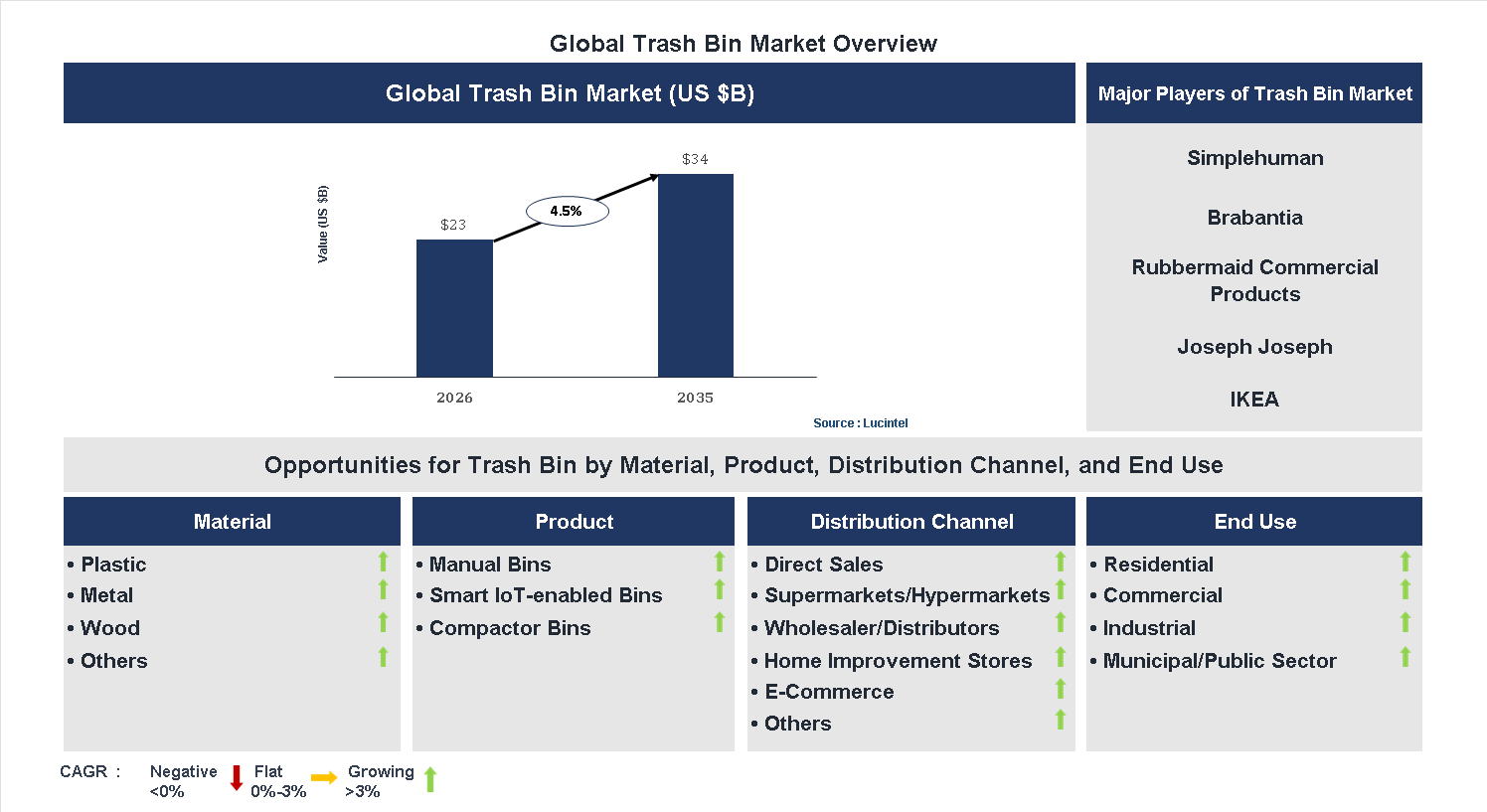
Trash Bin Market Trends and Forecast

Emerging Trends in the Trash Bin Market

The trash bin market is experiencing a significant transformation driven by technological advancements, changing consumer preferences, and increasing environmental concerns. As urbanization accelerates and sustainability becomes a priority, manufacturers are innovating to meet new demands for durability, aesthetics, and eco-friendliness. The integration of smart technology and sustainable materials is reshaping product offerings, while evolving regulations and consumer awareness are influencing market dynamics. These developments are not only enhancing product functionality but also promoting environmentally responsible practices, ultimately redefining the landscape of waste management solutions worldwide. The following key trends highlight the major shifts shaping this market.

• Adoption of Smart Trash Bins: Integration of IoT technology is revolutionizing waste management by enabling real-time monitoring of bin capacity, automated alerts for collection, and data analytics for optimizing collection routes. This trend improves efficiency, reduces operational costs, and minimizes environmental impact. Smart bins also enhance user convenience through features like touchless operation and usage tracking, aligning with health and hygiene standards. As cities and businesses seek smarter waste solutions, the adoption of IoT-enabled trash bins is expected to grow rapidly, transforming traditional waste collection methods into more intelligent systems.
• Emphasis on Eco-Friendly and Sustainable Materials: Increasing environmental awareness is driving manufacturers to develop trash bins using recyclable, biodegradable, and sustainable materials. These eco-friendly products aim to reduce plastic waste and carbon footprint, appealing to environmentally conscious consumers and organizations. Innovations include the use of recycled plastics, bamboo, and other renewable resources. This trend not only supports sustainability goals but also complies with stricter regulations on waste management and packaging. As consumers prioritize eco-friendly options, the market for sustainable trash bins is expanding, encouraging industry-wide shifts toward greener practices.
• Customization and Aesthetic Design: Consumers and commercial clients are demanding trash bins that blend seamlessly with their interior and exterior decor. Manufacturers are offering customizable options in terms of size, color, shape, and branding. Aesthetic design is becoming a key differentiator, especially in public spaces, offices, and residential areas. This trend enhances user experience and encourages proper waste disposal by making bins more attractive and accessible. The focus on design also opens new market segments, allowing brands to target premium and niche markets with tailored solutions that combine functionality with visual appeal.
• Growing Demand for Touchless and Hygiene-Focused Solutions: The COVID-19 pandemic accelerated the need for contactless waste disposal options. Touchless trash bins equipped with foot pedals, sensor-based lids, and voice-activated features are gaining popularity. These solutions promote hygiene, reduce cross-contamination, and align with health safety standards in public and private spaces. The demand is particularly high in healthcare, hospitality, and foodservice sectors. This trend is expected to continue as hygiene remains a priority, prompting manufacturers to innovate and expand their offerings of touchless waste management products to meet evolving health concerns.
• Regulatory and Policy Influences: Governments worldwide are implementing stricter waste management regulations, including mandates for recycling, waste segregation, and eco-friendly product standards. These policies are compelling manufacturers to innovate and adapt their product lines to comply with new legal requirements. Additionally, incentives and subsidies for sustainable products are encouraging market growth. Regulatory pressures are also fostering transparency and accountability in waste disposal practices. As policies become more stringent, the market is likely to see increased investment in compliant, innovative trash bin solutions that support sustainable development goals and responsible waste management.

These emerging trends are collectively transforming the trash bin market by fostering innovation, promoting sustainability, and enhancing user experience. The integration of smart technology, eco-friendly materials, aesthetic customization, hygiene-focused features, and regulatory compliance is driving growth and reshaping industry standards. As these trends continue to evolve, they will lead to more efficient, sustainable, and user-centric waste management solutions, ultimately contributing to smarter cities and environmentally responsible communities.
Emerging Trends in the Trash Bin Market

Recent Development in the Trash Bin Market

The trash bin market is experiencing rapid growth driven by increasing urbanization, environmental awareness, and technological advancements. Consumers and industries are seeking sustainable, durable, and smart waste management solutions. Innovations in design, material, and connectivity are transforming traditional waste disposal methods. Governments worldwide are implementing stricter waste regulations, further boosting demand. This evolving landscape presents significant opportunities for manufacturers to innovate and expand their market share, ultimately contributing to more efficient and eco-friendly waste management systems globally.

• Growing Urbanization and Waste Management Needs: Urban areas generate more waste, creating a demand for efficient trash bin solutions. As cities expand, the need for durable, space-saving, and smart waste disposal systems increases, encouraging manufacturers to develop innovative products that address space constraints and collection efficiency. This trend is expected to continue, driving market growth and encouraging sustainable urban waste management practices.
• Increasing Focus on Sustainability and Eco-Friendly Materials: Consumers and governments are prioritizing environmentally friendly products. The market is witnessing a shift towards biodegradable, recyclable, and eco-conscious materials for trash bins. This focus reduces plastic waste and promotes sustainability, influencing product design and manufacturing processes. The adoption of green materials enhances brand reputation and aligns with global environmental goals, expanding market opportunities for eco-friendly trash bin solutions.
• Technological Innovations in Smart Waste Bins: Integration of IoT and sensor technology in trash bins enables real-time monitoring, optimized collection routes, and waste level alerts. These smart solutions improve operational efficiency, reduce costs, and minimize environmental impact. The adoption of connected waste bins is gaining traction among municipalities and private companies, transforming waste management into a more data-driven and sustainable process, thus opening new revenue streams and market segments.
• Rising Government Regulations and Waste Management Policies: Governments worldwide are implementing stricter waste disposal regulations and promoting recycling initiatives. These policies encourage the adoption of advanced trash bin solutions that facilitate waste segregation and collection. Compliance with these regulations drives innovation and market expansion, as manufacturers develop products tailored to new standards, ultimately fostering a more sustainable and compliant waste management infrastructure.
• Expansion of Commercial and Industrial Waste Segregation Solutions: The increasing need for efficient waste segregation in commercial and industrial sectors is fueling demand for specialized trash bins. These solutions help organizations meet regulatory requirements and improve waste processing efficiency. The market is witnessing growth in large-capacity, durable, and customizable bins designed for specific waste streams, supporting sustainable practices and operational efficiency across various industries.

The overall impact of these developments is a dynamic, innovative, and sustainable trash bin market. Enhanced product offerings, driven by technological, regulatory, and environmental factors, are leading to more efficient waste management systems. This evolution benefits consumers, businesses, and governments by reducing environmental impact, lowering costs, and promoting sustainability, ultimately shaping a more responsible and technologically advanced waste disposal landscape.

Strategic Growth Opportunities in the Trash Bin Market

The trash bin market is experiencing significant growth driven by urbanization, increasing waste management needs, and environmental regulations. Innovations in materials and design are enhancing durability and aesthetics, while smart technology integration offers improved waste tracking and disposal efficiency. Expanding applications across residential, commercial, and industrial sectors present diverse opportunities. Companies are focusing on sustainable solutions to meet regulatory standards and consumer preferences, creating a dynamic landscape for growth and innovation in waste management infrastructure worldwide.

• Growing Demand for Smart Trash Bins Enhances Waste Management Efficiency: The integration of IoT technology into trash bins allows real-time monitoring of waste levels, optimizing collection routes, reducing operational costs, and minimizing environmental impact. Smart bins enable data-driven decision-making for municipalities and waste management companies, improving service delivery. As urban areas expand and waste volumes increase, the adoption of intelligent trash solutions is expected to accelerate, offering significant growth opportunities in smart infrastructure development.
• Increasing Adoption of Eco-Friendly and Sustainable Materials in Trash Bin Manufacturing: Environmental concerns and regulatory pressures are driving manufacturers to develop eco-friendly trash bins using recycled, biodegradable, or sustainable materials. These products appeal to environmentally conscious consumers and organizations aiming to reduce their carbon footprint. Innovations in biodegradable plastics and sustainable composites are making eco-friendly bins more durable and cost-effective, opening new markets and encouraging industry-wide shifts toward greener waste management solutions.
• Expansion of Trash Bin Applications in Commercial and Industrial Sectors: Beyond residential use, commercial and industrial sectors are adopting specialized trash bins designed for high-capacity, hazardous, or recyclable waste. Customized solutions for supermarkets, factories, and offices are creating new revenue streams for manufacturers. The demand for durable, tamper-proof, and easy-to-clean bins is rising, driven by strict hygiene standards and waste segregation policies, thereby expanding the market scope and fostering innovation in product design.
• Rising Focus on Aesthetic and Space-Saving Trash Bin Designs: Urbanization and space constraints are prompting the development of compact, stylish, and discreet trash bins suitable for public spaces, offices, and homes. Modern designs emphasize aesthetics without compromising functionality, encouraging wider adoption. Space-saving features and customizable options are appealing to consumers and businesses seeking to optimize space utilization while maintaining cleanliness and visual appeal, thus fueling market growth in design innovation.
• Implementation of Regulatory Standards Promoting Waste Segregation and Recycling: Governments worldwide are enforcing stricter waste management regulations, emphasizing segregation and recycling. This creates demand for specialized bins with multiple compartments and clear labeling to facilitate waste sorting. Compliance with these standards encourages manufacturers to innovate and develop compliant products, boosting sales and market penetration. The regulatory landscape is expected to continue evolving, further driving growth through increased adoption of compliant, efficient waste disposal solutions.

The overall market outlook is positively influenced by these growth opportunities, fostering innovation, sustainability, and efficiency. As stakeholders capitalize on technological advancements and regulatory trends, the trash bin market is poised for substantial expansion, supporting global waste management goals and environmental sustainability efforts.

Trash Bin Market Driver and Challenges

The trash bin market is influenced by a variety of technological, economic, and regulatory factors that shape its growth and development. Innovations in materials and design enhance durability and aesthetics, while economic conditions affect consumer spending and infrastructure investments. Regulatory standards regarding waste management and environmental sustainability also play a crucial role in shaping market dynamics. Additionally, urbanization and population growth drive demand for efficient waste disposal solutions. Navigating these diverse factors requires market players to adapt swiftly to technological advancements, comply with evolving regulations, and respond to economic fluctuations, ensuring sustainable growth and competitiveness in the trash bin market.

The factors responsible for driving the trash bin market include:-
• Technological Innovation: The development of advanced materials such as recycled plastics and corrosion-resistant metals has significantly improved the durability, hygiene, and aesthetic appeal of trash bins. Smart trash bins equipped with sensors for waste level monitoring are gaining popularity, optimizing waste collection processes. These innovations reduce maintenance costs and enhance user convenience, encouraging adoption across residential, commercial, and industrial sectors. As technology continues to evolve, the market is expected to see increased demand for innovative, eco-friendly, and smart waste management solutions, driving overall growth.
• Urbanization and Population Growth: Rapid urbanization and increasing population densities in cities worldwide have led to a surge in waste generation. This growth necessitates efficient waste disposal infrastructure, boosting demand for various types of trash bins, including large-capacity and specialized bins. Urban areas require aesthetically pleasing and space-efficient solutions to manage waste effectively, prompting manufacturers to innovate in design and functionality. The expanding urban landscape also creates opportunities for integrated waste management systems, further propelling market expansion as cities seek sustainable and scalable waste disposal options.
• Environmental Regulations and Sustainability Initiatives: Governments and regulatory bodies are implementing stringent standards to promote environmentally sustainable waste management practices. Regulations regarding the use of recyclable and biodegradable materials in trash bins are encouraging manufacturers to develop eco-friendly products. Compliance with these standards not only avoids penalties but also enhances brand reputation among environmentally conscious consumers. Sustainability initiatives, such as waste segregation and recycling programs, increase demand for specialized bins, including color-coded and compartmentalized options, thereby positively impacting market growth.
• Economic Factors and Infrastructure Investment: Economic stability and growth influence consumer purchasing power and government spending on waste management infrastructure. In regions with robust economic development, investments in modern waste disposal systems, including high-quality trash bins, are more prevalent. Public-private partnerships often fund large-scale waste management projects, creating opportunities for market expansion. Conversely, economic downturns can hinder investments, slowing market growth. Nonetheless, the increasing focus on urban cleanliness and environmental health continues to drive demand, making economic factors a critical driver for market development.
• Consumer Awareness and Lifestyle Changes: Growing awareness about environmental issues and personal hygiene has led consumers to prefer durable, hygienic, and aesthetically appealing trash bins. Lifestyle changes, such as the adoption of smart home systems, are also influencing demand for technologically advanced waste disposal solutions. Additionally, the rise in eco-conscious consumer behavior encourages the adoption of bins made from recycled or sustainable materials. This shift in consumer preferences is compelling manufacturers to innovate and diversify their product offerings, thereby fueling market growth.

The challenges facing the trash bin market include:-
• Regulatory Compliance and Material Restrictions: Stringent environmental regulations require manufacturers to adhere to specific standards regarding materials and manufacturing processes. These regulations can increase production costs and limit the use of certain plastics or hazardous substances, complicating product development. Non-compliance can result in penalties, product recalls, and damage to brand reputation. Keeping pace with evolving standards demands continuous innovation and investment, which can be challenging for smaller players and may slow overall market growth.
• High Competition and Market Saturation: The market is highly competitive, with numerous local and international players offering similar products. Market saturation in developed regions limits growth opportunities, forcing companies to differentiate through innovation, branding, and pricing strategies. Intense competition can lead to price wars, reducing profit margins and making it difficult for new entrants to establish a foothold. Maintaining a competitive edge requires significant investment in R&D, marketing, and distribution channels, posing ongoing challenges for market participants.
• Fluctuating Raw Material Prices: The cost of raw materials such as plastics, metals, and recycled components directly impacts manufacturing expenses. Volatility in raw material prices, driven by global supply chain disruptions, geopolitical tensions, or environmental policies, can lead to unpredictable production costs. This unpredictability complicates pricing strategies and profit planning for manufacturers. Additionally, reliance on imported raw materials exposes the market to currency fluctuations and trade restrictions, further challenging stable growth and profitability.

The trash bin market is shaped by technological advancements, urbanization, regulatory frameworks, economic conditions, and consumer preferences. While these drivers foster growth by promoting innovation, sustainability, and infrastructure development, challenges such as regulatory compliance, market saturation, and raw material price fluctuations pose significant hurdles. Navigating these factors requires strategic adaptation and innovation, which will determine the market’s trajectory. Overall, the market’s future hinges on balancing technological progress and sustainability with economic and regulatory realities, ensuring sustainable growth and competitive resilience.

List of Trash Bin Companies

Companies in the market compete on the basis of product quality offered. Major players in this market focus on expanding their manufacturing facilities, R&D investments, infrastructural development, and leverage integration opportunities across the value chain. With these strategies trash bin companies cater increasing demand, ensure competitive effectiveness, develop innovative products & technologies, reduce production costs, and expand their customer base. Some of the trash bin companies profiled in this report include-
• Simplehuman
• Brabantia
• Rubbermaid Commercial Products
• Joseph Joseph
• IKEA
• Hailo-Werk Rudolf Loh GmbH & Co. KG
• Rev-A-Shelf LLC
• Hettich Holding GmbH & Co. oHG
• Blanco GmbH + Co KG
• iTouchless Housewares

Trash Bin Market by Segment

The study includes a forecast for the global trash bin market by material, product, distribution channel, end use, and region.

Trash Bin Market by Material [Value from 2019 to 2035]:


• Plastic
• Metal
• Wood
• Others

Trash Bin Market by Product [Value from 2019 to 2035]:


• Manual Bins
• Smart IoT-enabled Bins
• Compactor Bins

Trash Bin Market by Distribution Channel [Value from 2019 to 2035]:


• Direct Sales
• Supermarkets/Hypermarkets
• Wholesaler/Distributors
• Home Improvement Stores
• E-Commerce
• Others

Trash Bin Market by End Use [Value from 2019 to 2035]:


• Residential
• Commercial
• Industrial
• Municipal/Public Sector

Trash Bin Market by Region [Value from 2019 to 2035]:


• North America
• Europe
• Asia Pacific
• The Rest of the World

Country Wise Outlook for the Trash Bin Market

The trash bin market has experienced significant shifts driven by technological innovation, environmental concerns, and changing consumer preferences across the globe. Countries are adopting sustainable materials, smart bin technologies, and eco-friendly designs to meet regulatory standards and consumer demand. The markets evolution reflects a broader focus on waste management efficiency, urban sanitation, and environmental sustainability. These developments vary by region, influenced by local policies, economic conditions, and technological capabilities. Understanding these regional trends provides insight into the future trajectory of the trash bin market worldwide, highlighting opportunities for innovation and growth.

• United States: The US market has seen a surge in smart trash bins equipped with sensors for waste level monitoring and automated collection systems. There is a growing emphasis on eco-friendly materials, such as recycled plastics and biodegradable components. Major companies are investing in IoT-enabled waste management solutions to optimize collection routes and reduce costs. Regulations promoting recycling and waste reduction are also driving innovation in design and functionality. Additionally, urban areas are adopting compact and space-saving bins to address limited space in city environments.
• China: China is rapidly expanding its waste management infrastructure, with a focus on smart city initiatives. The market is witnessing increased adoption of intelligent trash bins with features like automatic sorting and real-time data collection. Government policies strongly support environmental sustainability, encouraging the use of biodegradable and recyclable materials. The growth of e-commerce and urbanization has led to higher demand for durable, large-capacity bins. Local manufacturers are innovating with integrated waste segregation systems to improve recycling rates and reduce landfill dependency.
• Germany: Germanys trash bin market is characterized by a strong emphasis on sustainability and recycling. The country has implemented strict regulations on waste separation, prompting the development of specialized bins for different waste streams. There is a notable shift towards using eco-friendly, durable materials that can be recycled at the end of their lifecycle. Smart waste management solutions are increasingly being integrated into public and private spaces to enhance efficiency. Germany also leads in designing aesthetically pleasing bins that blend with urban architecture, promoting public acceptance and participation in waste segregation.
• India: The Indian market is experiencing rapid growth driven by urbanization and government initiatives like Swachh Bharat Abhiyan. There is a rising demand for affordable, durable trash bins suitable for diverse environments, from rural areas to urban centers. The focus is on simple, functional designs that facilitate waste segregation and collection. Recent developments include the introduction of low-cost, eco-friendly bins made from locally available materials. The government is also promoting the adoption of smart waste management solutions in cities to improve sanitation and reduce open dumping.
• Japan: Japans trash bin market is marked by technological innovation and strict waste management policies. The country emphasizes waste sorting and recycling, leading to the development of specialized bins for different materials. Smart bins with sensors and automated features are increasingly common in urban areas, supporting efficient waste collection. Japan also prioritizes environmentally friendly materials and compact designs suitable for limited space. Public awareness campaigns and government regulations foster high participation rates in waste segregation, driving continuous improvements in bin design and functionality.

Lucintel Analytics Dashboard

Features of the Global Trash Bin Market

Market Size Estimates: Trash bin market size estimation in terms of value ($B).
Trend and Forecast Analysis: Market trends (2019 to 2025) and forecast (2026 to 2035) by various segments and regions.
Segmentation Analysis: Trash bin market size by various segments, such as by material, product, distribution channel, end use, and region in terms of value ($B).
Regional Analysis: Trash bin market breakdown by North America, Europe, Asia Pacific, and Rest of the World.
Growth Opportunities: Analysis of growth opportunities in different materials, products, distribution channels, end uses, and regions for the trash bin market.
Strategic Analysis: This includes M&A, new product development, and competitive landscape of the trash bin market.
Analysis of competitive intensity of the industry based on Porter’s Five Forces model.

Lucintel Consulting Services

FAQ

Q1. What is the trash bin market size?
Answer: The global trash bin market is expected to reach an estimated $34 billion by 2035.
Q2. What is the growth forecast for trash bin market?
Answer: The global trash bin market is expected to grow with a CAGR of 4.5% from 2026 to 2035.
Q3. What are the major drivers influencing the growth of the trash bin market?
Answer: The major drivers for this market are the increasing focus on waste management solutions, the rising demand for eco-friendly trash bins, and the growing adoption of smart trash bin technologies.
Q4. What are the major segments for trash bin market?
Answer: The future of the trash bin market looks promising with opportunities in the residential, commercial, industrial, and municipal/public sector markets.
Q5. Who are the key trash bin market companies?
Answer: Some of the key trash bin companies are as follows:
• Simplehuman
• Brabantia
• Rubbermaid Commercial Products
• Joseph Joseph
• IKEA
• Hailo-Werk Rudolf Loh GmbH & Co. KG
• Rev-A-Shelf LLC
• Hettich Holding GmbH & Co. oHG
• Blanco GmbH + Co KG
• iTouchless Housewares
Q6. Which trash bin market segment will be the largest in future?
Answer: Lucintel forecasts that, within the material category, plastic is expected to witness the highest growth over the forecast period.
Q7. In trash bin market, which region is expected to be the largest in next 5 years?
Answer: In terms of region, APAC is expected to witness the highest growth over the forecast period.
Q8. Do we receive customization in this report?
Answer: Yes, Lucintel provides 10% customization without any additional cost.

This report answers following 11 key questions:

Q.1. What are some of the most promising, high-growth opportunities for the trash bin market by material (plastic, metal, wood, and others), product (manual bins, smart IoT-enabled bins, and compactor bins), distribution channel (direct sales, supermarkets/hypermarkets, wholesaler/distributors, home improvement stores, E-commerce, and others), end use (residential, commercial, industrial, and municipal/public sector), and region (North America, Europe, Asia Pacific, and the Rest of the World)?
Q.2. Which segments will grow at a faster pace and why?
Q.3. Which region will grow at a faster pace and why?
Q.4. What are the key factors affecting market dynamics? What are the key challenges and business risks in this market?
Q.5. What are the business risks and competitive threats in this market?
Q.6. What are the emerging trends in this market and the reasons behind them?
Q.7. What are some of the changing demands of customers in the market?
Q.8. What are the new developments in the market? Which companies are leading these developments?
Q.9. Who are the major players in this market? What strategic initiatives are key players pursuing for business growth?
Q.10. What are some of the competing products in this market and how big of a threat do they pose for loss of market share by material or product substitution?
Q.11. What M&A activity has occurred in the last 7 years and what has its impact been on the industry?

For any questions related to Trash Bin Market, Trash Bin Market Size, Trash Bin Market Growth, Trash Bin Market Analysis, Trash Bin Market Report, Trash Bin Market Share, Trash Bin Market Trends, Trash Bin Market Forecast, Trash Bin Companies, write Lucintel analyst at email: helpdesk@lucintel.com. We will be glad to get back to you soon.
                                           Table of Contents

            1. Executive Summary

            2. Market Overview

                        2.1 Background and Classifications
                        2.2 Supply Chain

            3. Market Trends & Forecast Analysis

                        3.1 Macroeconomic Trends and Forecasts
                        3.2 Industry Drivers and Challenges
                        3.3 PESTLE Analysis
                        3.4 Patent Analysis
                        3.5 Regulatory Environment
                        3.6 Global Trash Bin Market Trends and Forecast

            4. Global Trash Bin Market by Material

                        4.1 Overview
                        4.2 Attractiveness Analysis by Material
                        4.3 Plastic : Trends and Forecast (2019 to 2035)
                        4.4 Metal : Trends and Forecast (2019 to 2035)
                        4.5 Wood : Trends and Forecast (2019 to 2035)
                        4.6 Others : Trends and Forecast (2019 to 2035)

            5. Global Trash Bin Market by Product

                        5.1 Overview
                        5.2 Attractiveness Analysis by Product
                        5.3 Manual Bins : Trends and Forecast (2019 to 2035)
                        5.4 Smart IoT-enabled Bins : Trends and Forecast (2019 to 2035)
                        5.5 Compactor Bins : Trends and Forecast (2019 to 2035)

            6. Global Trash Bin Market by Distribution Channel

                        6.1 Overview
                        6.2 Attractiveness Analysis by Distribution Channel
                        6.3 Direct Sales : Trends and Forecast (2019 to 2035)
                        6.4 Supermarkets/Hypermarkets : Trends and Forecast (2019 to 2035)
                        6.5 Wholesaler/Distributors : Trends and Forecast (2019 to 2035)
                        6.6 Home Improvement Stores : Trends and Forecast (2019 to 2035)
                        6.7 E-Commerce : Trends and Forecast (2019 to 2035)
                        6.8 Others : Trends and Forecast (2019 to 2035)

            7. Global Trash Bin Market by End Use

                        7.1 Overview
                        7.2 Attractiveness Analysis by End Use
                        7.3 Residential : Trends and Forecast (2019 to 2035)
                        7.4 Commercial : Trends and Forecast (2019 to 2035)
                        7.5 Industrial : Trends and Forecast (2019 to 2035)
                        7.6 Municipal/Public Sector : Trends and Forecast (2019 to 2035)

            8. Regional Analysis

                        8.1 Overview
                        8.2 Global Trash Bin Market by Region

            9. North American Trash Bin Market

                        9.1 Overview
                        9.2 North American Trash Bin Market by Material
                        9.3 North American Trash Bin Market by End Use
                        9.4 The United States Trash Bin Market
                        9.5 Canadian Trash Bin Market
                        9.6 Mexican Trash Bin Market

            10. European Trash Bin Market

                        10.1 Overview
                        10.2 European Trash Bin Market by Material
                        10.3 European Trash Bin Market by End Use
                        10.4 German Trash Bin Market
                        10.5 French Trash Bin Market
                        10.6 Italian Trash Bin Market
                        10.7 Spanish Trash Bin Market
                        10.8 The United Kingdom Trash Bin Market

            11. APAC Trash Bin Market

                        11.1 Overview
                        11.2 APAC Trash Bin Market by Material
                        11.3 APAC Trash Bin Market by End Use
                        11.4 Chinese Trash Bin Market
                        11.5 Indian Trash Bin Market
                        11.6 Japanese Trash Bin Market
                        11.7 South Korean Trash Bin Market
                        11.8 Indonesian Trash Bin Market

            12. ROW Trash Bin Market

                        12.1 Overview
                        12.2 ROW Trash Bin Market by Material
                        12.3 ROW Trash Bin Market by End Use
                        12.4 Middle Eastern Trash Bin Market
                        12.5 South American Trash Bin Market
                        12.6 African Trash Bin Market

            13. Competitor Analysis

                        13.1 Product Portfolio Analysis
                        13.2 Operational Integration
                        13.3 Porter’s Five Forces Analysis
                                    • Competitive Rivalry
                                    • Bargaining Power of Buyers
                                    • Bargaining Power of Suppliers
                                    • Threat of Substitutes
                                    • Threat of New Entrants
                        13.4 Market Share Analysis

            14. Opportunities & Strategic Analysis

                        14.1 Value Chain Analysis
                        14.2 Growth Opportunity Analysis
                                    14.2.1 Growth Opportunity by Material
                                    14.2.2 Growth Opportunity by Product
                                    14.2.3 Growth Opportunity by Distribution Channel
                                    14.2.4 Growth Opportunity by End Use
                                    14.2.5 Growth Opportunity by Region
                        14.3 Emerging Trends in the Global Trash Bin Market
                        14.4 Strategic Analysis
                                    14.4.1 New Product Development
                                    14.4.2 Certification and Licensing
                                    14.4.3 Mergers, Acquisitions, Agreements, Collaborations, and Joint Ventures

            15. Company Profiles of the Leading Players Across the Value Chain

                        15.1 Competitive Analysis Overview
                        15.2 Simplehuman
                                    • Company Overview
                                    • Trash Bin Market Business Overview
                                    • New Product Development
                                    • Merger, Acquisition, and Collaboration
                                    • Certification and Licensing
                        15.3 Brabantia
                                    • Company Overview
                                    • Trash Bin Market Business Overview
                                    • New Product Development
                                    • Merger, Acquisition, and Collaboration
                                    • Certification and Licensing
                        15.4 Rubbermaid Commercial Products
                                    • Company Overview
                                    • Trash Bin Market Business Overview
                                    • New Product Development
                                    • Merger, Acquisition, and Collaboration
                                    • Certification and Licensing
                        15.5 Joseph Joseph
                                    • Company Overview
                                    • Trash Bin Market Business Overview
                                    • New Product Development
                                    • Merger, Acquisition, and Collaboration
                                    • Certification and Licensing
                        15.6 IKEA
                                    • Company Overview
                                    • Trash Bin Market Business Overview
                                    • New Product Development
                                    • Merger, Acquisition, and Collaboration
                                    • Certification and Licensing
                        15.7 Hailo-Werk Rudolf Loh GmbH & Co. KG
                                    • Company Overview
                                    • Trash Bin Market Business Overview
                                    • New Product Development
                                    • Merger, Acquisition, and Collaboration
                                    • Certification and Licensing
                        15.8 Rev-A-Shelf LLC
                                    • Company Overview
                                    • Trash Bin Market Business Overview
                                    • New Product Development
                                    • Merger, Acquisition, and Collaboration
                                    • Certification and Licensing
                        15.9 Hettich Holding GmbH & Co. oHG
                                    • Company Overview
                                    • Trash Bin Market Business Overview
                                    • New Product Development
                                    • Merger, Acquisition, and Collaboration
                                    • Certification and Licensing
                        15.10 Blanco GmbH + Co KG
                                    • Company Overview
                                    • Trash Bin Market Business Overview
                                    • New Product Development
                                    • Merger, Acquisition, and Collaboration
                                    • Certification and Licensing
                        15.11 iTouchless Housewares
                                    • Company Overview
                                    • Trash Bin Market Business Overview
                                    • New Product Development
                                    • Merger, Acquisition, and Collaboration
                                    • Certification and Licensing

            16. Appendix

                        16.1 List of Figures
                        16.2 List of Tables
                        16.3 Research Methodology
                        16.4 Disclaimer
                        16.5 Copyright
                        16.6 Abbreviations and Technical Units
                        16.7 About Us
                        16.8 Contact Us

                                               List of Figures


            Chapter 1

                        Figure 1.1: Trends and Forecast for the Global Trash Bin Market

            Chapter 2

                        Figure 2.1: Usage of Trash Bin Market
                        Figure 2.2: Classification of the Global Trash Bin Market
                        Figure 2.3: Supply Chain of the Global Trash Bin Market

            Chapter 3

                        Figure 3.1: Trends of the Global GDP Growth Rate
                        Figure 3.2: Trends of the Global Population Growth Rate
                        Figure 3.3: Trends of the Global Inflation Rate
                        Figure 3.4: Trends of the Global Unemployment Rate
                        Figure 3.5: Trends of the Regional GDP Growth Rate
                        Figure 3.6: Trends of the Regional Population Growth Rate
                        Figure 3.7: Trends of the Regional Inflation Rate
                        Figure 3.8: Trends of the Regional Unemployment Rate
                        Figure 3.9: Trends of Regional Per Capita Income
                        Figure 3.10: Forecast for the Global GDP Growth Rate
                        Figure 3.11: Forecast for the Global Population Growth Rate
                        Figure 3.12: Forecast for the Global Inflation Rate
                        Figure 3.13: Forecast for the Global Unemployment Rate
                        Figure 3.14: Forecast for the Regional GDP Growth Rate
                        Figure 3.15: Forecast for the Regional Population Growth Rate
                        Figure 3.16: Forecast for the Regional Inflation Rate
                        Figure 3.17: Forecast for the Regional Unemployment Rate
                        Figure 3.18: Forecast for Regional Per Capita Income
                        Figure 3.19: Driver and Challenges of the Trash Bin Market

            Chapter 4

                        Figure 4.1: Global Trash Bin Market by Material in 2019, 2025, and 2035
                        Figure 4.2: Trends of the Global Trash Bin Market ($B) by Material
                        Figure 4.3: Forecast for the Global Trash Bin Market ($B) by Material
                        Figure 4.4: Trends and Forecast for Plastic in the Global Trash Bin Market (2019-2035)
                        Figure 4.5: Trends and Forecast for Metal in the Global Trash Bin Market (2019-2035)
                        Figure 4.6: Trends and Forecast for Wood in the Global Trash Bin Market (2019-2035)
                        Figure 4.7: Trends and Forecast for Others in the Global Trash Bin Market (2019-2035)

            Chapter 5

                        Figure 5.1: Global Trash Bin Market by Product in 2019, 2025, and 2035
                        Figure 5.2: Trends of the Global Trash Bin Market ($B) by Product
                        Figure 5.3: Forecast for the Global Trash Bin Market ($B) by Product
                        Figure 5.4: Trends and Forecast for Manual Bins in the Global Trash Bin Market (2019-2035)
                        Figure 5.5: Trends and Forecast for Smart IoT-enabled Bins in the Global Trash Bin Market (2019-2035)
                        Figure 5.6: Trends and Forecast for Compactor Bins in the Global Trash Bin Market (2019-2035)

            Chapter 6

                        Figure 6.1: Global Trash Bin Market by Distribution Channel in 2019, 2025, and 2035
                        Figure 6.2: Trends of the Global Trash Bin Market ($B) by Distribution Channel
                        Figure 6.3: Forecast for the Global Trash Bin Market ($B) by Distribution Channel
                        Figure 6.4: Trends and Forecast for Direct Sales in the Global Trash Bin Market (2019-2035)
                        Figure 6.5: Trends and Forecast for Supermarkets/Hypermarkets in the Global Trash Bin Market (2019-2035)
                        Figure 6.6: Trends and Forecast for Wholesaler/Distributors in the Global Trash Bin Market (2019-2035)
                        Figure 6.7: Trends and Forecast for Home Improvement Stores in the Global Trash Bin Market (2019-2035)
                        Figure 6.8: Trends and Forecast for E-Commerce in the Global Trash Bin Market (2019-2035)
                        Figure 6.9: Trends and Forecast for Others in the Global Trash Bin Market (2019-2035)

            Chapter 7

                        Figure 7.1: Global Trash Bin Market by End Use in 2019, 2025, and 2035
                        Figure 7.2: Trends of the Global Trash Bin Market ($B) by End Use
                        Figure 7.3: Forecast for the Global Trash Bin Market ($B) by End Use
                        Figure 7.4: Trends and Forecast for Residential in the Global Trash Bin Market (2019-2035)
                        Figure 7.5: Trends and Forecast for Commercial in the Global Trash Bin Market (2019-2035)
                        Figure 7.6: Trends and Forecast for Industrial in the Global Trash Bin Market (2019-2035)
                        Figure 7.7: Trends and Forecast for Municipal/Public Sector in the Global Trash Bin Market (2019-2035)

            Chapter 8

                        Figure 8.1: Trends of the Global Trash Bin Market ($B) by Region (2019-2025)
                        Figure 8.2: Forecast for the Global Trash Bin Market ($B) by Region (2026-2035)

            Chapter 9

                        Figure 9.1: Trends and Forecast for the North American Trash Bin Market (2019-2035)
                        Figure 9.2: North American Trash Bin Market by Material in 2019, 2025, and 2035
                        Figure 9.3: Trends of the North American Trash Bin Market ($B) by Material (2019-2025)
                        Figure 9.4: Forecast for the North American Trash Bin Market ($B) by Material (2026-2035)
                        Figure 9.5: North American Trash Bin Market by Product in 2019, 2025, and 2035
                        Figure 9.6: Trends of the North American Trash Bin Market ($B) by Product (2019-2025)
                        Figure 9.7: Forecast for the North American Trash Bin Market ($B) by Product (2026-2035)
                        Figure 9.8: Trends and Forecast for the United States Trash Bin Market ($B) (2019-2035)
                        Figure 9.9: Trends and Forecast for the Mexican Trash Bin Market ($B) (2019-2035)
                        Figure 9.10: Trends and Forecast for the Canadian Trash Bin Market ($B) (2019-2035)

            Chapter 10

                        Figure 10.1: Trends and Forecast for the European Trash Bin Market (2019-2035)
                        Figure 10.2: European Trash Bin Market by Material in 2019, 2025, and 2035
                        Figure 10.3: Trends of the European Trash Bin Market ($B) by Material (2019-2025)
                        Figure 10.4: Forecast for the European Trash Bin Market ($B) by Material (2026-2035)
                        Figure 10.5: European Trash Bin Market by Product in 2019, 2025, and 2035
                        Figure 10.6: Trends of the European Trash Bin Market ($B) by Product (2019-2025)
                        Figure 10.7: Forecast for the European Trash Bin Market ($B) by Product (2026-2035)
                        Figure 10.8: Trends and Forecast for the German Trash Bin Market ($B) (2019-2035)
                        Figure 10.9: Trends and Forecast for the French Trash Bin Market ($B) (2019-2035)
                        Figure 10.10: Trends and Forecast for the Spanish Trash Bin Market ($B) (2019-2035)
                        Figure 10.11: Trends and Forecast for the Italian Trash Bin Market ($B) (2019-2035)
                        Figure 10.12: Trends and Forecast for the United Kingdom Trash Bin Market ($B) (2019-2035)

            Chapter 11

                        Figure 11.1: Trends and Forecast for the APAC Trash Bin Market (2019-2035)
                        Figure 11.2: APAC Trash Bin Market by Material in 2019, 2025, and 2035
                        Figure 11.3: Trends of the APAC Trash Bin Market ($B) by Material (2019-2025)
                        Figure 11.4: Forecast for the APAC Trash Bin Market ($B) by Material (2026-2035)
                        Figure 11.5: APAC Trash Bin Market by Product in 2019, 2025, and 2035
                        Figure 11.6: Trends of the APAC Trash Bin Market ($B) by Product (2019-2025)
                        Figure 11.7: Forecast for the APAC Trash Bin Market ($B) by Product (2026-2035)
                        Figure 11.8: Trends and Forecast for the Japanese Trash Bin Market ($B) (2019-2035)
                        Figure 11.9: Trends and Forecast for the Indian Trash Bin Market ($B) (2019-2035)
                        Figure 11.10: Trends and Forecast for the Chinese Trash Bin Market ($B) (2019-2035)
                        Figure 11.11: Trends and Forecast for the South Korean Trash Bin Market ($B) (2019-2035)
                        Figure 11.12: Trends and Forecast for the Indonesian Trash Bin Market ($B) (2019-2035)

            Chapter 12

                        Figure 12.1: Trends and Forecast for the ROW Trash Bin Market (2019-2035)
                        Figure 12.2: ROW Trash Bin Market by Material in 2019, 2025, and 2035
                        Figure 12.3: Trends of the ROW Trash Bin Market ($B) by Material (2019-2025)
                        Figure 12.4: Forecast for the ROW Trash Bin Market ($B) by Material (2026-2035)
                        Figure 12.5: ROW Trash Bin Market by Product in 2019, 2025, and 2035
                        Figure 12.6: Trends of the ROW Trash Bin Market ($B) by Product (2019-2025)
                        Figure 12.7: Forecast for the ROW Trash Bin Market ($B) by Product (2026-2035)
                        Figure 12.8: Trends and Forecast for the Middle Eastern Trash Bin Market ($B) (2019-2035)
                        Figure 12.9: Trends and Forecast for the South American Trash Bin Market ($B) (2019-2035)
                        Figure 12.10: Trends and Forecast for the African Trash Bin Market ($B) (2019-2035)

            Chapter 13

                        Figure 13.1: Porter’s Five Forces Analysis of the Global Trash Bin Market
                        Figure 13.2: Market Share (%) of Top Players in the Global Trash Bin Market (2025)

            Chapter 14

                        Figure 14.1: Growth Opportunities for the Global Trash Bin Market by Material
                        Figure 14.2: Growth Opportunities for the Global Trash Bin Market by Product
                        Figure 14.3: Growth Opportunities for the Global Trash Bin Market by Distribution Channel
                        Figure 14.4: Growth Opportunities for the Global Trash Bin Market by End Use
                        Figure 14.5: Growth Opportunities for the Global Trash Bin Market by Region
                        Figure 14.6: Emerging Trends in the Global Trash Bin Market

                                               List of Tables


            Chapter 1

                        Table 1.1: Growth Rate (%, 2024-2025) and CAGR (%, 2026-2035) of the Trash Bin Market by Material, Product, Distribution Channel, and End Use
                        Table 1.2: Attractiveness Analysis for the Trash Bin Market by Region
                        Table 1.3: Global Trash Bin Market Parameters and Attributes

            Chapter 3

                        Table 3.1: Trends of the Global Trash Bin Market (2019-2025)
                        Table 3.2: Forecast for the Global Trash Bin Market (2026-2035)

            Chapter 4

                        Table 4.1: Attractiveness Analysis for the Global Trash Bin Market by Material
                        Table 4.2: Market Size and CAGR of Various Material in the Global Trash Bin Market (2019-2025)
                        Table 4.3: Market Size and CAGR of Various Material in the Global Trash Bin Market (2026-2035)
                        Table 4.4: Trends of Plastic in the Global Trash Bin Market (2019-2025)
                        Table 4.5: Forecast for Plastic in the Global Trash Bin Market (2026-2035)
                        Table 4.6: Trends of Metal in the Global Trash Bin Market (2019-2025)
                        Table 4.7: Forecast for Metal in the Global Trash Bin Market (2026-2035)
                        Table 4.8: Trends of Wood in the Global Trash Bin Market (2019-2025)
                        Table 4.9: Forecast for Wood in the Global Trash Bin Market (2026-2035)
                        Table 4.10: Trends of Others in the Global Trash Bin Market (2019-2025)
                        Table 4.11: Forecast for Others in the Global Trash Bin Market (2026-2035)

            Chapter 5

                        Table 5.1: Attractiveness Analysis for the Global Trash Bin Market by Product
                        Table 5.2: Market Size and CAGR of Various Product in the Global Trash Bin Market (2019-2025)
                        Table 5.3: Market Size and CAGR of Various Product in the Global Trash Bin Market (2026-2035)
                        Table 5.4: Trends of Manual Bins in the Global Trash Bin Market (2019-2025)
                        Table 5.5: Forecast for Manual Bins in the Global Trash Bin Market (2026-2035)
                        Table 5.6: Trends of Smart IoT-enabled Bins in the Global Trash Bin Market (2019-2025)
                        Table 5.7: Forecast for Smart IoT-enabled Bins in the Global Trash Bin Market (2026-2035)
                        Table 5.8: Trends of Compactor Bins in the Global Trash Bin Market (2019-2025)
                        Table 5.9: Forecast for Compactor Bins in the Global Trash Bin Market (2026-2035)

            Chapter 6

                        Table 6.1: Attractiveness Analysis for the Global Trash Bin Market by Distribution Channel
                        Table 6.2: Market Size and CAGR of Various Distribution Channel in the Global Trash Bin Market (2019-2025)
                        Table 6.3: Market Size and CAGR of Various Distribution Channel in the Global Trash Bin Market (2026-2035)
                        Table 6.4: Trends of Direct Sales in the Global Trash Bin Market (2019-2025)
                        Table 6.5: Forecast for Direct Sales in the Global Trash Bin Market (2026-2035)
                        Table 6.6: Trends of Supermarkets/Hypermarkets in the Global Trash Bin Market (2019-2025)
                        Table 6.7: Forecast for Supermarkets/Hypermarkets in the Global Trash Bin Market (2026-2035)
                        Table 6.8: Trends of Wholesaler/Distributors in the Global Trash Bin Market (2019-2025)
                        Table 6.9: Forecast for Wholesaler/Distributors in the Global Trash Bin Market (2026-2035)
                        Table 6.10: Trends of Home Improvement Stores in the Global Trash Bin Market (2019-2025)
                        Table 6.11: Forecast for Home Improvement Stores in the Global Trash Bin Market (2026-2035)
                        Table 6.12: Trends of E-Commerce in the Global Trash Bin Market (2019-2025)
                        Table 6.13: Forecast for E-Commerce in the Global Trash Bin Market (2026-2035)
                        Table 6.14: Trends of Others in the Global Trash Bin Market (2019-2025)
                        Table 6.15: Forecast for Others in the Global Trash Bin Market (2026-2035)

            Chapter 7

                        Table 7.1: Attractiveness Analysis for the Global Trash Bin Market by End Use
                        Table 7.2: Market Size and CAGR of Various End Use in the Global Trash Bin Market (2019-2025)
                        Table 7.3: Market Size and CAGR of Various End Use in the Global Trash Bin Market (2026-2035)
                        Table 7.4: Trends of Residential in the Global Trash Bin Market (2019-2025)
                        Table 7.5: Forecast for Residential in the Global Trash Bin Market (2026-2035)
                        Table 7.6: Trends of Commercial in the Global Trash Bin Market (2019-2025)
                        Table 7.7: Forecast for Commercial in the Global Trash Bin Market (2026-2035)
                        Table 7.8: Trends of Industrial in the Global Trash Bin Market (2019-2025)
                        Table 7.9: Forecast for Industrial in the Global Trash Bin Market (2026-2035)
                        Table 7.10: Trends of Municipal/Public Sector in the Global Trash Bin Market (2019-2025)
                        Table 7.11: Forecast for Municipal/Public Sector in the Global Trash Bin Market (2026-2035)

            Chapter 8

                        Table 8.1: Market Size and CAGR of Various Regions in the Global Trash Bin Market (2019-2025)
                        Table 8.2: Market Size and CAGR of Various Regions in the Global Trash Bin Market (2026-2035)

            Chapter 9

                        Table 9.1: Trends of the North American Trash Bin Market (2019-2025)
                        Table 9.2: Forecast for the North American Trash Bin Market (2026-2035)
                        Table 9.3: Market Size and CAGR of Various Material in the North American Trash Bin Market (2019-2025)
                        Table 9.4: Market Size and CAGR of Various Material in the North American Trash Bin Market (2026-2035)
                        Table 9.5: Market Size and CAGR of Various Product in the North American Trash Bin Market (2019-2025)
                        Table 9.6: Market Size and CAGR of Various Product in the North American Trash Bin Market (2026-2035)
                        Table 9.7: Trends and Forecast for the United States Trash Bin Market (2019-2035)
                        Table 9.8: Trends and Forecast for the Mexican Trash Bin Market (2019-2035)
                        Table 9.9: Trends and Forecast for the Canadian Trash Bin Market (2019-2035)

            Chapter 10

                        Table 10.1: Trends of the European Trash Bin Market (2019-2025)
                        Table 10.2: Forecast for the European Trash Bin Market (2026-2035)
                        Table 10.3: Market Size and CAGR of Various Material in the European Trash Bin Market (2019-2025)
                        Table 10.4: Market Size and CAGR of Various Material in the European Trash Bin Market (2026-2035)
                        Table 10.5: Market Size and CAGR of Various Product in the European Trash Bin Market (2019-2025)
                        Table 10.6: Market Size and CAGR of Various Product in the European Trash Bin Market (2026-2035)
                        Table 10.7: Trends and Forecast for the German Trash Bin Market (2019-2035)
                        Table 10.8: Trends and Forecast for the French Trash Bin Market (2019-2035)
                        Table 10.9: Trends and Forecast for the Spanish Trash Bin Market (2019-2035)
                        Table 10.10: Trends and Forecast for the Italian Trash Bin Market (2019-2035)
                        Table 10.11: Trends and Forecast for the United Kingdom Trash Bin Market (2019-2035)

            Chapter 11

                        Table 11.1: Trends of the APAC Trash Bin Market (2019-2025)
                        Table 11.2: Forecast for the APAC Trash Bin Market (2026-2035)
                        Table 11.3: Market Size and CAGR of Various Material in the APAC Trash Bin Market (2019-2025)
                        Table 11.4: Market Size and CAGR of Various Material in the APAC Trash Bin Market (2026-2035)
                        Table 11.5: Market Size and CAGR of Various Product in the APAC Trash Bin Market (2019-2025)
                        Table 11.6: Market Size and CAGR of Various Product in the APAC Trash Bin Market (2026-2035)
                        Table 11.7: Trends and Forecast for the Japanese Trash Bin Market (2019-2035)
                        Table 11.8: Trends and Forecast for the Indian Trash Bin Market (2019-2035)
                        Table 11.9: Trends and Forecast for the Chinese Trash Bin Market (2019-2035)
                        Table 11.10: Trends and Forecast for the South Korean Trash Bin Market (2019-2035)
                        Table 11.11: Trends and Forecast for the Indonesian Trash Bin Market (2019-2035)

            Chapter 12

                        Table 12.1: Trends of the ROW Trash Bin Market (2019-2025)
                        Table 12.2: Forecast for the ROW Trash Bin Market (2026-2035)
                        Table 12.3: Market Size and CAGR of Various Material in the ROW Trash Bin Market (2019-2025)
                        Table 12.4: Market Size and CAGR of Various Material in the ROW Trash Bin Market (2026-2035)
                        Table 12.5: Market Size and CAGR of Various Product in the ROW Trash Bin Market (2019-2025)
                        Table 12.6: Market Size and CAGR of Various Product in the ROW Trash Bin Market (2026-2035)
                        Table 12.7: Trends and Forecast for the Middle Eastern Trash Bin Market (2019-2035)
                        Table 12.8: Trends and Forecast for the South American Trash Bin Market (2019-2035)
                        Table 12.9: Trends and Forecast for the African Trash Bin Market (2019-2035)

            Chapter 13

                        Table 13.1: Product Mapping of Trash Bin Suppliers Based on Segments
                        Table 13.2: Operational Integration of Trash Bin Manufacturers
                        Table 13.3: Rankings of Suppliers Based on Trash Bin Revenue

            Chapter 14

                        Table 14.1: New Product Launches by Major Trash Bin Producers (2019-2025)
                        Table 14.2: Certification Acquired by Major Competitor in the Global Trash Bin Market

.

Buy full report or by chapter as follows

Price by License Type:
[-] Hide Chapter Details
[Chapter Number] [Chapter Name] [Chapter Number Of Pages] [Chapter Price]
Title/Chapter Name Pages Price
Full Report: Trash Bin Market Report: Trends, Forecast and Competitive Analysis to 2035 Full Report $ 4,850
A 150 Page Report
Lucintel has been in the business of market research and management consulting since 2000 and has published over 1000 market intelligence reports in various markets / applications and served over 1,000 clients worldwide. This study is a culmination of four months of full-time effort performed by Lucintel's analyst team. The analysts used the following sources for the creation and completion of this valuable report:
  • In-depth interviews of the major players in this market
  • Detailed secondary research from competitors’ financial statements and published data 
  • Extensive searches of published works, market, and database information pertaining to industry news, company press releases, and customer intentions
  • A compilation of the experiences, judgments, and insights of Lucintel’s professionals, who have analyzed and tracked this market over the years.
Extensive research and interviews are conducted across the supply chain of this market to estimate market share, market size, trends, drivers, challenges, and forecasts. Below is a brief summary of the primary interviews that were conducted by job function for this report.
 
Thus, Lucintel compiles vast amounts of data from numerous sources, validates the integrity of that data, and performs a comprehensive analysis. Lucintel then organizes the data, its findings, and insights into a concise report designed to support the strategic decision-making process. The figure below is a graphical representation of Lucintel’s research process. 
 

Please sign in below to get report brochure - Trash Bin Market Report.

At Lucintel, we respect your privacy and maintain the confidentiality of information / data provided by you
(Please enter your corporate email. * These fields are mandatory )

Follow us on