
Close Lucintel Chat
Didn't Find What You're Looking for?
Call us at +1972 636 5056 or write at helpdesk@Lucintel.com
Ask an Expert Provide Custom Requirements Download Sample Report Search Available Reports
  • helpdesk@Lucintel.com
  • |
  • Call Lucintel +1 972 636 5056
  • |
  • Login
  • |
  • Register
  • |
  • Search
  • |
'
...

The Impact of COVID-19 is included in Transcutaneous Bilirubin Meter Market Report. Buy it today to get an advantage.

Request the impact of COVID-19 on your product or industry


Transcutaneous Bilirubin Meter Market Trends and Forecast

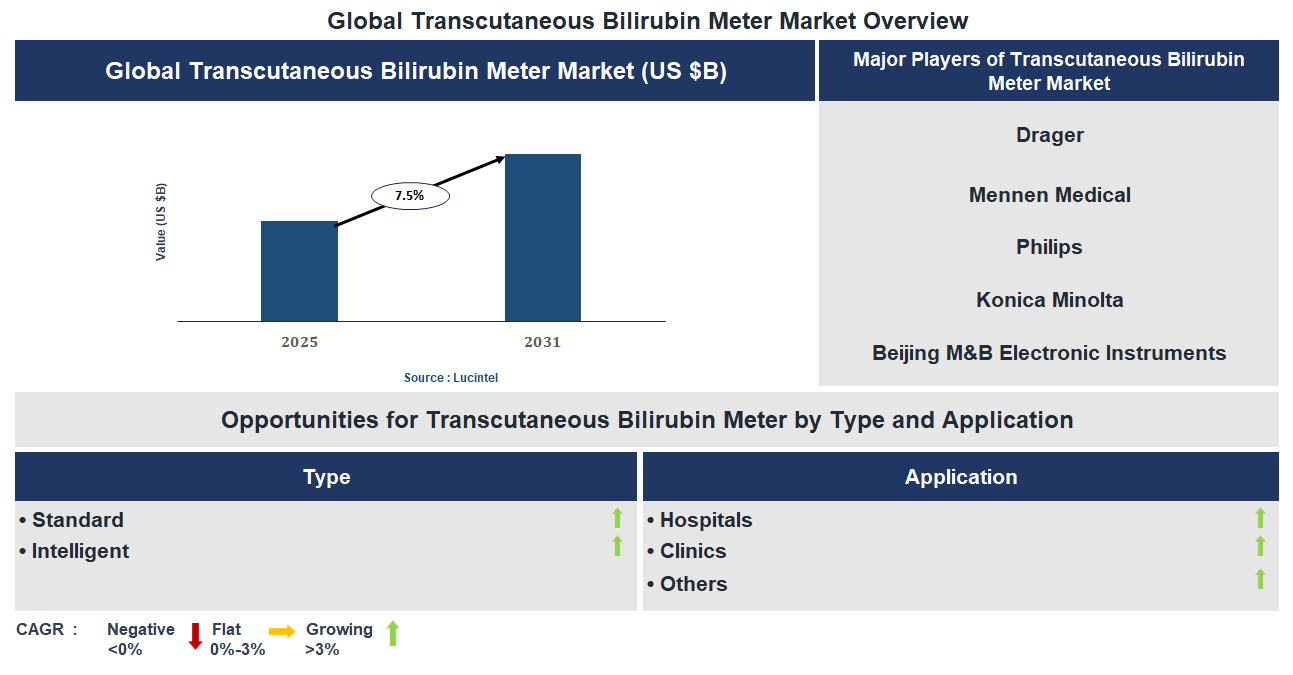
The future of the global transcutaneous bilirubin meter market looks promising with opportunities in the hospital and clinic markets. The global transcutaneous bilirubin meter market is expected to grow with a CAGR of 7.5% from 2025 to 2031. The major drivers for this market are the increasing prevalence of neonatal jaundice cases, the rising demand for non-invasive diagnostic tools, and the growing adoption of point-of-care testing devices.

• Lucintel forecasts that, within the type category, intelligent is expected to witness higher growth over the forecast period.
• Within the application category, hospital is expected to witness higher growth.
• In terms of region, APAC is expected to witness the highest growth over the forecast period.
Gain valuable insights for your business decisions with our comprehensive 150+ page report. Sample figures with some insights are shown below.
Transcutaneous Bilirubin Meter Market Trends and Forecast

Emerging Trends in the Transcutaneous Bilirubin Meter Market

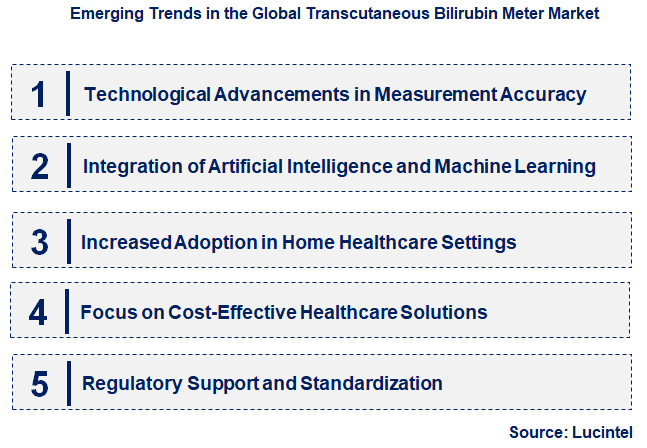
The transcutaneous bilirubin meter market is undergoing significant changes, influenced by emerging trends that are shaping the development and adoption of these devices. Technological advancements, increased awareness, and the growing demand for non-invasive healthcare solutions are key factors contributing to these trends. As the market expands globally, it is essential to understand how these trends are reshaping the future of bilirubin measurement and its impact on neonatal care.

• Technological Advancements in Measurement Accuracy: With innovations in sensor technology and software algorithms, transcutaneous bilirubin meters are becoming increasingly accurate. Improved accuracy reduces the risk of misdiagnosis and the need for confirmatory blood tests. This advancement makes transcutaneous bilirubin meters a more reliable alternative for jaundice screening, especially in neonatal care where precision is critical. As manufacturers invest in R&D, the market is witnessing the development of devices that provide faster, more precise readings, further enhancing their appeal in hospitals and clinics.
• Integration of Artificial Intelligence and Machine Learning: The integration of artificial intelligence (AI) and machine learning (ML) into transcutaneous bilirubin meter is revolutionizing the diagnostic process. AI-powered devices can analyze bilirubin levels more effectively, considering various patient factors such as skin tone and age. This trend is expected to increase the reliability of transcutaneous bilirubin meter measurements while reducing the potential for human error. The future of transcutaneous bilirubin meter likely involves AI-driven diagnostic systems that enable healthcare providers to make quicker, more informed decisions.
• Increased Adoption in Home Healthcare Settings: As healthcare systems evolve, there is a growing trend towards decentralizing care, particularly for neonatal jaundice management. transcutaneous bilirubin meter are becoming increasingly popular for use in home healthcare settings, where parents and caregivers can monitor bilirubin levels without the need for hospital visits. Portable, easy-to-use devices are a significant trend in this area, providing convenience and reducing the burden on healthcare facilities. The growth of telemedicine and remote monitoring further supports this trend.
• Focus on Cost-Effective Healthcare Solutions: As healthcare costs continue to rise globally, there is a growing demand for cost-effective diagnostic tools. Transcutaneous bilirubin meter offer a less expensive alternative to invasive blood testing, making them an attractive solution for countries with limited healthcare resources. The affordability of these devices is driving their adoption in low- and middle-income countries, where access to healthcare may be limited.
• Regulatory Support and Standardization: Governments and regulatory bodies are increasingly focused on improving neonatal care, and this is reflected in the growing adoption of transcutaneous bilirubin meter. Many countries are implementing policies and regulations to support the use of non-invasive diagnostic tools, making it easier for manufacturers to introduce new devices. Additionally, efforts to standardize transcutaneous bilirubin meter measurements across various platforms are expected to enhance the reliability and accuracy of these devices. This trend is crucial for ensuring consistent quality and performance across the global market.

These emerging trends in the transcutaneous bilirubin meter market are driving the evolution of neonatal care. Technological innovations, the integration of AI, and the focus on cost-effective solutions are expanding the reach and efficiency of transcutaneous bilirubin meters. As adoption grows in home healthcare settings and regulatory support strengthens, these trends will continue to shape the future of the market, enhancing the ability of healthcare providers to monitor and manage neonatal jaundice effectively.
Emerging Trends in the Transcutaneous Bilirubin Meter Market

Recent Development in the Transcutaneous Bilirubin Meter Market

The transcutaneous bilirubin meter market has seen several key developments in recent years, particularly in terms of technology, regulatory frameworks, and market penetration. These developments are reshaping how neonatal jaundice is diagnosed and managed, providing more accurate, non-invasive solutions for healthcare providers worldwide.

• Improved Sensor Technologies: Recent developments in sensor technology have led to more accurate and reliable transcutaneous bilirubin meters. Advances in light-emitting diodes (LEDs) and photodetectors allow for more precise bilirubin measurements, reducing the need for invasive blood tests. These innovations are particularly beneficial in detecting jaundice in newborns, improving diagnostic accuracy and patient outcomes. The adoption of these improved sensors is expected to drive the market further, especially in hospitals and pediatric care units.
• Portability and User-Friendliness: New transcutaneous bilirubin meters are designed to be portable and easy to use, allowing healthcare providers to conduct tests outside of traditional hospital settings. This portability is especially valuable in remote or rural areas, where access to specialized healthcare facilities may be limited. User-friendly interfaces make it easier for both healthcare professionals and parents to operate these devices, enhancing adoption rates and improving patient care across various settings.
• Integration with Digital Health Systems: As digital health systems and telemedicine gain prominence, transcutaneous bilirubin meters are increasingly being integrated with electronic health records (EHR) and remote monitoring platforms. This integration allows healthcare providers to track bilirubin levels in real-time and make informed decisions about treatment. The ability to share data remotely enhances the accessibility of neonatal care, particularly in underserved areas. It also streamlines the process for healthcare providers, improving workflow efficiency.
• Expansion of Government Support and Initiatives: Governments worldwide are recognizing the importance of neonatal jaundice prevention and are offering increased support for non-invasive diagnostic tools. Subsidies, funding for healthcare infrastructure, and regulatory approvals are helping to facilitate the adoption of transcutaneous bilirubin meters, particularly in low- and middle-income countries. These initiatives are expected to accelerate market growth, as they make transcutaneous bilirubin meters more affordable and accessible to a broader population.
• Regulatory Advancements: There have been notable advancements in the regulatory landscape surrounding transcutaneous bilirubin meters. Many countries have introduced clearer guidelines for the approval and use of these devices, ensuring that they meet safety and efficacy standards. Regulatory bodies are also working towards standardizing transcutaneous bilirubin meter measurements to improve consistency and reliability. This is crucial for building trust among healthcare providers and patients, contributing to increased market adoption.

Recent developments in the transcutaneous bilirubin meter market are pushing the boundaries of neonatal care. Technological innovations, such as improved sensors and portability, along with increased regulatory support, are accelerating the adoption of these devices globally. As digital health integration and government initiatives continue to drive market growth, transcutaneous bilirubin meters will play an increasingly central role in managing neonatal jaundice and enhancing patient care.

Strategic Growth Opportunities in the Transcutaneous Bilirubin Meter Market

The transcutaneous bilirubin meter market is expanding rapidly, driven by the growing need for non-invasive jaundice screening in neonates. With increasing awareness about neonatal jaundice, technological advancements, and healthcare system improvements, there are several strategic growth opportunities for transcutaneous bilirubin meters across various applications. These opportunities are being shaped by innovations in product design, regional demand variations, and the drive for cost-effective healthcare solutions.

• Neonatal Care Units: Neonatal Care Units are seeing increasing demand for transcutaneous bilirubin meters due to their non-invasive nature and ability to provide rapid, accurate bilirubin measurements. In neonatal care settings, where early detection of jaundice is critical, transcutaneous bilirubin meters help streamline diagnostic processes, reduce stress for newborns, and enhance patient safety. With advances in portability and ease of use, transcutaneous bilirubin meters are becoming essential tools in neonatal care, improving efficiency in hospital settings and reducing the need for invasive blood sampling.
• Home Healthcare Settings: Home healthcare applications for transcutaneous bilirubin meters are rapidly gaining traction, driven by the rising preference for home-based care, particularly for neonatal jaundice monitoring. With portable, user-friendly designs, these meters enable parents or caregivers to monitor bilirubin levels in the comfort of their homes, reducing hospital visits. This shift is especially important in rural and underserved areas where access to healthcare facilities may be limited.
• Telemedicine and Remote Monitoring: The rise of telemedicine and remote healthcare monitoring presents a significant growth opportunity for transcutaneous bilirubin meters. Integration with digital health systems allows for remote tracking of bilirubin levels and real-time data transmission to healthcare providers, enabling better management of neonatal jaundice. This is particularly beneficial in remote or underserved regions, where in-person consultations may be difficult.
• Pediatric Care Clinics: Pediatric care clinics are becoming important users of transcutaneous bilirubin meters as they focus on early detection of neonatal jaundice in infants. The ability to perform quick and non-invasive tests in a clinical setting allows pediatricians to monitor bilirubin levels without the need for more invasive procedures like blood sampling. This trend is particularly beneficial for pediatricians who serve a large volume of newborns and infants. transcutaneous bilirubin meters in these settings help improve diagnostic efficiency, enhance patient comfort, and reduce the risk of complications from untreated jaundice, thus promoting early intervention.
• Low-Income and Developing Regions: The growing focus on improving healthcare access in low-income and developing regions presents a strategic opportunity for the adoption of transcutaneous bilirubin meters. In these areas, where access to invasive testing may be limited due to financial constraints or lack of medical infrastructure, transcutaneous bilirubin meters offer an affordable and effective alternative for jaundice screening. Governments and NGOs are increasingly supporting the use of non-invasive diagnostic tools to reduce neonatal mortality.

These strategic growth opportunities illustrate how the transcutaneous bilirubin meter market is evolving across key applications. Neonatal care units, home healthcare settings, telemedicine, pediatric care clinics, and low-income regions represent significant areas of expansion. As the demand for non-invasive, accurate, and cost-effective jaundice screening solutions grows, transcutaneous bilirubin meters are becoming increasingly integrated into both developed and developing healthcare systems, improving patient care, reducing hospital visits, and enhancing diagnostic efficiency.

Transcutaneous Bilirubin Meter Market Driver and Challenges

The transcutaneous bilirubin meter market is influenced by several drivers and challenges related to technological, economic, and regulatory factors. While the market is expanding due to technological advancements and increased awareness about neonatal jaundice, several barriers still hinder widespread adoption. Understanding these drivers and challenges helps to grasp the dynamics of the market and predict future growth trends.

The factors responsible for driving the transcutaneous bilirubin meter market include:
1. Technological Advancements in Non-Invasive Monitoring: One of the primary drivers of the transcutaneous bilirubin meter market is the continuous improvement in sensor and measurement technologies. New sensors, enhanced algorithms, and more precise light sources allow transcutaneous bilirubin meters to offer highly accurate and reliable measurements of bilirubin levels. These innovations not only improve diagnostic accuracy but also reduce the time needed for results, which is crucial for neonatal care.
2. Increasing Awareness of Neonatal Jaundice: Raising awareness about neonatal jaundice has been a major driver for the transcutaneous bilirubin meter market. As more healthcare providers and parents understand the risks of untreated jaundice and its potential long-term effects, there is growing demand for tools that can detect this condition early. Awareness campaigns, especially in emerging markets, are encouraging early screening and diagnostic efforts.
3. Government Support and Healthcare Policies: Government initiatives to improve maternal and child healthcare, especially in developing nations, are fostering the adoption of transcutaneous bilirubin meters. Many countries are focusing on reducing neonatal mortality and promoting the use of non-invasive diagnostic technologies. Governments are also providing subsidies or funding for healthcare programs that support the integration of transcutaneous bilirubin meters into routine newborn care.
4. Cost-Efficiency and Affordability: The increasing cost of healthcare services and the growing emphasis on cost-effective solutions in medical diagnostics have driven the demand for transcutaneous bilirubin meters. These meters provide a non-invasive and affordable alternative to traditional blood tests, reducing the overall cost of jaundice screening and treatment. For countries with limited resources, this affordability makes transcutaneous bilirubin meters an attractive option.
5. Rise of Home Healthcare and Remote Monitoring: The growing shift toward home healthcare and remote monitoring is a key factor propelling the transcutaneous bilirubin meter market. As more families prefer to monitor their infants health at home, the demand for portable, easy-to-use devices increases. The integration of transcutaneous bilirubin meters with digital health platforms allows for remote monitoring of bilirubin levels, ensuring timely intervention. This trend, combined with advances in telemedicine, is helping expand the market by providing convenient, cost-effective solutions for parents and healthcare providers.

Challenges in the transcutaneous bilirubin meter market are:
1. High Initial Investment and Device Costs: Despite the long-term cost savings offered by transcutaneous bilirubin meters, the initial investment in purchasing and maintaining these devices can be a significant barrier, particularly in low-income regions or small healthcare facilities. The upfront costs, including device calibration and training for healthcare workers, may deter some institutions from adopting this technology. While the affordability of transcutaneous bilirubin meters is improving, the cost remains a key challenge for wider adoption, especially in resource-constrained environments.
2. Regulatory Hurdles and Approval Delays: Regulatory challenges can delay the market entry of new transcutaneous bilirubin meters or limit their use in certain regions. Different countries have varying requirements for device approval, and ensuring compliance with these regulations can be time-consuming and expensive. Stringent testing and approval processes can delay product launches and limit market access for manufacturers. The need for standardized regulations globally could ease this challenge and help accelerate the market penetration of transcutaneous bilirubin meters.
3. Lack of Awareness in Emerging Markets: While awareness of neonatal jaundice is growing in many regions, there are still gaps in understanding and diagnostic practices, particularly in rural and underserved areas. In emerging markets, a lack of trained healthcare professionals and access to modern diagnostic tools can limit the widespread adoption of transcutaneous bilirubin meters. Educating both healthcare providers and the public on the benefits of non-invasive jaundice screening will be crucial to overcoming this barrier and unlocking the full market potential.

The major drivers of the transcutaneous bilirubin meter market include technological advancements, increasing awareness of neonatal jaundice, government support, cost-efficiency, and the rise of home healthcare. However, challenges such as high initial investment, regulatory hurdles, and a lack of awareness in certain regions continue to hinder adoption. Despite these challenges, the overall impact of these drivers and challenges suggests a positive growth trajectory for the market, particularly as technologies improve and market penetration expands, especially in emerging regions and remote healthcare settings.

List of Transcutaneous Bilirubin Meter Companies

Companies in the market compete on the basis of product quality offered. Major players in this market focus on expanding their manufacturing facilities, R&D investments, infrastructural development, and leverage integration opportunities across the value chain. With these strategies transcutaneous bilirubin meter companies cater increasing demand, ensure competitive effectiveness, develop innovative products & technologies, reduce production costs, and expand their customer base. Some of the transcutaneous bilirubin meter companies profiled in this report include-
• Drager
• Mennen Medical
• Philips
• Konica Minolta
• Beijing M&B Electronic Instruments
• Ningbo David Medical Device
• VECH MEDICAL
• AVI Healthcare
• NEORUBIN
• Dolphin Nanjing electronics

Transcutaneous Bilirubin Meter Market by Segment

The study includes a forecast for the global transcutaneous bilirubin meter market by type, application, and region.

Transcutaneous Bilirubin Meter Market by Type [Value from 2019 to 2031]:


• Standard
• Intelligent

Transcutaneous Bilirubin Meter Market by Application [Value from 2019 to 2031]:


• Hospitals
• Clinics
• Others

Transcutaneous Bilirubin Meter Market by Region [Value from 2019 to 2031]:


• North America
• Europe
• Asia Pacific
• The Rest of the World

Country Wise Outlook for the Transcutaneous Bilirubin Meter Market

The transcutaneous bilirubin meter market is experiencing significant growth due to advancements in non-invasive bilirubin measurement technology. This is a crucial tool for the detection and management of neonatal jaundice, providing a safer and more convenient alternative to traditional blood sampling. Several countries, including the United States, China, Germany, India, and Japan, are witnessing key developments that are driving the market’s expansion. These developments span across technological improvements, adoption rates, and regulatory advancements, reshaping the market landscape in each region.

• United States: In the United States, the transcutaneous bilirubin meter market is expanding as hospitals and healthcare centers increasingly adopt non-invasive bilirubin meters. This is due to rising awareness of the benefits of early jaundice detection in newborns, particularly in outpatient settings. Key advancements include the development of devices with greater accuracy, faster readings, and ease of use. Moreover, increased government support for neonatal care and growing healthcare infrastructure are fueling market growth.
• China: China’s transcutaneous bilirubin meter market has seen significant growth, driven by the country’s expanding healthcare sector and the increasing focus on pediatric care. Government initiatives to improve maternal and child health, along with rising awareness of neonatal jaundice, are key drivers. Technological advancements, such as improved sensors and the integration of artificial intelligence (AI) for better diagnostics, are pushing the market forward. However, regional disparities in healthcare infrastructure may slow adoption rates in rural areas, despite the rapid urbanization and growth of healthcare facilities in major cities.
• Germany: Germany is witnessing steady growth in the transcutaneous bilirubin meter market due to a well-established healthcare system and a strong emphasis on early diagnosis and prevention of neonatal jaundice. The adoption of transcutaneous bilirubin meter is rising as hospitals seek to reduce reliance on invasive blood tests. Moreover, Germanys regulatory framework and focus on patient safety are fostering the development of innovative, more accurate devices.
• India: In India, the transcutaneous bilirubin meter is experiencing rapid growth due to increasing awareness about neonatal jaundice and the growing healthcare infrastructure. The demand for non-invasive diagnostic tools is increasing, driven by a focus on reducing neonatal mortality. Moreover, with the government pushing for improved healthcare access in rural areas, the adoption of transcutaneous bilirubin meters is expected to rise. However, challenges like cost concerns and the need for improved healthcare training in remote areas remain as obstacles to more widespread adoption.
• Japan: Japan’s market for transcutaneous bilirubin meter is expanding due to its aging population and the government’s focus on improving maternal and child healthcare. Japanese healthcare providers are increasingly adopting transcutaneous bilirubin meter to streamline neonatal jaundice screening and reduce healthcare costs associated with invasive procedures. The development of highly accurate, portable, and user-friendly transcutaneous bilirubin meter is being driven by technological innovation, and there is growing acceptance of these devices among both medical professionals and parents.

Lucintel Analytics Dashboard

Features of the Global Transcutaneous Bilirubin Meter Market

Market Size Estimates: Transcutaneous bilirubin meter market size estimation in terms of value ($B).
Trend and Forecast Analysis: Market trends (2019 to 2024) and forecast (2025 to 2031) by various segments and regions.
Segmentation Analysis: Transcutaneous bilirubin meter market size by type, application, and region in terms of value ($B).
Regional Analysis: Transcutaneous bilirubin meter market breakdown by North America, Europe, Asia Pacific, and Rest of the World.
Growth Opportunities: Analysis of growth opportunities in different types, applications, and regions for the transcutaneous bilirubin meter market.
Strategic Analysis: This includes M&A, new product development, and competitive landscape of the transcutaneous bilirubin meter market.
Analysis of competitive intensity of the industry based on Porter’s Five Forces model.

Lucintel Consulting Services

FAQ

Q1. What is the growth forecast for transcutaneous bilirubin meter market?
Answer: The global transcutaneous bilirubin meter market is expected to grow with a CAGR of 7.5% from 2025 to 2031.
Q2. What are the major drivers influencing the growth of the transcutaneous bilirubin meter market?
Answer: The major drivers for this market are the increasing prevalence of neonatal jaundice cases, the rising demand for non-invasive diagnostic tools, and the growing adoption of point-of-care testing devices.
Q3. What are the major segments for transcutaneous bilirubin meter market?
Answer: The future of the transcutaneous bilirubin meter market looks promising with opportunities in the hospital and clinic markets.
Q4. Who are the key transcutaneous bilirubin meter market companies?
Answer: Some of the key transcutaneous bilirubin meter companies are as follows:
• Drager
• Mennen Medical
• Philips
• Konica Minolta
• Beijing M&B Electronic Instruments
• Ningbo David Medical Device
• VECH MEDICAL
• AVI Healthcare
• NEORUBIN
• Dolphin Nanjing electronics
Q5. Which transcutaneous bilirubin meter market segment will be the largest in future?
Answer: Lucintel forecasts that, within the type category, intelligent is expected to witness higher growth over the forecast period.
Q6. In transcutaneous bilirubin meter market, which region is expected to be the largest in next 5 years?
Answer: In terms of region, APAC is expected to witness the highest growth over the forecast period.
Q7. Do we receive customization in this report?
Answer: Yes, Lucintel provides 10% customization without any additional cost.

This report answers following 11 key questions:

Q.1. What are some of the most promising, high-growth opportunities for the transcutaneous bilirubin meter market by type (standard and intelligent), application (hospitals, clinics, and others), and region (North America, Europe, Asia Pacific, and the Rest of the World)?
Q.2. Which segments will grow at a faster pace and why?
Q.3. Which region will grow at a faster pace and why?
Q.4. What are the key factors affecting market dynamics? What are the key challenges and business risks in this market?
Q.5. What are the business risks and competitive threats in this market?
Q.6. What are the emerging trends in this market and the reasons behind them?
Q.7. What are some of the changing demands of customers in the market?
Q.8. What are the new developments in the market? Which companies are leading these developments?
Q.9. Who are the major players in this market? What strategic initiatives are key players pursuing for business growth?
Q.10. What are some of the competing products in this market and how big of a threat do they pose for loss of market share by material or product substitution?
Q.11. What M&A activity has occurred in the last 5 years and what has its impact been on the industry?

For any questions related to Transcutaneous Bilirubin Meter Market, Transcutaneous Bilirubin Meter Market Size, Transcutaneous Bilirubin Meter Market Growth, Transcutaneous Bilirubin Meter Market Analysis, Transcutaneous Bilirubin Meter Market Report, Transcutaneous Bilirubin Meter Market Share, Transcutaneous Bilirubin Meter Market Trends, Transcutaneous Bilirubin Meter Market Forecast, Transcutaneous Bilirubin Meter Companies, write Lucintel analyst at email: helpdesk@lucintel.com. We will be glad to get back to you soon.
                                           Table of Contents

            1. Executive Summary

            2. Market Overview

                        2.1 Background and Classifications
                        2.2 Supply Chain

            3. Market Trends & Forecast Analysis

                        3.1 Macroeconomic Trends and Forecasts
                        3.2 Industry Drivers and Challenges
                        3.3 PESTLE Analysis
                        3.4 Patent Analysis
                        3.5 Regulatory Environment
                        3.6 Global Transcutaneous Bilirubin Meter Market Trends and Forecast

            4. Global Transcutaneous Bilirubin Meter Market by Type

                        4.1 Overview
                        4.2 Attractiveness Analysis by Type
                        4.3 Standard : Trends and Forecast 2019 to 2031
                        4.4 Intelligent : Trends and Forecast 2019 to 2031

            5. Global Transcutaneous Bilirubin Meter Market by Application

                        5.1 Overview
                        5.2 Attractiveness Analysis by Application
                        5.3 Hospitals : Trends and Forecast 2019 to 2031
                        5.4 Clinics : Trends and Forecast 2019 to 2031
                        5.5 Others : Trends and Forecast 2019 to 2031

            6. Regional Analysis

                        6.1 Overview
                        6.2 Global Transcutaneous Bilirubin Meter Market by Region

            7. North American Transcutaneous Bilirubin Meter Market

                        7.1 Overview
                        7.2 North American Transcutaneous Bilirubin Meter Market by Type
                        7.3 North American Transcutaneous Bilirubin Meter Market by Application
                        7.4 The United States Transcutaneous Bilirubin Meter Market
                        7.5 Canadian Transcutaneous Bilirubin Meter Market
                        7.6 Mexican Transcutaneous Bilirubin Meter Market

            8. European Transcutaneous Bilirubin Meter Market

                        8.1 Overview
                        8.2 European Transcutaneous Bilirubin Meter Market by Type
                        8.3 European Transcutaneous Bilirubin Meter Market by Application
                        8.4 German Transcutaneous Bilirubin Meter Market
                        8.5 French Transcutaneous Bilirubin Meter Market
                        8.6 Italian Transcutaneous Bilirubin Meter Market
                        8.7 Spanish Transcutaneous Bilirubin Meter Market
                        8.8 The United Kingdom Transcutaneous Bilirubin Meter Market

            9. APAC Transcutaneous Bilirubin Meter Market

                        9.1 Overview
                        9.2 APAC Transcutaneous Bilirubin Meter Market by Type
                        9.3 APAC Transcutaneous Bilirubin Meter Market by Application
                        9.4 Chinese Transcutaneous Bilirubin Meter Market
                        9.5 Indian Transcutaneous Bilirubin Meter Market
                        9.6 Japanese Transcutaneous Bilirubin Meter Market
                        9.7 South Korean Transcutaneous Bilirubin Meter Market
                        9.8 Indonesian Transcutaneous Bilirubin Meter Market

            10. ROW Transcutaneous Bilirubin Meter Market

                        10.1 Overview
                        10.2 ROW Transcutaneous Bilirubin Meter Market by Type
                        10.3 ROW Transcutaneous Bilirubin Meter Market by Application
                        10.4 Middle Eastern Transcutaneous Bilirubin Meter Market
                        10.5 South American Transcutaneous Bilirubin Meter Market
                        10.6 African Transcutaneous Bilirubin Meter Market

            11. Competitor Analysis

                        11.1 Product Portfolio Analysis
                        11.2 Operational Integration
                        11.3 Porter’s Five Forces Analysis
                                    • Competitive Rivalry
                                    • Bargaining Power of Buyers
                                    • Bargaining Power of Suppliers
                                    • Threat of Substitutes
                                    • Threat of New Entrants
                        11.4 Market Share Analysis

            12. Opportunities & Strategic Analysis

                        12.1 Value Chain Analysis
                        12.2 Growth Opportunity Analysis
                                    12.2.1 Growth Opportunity by Type
                                    12.2.2 Growth Opportunity by Application
                        12.3 Emerging Trends in the Global Transcutaneous Bilirubin Meter Market
                        12.4 Strategic Analysis
                                    12.4.1 New Product Development
                                    12.4.2 Certification and Licensing
                                    12.4.3 Mergers, Acquisitions, Agreements, Collaborations, and Joint Ventures

            13. Company Profiles of the Leading Players Across the Value Chain

                        13.1 Competitive Analysis Overview
                        13.2 Drager
                                    • Company Overview
                                    • Transcutaneous Bilirubin Meter Market Business Overview
                                    • New Product Development
                                    • Merger, Acquisition, and Collaboration
                                    • Certification and Licensing
                        13.3 Mennen Medical
                                    • Company Overview
                                    • Transcutaneous Bilirubin Meter Market Business Overview
                                    • New Product Development
                                    • Merger, Acquisition, and Collaboration
                                    • Certification and Licensing
                        13.4 Philips
                                    • Company Overview
                                    • Transcutaneous Bilirubin Meter Market Business Overview
                                    • New Product Development
                                    • Merger, Acquisition, and Collaboration
                                    • Certification and Licensing
                        13.5 Konica Minolta
                                    • Company Overview
                                    • Transcutaneous Bilirubin Meter Market Business Overview
                                    • New Product Development
                                    • Merger, Acquisition, and Collaboration
                                    • Certification and Licensing
                        13.6 Beijing M&B Electronic Instruments
                                    • Company Overview
                                    • Transcutaneous Bilirubin Meter Market Business Overview
                                    • New Product Development
                                    • Merger, Acquisition, and Collaboration
                                    • Certification and Licensing
                        13.7 Ningbo David Medical Device
                                    • Company Overview
                                    • Transcutaneous Bilirubin Meter Market Business Overview
                                    • New Product Development
                                    • Merger, Acquisition, and Collaboration
                                    • Certification and Licensing
                        13.8 VECH MEDICAL
                                    • Company Overview
                                    • Transcutaneous Bilirubin Meter Market Business Overview
                                    • New Product Development
                                    • Merger, Acquisition, and Collaboration
                                    • Certification and Licensing
                        13.9 AVI Healthcare
                                    • Company Overview
                                    • Transcutaneous Bilirubin Meter Market Business Overview
                                    • New Product Development
                                    • Merger, Acquisition, and Collaboration
                                    • Certification and Licensing
                        13.10 NEORUBIN
                                    • Company Overview
                                    • Transcutaneous Bilirubin Meter Market Business Overview
                                    • New Product Development
                                    • Merger, Acquisition, and Collaboration
                                    • Certification and Licensing
                        13.11 Dolphin Nanjing electronics
                                    • Company Overview
                                    • Transcutaneous Bilirubin Meter Market Business Overview
                                    • New Product Development
                                    • Merger, Acquisition, and Collaboration
                                    • Certification and Licensing

            14. Appendix

                        14.1 List of Figures
                        14.2 List of Tables
                        14.3 Research Methodology
                        14.4 Disclaimer
                        14.5 Copyright
                        14.6 Abbreviations and Technical Units
                        14.7 About Us
                        14.8 Contact Us

                                               List of Figures


            Chapter 1

                        Figure 1.1: Trends and Forecast for the Global Transcutaneous Bilirubin Meter Market

            Chapter 2

                        Figure 2.1: Usage of Transcutaneous Bilirubin Meter Market
                        Figure 2.2: Classification of the Global Transcutaneous Bilirubin Meter Market
                        Figure 2.3: Supply Chain of the Global Transcutaneous Bilirubin Meter Market

            Chapter 3

                        Figure 3.1: Trends of the Global GDP Growth Rate
                        Figure 3.2: Trends of the Global Population Growth Rate
                        Figure 3.3: Trends of the Global Inflation Rate
                        Figure 3.4: Trends of the Global Unemployment Rate
                        Figure 3.5: Trends of the Regional GDP Growth Rate
                        Figure 3.6: Trends of the Regional Population Growth Rate
                        Figure 3.7: Trends of the Regional Inflation Rate
                        Figure 3.8: Trends of the Regional Unemployment Rate
                        Figure 3.9: Trends of Regional Per Capita Income
                        Figure 3.10: Forecast for the Global GDP Growth Rate
                        Figure 3.11: Forecast for the Global Population Growth Rate
                        Figure 3.12: Forecast for the Global Inflation Rate
                        Figure 3.13: Forecast for the Global Unemployment Rate
                        Figure 3.14: Forecast for the Regional GDP Growth Rate
                        Figure 3.15: Forecast for the Regional Population Growth Rate
                        Figure 3.16: Forecast for the Regional Inflation Rate
                        Figure 3.17: Forecast for the Regional Unemployment Rate
                        Figure 3.18: Forecast for Regional Per Capita Income
                        Figure 3.19: Driver and Challenges of the Transcutaneous Bilirubin Meter Market

            Chapter 4

                        Figure 4.1: Global Transcutaneous Bilirubin Meter Market by Type in 2019, 2024, and 2031
                        Figure 4.2: Trends of the Global Transcutaneous Bilirubin Meter Market ($B) by Type
                        Figure 4.3: Forecast for the Global Transcutaneous Bilirubin Meter Market ($B) by Type
                        Figure 4.4: Trends and Forecast for Standard in the Global Transcutaneous Bilirubin Meter Market (2019-2031)
                        Figure 4.5: Trends and Forecast for Intelligent in the Global Transcutaneous Bilirubin Meter Market (2019-2031)

            Chapter 5

                        Figure 5.1: Global Transcutaneous Bilirubin Meter Market by Application in 2019, 2024, and 2031
                        Figure 5.2: Trends of the Global Transcutaneous Bilirubin Meter Market ($B) by Application
                        Figure 5.3: Forecast for the Global Transcutaneous Bilirubin Meter Market ($B) by Application
                        Figure 5.4: Trends and Forecast for Hospitals in the Global Transcutaneous Bilirubin Meter Market (2019-2031)
                        Figure 5.5: Trends and Forecast for Clinics in the Global Transcutaneous Bilirubin Meter Market (2019-2031)
                        Figure 5.6: Trends and Forecast for Others in the Global Transcutaneous Bilirubin Meter Market (2019-2031)

            Chapter 6

                        Figure 6.1: Trends of the Global Transcutaneous Bilirubin Meter Market ($B) by Region (2019-2024)
                        Figure 6.2: Forecast for the Global Transcutaneous Bilirubin Meter Market ($B) by Region (2025-2031)

            Chapter 7

                        Figure 7.1: Trends and Forecast for the North American Transcutaneous Bilirubin Meter Market (2019-2031)
                        Figure 7.2: North American Transcutaneous Bilirubin Meter Market by Type in 2019, 2024, and 2031
                        Figure 7.3: Trends of the North American Transcutaneous Bilirubin Meter Market ($B) by Type (2019-2024)
                        Figure 7.4: Forecast for the North American Transcutaneous Bilirubin Meter Market ($B) by Type (2025-2031)
                        Figure 7.5: North American Transcutaneous Bilirubin Meter Market by Application in 2019, 2024, and 2031
                        Figure 7.6: Trends of the North American Transcutaneous Bilirubin Meter Market ($B) by Application (2019-2024)
                        Figure 7.7: Forecast for the North American Transcutaneous Bilirubin Meter Market ($B) by Application (2025-2031)
                        Figure 7.8: Trends and Forecast for the United States Transcutaneous Bilirubin Meter Market ($B) (2019-2031)
                        Figure 7.9: Trends and Forecast for the Mexican Transcutaneous Bilirubin Meter Market ($B) (2019-2031)
                        Figure 7.10: Trends and Forecast for the Canadian Transcutaneous Bilirubin Meter Market ($B) (2019-2031)

            Chapter 8

                        Figure 8.1: Trends and Forecast for the European Transcutaneous Bilirubin Meter Market (2019-2031)
                        Figure 8.2: European Transcutaneous Bilirubin Meter Market by Type in 2019, 2024, and 2031
                        Figure 8.3: Trends of the European Transcutaneous Bilirubin Meter Market ($B) by Type (2019-2024)
                        Figure 8.4: Forecast for the European Transcutaneous Bilirubin Meter Market ($B) by Type (2025-2031)
                        Figure 8.5: European Transcutaneous Bilirubin Meter Market by Application in 2019, 2024, and 2031
                        Figure 8.6: Trends of the European Transcutaneous Bilirubin Meter Market ($B) by Application (2019-2024)
                        Figure 8.7: Forecast for the European Transcutaneous Bilirubin Meter Market ($B) by Application (2025-2031)
                        Figure 8.8: Trends and Forecast for the German Transcutaneous Bilirubin Meter Market ($B) (2019-2031)
                        Figure 8.9: Trends and Forecast for the French Transcutaneous Bilirubin Meter Market ($B) (2019-2031)
                        Figure 8.10: Trends and Forecast for the Spanish Transcutaneous Bilirubin Meter Market ($B) (2019-2031)
                        Figure 8.11: Trends and Forecast for the Italian Transcutaneous Bilirubin Meter Market ($B) (2019-2031)
                        Figure 8.12: Trends and Forecast for the United Kingdom Transcutaneous Bilirubin Meter Market ($B) (2019-2031)

            Chapter 9

                        Figure 9.1: Trends and Forecast for the APAC Transcutaneous Bilirubin Meter Market (2019-2031)
                        Figure 9.2: APAC Transcutaneous Bilirubin Meter Market by Type in 2019, 2024, and 2031
                        Figure 9.3: Trends of the APAC Transcutaneous Bilirubin Meter Market ($B) by Type (2019-2024)
                        Figure 9.4: Forecast for the APAC Transcutaneous Bilirubin Meter Market ($B) by Type (2025-2031)
                        Figure 9.5: APAC Transcutaneous Bilirubin Meter Market by Application in 2019, 2024, and 2031
                        Figure 9.6: Trends of the APAC Transcutaneous Bilirubin Meter Market ($B) by Application (2019-2024)
                        Figure 9.7: Forecast for the APAC Transcutaneous Bilirubin Meter Market ($B) by Application (2025-2031)
                        Figure 9.8: Trends and Forecast for the Japanese Transcutaneous Bilirubin Meter Market ($B) (2019-2031)
                        Figure 9.9: Trends and Forecast for the Indian Transcutaneous Bilirubin Meter Market ($B) (2019-2031)
                        Figure 9.10: Trends and Forecast for the Chinese Transcutaneous Bilirubin Meter Market ($B) (2019-2031)
                        Figure 9.11: Trends and Forecast for the South Korean Transcutaneous Bilirubin Meter Market ($B) (2019-2031)
                        Figure 9.12: Trends and Forecast for the Indonesian Transcutaneous Bilirubin Meter Market ($B) (2019-2031)

            Chapter 10

                        Figure 10.1: Trends and Forecast for the ROW Transcutaneous Bilirubin Meter Market (2019-2031)
                        Figure 10.2: ROW Transcutaneous Bilirubin Meter Market by Type in 2019, 2024, and 2031
                        Figure 10.3: Trends of the ROW Transcutaneous Bilirubin Meter Market ($B) by Type (2019-2024)
                        Figure 10.4: Forecast for the ROW Transcutaneous Bilirubin Meter Market ($B) by Type (2025-2031)
                        Figure 10.5: ROW Transcutaneous Bilirubin Meter Market by Application in 2019, 2024, and 2031
                        Figure 10.6: Trends of the ROW Transcutaneous Bilirubin Meter Market ($B) by Application (2019-2024)
                        Figure 10.7: Forecast for the ROW Transcutaneous Bilirubin Meter Market ($B) by Application (2025-2031)
                        Figure 10.8: Trends and Forecast for the Middle Eastern Transcutaneous Bilirubin Meter Market ($B) (2019-2031)
                        Figure 10.9: Trends and Forecast for the South American Transcutaneous Bilirubin Meter Market ($B) (2019-2031)
                        Figure 10.10: Trends and Forecast for the African Transcutaneous Bilirubin Meter Market ($B) (2019-2031)

            Chapter 11

                        Figure 11.1: Porter’s Five Forces Analysis of the Global Transcutaneous Bilirubin Meter Market
                        Figure 11.2: Market Share (%) of Top Players in the Global Transcutaneous Bilirubin Meter Market (2024)

            Chapter 12

                        Figure 12.1: Growth Opportunities for the Global Transcutaneous Bilirubin Meter Market by Type
                        Figure 12.2: Growth Opportunities for the Global Transcutaneous Bilirubin Meter Market by Application
                        Figure 12.3: Growth Opportunities for the Global Transcutaneous Bilirubin Meter Market by Region
                        Figure 12.4: Emerging Trends in the Global Transcutaneous Bilirubin Meter Market

                                               List of Tables


            Chapter 1

                        Table 1.1: Growth Rate (%, 2023-2024) and CAGR (%, 2025-2031) of the Transcutaneous Bilirubin Meter Market by Type and Application
                        Table 1.2: Attractiveness Analysis for the Transcutaneous Bilirubin Meter Market by Region
                        Table 1.3: Global Transcutaneous Bilirubin Meter Market Parameters and Attributes

            Chapter 3

                        Table 3.1: Trends of the Global Transcutaneous Bilirubin Meter Market (2019-2024)
                        Table 3.2: Forecast for the Global Transcutaneous Bilirubin Meter Market (2025-2031)

            Chapter 4

                        Table 4.1: Attractiveness Analysis for the Global Transcutaneous Bilirubin Meter Market by Type
                        Table 4.2: Market Size and CAGR of Various Type in the Global Transcutaneous Bilirubin Meter Market (2019-2024)
                        Table 4.3: Market Size and CAGR of Various Type in the Global Transcutaneous Bilirubin Meter Market (2025-2031)
                        Table 4.4: Trends of Standard in the Global Transcutaneous Bilirubin Meter Market (2019-2024)
                        Table 4.5: Forecast for Standard in the Global Transcutaneous Bilirubin Meter Market (2025-2031)
                        Table 4.6: Trends of Intelligent in the Global Transcutaneous Bilirubin Meter Market (2019-2024)
                        Table 4.7: Forecast for Intelligent in the Global Transcutaneous Bilirubin Meter Market (2025-2031)

            Chapter 5

                        Table 5.1: Attractiveness Analysis for the Global Transcutaneous Bilirubin Meter Market by Application
                        Table 5.2: Market Size and CAGR of Various Application in the Global Transcutaneous Bilirubin Meter Market (2019-2024)
                        Table 5.3: Market Size and CAGR of Various Application in the Global Transcutaneous Bilirubin Meter Market (2025-2031)
                        Table 5.4: Trends of Hospitals in the Global Transcutaneous Bilirubin Meter Market (2019-2024)
                        Table 5.5: Forecast for Hospitals in the Global Transcutaneous Bilirubin Meter Market (2025-2031)
                        Table 5.6: Trends of Clinics in the Global Transcutaneous Bilirubin Meter Market (2019-2024)
                        Table 5.7: Forecast for Clinics in the Global Transcutaneous Bilirubin Meter Market (2025-2031)
                        Table 5.8: Trends of Others in the Global Transcutaneous Bilirubin Meter Market (2019-2024)
                        Table 5.9: Forecast for Others in the Global Transcutaneous Bilirubin Meter Market (2025-2031)

            Chapter 6

                        Table 6.1: Market Size and CAGR of Various Regions in the Global Transcutaneous Bilirubin Meter Market (2019-2024)
                        Table 6.2: Market Size and CAGR of Various Regions in the Global Transcutaneous Bilirubin Meter Market (2025-2031)

            Chapter 7

                        Table 7.1: Trends of the North American Transcutaneous Bilirubin Meter Market (2019-2024)
                        Table 7.2: Forecast for the North American Transcutaneous Bilirubin Meter Market (2025-2031)
                        Table 7.3: Market Size and CAGR of Various Type in the North American Transcutaneous Bilirubin Meter Market (2019-2024)
                        Table 7.4: Market Size and CAGR of Various Type in the North American Transcutaneous Bilirubin Meter Market (2025-2031)
                        Table 7.5: Market Size and CAGR of Various Application in the North American Transcutaneous Bilirubin Meter Market (2019-2024)
                        Table 7.6: Market Size and CAGR of Various Application in the North American Transcutaneous Bilirubin Meter Market (2025-2031)
                        Table 7.7: Trends and Forecast for the United States Transcutaneous Bilirubin Meter Market (2019-2031)
                        Table 7.8: Trends and Forecast for the Mexican Transcutaneous Bilirubin Meter Market (2019-2031)
                        Table 7.9: Trends and Forecast for the Canadian Transcutaneous Bilirubin Meter Market (2019-2031)

            Chapter 8

                        Table 8.1: Trends of the European Transcutaneous Bilirubin Meter Market (2019-2024)
                        Table 8.2: Forecast for the European Transcutaneous Bilirubin Meter Market (2025-2031)
                        Table 8.3: Market Size and CAGR of Various Type in the European Transcutaneous Bilirubin Meter Market (2019-2024)
                        Table 8.4: Market Size and CAGR of Various Type in the European Transcutaneous Bilirubin Meter Market (2025-2031)
                        Table 8.5: Market Size and CAGR of Various Application in the European Transcutaneous Bilirubin Meter Market (2019-2024)
                        Table 8.6: Market Size and CAGR of Various Application in the European Transcutaneous Bilirubin Meter Market (2025-2031)
                        Table 8.7: Trends and Forecast for the German Transcutaneous Bilirubin Meter Market (2019-2031)
                        Table 8.8: Trends and Forecast for the French Transcutaneous Bilirubin Meter Market (2019-2031)
                        Table 8.9: Trends and Forecast for the Spanish Transcutaneous Bilirubin Meter Market (2019-2031)
                        Table 8.10: Trends and Forecast for the Italian Transcutaneous Bilirubin Meter Market (2019-2031)
                        Table 8.11: Trends and Forecast for the United Kingdom Transcutaneous Bilirubin Meter Market (2019-2031)

            Chapter 9

                        Table 9.1: Trends of the APAC Transcutaneous Bilirubin Meter Market (2019-2024)
                        Table 9.2: Forecast for the APAC Transcutaneous Bilirubin Meter Market (2025-2031)
                        Table 9.3: Market Size and CAGR of Various Type in the APAC Transcutaneous Bilirubin Meter Market (2019-2024)
                        Table 9.4: Market Size and CAGR of Various Type in the APAC Transcutaneous Bilirubin Meter Market (2025-2031)
                        Table 9.5: Market Size and CAGR of Various Application in the APAC Transcutaneous Bilirubin Meter Market (2019-2024)
                        Table 9.6: Market Size and CAGR of Various Application in the APAC Transcutaneous Bilirubin Meter Market (2025-2031)
                        Table 9.7: Trends and Forecast for the Japanese Transcutaneous Bilirubin Meter Market (2019-2031)
                        Table 9.8: Trends and Forecast for the Indian Transcutaneous Bilirubin Meter Market (2019-2031)
                        Table 9.9: Trends and Forecast for the Chinese Transcutaneous Bilirubin Meter Market (2019-2031)
                        Table 9.10: Trends and Forecast for the South Korean Transcutaneous Bilirubin Meter Market (2019-2031)
                        Table 9.11: Trends and Forecast for the Indonesian Transcutaneous Bilirubin Meter Market (2019-2031)

            Chapter 10

                        Table 10.1: Trends of the ROW Transcutaneous Bilirubin Meter Market (2019-2024)
                        Table 10.2: Forecast for the ROW Transcutaneous Bilirubin Meter Market (2025-2031)
                        Table 10.3: Market Size and CAGR of Various Type in the ROW Transcutaneous Bilirubin Meter Market (2019-2024)
                        Table 10.4: Market Size and CAGR of Various Type in the ROW Transcutaneous Bilirubin Meter Market (2025-2031)
                        Table 10.5: Market Size and CAGR of Various Application in the ROW Transcutaneous Bilirubin Meter Market (2019-2024)
                        Table 10.6: Market Size and CAGR of Various Application in the ROW Transcutaneous Bilirubin Meter Market (2025-2031)
                        Table 10.7: Trends and Forecast for the Middle Eastern Transcutaneous Bilirubin Meter Market (2019-2031)
                        Table 10.8: Trends and Forecast for the South American Transcutaneous Bilirubin Meter Market (2019-2031)
                        Table 10.9: Trends and Forecast for the African Transcutaneous Bilirubin Meter Market (2019-2031)

            Chapter 11

                        Table 11.1: Product Mapping of Transcutaneous Bilirubin Meter Suppliers Based on Segments
                        Table 11.2: Operational Integration of Transcutaneous Bilirubin Meter Manufacturers
                        Table 11.3: Rankings of Suppliers Based on Transcutaneous Bilirubin Meter Revenue

            Chapter 12

                        Table 12.1: New Product Launches by Major Transcutaneous Bilirubin Meter Producers (2019-2024)
                        Table 12.2: Certification Acquired by Major Competitor in the Global Transcutaneous Bilirubin Meter Market

.

Buy full report or by chapter as follows

Limited Time Offer

Price by License Type:
[-] Hide Chapter Details
[Chapter Number] [Chapter Name] [Chapter Number Of Pages] [Chapter Price]
Title/Chapter Name Pages Price
Full Report: Transcutaneous Bilirubin Meter Market Report: Trends, Forecast and Competitive Analysis to 2031 Full Report $ 2,990
A 150 Page Report
Lucintel has been in the business of market research and management consulting since 2000 and has published over 1000 market intelligence reports in various markets / applications and served over 1,000 clients worldwide. This study is a culmination of four months of full-time effort performed by Lucintel's analyst team. The analysts used the following sources for the creation and completion of this valuable report:
  • In-depth interviews of the major players in this market
  • Detailed secondary research from competitors’ financial statements and published data 
  • Extensive searches of published works, market, and database information pertaining to industry news, company press releases, and customer intentions
  • A compilation of the experiences, judgments, and insights of Lucintel’s professionals, who have analyzed and tracked this market over the years.
Extensive research and interviews are conducted across the supply chain of this market to estimate market share, market size, trends, drivers, challenges, and forecasts. Below is a brief summary of the primary interviews that were conducted by job function for this report.
 
Thus, Lucintel compiles vast amounts of data from numerous sources, validates the integrity of that data, and performs a comprehensive analysis. Lucintel then organizes the data, its findings, and insights into a concise report designed to support the strategic decision-making process. The figure below is a graphical representation of Lucintel’s research process. 
 

Please sign in below to get report brochure - Transcutaneous Bilirubin Meter Market Report.

At Lucintel, we respect your privacy and maintain the confidentiality of information / data provided by you
(Please enter your corporate email. * These fields are mandatory )

Follow us on