
Market Report · July 16, 2026

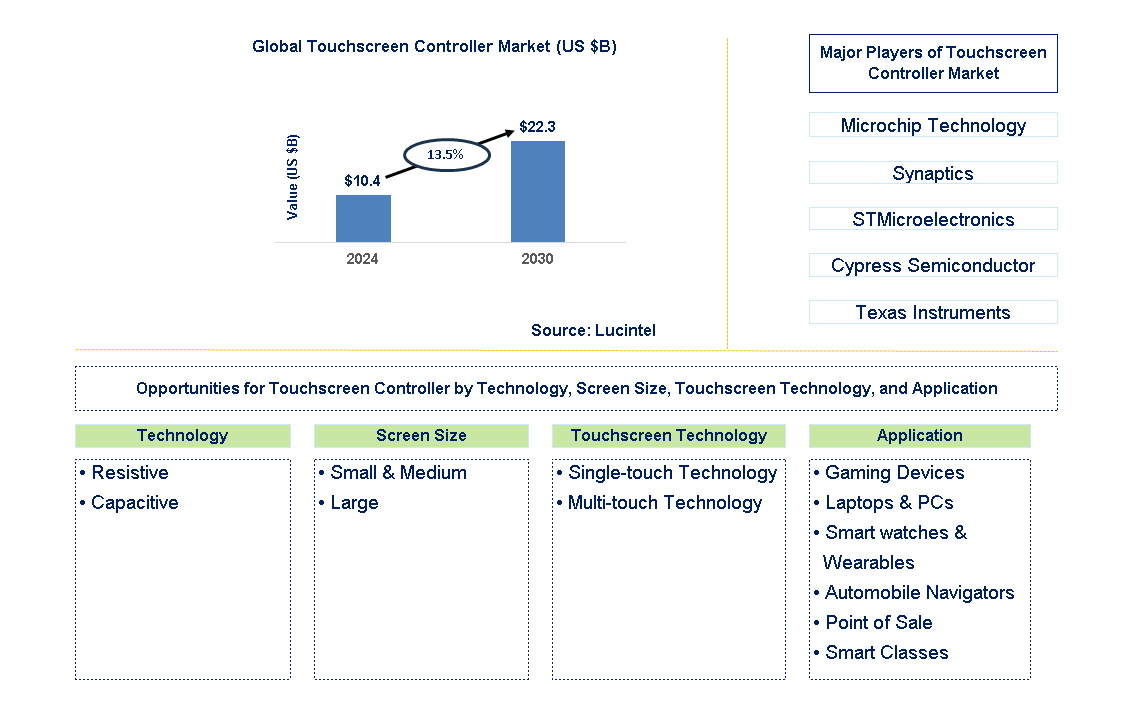
Key data points: The market size in 2030 = $22.3 billion, growth forecast = 13.5% annually for the next 6 years. Scroll below to get more insights. This market report covers trends, opportunities, and forecasts in the global touchscreen controller market to 2030 by technology (resistive and capacitive), screen size (small & medium and large), touchscreen technology (single-touch technology and multi-touch technology), application (gaming devices, laptops & pcs, smart watches & wearables, automobile navigators, point of sale, and smart classes), and region (North America, Europe, Asia Pacific, and the Rest of the World)
We'll send your sample report shortly.
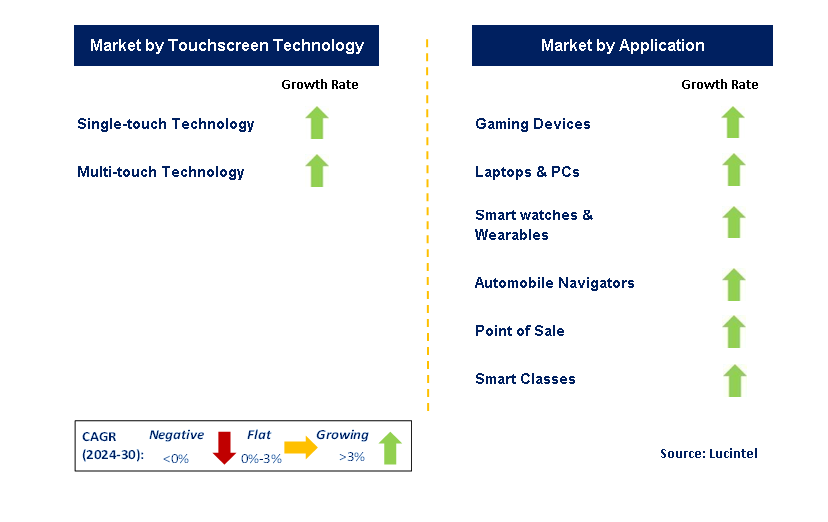
• Lucintel forecasts that, within the touchscreen technology category, multi-touch technology is expected to witness the highest growth over the forecast period due to growing demand for devices that require touchscreen technology supporting multi-touch features owing to the market for touchscreen controllers complying with the requirements of multi-touchscreen technology.
• In terms of regions, APAC will remain the largest region over the forecast period. Gain valuable insights for your business decisions with our 150+ page report.
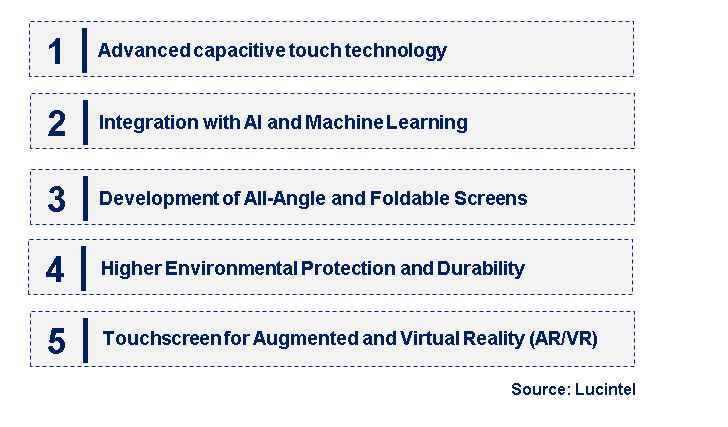
• Advanced capacitive touch technology: The evolution of textile touchscreen controllers towards advanced capacitive touch technology not only affects the former but also enables higher resolution support, improved multi-touch capabilities, and greater accuracy of the touch controllers. It improves the instant response of a touchscreen, thereby making it feasible for use in high-definition consumer electronics and interactive displays.
• Integration with AI and Machine Learning: There is a growing incorporation of artificial intelligence and machine learning components within touchscreen controllers, thus making them smarter and capable of more adaptive touch interfaces. Such controllers can observe user actions, behaviors, and preferences, which in turn redefine future interactions.
• Development of All-Angle and Foldable Screens: The development of flexible and foldable displays is also creating a demand for touchscreen controllers that address these needs. Systems must, therefore, be able to bend and fold while tolerating different forms of touch.
• Higher Environmental Protection and Durability: Developers are now focusing more on producing touchscreen controllers that improve in the areas of environmental adoption and durability while shielding against dust, water, or extreme temperature effects. This is particularly common in the industrial and motor vehicle sectors.
• Touchscreen for Augmented and Virtual Reality (AR/VR): As the advancement of AR and VR technologies expands, there is a need for touchscreen controllers that are immersive and interactive. In contrast, controllers designed for such uses must also be able to manage complicated gestures and augment responses. The touchscreen controller segment has new dynamic factors, such as improvements in capacitive touch technology, the incorporation of artificial intelligence, flexible screens, high-end ruggedness, and extensions into AR/VR applications. These factors positively affect the market by promoting development in touch interfaces and broadening their usage areas, including consumer electronics, automotive, and industrial applications. Such trends are bound to alter the designs and operations of touchscreen controllers and will open up new avenues and challenges within the market as they develop.
• Development of High-Resolution Controllers: Touchscreen controllers that allow for higher resolution and finer touch input have been designed. This is in response to the high definitions sought after in most consumer electronics, such as smartphones and tablets, and is also concerned with appropriate touch input resolution controls.
• A Thrust towards Energy Efficiency: The development of low-power touchscreen controllers has focused on improving battery performance in mobile gadget applications; energy efficiency has emerged as a priority in recent inventions.
• Extension into Automotive Applications: More types of touchscreen controllers are in production for use in cars' infotainment systems and advanced driver-assistance systems (ADAS). This entails making them more durable and enhancing their performance to meet automotive standards. The recent developments reported in the touchscreen controller market have been in terms of high-resolution support, gesture recognition, haptic feedback, energy efficiency, and automotive applications. These improvements enhance user satisfaction, functionality of devices, and adaptability of applications, thereby improving the future of touchscreen technology across different industries. As the industry develops, these advancements will be of utmost importance to satisfy the ever-expanding market needs and advancing interactive technology.
• Consumer Electronics: Touchscreen controllers represent a significant area of new growth in the consumer electronics sector, which has seen a major influx of smartphones, tablets, and smart home devices. Improvements in touch resolution, touch sensitivity, and multi-touch capabilities are enhancing user experiences.
• Automotive Industry: The automotive industry is quickly incorporating touchscreen controllers, particularly in entertainment systems, navigation systems, and advanced driver assistance systems. It has been noted that automotive applications require improved durability and high performance.
• Industrial Controls: The use of touchscreen controllers in industrial applications is also increasing, including interfaces for machinery, process control, and automation systems. Such devices must provide greater durability, reliability, and resistance to adverse conditions.
• Healthcare: Touchscreen controllers have been integrated into medical instruments, devices for monitoring patients, and electronic health records in the healthcare field. This integration has positively impacted design and usability, making it easier to control health data and interact with patients.
• Retail: Touchscreen controllers have also found their way into the retail environment, where they are used in banks for POS systems, in pharmacies for self-service kiosks, and in airports for interactive display systems. Enhanced usability of such controls increases procedural efficiency and improves customer engagement. The growth opportunities in the touchscreen controller market cover diverse sectors, including consumer electronics, automotive, industrial controls, healthcare, and retail. Each industry has specific requirements and opportunities for product enhancement, which spur improvements in touchscreen technologies. As these applications change, so too does the scope of the touchscreen controller market, expanding its frontiers for new opportunities for growth and technological development.
• Emerging Technologies: Development of better touchscreen technologies, such as enhanced capacitive touch, haptic feedback, and greater resolutions, push the market. Improvements in materials and processing of touch screens enhance the capability and usability of touchscreen features.
• Spiraling Customer Demand: Consumer demand for touchscreen controllers is driven by the increasing desire for proximity and touchscreen interaction with interactive devices. This trend is in tandem with the growth in the utilization of mobile devices, including smartphones, tablets, and smart home devices.
• Proliferation in Automotive Applications: The automotive sector is experiencing growth, facilitated by the increasing demand for touchscreen controllers as automakers move from traditional dashboards to more sophisticated infotainment, navigation, and ADAS systems. As more functionality is provided, greater robustness is anticipated.
• Increase in Industrial Automation: The progress of industrial automation and smart manufacturing has increased the need for touchscreen controllers that are durable and of high quality. Such controllers are found in machinery interfaces and are used in process control systems.
• Trends in Healthcare Technology/Programs: The use of touchscreen controllers in medical devices and patient monitoring systems not only facilitates usability but also improves information management. This trend is further heightened by the increasing demand for digital health. Challenges in the touchscreen controller market include:
• Cost Pressures: Advanced touchscreen technology can be so expensive that it restricts its application in developing countries where purchasing power is low. Manufacturers face pressure to maintain performance levels while controlling prices.
• Intense Competition: Competition in the touchscreen controller market is stiff, as many companies strive to gain a foothold. Such competition may result in pricing insurgencies and the need for constant innovation.
• Regulatory and Compliance Issues: Safety, environmental, electromagnetic compatibility, and other regulatory measures may deter the evolution and use of touchscreen controllers. Compliance with such standards presents an added difficulty and expense in product design. Adherence to these regulations is crucial for manufacturers if they are to sell their products in the marketplace and protect themselves against liabilities.
• Microchip Technology
• Synaptics
• STMicroelectronics
• Cypress Semiconductor
• Texas Instruments
• Broadcom
• Analog Devices
• Resistive
• Capacitive
• Small & Medium
• Large
• Single-touch Technology
• Multi-touch Technology
• Gaming Devices
• Laptops & PCs
• Smart watches & Wearables
• Automobile Navigators
• Point of Sale
• Smart Classes
• North America
• Europe
• Asia Pacific
• The Rest of the World
• United States: The newest trend in touchscreen controllers in the United States is the incorporation of advanced capacitive touch technology that improves accuracy and enhances the ability to utilize multiple touch points. Companies like Synaptics and Cypress Semiconductor are currently at the forefront of innovations, developing controllers that enhance high-tech displays and respond more quickly. Increased interest from companies in advanced consumer electronics and smart home devices continues to drive the need for developing controllers that can adapt touch sensitivity and respond well to various environmental conditions.
• China: China, like others, has developed low-cost and high-performance touchscreen controller technologies that mobilize efforts towards greater acceptability in mobile devices and consumer electronics. Firms like Goodix and FocalTech are advancing by developing stronger controllers that consume less energy. Another emphasis area in China is the addition of AI layers to touch controllers to facilitate user engagement and device performance.
• Germany: Germany has experienced advances in touchscreen controllers, particularly in precision and industrial applications. Companies like Infineon Technologies are producing strong and reliable controllers for automotive and other industrial applications. Additionally, many modified gesture controls and feedback technologies are being incorporated into touchscreen controllers to facilitate a more interactive user experience in sophisticated automotive and industrial systems.
• India: In India, attention is given to the development of touchscreen controllers with a focus on cost and efficiency to meet the ever-evolving demand associated with mobile devices and educational technologies. Different companies in the country are offering competitive solutions that provide acceptable pricing structures while maintaining quality standards. The demand for touchscreen controllers is driven by rising smartphone penetration and increasing digital interaction in educational technologies.
• Japan: Japan stands out for its work in producing high-performance touchscreen controllers suitable for high-end consumer devices, automotive applications, and industrial control systems. Major companies like Renesas Electronics focus on offering high-resolution solutions while emphasizing energy efficiency and multi-touch capabilities. With the push for greener technologies, Japan is producing controllers that are adaptable and environmentally friendly.


• Microchip Technology
• Synaptics
• STMicroelectronics
• Cypress Semiconductor
• Texas Instruments
• Broadcom
• Analog Devices Q6. Which touchscreen controller market segment will be the largest in future? Answer: Lucintel forecasts that multi-touch technology is expected to witness highest growth over the forecast period due to growing demand for devices which requires touchscreen technology supporting multi-touch features owing to the market for touchscreen controllers complying with the requirements of multi-touchscreen technology. Q7. In touchscreen controller market, which region is expected to be the largest in next 5 years? Answer: APAC will remain the largest region over the forecast period. Q.8 Do we receive customization in this report? Answer: Yes, Lucintel provides 10% customization without any additional cost.


Choose a license that fits your team. Instant PDF delivery.
Prices exclude taxes. Instant delivery. Custom licensing available on request.
Market Report · July 16, 2026
Market Report · May 18, 2026
Market Report · May 18, 2026
Trusted partner for strategic intelligence and business growth


Receive a complimentary market analysis tailored to your industry. Our analysts will identify key growth opportunities and competitive dynamics specific to your business.

Market size, growth rate, and key trend analysis for your specific sector.

Top competitor positioning and market share analysis.

Strategic recommendations backed by data-driven insights.
Get curated market intelligence and competitive moves straight to your inbox.
By subscribing, you agree to receive our monthly insights. Unsubscribe anytime.
Receive a complimentary market analysis tailored to your industry. Our analysts will identify key growth opportunities and competitive dynamics specific to your business.
Market size, growth rate, and key trend analysis for your specific sector.
Top competitor positioning and market share analysis.
Strategic recommendations backed by data-driven insights.
Get curated market intelligence, emerging trends, and competitive moves straight to your inbox each month.
By subscribing, you agree to receive our monthly insights. Unsubscribe anytime.
We'll send your sample report shortly.