
Market Report · July 29, 2026

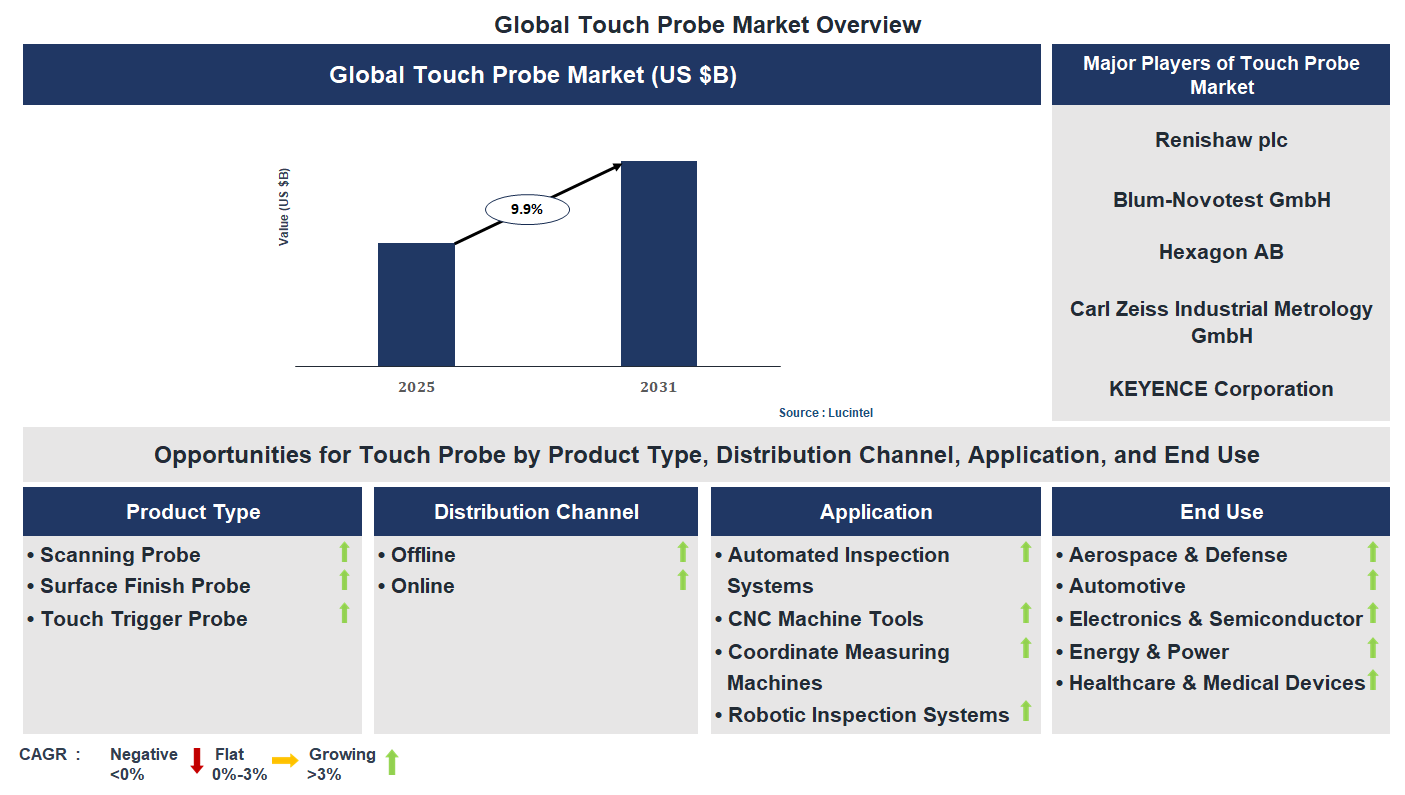
Key data points: The growth forecast = 9.9% annually for the next 7 years. Scroll below to get more insights. This market report covers trends, opportunities and forecasts in touch probe market to 2031 by product type (scanning probe, surface finish probe, and touch trigger probe), distribution channel (offline and online), application (automated inspection systems, CNC machine tools, coordinate measuring machines, and robotic inspection systems), end use (aerospace & defense, automotive, electronics & semiconductor, energy & power, and healthcare & medical devices), and region (North America, Europe, Asia Pacific, and the Rest of the World)
We'll send your sample report shortly.
• Lucintel forecasts that, within the product type category, surface finish probe is expected to witness the highest growth over the forecast period.
• Within the end use category, automotive is expected to witness the highest growth.
• In terms of region, North America is expected to witness the highest growth over the forecast period. Gain valuable insights for your business decisions with our comprehensive 150+ page report. Sample figures with some insights are shown below.
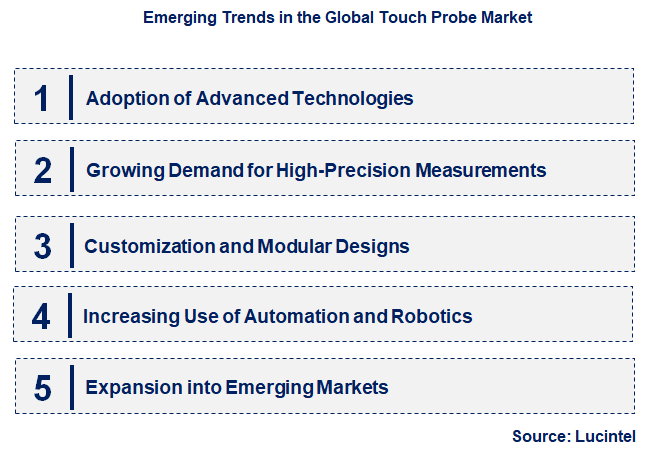
• Adoption of Advanced Technologies: Integration of digital and smart technologies is transforming touch probes. Innovations such as wireless connectivity, IoT-enabled probes, and AI-driven data analysis enhance measurement accuracy, reduce setup times, and enable real-time monitoring. These advancements improve operational efficiency and allow for predictive maintenance, minimizing downtime. As technology becomes more accessible, manufacturers are increasingly adopting these solutions to stay competitive and meet the rising demand for precision.
• Growing Demand for High-Precision Measurements: Industries like aerospace and automotive require extremely accurate measurements for quality control and product development. The market is witnessing a shift towards high-precision touch probes capable of delivering micron-level accuracy. This trend is driven by stricter quality standards and the need for complex component manufacturing. High-precision probes help reduce errors, improve product reliability, and ensure compliance with industry regulations, thereby boosting their adoption across various sectors.
• Customization and Modular Designs: Customers are seeking tailored solutions to meet specific application needs. Manufacturers are responding by offering customizable and modular touch probes that can be adapted for different machines and measurement tasks. This flexibility allows for better integration into existing workflows and enhances usability. Modular designs also facilitate easier maintenance and upgrades, extending the lifespan of measurement systems and providing cost-effective solutions for diverse industrial environments.
• Increasing Use of Automation and Robotics: The integration of touch probes with automated systems and robotic arms is gaining momentum. Automated measurement processes improve speed, consistency, and safety, especially in high-volume manufacturing. Robotics-enabled probes can operate in hazardous or hard-to-reach areas, expanding their application scope. This trend aligns with Industry 4.0 initiatives, promoting smarter factories and reducing human error, ultimately leading to higher productivity and quality assurance.
• Expansion into Emerging Markets: Developing regions are witnessing increased adoption of touch probes due to expanding manufacturing sectors and infrastructure investments. Market players are focusing on regional expansion, establishing local manufacturing facilities, and offering cost-effective solutions to penetrate these markets. This growth is driven by rising industrialization, government initiatives, and the need for quality control in emerging economies, which collectively contribute to the global markets expansion and diversification. In summary, these trends are fundamentally reshaping the touch probe market by enhancing technological capabilities, increasing precision, enabling customization, integrating automation, and expanding geographical reach. Collectively, they are driving market growth, improving product quality, and fostering innovation, positioning the industry for sustained development in the coming years.
• Integration of Digital Technologies: The adoption of digital and wireless touch probes has revolutionized measurement processes by enabling real-time data collection and remote monitoring. This integration improves accuracy, reduces setup time, and enhances overall productivity. Manufacturers are increasingly offering smart probes with IoT connectivity, facilitating seamless data transfer to control systems. The impact is a significant boost in efficiency and precision, especially in complex manufacturing environments, leading to broader adoption across industries.
• Development of High-Precision Probes: Advances in sensor technology have led to the creation of high-precision touch probes capable of measuring minute deviations with exceptional accuracy. These probes are crucial in industries like aerospace and electronics, where tolerances are extremely tight. The impact includes improved quality control, reduced scrap rates, and enhanced product reliability. As demand for precision grows, manufacturers are investing heavily in R&D to develop even more accurate and durable probes.
• Expansion into New Industries: Traditionally used in automotive and manufacturing sectors, touch probes are now increasingly adopted in emerging fields such as medical device manufacturing, renewable energy, and 3D printing. This diversification broadens the market scope and opens new revenue streams. The impact is a more resilient market with increased demand for specialized probes tailored to industry-specific requirements, fostering innovation and competition.
• Miniaturization and Portability: The trend toward smaller, portable touch probes has gained momentum, driven by the need for on-site, quick measurements in confined or hard-to-reach spaces. These compact probes facilitate faster inspections and reduce downtime. The impact includes enhanced flexibility for operators, cost savings, and the ability to perform measurements in diverse environments, thereby expanding the market reach and application versatility.
• Focus on Automation and Integration: The integration of touch probes with CNC machines and automated inspection systems has become a key development. Automated measurement processes improve consistency, reduce human error, and increase throughput. The impact is a significant enhancement in manufacturing efficiency, enabling Industry 4.0 initiatives. Companies investing in automation are gaining competitive advantages through faster production cycles and higher quality standards. In summary, these developments are transforming the touch probe market by increasing precision, expanding application areas, and integrating advanced digital and automation technologies. The market is becoming more efficient, versatile, and responsive to industry demands, fostering innovation and growth across multiple sectors.
• Enhanced precision for quality control : The automotive sector is increasingly adopting touch probes for complex component measurement, ensuring high-quality standards and reducing manufacturing errors. This leads to improved vehicle safety, performance, and customer satisfaction, driving market growth.
• Lightweight and high-accuracy applications : Aerospace manufacturers utilize touch probes for intricate part inspection, where precision and reliability are critical. The demand for lightweight, durable components boosts the need for advanced measurement solutions, expanding market opportunities.
• Miniaturization and high-speed production : As electronic devices become smaller and more complex, touch probes facilitate rapid, accurate measurements of tiny components. This accelerates production cycles and enhances product quality, fueling growth in this segment.
• Precision in medical device manufacturing : The healthcare industry requires exact measurements for medical devices and implants. Touch probes enable manufacturers to meet stringent regulatory standards, ensuring safety and efficacy, thus opening new avenues for market expansion.
• Automation and Industry 4.0 integration : The push towards smart factories and automation drives demand for touch probes that support real-time data collection and process optimization. This integration enhances productivity and reduces costs, contributing to overall market growth. In summary, these growth opportunities across diverse applications are significantly impacting the touch probe market by fostering innovation, improving measurement accuracy, and supporting the shift towards automated, high-precision manufacturing environments. As industries continue to evolve, the market is poised for sustained expansion driven by these strategic opportunities.
• Technological Advancements: The continuous evolution of manufacturing processes, such as CNC machining and automation, necessitates high-precision measurement tools like touch probes. Innovations in probe design, including wireless and contactless options, enhance efficiency and accuracy, leading to increased adoption. Integration with digital systems and IoT connectivity allows real-time data collection and analysis, further boosting market growth. These technological improvements reduce setup times and improve product quality, making touch probes indispensable in modern manufacturing environments.
• Growing Manufacturing Sector: The expansion of automotive, aerospace, and electronics industries globally fuels demand for precise measurement solutions. As these sectors aim for higher quality standards and complex component designs, the need for accurate, reliable measurement tools becomes critical. Increased production volumes and the adoption of automation technologies in manufacturing plants contribute significantly to market growth. The rising focus on reducing errors and improving efficiency further propels the adoption of touch probes across various manufacturing processes.
• Emphasis on Quality Control and Precision: Stringent quality standards imposed by regulatory bodies and industry certifications compel manufacturers to adopt advanced measurement tools. Touch probes enable precise, non-destructive measurement of complex geometries, ensuring products meet strict specifications. This focus on quality control reduces rework, scrap, and warranty costs, providing a competitive advantage. As industries continue to prioritize high-quality outputs, the demand for sophisticated touch probe solutions is expected to rise steadily.
• Increasing Adoption of Automation and Industry 4.0: The shift towards automated manufacturing systems and Industry 4.0 initiatives emphasizes real-time data collection and process optimization. Touch probes are integral to these systems, providing accurate measurements that feed into automated quality assurance processes. Their ability to facilitate seamless integration with CNC machines and robotic systems enhances productivity and reduces manual intervention. This trend is expected to accelerate the market growth as manufacturers seek smarter, more connected production environments.
• Rising Investment in R&D: Companies are investing heavily in research and development to improve touch probe technology, making devices more accurate, durable, and easier to use. R&D efforts focus on developing contactless and wireless probes, as well as enhancing compatibility with digital manufacturing systems. These innovations help meet evolving industry demands and open new application areas. Increased R&D activity also fosters competitive differentiation, encouraging market players to innovate continuously and expand their product portfolios. The challenges in the touch probe market are:
• High Cost of Advanced Touch Probes: The sophisticated features and technological complexity of modern touch probes often result in high manufacturing and procurement costs. Small and medium-sized enterprises may find it difficult to justify the investment, limiting market penetration in cost-sensitive regions. Additionally, maintenance and calibration expenses add to the total cost of ownership, potentially hindering widespread adoption. Overcoming cost barriers requires manufacturers to develop more affordable yet reliable solutions to expand market reach.
• Technological Complexity and Skill Gap: The integration of advanced touch probes with CNC machines and digital systems demands specialized knowledge and technical expertise. A lack of skilled personnel can impede proper installation, calibration, and maintenance, leading to suboptimal performance. This skill gap poses a significant challenge, especially in regions with limited technical training infrastructure. Addressing this issue involves providing comprehensive training and developing user-friendly interfaces to facilitate broader adoption.
• Regulatory and Standardization Challenges: Variations in industry standards and regulatory requirements across different regions create compliance complexities for touch probe manufacturers. Ensuring that products meet diverse safety, quality, and environmental standards can delay product launches and increase costs. Additionally, evolving regulations require continuous updates and certifications, which can be resource-intensive. Navigating these regulatory landscapes is crucial for market players aiming for global expansion and sustained growth. In summary, the touch probe market is driven by technological innovations, expanding manufacturing sectors, quality emphasis, automation adoption, and R&D investments. However, high costs, technological complexity, and regulatory hurdles pose significant challenges. These factors collectively influence market dynamics, with growth opportunities emerging from ongoing technological advancements and industry shifts. Addressing the challenges effectively will be key for stakeholders to capitalize on the market’s full potential and sustain competitive advantage in a rapidly evolving landscape.
• Renishaw plc
• Blum-Novotest GmbH
• Hexagon AB
• Carl Zeiss Industrial Metrology GmbH
• KEYENCE Corporation
• Nikon Corporation
• Mitutoyo Corporation
• Mahr GmbH
• Optical Gaging Products, Inc.
• Dr. Johannes Heidenhain GmbH
• Scanning Probe
• Surface Finish Probe
• Touch Trigger Probe
• Offline
• Online
• Automated Inspection Systems
• CNC Machine Tools
• Coordinate Measuring Machines
• Robotic Inspection Systems
• Aerospace & Defense
• Automotive
• Electronics & Semiconductor
• Energy & Power
• Healthcare & Medical Devices
• North America
• Europe
• Asia Pacific
• The Rest of the World
• United States: The US market for touch probes has seen increased adoption in aerospace, automotive, and electronics sectors. Innovations in digital and wireless touch probes have improved measurement accuracy and ease of use. Major players are investing in R&D to develop smart probes with integrated sensors and IoT connectivity, enhancing real-time data collection and analysis. The US government’s focus on manufacturing automation and Industry 4.0 initiatives further boost market growth. Additionally, the rise of additive manufacturing and robotics integration has expanded the application scope of touch probes in complex assembly lines.
• China: China continues to dominate the global market with rapid industrial expansion and technological adoption. The country has seen a surge in demand for touch probes in automotive, machinery, and consumer electronics manufacturing. Local manufacturers are increasingly investing in advanced probe technologies, including multi-sensor probes and high-speed measurement systems. Government policies supporting smart manufacturing and automation have accelerated market growth. China’s focus on cost-effective solutions and mass production capabilities has led to the development of affordable yet high-performance touch probes, strengthening its position as a key market player.
• Germany: Germany remains a leader in precision engineering and manufacturing, with a strong emphasis on quality and innovation. The German market for touch probes is characterized by the integration of high-precision probes in automotive and industrial machinery sectors. Companies are adopting advanced materials and miniaturized probe designs to meet stringent standards. Germany’s focus on Industry 4.0 and digital twin technologies has driven the development of intelligent touch probes capable of seamless integration with manufacturing systems. The emphasis on sustainable and energy-efficient solutions also influences product development, ensuring competitiveness in the global market.
• India: The Indian market is witnessing rapid growth driven by expanding manufacturing sectors such as automotive, aerospace, and electronics. Increasing investments in automation and quality control are fueling demand for touch probes. Local companies are adopting innovative, cost-effective solutions to cater to small and medium enterprises. The government’s Make in India initiative and push towards smart manufacturing are creating a conducive environment for market expansion. Additionally, the rise of startups and technological collaborations are fostering the development of advanced touch probe solutions tailored to regional needs, boosting overall market penetration.
• Japan: Japan’s touch probe market is characterized by high precision and technological innovation. The country’s focus on robotics, automotive, and electronics manufacturing has led to the adoption of sophisticated touch probe systems. Japanese companies are investing in miniaturization, durability, and integration with automated systems to enhance measurement accuracy. The emphasis on quality assurance and continuous improvement aligns with Japan’s industrial standards. Furthermore, advancements in sensor technology and the integration of AI for predictive maintenance are shaping the future of the Japanese touch probe market, ensuring its competitiveness in global high-tech manufacturing sectors.


• Renishaw plc
• Blum-Novotest GmbH
• Hexagon AB
• Carl Zeiss Industrial Metrology GmbH
• KEYENCE Corporation
• Nikon Corporation
• Mitutoyo Corporation
• Mahr GmbH
• Optical Gaging Products, Inc.
• Dr. Johannes Heidenhain GmbH Q5. Which touch probe market segment will be the largest in future? Answer: Lucintel forecasts that, within the product type category, surface finish probe is expected to witness the highest growth over the forecast period. Q6. In touch probe market, which region is expected to be the largest in next 5 years? Answer: In terms of region, North America is expected to witness the highest growth over the forecast period. Q7. Do we receive customization in this report? Answer: Yes, Lucintel provides 10% customization without any additional cost.


Choose a license that fits your team. Instant PDF delivery.
Prices exclude taxes. Instant delivery. Custom licensing available on request.
Market Report · July 29, 2026
Market Report · July 20, 2026
Market Report · July 20, 2026
Trusted partner for strategic intelligence and business growth


Receive a complimentary market analysis tailored to your industry. Our analysts will identify key growth opportunities and competitive dynamics specific to your business.

Market size, growth rate, and key trend analysis for your specific sector.

Top competitor positioning and market share analysis.

Strategic recommendations backed by data-driven insights.
Get curated market intelligence and competitive moves straight to your inbox.
By subscribing, you agree to receive our monthly insights. Unsubscribe anytime.
Receive a complimentary market analysis tailored to your industry. Our analysts will identify key growth opportunities and competitive dynamics specific to your business.
Market size, growth rate, and key trend analysis for your specific sector.
Top competitor positioning and market share analysis.
Strategic recommendations backed by data-driven insights.
Get curated market intelligence, emerging trends, and competitive moves straight to your inbox each month.
By subscribing, you agree to receive our monthly insights. Unsubscribe anytime.
We'll send your sample report shortly.