
Market Report · July 15, 2026

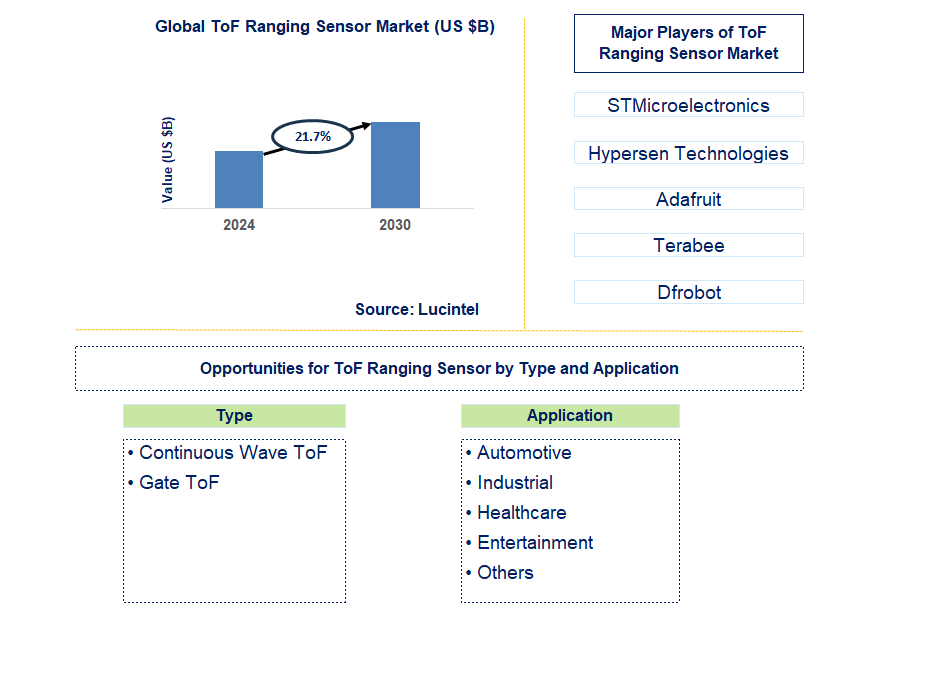
Key data points: The growth forecast = 21.7% annually for the next 6 years. Scroll below to get more insights. This market report covers trends, opportunities, and forecast in the global tof ranging sensor market to 2030 by type (continuous wave ToF and gate ToF), application (automotive, industrial, healthcare, entertainment, and others), and region (North America, Europe, Asia Pacific, and the Rest of the World)
We'll send your sample report shortly.
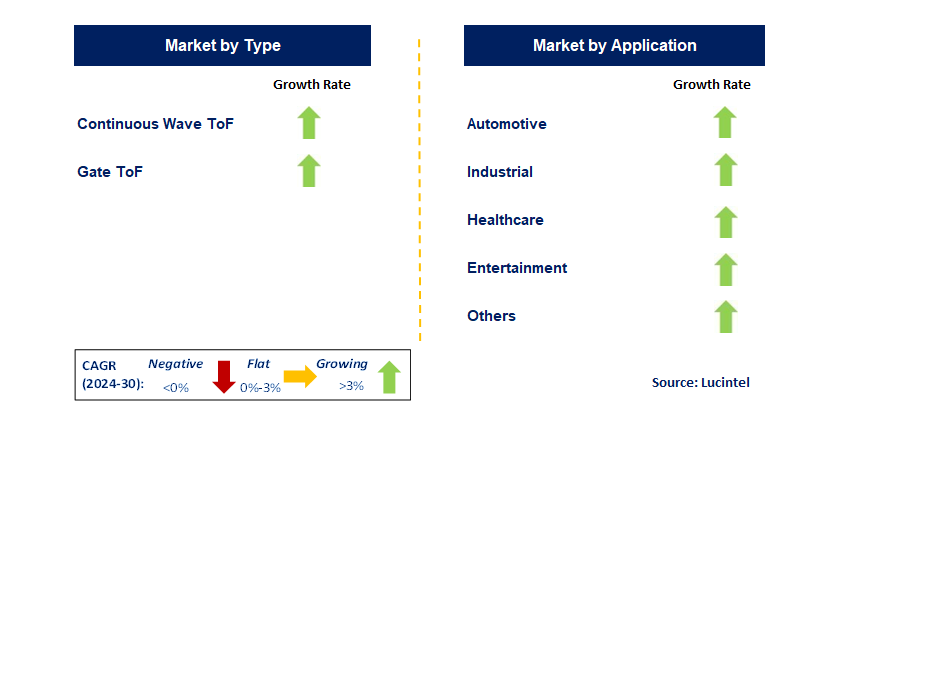
• Lucintel forecasts that, within the type category continuous wave ToF is expected to witness higher growth over the forecast period.
• Within the application category, automotive is expected to witness the highest growth.
• In terms of regions, North America is expected to witness the highest growth over the forecast period. A more than 150-page report is developed to help in your business decisions.
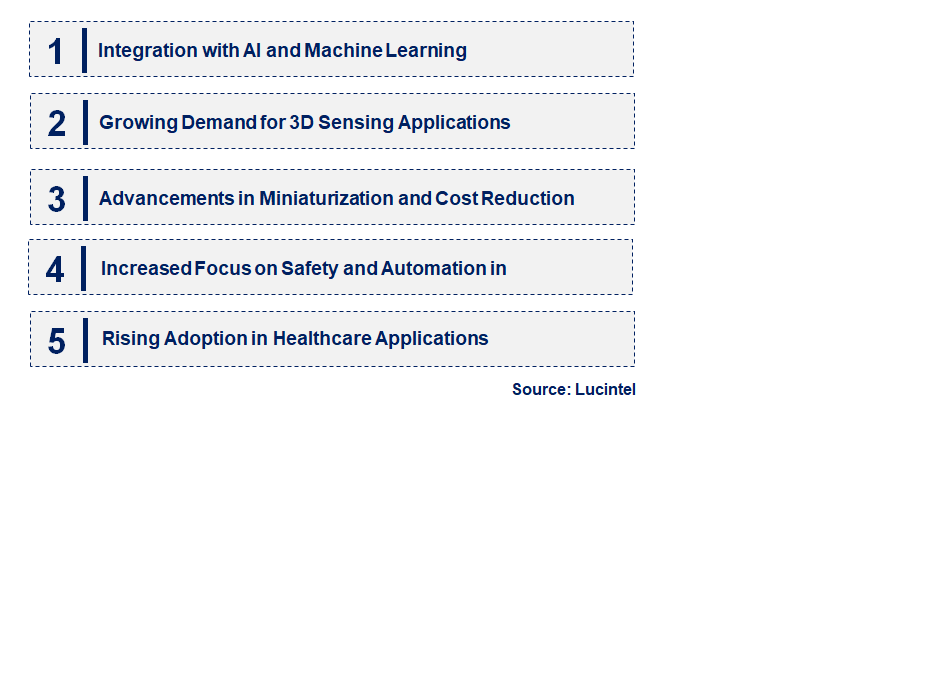
• Integration with AI and Machine Learning: Artificial Intelligence (AI) and Machine Learning (ML) are becoming major trends in the application of ToF (Time of Flight) sensor technology. These technologies expand the capabilities of ToF sensors by enabling more advanced applications, such as gesture and spatial mapping. When combined with ToF sensors, AI improves data interpretation, leading to advancements in fields like robotics and consumer electronics.
• Growing Demand for 3D Sensing Applications: The demand for 3D sensing technologies is increasing in many sectors, including smartphones, gaming, and industrial automation. ToF sensors are increasingly used for facial recognition, gesture recognition, gesture control, and object detection. This development is fueling competition among manufacturers, prompting them to develop more advanced ToF solutions that enhance the efficiency and reliability of 3D sensing applications.
• Advancements in Miniaturization and Cost Reduction: Miniaturization of ToF sensors is becoming a key trend, as more manufacturers seek to design compact and low-cost solutions. Smaller sensors will lead to broader applications, especially with the integration of sensors in wearable devices and IoT systems. Balancing performance improvements with cost reduction is crucial, especially in the consumer electronics market.
• Increased Focus on Safety and Automation in Automotive: The automotive industry is increasingly focusing on safety and automation, which is driving the demand for ToF sensors in autonomous vehicles and ADAS applications. These sensors help reduce accidents by improving distance measurement and situational awareness. As technological advancements continue in the automotive sector, the use of ToF sensors will expand to develop additional safety features.
• Rising Adoption in Healthcare Applications: ToF sensors are seeing growing use in healthcare, particularly in non-contact measurement and monitoring. These sensors allow for patient monitoring without physical contact, which has become especially relevant in the post-COVID-19 era. This shift is driven by the growing need for remote healthcare solutions. These emerging trends are reshaping the ToF ranging sensor market by fostering creativity and opening new application areas. The integration of AI, the expansion of 3D sensing applications, miniaturization, and the growth of automotive safety features all demonstrate the potential applications of ToF sensors. As these trends evolve, they will significantly influence the market's growth and the development of new technologies.
• Launch of Advanced ToF Sensor Models: Several companies are introducing advanced ToF sensors with higher accuracy and longer distance ranges than ever before. These sensors are designed to meet the evolving needs of applications such as robotics and industrial automation. The launch of these models positively impacts the performance and efficiency of ToF solutions, increasing market competition and adding value for consumers.
• Diverse Applications in Mobile Devices: The ToF sensor market is expanding into the consumer electronics sector, with manufacturers integrating ToF technology into smartphones, tablets, and smart home devices. This trend is driven by the growing demand for enhanced user experiences, including facial recognition and gesture control, which requires smaller and more efficient ToF sensors.
• Liaison and Networks: The collaboration between technology firms and manufacturers is increasing, helping to advance the development of ToF sensors for ADAS systems and autonomous vehicles. Innovations are being made that extend the functionality of sensors beyond traditional applications, reducing the time required to bring new technologies to market.
• Emphasis on Energy Preservation: Manufacturers are focusing on reducing energy consumption while maintaining performance levels. This is particularly important for battery-powered devices and wearable technology that rely on the Internet of Things (IoT). The development of low-power ToF sensors is expanding their applicability across various devices.
• Use of ToF Sensors in Smart Manufacturing: The adoption of ToF sensors in smart factories is growing as companies strive to improve automation and efficiency. ToF sensors help with tasks like distance measurement, object detection, and process automation, improving precision and efficiency in manufacturing. This trend is positioning ToF technology as a key player in Industry 4.0 approaches. Based on expert analyses of business strategies, technological advancements, and manufacturing capabilities, the ToF ranging sensor market is set to experience continued growth. The trends and drivers discussed above will shape the future market prospects for ToF sensors in healthcare and other sectors.
• Automotive Safety and Automation: The penetration of ToF sensors in stereo camera systems is currently lower compared to their use in ToF camera SoC modules. However, there are growth prospects in the automotive industry, particularly in safety and autonomous driving applications. As more vehicle manufacturers adopt advanced safety technologies like ADAS, the demand for accurate ToF sensors will continue to grow, driving innovation in automotive-oriented sensor technology.
• Consumer Electronics and Smart Devices: The growing demand for smart devices, including smartphones and smart appliances, is driving the need for ToF sensors. Companies should seize the opportunity to develop compact and high-performing ToF sensors that enhance user interactions, incorporating features like facial recognition, augmented reality, and gesture-based controls.
• Healthcare and Medical Applications: The use of ToF sensors in healthcare is increasing, particularly for non-contact measurement and monitoring applications. There are significant opportunities for creating new products for patient monitoring, diagnostics, and telemedicine. With the rising focus on remote medical care, ToF sensors will play a crucial role in improving patient care and safety.
• Industrial Automation and Robotics: The growing influence of industrial automation and robotics is opening new market opportunities for ToF sensors. These sensors are being used in distance measurement, object detection, and environmental sensing applications in manufacturing processes. Companies focusing on integrating ToF technology into automation systems are likely to gain a competitive edge in the industry.
• Smart Cities and Infrastructure Development: The development of smart cities is driving the demand for ToF sensors in applications such as traffic management, security, and environmental monitoring. As governments invest in smart infrastructure, the need for reliable and efficient ToF solutions will grow, providing companies with opportunities to innovate and expand their market presence. These strategic growth opportunities in the ToF ranging sensor market present a strong case for innovation and diversification across various applications. ToF technology offers significant opportunities for companies in automotive, consumer electronics, healthcare, industrial automation, and smart city sectors. As these opportunities evolve, they will define the future direction of ToF sensor applications.
• Technological Advancements in Sensing Solutions: The increase in market volume is driven by ongoing improvements in sensor technologies. Advances in laser technology, semiconductor materials, and signal processing methods enhance the feasibility and usability of ToF sensors. These developments enable manufacturing firms to produce high-accuracy sensors in demand across various industries.
• Growing Demand for Automation and Smart Technologies: A major factor fueling the ToF sensor market is the increasing demand for automation and smart technologies in sectors such as automotive, healthcare, and consumer electronics. As technologies continue to advance, driving productivity and enhancing user interaction, the demand for efficient and effective sensing solutions will continue to rise.
• Government Initiatives Supporting Technology Development: Government policies and funding aimed at advancing technology development create a favorable market environment for the ToF sensor industry. Research and development in critical fields like automotive and healthcare inspire companies to innovate, driving market growth.
• Ramping Up Consumer Awareness Regarding Safety and Security: Rising consumer awareness regarding safety and security is creating demand for advanced sensing solutions across industries, particularly in automotive safety systems and smart home devices. As consumers seek greater assurance and security, ToF sensors are becoming increasingly essential in enhancing safety features and user satisfaction.
• Economic Factors Affecting Market Investments: Fluctuations in the economy, investment levels, and consumer spending can slow the growth of the ToF sensor market. Companies may face challenges in securing funding for R&D projects, which could limit innovation and reduce competitiveness in an ever-changing business environment. Challenges in the ToF ranging sensor market include:
• Market Competition and Margin Erosion: The ToF sensor market is highly competitive, with numerous players vying for market share. Intense competition often leads to price undercutting, resulting in reduced profitability for manufacturers. Companies must continuously innovate and find new uses for their existing products to stay competitive and maintain profit margins.
• Integration Challenges: Integrating ToF sensors into existing systems can be challenging for manufacturers and end-users. There is a need for R&D to develop technologies that can easily integrate with different systems. This difficulty may slow consumer adoption and hinder market expansion.
• Legal Aspects and Compliance: ToF sensor companies must comply with various legal, statutory, and industry regulations. Non-compliance can result in penalties and hinder market entry. Companies must continuously evolve to meet regulatory changes and ensure compliance. The commercial ToF ranging sensors market is shaped by several factors, including demand, technological advancements, government support, public knowledge, and economic factors. While competition, integration challenges, and legal restrictions present constraints, understanding these dynamics is critical for businesses seeking to position themselves in this rapidly changing market.
• STMicroelectronics
• Hypersen Technologies
• Adafruit
• Terabee
• Dfrobot
• Dragino
• Daoki
• Tinytronics
• RP Electronics
• Waveshare
• Continuous Wave ToF
• Gate ToF
• Automotive
• Industrial
• Healthcare
• Entertainment
• Others
• North America
• Europe
• Asia Pacific
• The Rest of the World
• United States: In the US, the ToF ranging sensor market is experiencing rapid growth due to advancements in autonomous vehicle technology and intelligent home appliances. There is a strong demand for ToF sensors with high accuracy and long-range capabilities. Additionally, the fast development of artificial intelligence and machine learning technologies is enhancing the functionality of ToF sensors, particularly in applications such as gesture recognition and environmental mapping, further boosting market growth.
• China: China is quickly becoming a dominant player in the ToF ranging sensor market, thanks to government support for smart city projects and the robotics industry. Local companies are focusing their resources on research and development to produce cost-effective ToF sensors for use in industrial automation and consumer devices, such as cameras. Furthermore, the growing adoption of mobile devices with 3D sensing capabilities is contributing to the expansion of the ToF sensor market.
• Germany: In Germany, the ToF sensor market is primarily driven by the automotive sector, particularly in the development of driver assistance (ADAS) and self-driving vehicle technologies. To improve vehicle safety and navigation, German companies are focusing on the development of advanced, reliable, and precise Time-of-Flight sensors. Increased collaboration between automotive manufacturers and technology providers is strengthening the country's competitiveness in the global ToF sensor market, which is increasingly driven by high-precision applications.
• India: In India, ToF ranging sensors are gaining popularity as the country embraces digital transformation and smart devices. With the government’s push for digitalization and smart manufacturing, there are strong prospects for ToF sensor deployment in industrial applications and consumer electronics. Additionally, local startups are developing custom ToF solutions tailored to the specific needs of the Indian market, further fostering growth in this sector.
• Japan: Japan has seen notable developments in the ToF ranging sensor market, particularly in robotics and consumer electronics. Japanese companies are leading the production of compact and advanced ToF sensors, which are ideal for applications such as augmented reality and gaming. The pursuit of perfecting the user experience, especially through accurate gesture recognition and environmental sensing, is a key motivation behind Japan’s leadership in ToF sensor technology.


• STMicroelectronics
• Hypersen Technologies
• Adafruit
• Terabee
• Dfrobot
• Dragino
• Daoki
• Tinytronics
• RP Electronics
• Waveshare Q5. Which ToF-ranging sensor market segment will be the largest in the future? Answer: Lucintel forecasts that continuous wave ToF is expected to witness higher growth over the forecast period. Q6. In the ToF ranging sensor market, which region is expected to be the largest in the next 5 years? Answer: North America is expected to witness the highest growth over the forecast period. Q.7 Do we receive customization in this report? Answer: Yes, Lucintel provides 10% customization without any additional cost.


Choose a license that fits your team. Instant PDF delivery.
Prices exclude taxes. Instant delivery. Custom licensing available on request.
Market Report · July 15, 2026
Market Report · July 13, 2026
Market Report · July 13, 2026
Trusted partner for strategic intelligence and business growth


Receive a complimentary market analysis tailored to your industry. Our analysts will identify key growth opportunities and competitive dynamics specific to your business.

Market size, growth rate, and key trend analysis for your specific sector.

Top competitor positioning and market share analysis.

Strategic recommendations backed by data-driven insights.
Get curated market intelligence and competitive moves straight to your inbox.
By subscribing, you agree to receive our monthly insights. Unsubscribe anytime.
Receive a complimentary market analysis tailored to your industry. Our analysts will identify key growth opportunities and competitive dynamics specific to your business.
Market size, growth rate, and key trend analysis for your specific sector.
Top competitor positioning and market share analysis.
Strategic recommendations backed by data-driven insights.
Get curated market intelligence, emerging trends, and competitive moves straight to your inbox each month.
By subscribing, you agree to receive our monthly insights. Unsubscribe anytime.
We'll send your sample report shortly.