
Market Report · May 18, 2026

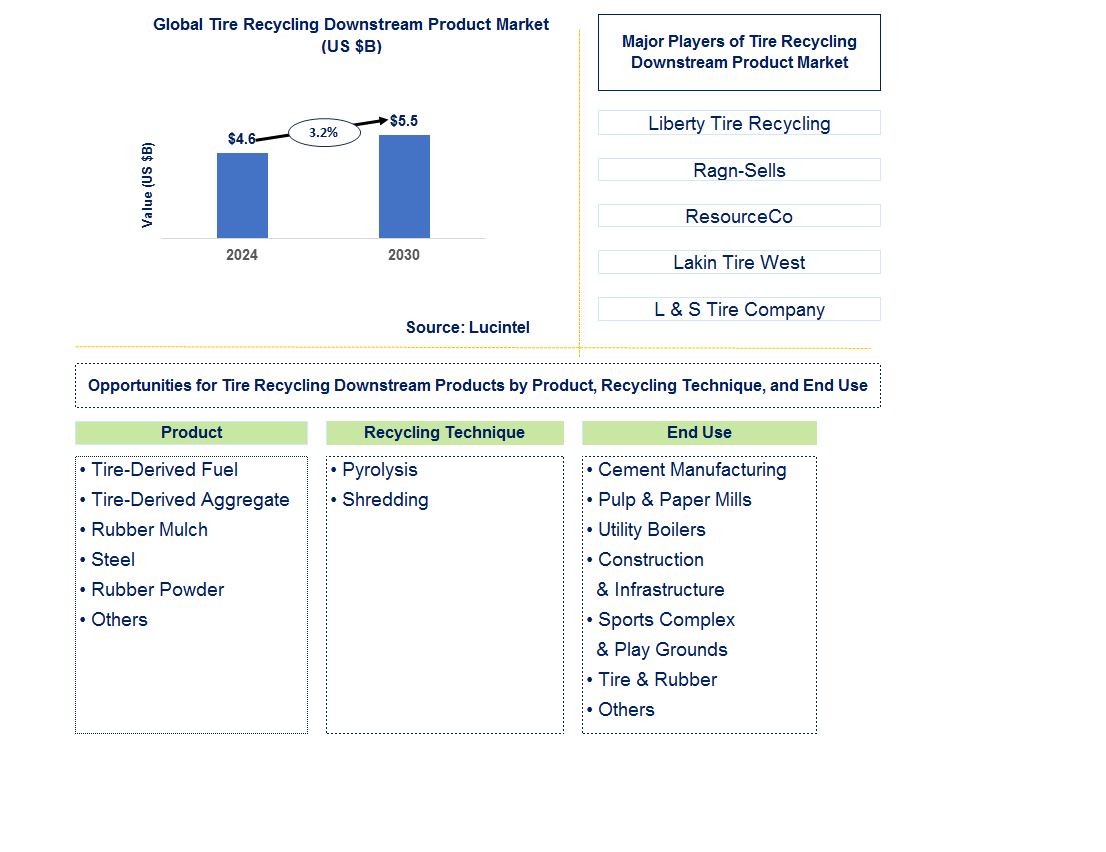
Key data points: The market size in 2030 = $5.5 billion, growth forecast = 3.2% annually for the next 6 years. Scroll below to get more insights. This market report covers trends, opportunities, and forecasts in the global tire recycling downstream product market to 2030 by product (tire-derived fuel, tire-derived aggregate, rubber mulch, steel, rubber powder, and others), recycling technique (pyrolysis and shredding), end use (cement manufacturing, pulp & paper mills, utility boilers, construction & infrastructure, sports complex & play grounds, tire & rubber, and others), and region (North America, Europe, Asia Pacific, and the Rest of the World)
We'll send your sample report shortly.
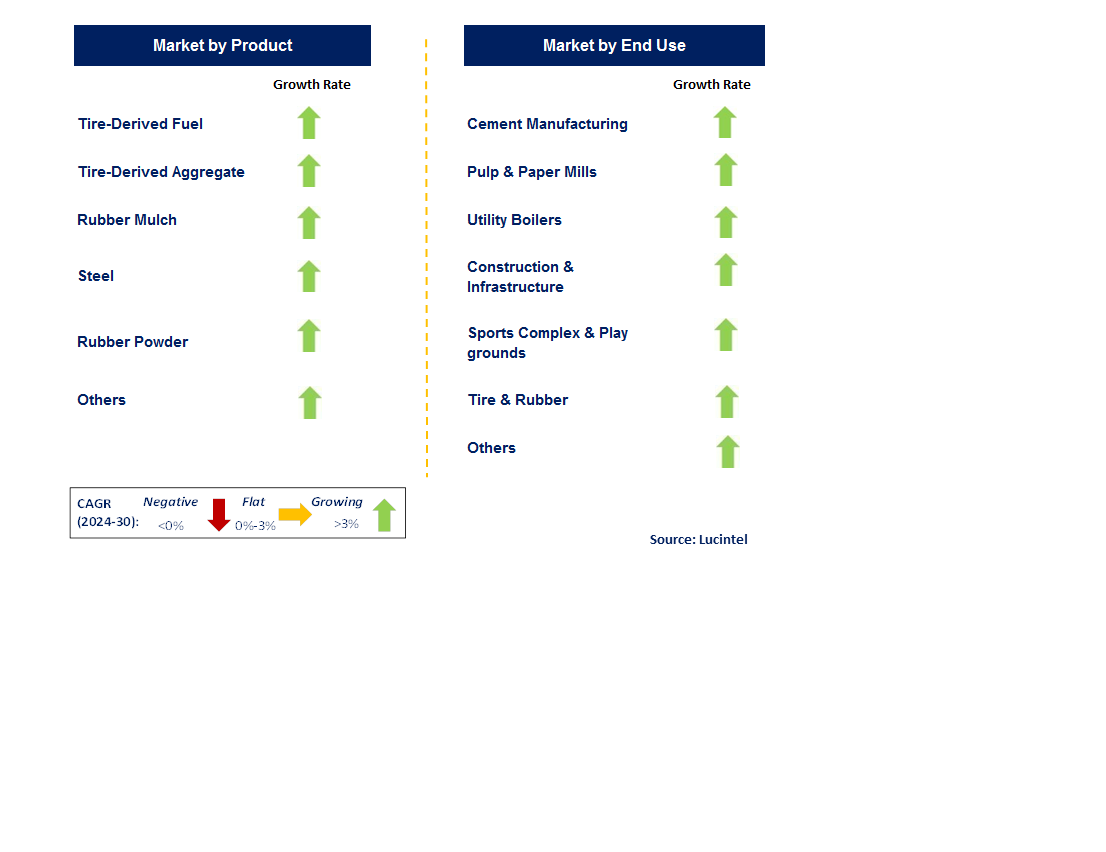
• Lucintel forecasts that, within the product category, rubber powder is expected to witness the highest growth over the forecast period as it can be repurposed, reworked, or manually fashioned into new goods.
• Within the end-use category, construction & infrastructure is expected to witness the highest growth due to rising demand for high-performance road construction materials to avoid cracks and holes.
• In terms of regions, APAC is expected to witness the highest growth over the forecast period due to growing industrialization and urbanization in developing economies like China and India. Gain valuable insights for your business decisions with our comprehensive 150+ page report.
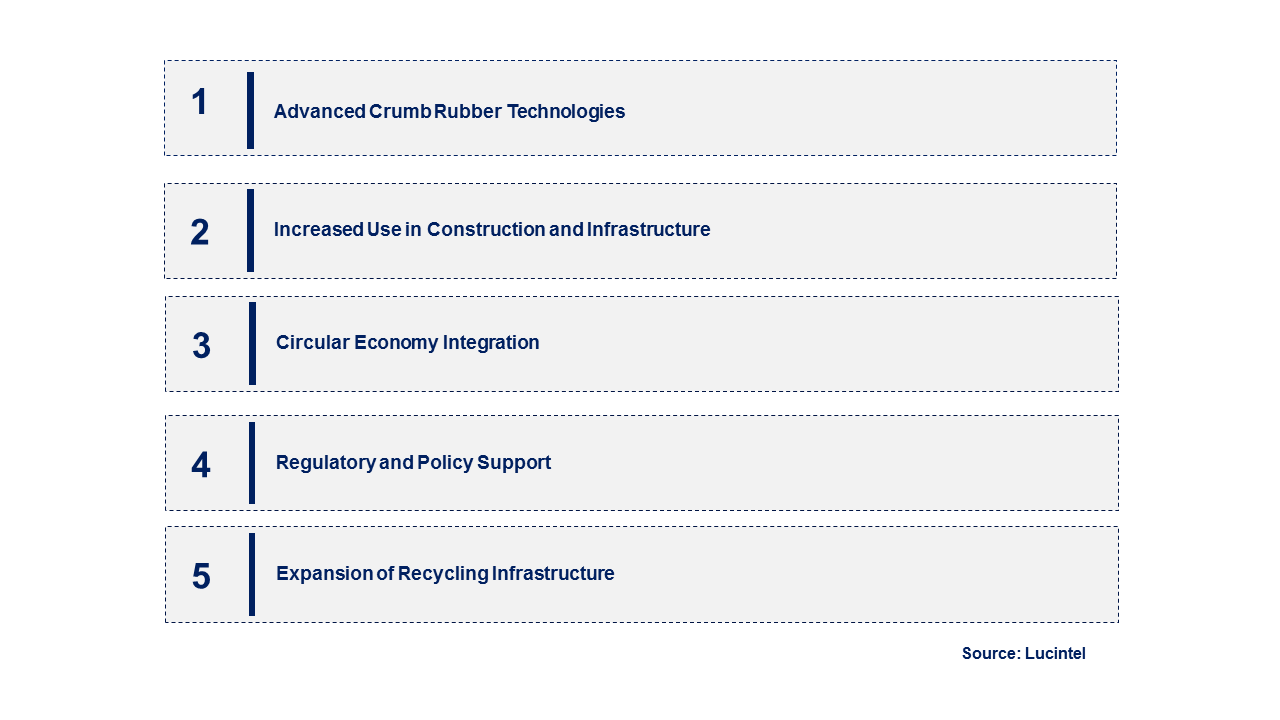
• Advanced Crumb Rubber Technologies: Innovative crumb rubber processing technologies have resulted in increased quality and performance of recycled rubber. Crumb rubber can now be made more uniform and functional through techniques such as cryogenic grinding and micronization, thereby increasing its attractiveness and application range for asphalt mixes and playground surfaces.
• Increased Use in Construction and Infrastructure: Recycled tire products are increasingly being used in building and infrastructure projects. Roadbeds, pavement materials, and asphalt mixtures are among some of the areas where crumb rubber is used, which helps to improve durability while reducing noise pollution, hence widening its marketing potential.
• Circular Economy Integration: There is growing integration of circular economy principles into tire recycling. This includes designing products for easy disassembly and recycling, advocating for the reuse of materials, and adopting closed-loop systems that promote sustainability during the recycling process, ensuring resources are used optimally.
• Regulatory and Policy Support: To increase tire recycling percentages and promote the use of recycled materials, governments have begun to impose stricter regulations and incentives. The policies are geared towards higher recycling targets, environmental protection, and support for advanced technology in recycling as a way of encouraging growth, thus driving industry growth.
• Expansion of Recycling Infrastructure: The market is witnessing heavy investments in recycling infrastructure, including new processing facilities and automation being adopted. These investments increase the amount of waste that can be handled by creating more processing capacity, thus improving efficiency. Technological innovation, increased application areas, and improved sustainability are some trends currently reshaping the tire recycling downstream product market. Tire recycling processes have received a boost from advanced technologies, regulatory support, and infrastructure development, which has led to an increase in efficiency.
• Implementation of Advanced Processing Technologies: This includes cryogenic grinding and micronization processes that are being used to improve crumb rubber quality for various applications. Consequently, these innovations stimulate the demand for both playground surfaces and asphalt with rubberized concrete place mats, thus pushing forward this industry through its expansion and promotion mechanisms.
• Expansion of Recycling Facilities: Significant investments have been made into establishing new recycling facilities and expanding existing ones. These facilities adopt automated systems and next-generation technologies, thus increasing their processing capabilities and enhancing efficiency when dealing with tire waste.
• Strengthening of Regulatory Frameworks: To increase the rates at which tires are recycled, governments have introduced tighter controls on businesses involved in this sector. Furthermore, regulations provide for high levels of recyclable materials to be utilized within specific limits, thereby aligning with global directions set out for sustainable development.
• Growth in End-Use Applications: Different industries, such as construction, infrastructure, and sports, are utilizing recycled tire products. This is due to the growing need for sustainable materials and the benefits that come with using them in these sectors.
• Development of Circular Economy Models: The tire recycling industry is increasingly adopting circular economy models. These models promote material reuse, design for disassembly, and closed-loop systems that enhance resource efficiency while reducing waste, thus meeting sustainability targets. These developments are advancing the tire recycling downstream product market by improving technology, expanding infrastructure, and enhancing regulatory compliance. The focus on efficient processing, sustainable practices, and expanded applications is driving market growth and innovation.
• Development of High-Performance Crumb Rubber: By improving product quality and functionality through investment in high-performance crumb rubber technologies, there are prospects for growth. Better crumb rubber can be used where longer-lived applications have been implemented, such as in asphalt or pavement surfaces, thereby leading to a wider range of markets.
• Expansion into Construction and Infrastructure: Construction and infrastructure represent significant areas where recycled tires can be utilized more extensively. Road bases, including asphalt mixtures and paving blocks, gain strength from adding crumb rubber, thus contributing to a longer lifespan with reduced noise, hence creating a niche area for business expansion.
• Circular Economy Adoption: A circular economy approach can create growth opportunities by stimulating material reuse and closed-loop systems. This aligns with the goal of sustainability and increases tire recycling efficiency through designing products that disassemble easily for recycling.
• Investing in Automated Recycling Technologies: Investment in automated recycling technologies can increase processing efficiency and capacity. With improvements in sorting accuracy, processing speed, and safety through automation, more tire waste can be handled at once, thereby enhancing overall market performance.
• Focus on Sustainable and Eco-Friendly Practices: Emphasizing sustainable and eco-friendly practices also presents opportunities for development because it meets both regulatory demands and market expectations. Energy-saving approaches, such as using energy-efficient technologies and reducing greenhouse gas emissions, attract potential investors. These strategic growth opportunities shape technological innovation, increase usage, expand applications, and promote sustainability in the downstream tire recycling sector. The industry’s growth is backed by investments in advanced technology, circular economy practices, and automation.
• Technological Advancements: Growth is facilitated through improvements made to cryogenic grinding systems or automated ones, which enhance the quality of recycled tires and improve efficiency. These innovations have improved processing capabilities while expanding uses for recycled materials.
• Regulatory Support: Recycling percentages are enhanced through strict laws, with government incentives supporting increased usage of recyclable inputs. This means that legislations mandating minimum reuse targets, coupled with promoting sustainable practices, provide avenues for expansion in this field, resulting in increased investments in modern recycling methods.
• Increased Demand for Sustainable Materials: The need for eco-friendly products, such as recycled tire products, has risen, particularly in sectors like construction and infrastructure. This is due to the merits associated with these materials, including durability and environmental friendliness.
• Investment in Recycling Infrastructure: Significant investment in recycling infrastructure improves processing efficiency. Transporting more materials to achieve improved recovery while enabling the growth of a tire recycling business involves expanding facilities and adopting sophisticated technologies.
• Focus on Circular Economy: Circular economy principles encourage the reuse of materials and closed-loop systems. The focus on sustainability and resource efficiency aligns with environmental goals, thus driving innovation in tire recycling practices. Challenges in the tire recycling downstream product market include:
• Complexity of Tire Composition: Tires have a complex composition, making it difficult to develop efficient recycling methods. The heterogeneity of rubber compositions and component substances necessitates specific techniques and procedures for efficient retrieval.
• High Processing Costs: Expensive, state-of-the-art recycling technology, coupled with costly infrastructure requirements, makes advanced recycling very expensive, thereby affecting profitability. Thus, how much an organization invests must be weighed against its cost-effectiveness compared to competitors in this market.
• Regulatory Compliance: Complying with stringent regulations can be challenging and expensive. Ensuring that recycling operations not only meet regulatory standards but also remain economically viable requires careful planning alongside substantial capital investment. Major drivers and challenges in the tire recycling downstream product market highlight technological innovation, regulatory compliance, and economic considerations. Overcoming these obstacles while leveraging opportunities would lead to sustainable growth within this industry.
• Liberty Tire Recycling
• Ragn-Sells
• ResourceCo
• Lakin Tire West
• L & S Tire Company
• Probio Energy
• Renelux Cyprus
• Globarket Tire Recycling
• Emanuel Tire
• Tire Disposal & Recycling
• Tire-Derived Fuel
• Tire-Derived Aggregate
• Rubber Mulch
• Steel
• Rubber Powder
• Others
• Pyrolysis
• Shredding
• Cement Manufacturing
• Pulp & Paper Mills
• Utility Boilers
• Construction & Infrastructure
• Sports Complex & Play Grounds
• Tire & Rubber
• North America
• Europe
• Asia Pacific
• The Rest of the World
• United States: In the United States, innovation in crumb rubber technology has improved its use in both asphalt and rubberized playgrounds. New regulations are constantly being implemented to increase recycling rates and ensure environmentally sustainable practices. Additionally, investments in recycling infrastructure are increasing, which also boosts processing capacity, thereby improving the quality of recycled materials.
• China: China is innovating its tire recycling industry with cutting-edge technologies such as shredding and production of crumb rubber. As a way to address the growing tire waste concern and improve the quality of recycled products, it is introducing incentives for recycling. The government has initiated schemes aimed at promoting environmental compliance in this area to tackle the escalating tire waste problem.
• Germany: Germany adopts circular economy principles along with advanced methods for recycling to achieve better quality recycled tires for end uses. This country considers high recycling rates important, hence supports regulations that foster sustainable practices. Consequently, recycled materials are increasingly being adopted in the construction and infrastructure industry.
• India: India is developing its tire recycling industry with a focus on upgrading facilities and enhancing technology for better rubber recovery. The Indian government has been promoting improvements in recycling rates through public-private partnerships while expanding market applications for recycled materials.
• Japan: In Japan, the tire recycling industry has become highly innovative, featuring advanced processing technologies and superior crumb rubber utilization. However, Japan still relies on some poor practices, including incineration without pollution controls, which affect the overall material quality and recyclability.


• Liberty Tire Recycling
• Ragn-Sells
• ResourceCo
• Lakin Tire West
• L & S Tire Company
• Probio Energy
• Renelux Cyprus
• Globarket Tire Recycling
• Emanuel Tire
• Tire Disposal & Recycling Q6. Which tire recycling downstream product market segment will be the largest in future? Answer: Lucintel forecasts that rubber powder is expected to witness the highest growth over the forecast period as it can repurposed, reworked, or manually fashioned into new goods. Q7. In tire recycling downstream product market, which region is expected to be the largest in next 5 years? Answer: APAC is expected to witness the highest growth over the forecast period due to growing industrialization and urbanization in developing economies like China and India. Q.8 Do we receive customization in this report? Answer: Yes, Lucintel provides 10% customization without any additional cost.


Choose a license that fits your team. Instant PDF delivery.
Prices exclude taxes. Instant delivery. Custom licensing available on request.
Market Report · May 18, 2026
Market Report · May 18, 2026
Market Report · May 18, 2026
Trusted partner for strategic intelligence and business growth


Receive a complimentary market analysis tailored to your industry. Our analysts will identify key growth opportunities and competitive dynamics specific to your business.

Market size, growth rate, and key trend analysis for your specific sector.

Top competitor positioning and market share analysis.

Strategic recommendations backed by data-driven insights.
Get curated market intelligence and competitive moves straight to your inbox.
By subscribing, you agree to receive our monthly insights. Unsubscribe anytime.
Receive a complimentary market analysis tailored to your industry. Our analysts will identify key growth opportunities and competitive dynamics specific to your business.
Market size, growth rate, and key trend analysis for your specific sector.
Top competitor positioning and market share analysis.
Strategic recommendations backed by data-driven insights.
Get curated market intelligence, emerging trends, and competitive moves straight to your inbox each month.
By subscribing, you agree to receive our monthly insights. Unsubscribe anytime.
We'll send your sample report shortly.