
Market Report · July 22, 2026

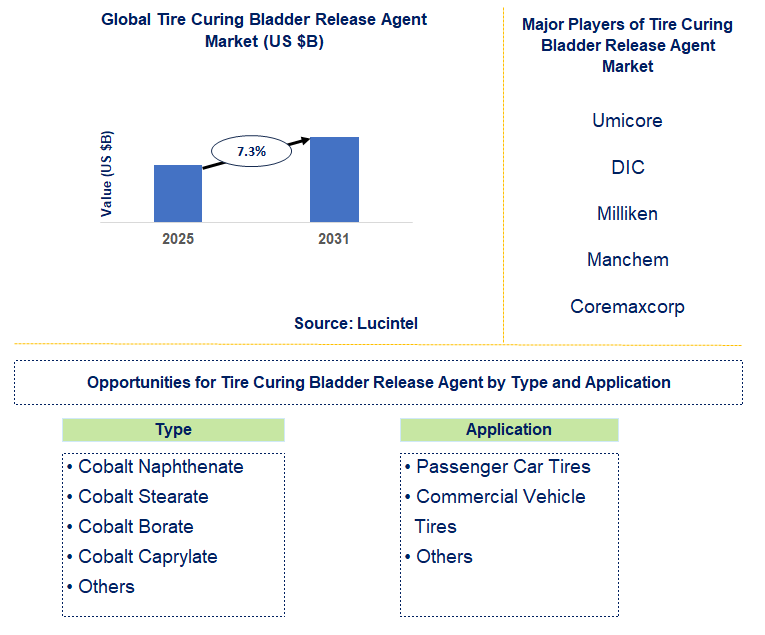
Key data points: The growth forecast = 7.3% annually for the next 7 years. Scroll below to get more insights. This market report covers trends, opportunities and forecasts in tire curing bladder release agent market to 2031 by type (cobalt naphthenate, cobalt stearate, cobalt borate, cobalt caprylate, and others), application (passenger car tires, commercial vehicle tires, and others), and region (North America, Europe, Asia Pacific, and the Rest of the World)
We'll send your sample report shortly.
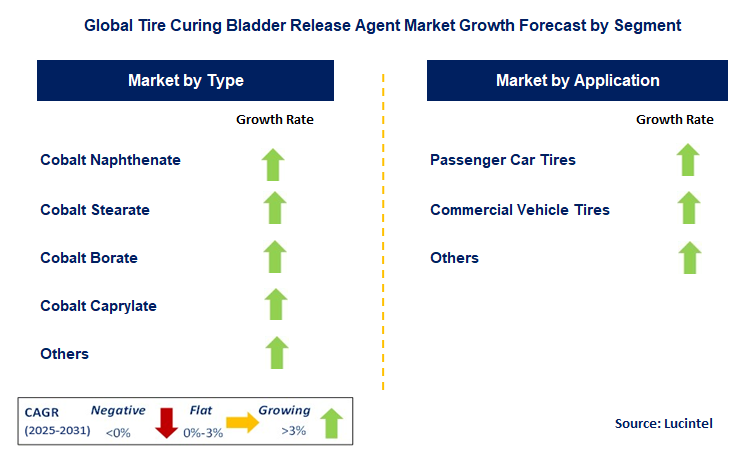
• Lucintel forecasts that, within the type category, cobalt stearate is expected to witness the highest growth over the forecast period.
• Within the application category, passenger car tire is expected to witness higher growth.
• In terms of region, APAC is expected to witness the highest growth over the forecast period. Gain valuable insights for your business decisions with our comprehensive 150+ page report. Sample figures with some insights are shown below.
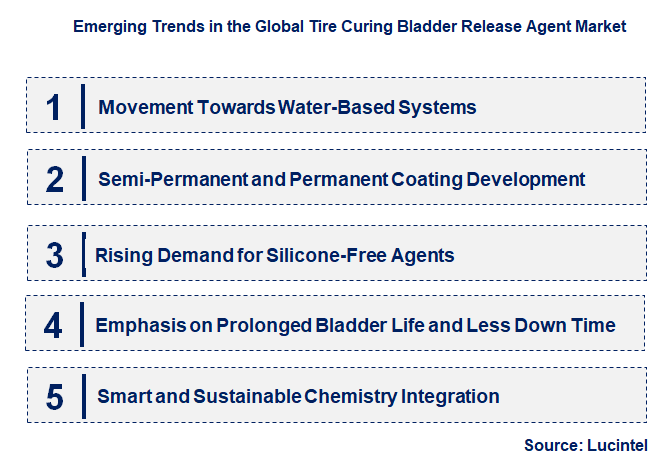
• Movement Towards Water-Based Systems: There is a large trend towards the use of water-based bladder release agents, away from the use of solvent-based agents. This is largely led by tighter environmental control over volatile organic compounds (VOCs) and the requirement for safer workplace conditions in tire factory operations. The effect is less air pollution, enhanced occupational health and safety, and a cleaner production process. Water-based agents also minimize the risks of flammability within the manufacturing plant.
• Semi-Permanent and Permanent Coating Development: Companies are placing more emphasis on creating semi-permanent and permanent bladder release coatings. These coatings are developed to give many release cycles from a single application, minimizing reapplication many times during the curing process. The result is enhanced production efficiency from lesser downtime for reapplying, reduced usage of release agents, and increased consistency in tire quality as the bladder surface is kept optimally lubricated for more extended periods. This also translates into cost benefits for tire manufacturers.
• Rising Demand for Silicone-Free Agents: One trend to watch for is the growing need for silicone-free bladder release agents. Although silicone-based agents have superior release characteristics, their residue may complicate downstream processes like tire painting, labeling, or the application of noise-dampening foams, necessitating expensive and time-consuming cleaning operations. The effect is a cleaner tire surface that does away with post-curing cleaning operations like laser or chemical treatments, thus facilitating leaner production, lowering manufacturing costs, and enhancing the adhesion of additional coatings.
• Emphasis on Prolonged Bladder Life and Less Down Time: Tire makers are focusing on release agents that help increase the lifespan of costly curing bladders and reduce press downtime. Specialized formulations are being created to minimize chemical and mechanical stress on the bladder throughout the cure cycle. The effect is dramatic cost savings to tire makers by lowering the rate of bladder replacement, reducing maintenance costs, and raising overall production throughput, resulting in greater operational efficiency.
• Smart and Sustainable Chemistry Integration: The industry is experiencing the integration of smart chemistry concepts and renewable raw materials in release agent formulations. It involves employing bio-based materials, recyclable compounds, and creating agents with reduced waste. The outcome is a more sustainable process of tire production to match world environmental standards and consumer expectations for green products. This trend also sparks innovation within material science to produce more efficient and sustainable chemical solutions. These new trends are essentially transforming the tire curing bladder release agent market by demanding more performance, more efficiency, and more environmental stewardship. The market is shifting towards more sophisticated, multi-purpose, and eco-friendly solutions that are essential to addressing the changing needs of contemporary tire production and helping the industry become greener.
• Introduction of New Water-Based, High-Performance Formulations: A major recent breakthrough is the development of new water-based release agent formulations providing superior performance similar to or better than conventional solvent-based products. These water-based formulations are formulated to deliver better release properties, enhance slip, and minimize residue accumulation on the bladder and mold. The result is a direct benefit to tire makers in terms of increased operational efficiency, lesser environmental footprint due to minimized VOC emissions, and improved safety for workers, in line with worldwide green manufacturing programs.
• Advances in Multi-Release and Semi-Permanent Technologies: There has been a major emphasis on creating next-generation, multi-release and semi-permanent bladder coatings. These new products enable many times greater curing cycles per application, minimizing reapplication frequency. The effect is a dramatic boost in production uptime, since presses do not have to be shut down so frequently for re-coating. This translates into increased throughput, less consumption of release agents, and ultimately, lower manufacturing cost to tire companies, which directly enhances their profitability.
• Launch of Silicone-Free Alternatives with Comparable Performance: With the need to remove silicone residue on tires that can make downstream operations such as painting and labeling more difficult, recent innovations involve the commercial launch of high-performance silicone-free release agents. New formulations promise similar release performance without the disadvantage of silicone transfer. The effect is an efficient tire production process, removing time- and expense-consuming cleaning operations, and allowing improved adhesion for finishing tire treatments, thereby enhancing product quality and efficiency overall.
• Bladder-Specific Coatings for Long Lifespan Development: The companies are now concentrating on creating bladder release agents that are specifically designed to guard and prolong the life of curing bladders. These agents have ingredients that minimize wear, inhibit chemical decay, and reduce ingress of sulfur and other materials from the rubber. The effect is a significant decrease in bladder replacement costs and maintenance downtime for tire companies, which translates into substantial operational cost savings as well as better uniformity in curing over a longer time.
• Greater Adoption of Automated Spraying Systems: To complement the improvements in release agent formulations, there has been greater emphasis on creating and adopting automated spraying systems for the application of these agents to curing bladders and green tires. These systems provide even and accurate application, with minimal waste. The effect is enhanced consistency of application, which translates into more consistent tire quality and fewer defects. Automation also maximizes the application of the release agent, leading to cost savings and greater efficiency in large-scale tire manufacturing operations. These new developments are influencing the tire curing bladder release agent market profoundly by expanding performance, efficiency, and sustainability frontiers. The market is shifting towards more specialized, long-term, and sustainable solutions that are essential to cope with the intricate requirements of the contemporary tire sector.
• Passenger Car Tire Production: The greatest opportunity for growth is in the passenger car tire production business. Ongoing production of new passenger cars by the global automotive market, combined with the aftermarket replacement tire demand, generates a perpetual demand for effective tire curing. The strategic challenge is creating water-based, high-performance, and multi-release agents to satisfy the high quality and efficiency requirements of mass production, leading to decreased cycle times and enhanced tire appearance for automotive manufacturers.
• Truck and Bus Radial Commercial Vehicle Tire Production: The truck and bus radial (TBR) tire segment in the commercial vehicle tire market represents enormous growth opportunities. TBR tires are bigger and subject to more severe curing cycles, which call for strong and durable release agents. The strategic potential lies in offering specialty release agents that endure high pressure and heat, thereby increasing the longevity of bladders in heavy-duty tires, lowering maintenance costs, and enhancing the overall efficiency of TBR tire manufacturing.
• Off-the-Road and Specialty Tire Production: The specialty tire and OTR market (e.g., construction, agriculture, mining) is a high-value but niche growth opportunity. They are huge and costly tires, so the efficiency and longevity of the curing process is critical. The strategic play is to create ultra-long-lived, high-temperature resistant release agents for the specific application of curing large, complex OTR tires, where reducing defects and extending bladder life equates to substantial cost savings for manufacturers.
• Green and Sustainable Tire Manufacturing: The increasing international emphasis on environmental sustainability is bringing a significant growth opportunity for environmentally friendly bladder release agents. These are water-based, solvent-free, and biodegradable products which enable tire makers to minimize their environmental impact and meet ever-tighter regulations. The strategic opportunity is to develop and market "green" release agents that not only meet environmental requirements but also provide competitive performance, which will attract tire firms dedicated to sustainable manufacturing processes.
• Tire Retreading Industry: The tire retreading industry, which extends the life of tires that have been worn down, is another significant opportunity for growth. In retreading, the reused tire casing is cured with a fresh tread, and effective release agents are needed in this process. The strategic potential is to furnish economical, high-performance release agents specifically designed for the particular conditions of retreading, which include often-changing conditions of the tires and specialty curing processes. This chapter is part of circular economy efforts in the tire industry. These strategic growth opportunities will help to make a material difference in the tire curing bladder release agent market by creating innovation across tire types and manufacturing processes. Companies that make strategic investments in research and development and customize their products to address the unique needs of these high-growth application areas will be well on their way to success and to the expansion of the market overall.
• Umicore
• DIC
• Milliken
• Manchem
• Coremaxcorp
• Shanghai Sansi Additives Products
• Zhenjiang Matt Chemical New Materials
• Cobalt Naphthenate
• Cobalt Stearate
• Cobalt Borate
• Cobalt Caprylate
• Others
• Passenger Car Tires
• Commercial Vehicle Tires
• Others
• North America
• Europe
• Asia Pacific
• The Rest of the World
• United States: United States' tire curing bladder release agent market is dominated by an emphasis on innovative, high-performance formulations. New technologies include higher use of high-tech water-based technologies that provide better release properties and longer bladder life. Sustainable solutions gain momentum because of tighter environmental regulations and corporate sustainability initiatives from large tire companies. Research and development are focused on lower volatile organic compounds (VOCs) and higher efficiency in the curing process of tires.
• China: China tire curing bladder release agent market is growing fast because of its vast and growing tire production industry. Some of the recent trends involve substantial investments in domestic production facilities to satisfy the high domestic demand. There is a strong trend towards improving existing formulations for improved cost-effectiveness and higher application efficiency. Although price competitiveness is a dominant theme, Chinese producers are also putting greater emphasis on product quality enhancements and more environmentally compatible solutions in order to comply with global standards and export market demand.
• Germany: Germany's tire curing bladder release agent market is leading the way with technological advancement, thanks to its highly developed automotive and tire manufacturing industries. Recent developments cover the creation of highly specialized, long-lasting, and semi-permanent release agents with greatly increased operational life of curing bladders. German manufacturers are at the forefront of silicone-free and solvent-free development, focusing on environmental friendliness and worker protection. Market growth is also influenced by intense interest in tailor-made solutions for particular tire types and curing processes.
• India: India's tire curing bladder release agent industry is rapidly changing with the massive development of its local automobile and tire sectors. Recent trends have seen growing take-up of advanced release agents to enhance tire quality and manufacturing efficiency. There is an emerging consciousness and demand for water-based and more eco-friendly formulations, though with keen emphasis on cost competitiveness. Indian producers are diversifying their capacity and looking for partnerships to bring higher-level products to the market.
• Japan: Japan's tire curing bladder release agent market is dominated by a high-performance and precision-oriented culture. More recent developments involve the creation of higher-level formulations with outstanding release characteristics, even under difficult curing conditions. Japanese firms are leaders in creating very long-lasting, multi-release agents that reduce residue accumulation and improve the life of curing bladders. Low-VOC and non-hazardous products also enjoy a strong focus on minimizing environmental footprint, in line with stringent national regulations.


• Umicore
• DIC
• Milliken
• Manchem
• Coremaxcorp
• Shanghai Sansi Additives Products
• Zhenjiang Matt Chemical New Materials Q5. Which tire curing bladder release agent market segment will be the largest in future? Answer: Lucintel forecasts that, within the type category, cobalt stearate is expected to witness the highest growth over the forecast period. Q6. In tire curing bladder release agent market, which region is expected to be the largest in next 5 years? Answer: In terms of region, APAC is expected to witness the highest growth over the forecast period. Q7. Do we receive customization in this report? Answer: Yes, Lucintel provides 10% customization without any additional cost.


Choose a license that fits your team. Instant PDF delivery.
Prices exclude taxes. Instant delivery. Custom licensing available on request.
Market Report · July 22, 2026
Market Report · July 22, 2026
Market Report · July 22, 2026
Trusted partner for strategic intelligence and business growth


Receive a complimentary market analysis tailored to your industry. Our analysts will identify key growth opportunities and competitive dynamics specific to your business.

Market size, growth rate, and key trend analysis for your specific sector.

Top competitor positioning and market share analysis.

Strategic recommendations backed by data-driven insights.
Get curated market intelligence and competitive moves straight to your inbox.
By subscribing, you agree to receive our monthly insights. Unsubscribe anytime.
Receive a complimentary market analysis tailored to your industry. Our analysts will identify key growth opportunities and competitive dynamics specific to your business.
Market size, growth rate, and key trend analysis for your specific sector.
Top competitor positioning and market share analysis.
Strategic recommendations backed by data-driven insights.
Get curated market intelligence, emerging trends, and competitive moves straight to your inbox each month.
By subscribing, you agree to receive our monthly insights. Unsubscribe anytime.
We'll send your sample report shortly.