
Report Feature
Thunderbolt Docking Station Market Trends and Forecast
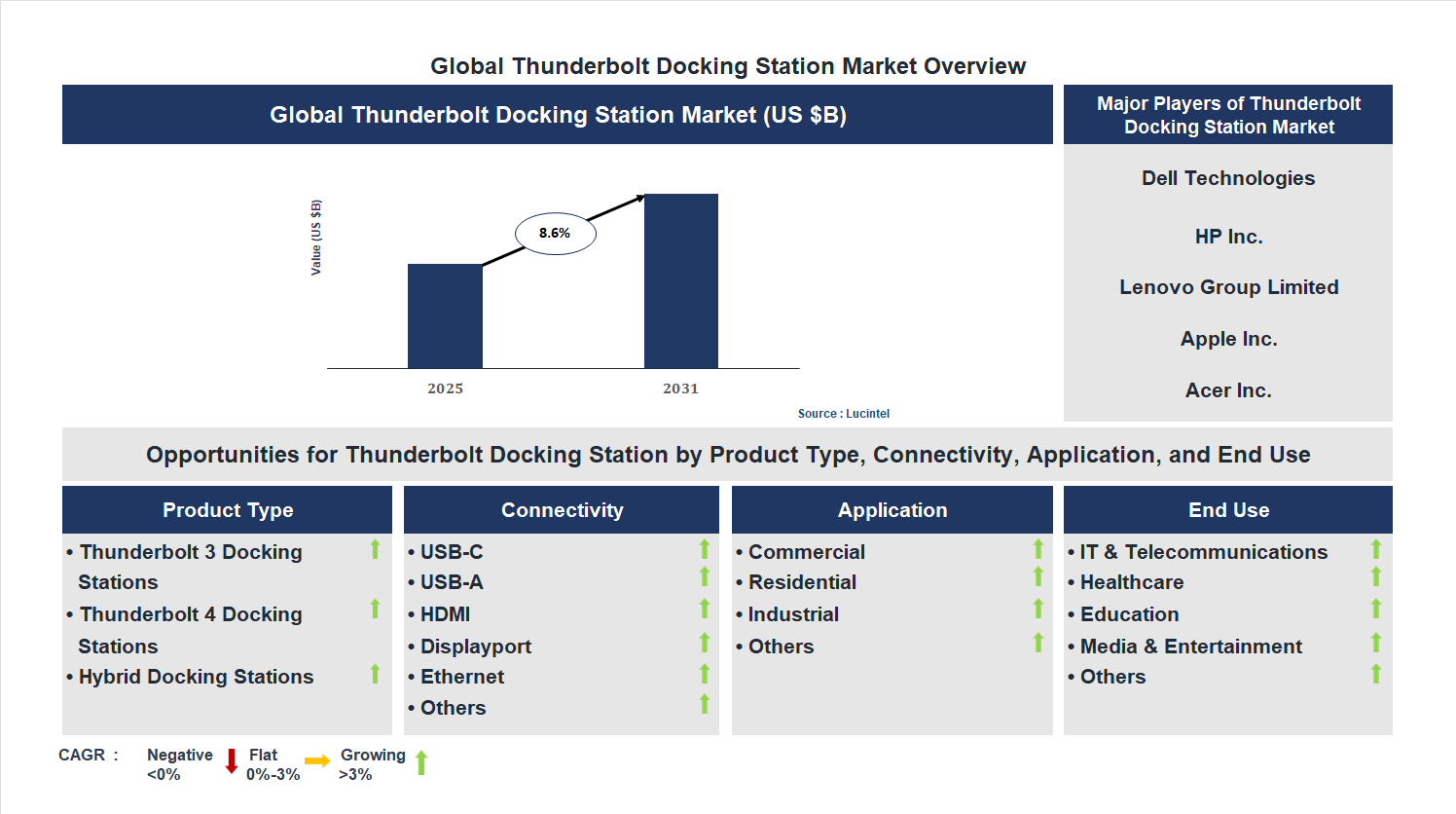
The future of the global thunderbolt docking station market looks promising with opportunities in the IT & telecommunication, healthcare, education, and media & entertainment markets. The global thunderbolt docking station market is expected to grow with a CAGR of 8.6% from 2025 to 2031. The major drivers for this market are the increasing need for high speed connectivity, the rising adoption of multi device workstations, and the growing demand for compact docking solutions.• Lucintel forecasts that, within the product type category, thunderbolt 3 docking station is expected to witness the highest growth over the forecast period.
• Within the end use category, IT & telecommunication is expected to witness the highest growth.
• In terms of region, APAC is expected to witness the highest growth over the forecast period. Gain valuable insights for your business decisions with our comprehensive 150+ page report. Sample figures with some insights are shown below.
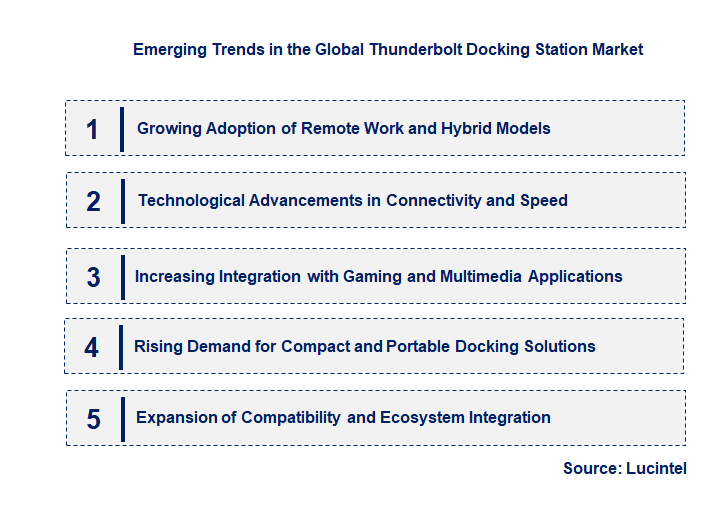
Emerging Trends in the Thunderbolt Docking Station Market
The thunderbolt docking station market is experiencing rapid growth driven by increasing demand for versatile connectivity solutions in professional and consumer electronics. As technology advances, users seek seamless integration of multiple devices with high-speed data transfer, power delivery, and expanded display options. Innovations in hardware design, compatibility, and performance are shaping the market landscape, making docking stations more efficient and user-friendly. These developments are not only enhancing productivity but also influencing the overall ecosystem of connected devices. The markets evolution reflects broader trends in remote work, gaming, and multimedia consumption, prompting manufacturers to innovate continuously to meet diverse user needs.• Growing Adoption of Remote Work and Hybrid Models: The rise of remote and hybrid work arrangements has significantly increased the demand for reliable, high-performance docking stations. Professionals require seamless connectivity for multiple monitors, peripherals, and network access, which traditional ports cannot support efficiently. Thunderbolt docking stations offer fast data transfer, power delivery, and multiple port options, making them essential tools for remote workers. This trend is expected to continue as organizations prioritize flexible work environments, thereby expanding the market for advanced docking solutions that enhance productivity and connectivity.
• Technological Advancements in Connectivity and Speed: Innovations in Thunderbolt technology, such as Thunderbolt 4, have improved data transfer speeds, power delivery, and device compatibility. These advancements enable docking stations to support 8K displays, faster data transfer rates, and more power-efficient operation. As a result, users experience smoother workflows, reduced latency, and enhanced multimedia capabilities. Manufacturers are integrating these technological improvements into their products, which boosts market competitiveness and attracts a broader customer base seeking high-performance connectivity solutions for professional and entertainment purposes.
• Increasing Integration with Gaming and Multimedia Applications: The gaming industry and multimedia content creators are increasingly adopting Thunderbolt docking stations for their high-speed data transfer and multiple display support. Gamers and content creators require robust connectivity to handle large files, high-resolution displays, and multiple peripherals simultaneously. The market is witnessing a surge in products tailored for these segments, emphasizing high bandwidth, low latency, and compatibility with gaming hardware. This trend is expanding the market beyond traditional professional use, opening new avenues for growth driven by the expanding gaming and multimedia sectors.
• Rising Demand for Compact and Portable Docking Solutions: Consumers and professionals alike prefer lightweight, portable docking stations that do not compromise on performance. The demand for compact designs with integrated features such as charging, multiple ports, and high-speed data transfer is increasing. Manufacturers are focusing on miniaturization and sleek aesthetics to cater to mobile users, remote workers, and travelers. This trend enhances user convenience and broadens the market scope, making high-performance docking stations accessible to a wider audience seeking mobility without sacrificing connectivity quality.
• Expansion of Compatibility and Ecosystem Integration: Compatibility with various operating systems, devices, and ecosystems is becoming a key market focus. Docking stations now support Windows, macOS, and even Linux platforms, along with compatibility with smartphones, tablets, and other portable devices. Integration with smart home and office ecosystems is also emerging, allowing for centralized control and automation. This trend improves user experience, increases product versatility, and encourages cross-platform adoption. As ecosystems become more interconnected, the market is poised for growth driven by versatile, multi-device compatibility and seamless integration. In summary, these trends are transforming the thunderbolt docking station market by enhancing device performance, expanding application areas, and improving user convenience. The market is evolving from simple connectivity solutions to sophisticated, integrated systems that support a wide range of professional, gaming, and multimedia needs. This evolution is fostering innovation, increasing competition, and opening new opportunities for manufacturers to meet the dynamic demands of modern digital lifestyles.
Recent Development in the Thunderbolt Docking Station Market
The thunderbolt docking station market has experienced significant growth driven by increasing demand for versatile connectivity solutions in professional and consumer electronics. As technology advances, users seek seamless integration of multiple devices with high-speed data transfer and power delivery. Innovations in hardware, expanding application areas, and strategic partnerships are shaping the market landscape. The markets evolution is also influenced by rising adoption in remote work setups and the proliferation of high-performance computing devices. These developments are enhancing user experience, expanding market reach, and fostering competitive innovation, ultimately transforming how users connect and operate their devices efficiently.• Technological Advancements: Introduction of Thunderbolt 4 and USB4 standards has improved data transfer speeds, power delivery, and compatibility, making docking stations more efficient and reliable. This has increased consumer confidence and expanded application possibilities, especially in professional environments requiring high data throughput. The enhanced standards also support daisy chaining multiple devices, reducing clutter and improving workspace organization. As a result, market growth accelerates, with manufacturers investing in R&D to develop next-generation docking stations that leverage these standards.
• Growing Adoption in Remote Work: The surge in remote working arrangements has driven demand for docking stations that enable users to connect multiple peripherals to laptops and desktops seamlessly. These devices facilitate a more productive home office setup by providing high-speed connectivity for monitors, external drives, and peripherals. The convenience and efficiency offered by Thunderbolt docking stations have made them essential tools for remote workers, boosting sales and encouraging manufacturers to develop more compact, feature-rich models tailored for home use.
• Expansion into New Application Areas: Beyond traditional computing, the market is expanding into sectors such as healthcare, education, and entertainment. In healthcare, docking stations support high-resolution imaging and data transfer for medical devices. In education, they enable enhanced connectivity for interactive learning tools. The entertainment industry benefits from high-quality audio and video streaming capabilities. This diversification broadens the market scope, attracting new customers and creating opportunities for specialized product development, thereby fueling overall market growth.
• Strategic Partnerships and Collaborations: Companies are forming alliances with technology giants and peripheral manufacturers to develop integrated solutions and expand distribution channels. These collaborations facilitate the development of innovative docking stations with advanced features, such as wireless connectivity and modular designs. Partnerships also help in expanding market reach into emerging regions and verticals, increasing brand visibility and customer base. Such strategic moves are crucial for staying competitive and driving innovation within the market.
• Rising Focus on Sustainability and Eco-Friendly Designs: Manufacturers are increasingly adopting sustainable practices by using recyclable materials and energy-efficient components in docking stations. Eco-friendly designs appeal to environmentally conscious consumers and comply with global regulations. This focus on sustainability not only enhances brand reputation but also encourages innovation in product design, such as low-power consumption models and modular components for easy upgrades. The emphasis on eco-friendly solutions is shaping market trends and influencing consumer purchasing decisions. In summary, these developments are significantly impacting the thunderbolt docking station market by enhancing product capabilities, expanding application areas, and fostering innovation. The market is becoming more dynamic, with increased adoption driven by technological improvements, changing work environments, and sustainability initiatives. As a result, the market is poised for continued growth, offering diverse solutions that meet evolving user needs across various sectors.
Strategic Growth Opportunities in the Thunderbolt Docking Station Market
The thunderbolt docking station market is experiencing rapid growth driven by increasing demand for versatile connectivity solutions across various industries. As technology advances, users seek seamless integration of multiple devices, high-speed data transfer, and enhanced productivity. This evolving landscape presents numerous opportunities for market expansion, particularly in key applications such as IT and telecommunications, consumer electronics, enterprise solutions, healthcare, and education. Companies that capitalize on these growth areas can gain a competitive edge and meet the rising needs of consumers and businesses alike. The following are five key growth opportunities across these applications that are shaping the future of the market.• IT and Telecommunications: Expansion of remote work and cloud computing drives demand for high-performance docking stations, enabling seamless connectivity and data transfer for professionals working from home or in offices. This growth enhances productivity and supports digital transformation initiatives.
• Consumer Electronics: Increasing adoption of gaming, multimedia, and smart home devices fuels demand for versatile Thunderbolt docking stations that support multiple peripherals, high-resolution displays, and fast data transfer, enriching user experiences and device compatibility.
• Enterprise Solutions: Growing need for efficient workspace management and device connectivity in corporate environments creates opportunities for advanced docking stations that support multiple devices, secure data transfer, and centralized management, boosting operational efficiency.
• Healthcare: Integration of medical devices and telemedicine solutions benefits from Thunderbolt docking stations that facilitate high-speed data sharing, real-time diagnostics, and secure connectivity, improving patient care and operational workflows.
• Education: The shift towards digital learning and remote education increases demand for docking stations that support multiple peripherals, high-quality video conferencing, and data sharing, enhancing virtual classroom experiences and collaboration. In summary, these growth opportunities are significantly impacting the thunderbolt docking station market by expanding its applications and driving innovation. The increasing need for high-speed, reliable connectivity solutions across various sectors is fueling market growth, encouraging product development, and fostering competitive advantages for key players. As these opportunities continue to evolve, the market is poised for sustained expansion and technological advancement.
Thunderbolt Docking Station Market Driver and Challenges
The thunderbolt docking station market is influenced by a variety of technological, economic, and regulatory factors that shape its growth trajectory. Rapid advancements in connectivity technology, increasing demand for versatile workspace solutions, and evolving standards for data transfer and power delivery are key drivers. Economic factors such as rising remote work trends and enterprise IT upgrades further propel market expansion. However, the market also faces challenges, including high product costs, compatibility issues, and regulatory uncertainties that could hinder growth. Understanding these drivers and challenges is essential for stakeholders aiming to capitalize on emerging opportunities and navigate potential risks effectively. The factors responsible for driving the thunderbolt docking station market include:-• Technological Innovation: The continuous development of Thunderbolt technology, with higher data transfer speeds and increased power delivery, enhances device performance and user experience. This innovation encourages adoption among professionals and enterprises seeking efficient connectivity solutions. As technology evolves, manufacturers introduce more advanced docking stations, expanding market options and driving sales. The integration of features like multiple display support and fast data transfer makes these stations indispensable for modern workflows, fueling market growth.
• Growing Remote Work and BYOD Trends: The surge in remote working arrangements and Bring Your Own Device (BYOD) policies has increased demand for flexible, portable, and high-performance docking solutions. Professionals require reliable connectivity for multiple peripherals, displays, and network access, which Thunderbolt docking stations provide. This trend is further accelerated by the COVID-19 pandemic, prompting organizations to invest in efficient home office setups, thereby expanding the market.
• Increasing Adoption in Enterprise Sector: Enterprises are adopting Thunderbolt docking stations to streamline workspace management, improve productivity, and support high-speed data transfer needs. These stations facilitate seamless integration of multiple devices, reducing clutter and enhancing operational efficiency. As businesses upgrade their IT infrastructure to support high-performance computing and data-intensive tasks, the demand for robust docking solutions continues to rise, contributing significantly to market growth.
• Regulatory and Standardization Developments: The establishment of industry standards and regulatory frameworks for Thunderbolt technology ensures compatibility, safety, and performance consistency. These standards foster consumer confidence and encourage manufacturers to develop compliant products, thereby expanding the market. Ongoing regulatory support also facilitates international trade and market penetration, further boosting growth prospects. The challenges in the thunderbolt docking station market are:
• High Product Costs: The advanced technology and high-quality components used in Thunderbolt docking stations result in premium pricing. This can limit adoption among budget-conscious consumers and small businesses, restricting market penetration. Additionally, ongoing R&D and compliance costs may keep prices elevated, posing a barrier to widespread adoption, especially in emerging markets.
• Compatibility and Ecosystem Limitations: Despite technological advancements, compatibility issues with certain devices and operating systems can hinder seamless integration. Variations in hardware configurations and software support may lead to user dissatisfaction and increased support costs. This fragmentation can slow market growth as consumers and enterprises seek universally compatible solutions.
• Regulatory Uncertainties and Patent Disputes: Evolving regulatory landscapes and patent disputes related to Thunderbolt technology can create uncertainties for manufacturers and consumers. These issues may delay product launches, increase compliance costs, and restrict market expansion in certain regions. Navigating complex legal frameworks poses a significant challenge for sustained growth and innovation. In summary, the thunderbolt docking station market is driven by technological advancements, increasing remote work, enterprise adoption, and supportive standards. However, high costs, compatibility issues, and regulatory uncertainties present notable challenges. These factors collectively influence market dynamics, with growth prospects hinging on technological innovation and strategic management of barriers. Overall, the market is poised for expansion, provided stakeholders effectively address the challenges and leverage emerging opportunities to meet evolving consumer and enterprise needs.
List of Thunderbolt Docking Station Companies
Companies in the market compete on the basis of product quality offered. Major players in this market focus on expanding their manufacturing facilities, R&D investments, infrastructural development, and leverage integration opportunities across the value chain. With these strategies thunderbolt docking station companies cater increasing demand, ensure competitive effectiveness, develop innovative products & technologies, reduce production costs, and expand their customer base. Some of the thunderbolt docking station companies profiled in this report include-• Dell Technologies
• HP Inc.
• Lenovo Group Limited
• Apple Inc.
• Acer Inc.
• ASUS (ASUSTeK Computer Inc.)
• Belkin International
• CalDigit
• Plugable Technologies
• StarTech.com
Thunderbolt Docking Station Market by Segment
The study includes a forecast for the global thunderbolt docking station market by product type, connectivity, application, end use, and region.Thunderbolt Docking Station Market by Product Type [Value from 2019 to 2031]:
• Thunderbolt 3 Docking Stations
• Thunderbolt 4 Docking Stations
• Hybrid Docking Stations
Thunderbolt Docking Station Market by Connectivity [Value from 2019 to 2031]:
• USB-C
• USB-A
• HDMI
• DisplayPort
• Ethernet
• Others
Thunderbolt Docking Station Market by Application [Value from 2019 to 2031]:
• Commercial
• Residential
• Industrial
• Others
Thunderbolt Docking Station Market by End Use [Value from 2019 to 2031]:
• IT & Telecommunications
• Healthcare
• Education
• Media & Entertainment
• Others
Thunderbolt Docking Station Market by Region [Value from 2019 to 2031]:
• North America
• Europe
• Asia Pacific
• The Rest of the World
Country Wise Outlook for the Thunderbolt Docking Station Market
The thunderbolt docking station market has experienced significant growth driven by increasing demand for high-speed data transfer, versatile connectivity options, and enhanced productivity solutions across various industries. Technological advancements and the proliferation of remote work have accelerated adoption, especially in developed economies. Countries are focusing on integrating innovative features such as 8K video support, multiple port configurations, and improved power delivery to meet diverse user needs. As the market evolves, regional players are competing to offer more efficient, compact, and cost-effective solutions, shaping the future landscape of professional and consumer electronics.• United States: The US market has seen rapid adoption of Thunderbolt docking stations, driven by the rise of remote work and the need for seamless connectivity. Major tech companies are investing in advanced docking solutions with higher data transfer speeds and multiple port options. Innovations such as 8K video support and enhanced power delivery are becoming standard. The US also witnesses increased integration of Thunderbolt docks in enterprise environments, boosting productivity and device compatibility. Market players are focusing on developing lightweight, portable docks to cater to mobile professionals, further expanding market reach.
• China: Chinas market for Thunderbolt docking stations is expanding due to the growing consumer electronics sector and increasing adoption of high-performance computing devices. Local manufacturers are investing in R&D to develop cost-effective, feature-rich docks tailored for the domestic market. The government’s push for technological self-reliance has spurred innovation, leading to the launch of products with improved compatibility and durability. Additionally, the rise of e-sports and digital content creation has increased demand for high-speed data transfer solutions, fueling market growth. Distribution channels are strengthening, making these products more accessible nationwide.
• Germany: In Germany, the market is characterized by a focus on high-quality, durable Thunderbolt docking stations suitable for professional and industrial use. The emphasis on data security and reliability has led to the adoption of premium docks with advanced features like multi-display support and robust build quality. The increasing integration of Thunderbolt docks in corporate IT infrastructure is driven by the need for efficient remote working solutions. German manufacturers are also emphasizing eco-friendly designs and energy efficiency, aligning with sustainability goals. The market is witnessing steady growth, supported by technological innovation and a strong industrial base.
• India: The Indian market for Thunderbolt docking stations is emerging, with increasing demand from IT professionals, educational institutions, and startups. Cost-effective solutions are prioritized, with local and international brands offering affordable docks with essential features. The growth of remote working and digital education has accelerated adoption, especially in urban centers. Market players are focusing on expanding distribution networks and after-sales service to reach a broader customer base. The rising penetration of high-speed internet and increasing smartphone and laptop usage are further propelling market growth, making Thunderbolt docks more accessible to a wider audience.
• Japan: Japans market is driven by technological innovation and a high adoption rate of advanced computing devices. The demand for high-performance Thunderbolt docking stations is prominent among professionals in sectors like gaming, digital content creation, and enterprise IT. Japanese manufacturers are leading in integrating cutting-edge features such as 8K video output and multi-port configurations. The focus on compact, stylish designs with energy efficiency aligns with consumer preferences. The market benefits from strong R&D capabilities and a culture of quality, resulting in premium product offerings. Overall, Japan continues to be a key player in advancing Thunderbolt docking station technology.

Features of the Global Thunderbolt Docking Station Market
Market Size Estimates: Thunderbolt docking station market size estimation in terms of value ($B). Trend and Forecast Analysis: Market trends (2019 to 2024) and forecast (2025 to 2031) by various segments and regions. Segmentation Analysis: Thunderbolt docking station market size by various segments, such as by product type, connectivity, application, end use, and region in terms of value ($B). Regional Analysis: Thunderbolt docking station market breakdown by North America, Europe, Asia Pacific, and Rest of the World. Growth Opportunities: Analysis of growth opportunities in different product type, connectivity, application, end use, and regions for the thunderbolt docking station market. Strategic Analysis: This includes M&A, new product development, and competitive landscape of the thunderbolt docking station market. Analysis of competitive intensity of the industry based on Porter’s Five Forces model.
FAQ
Q1. What is the growth forecast for thunderbolt docking station market? Answer: The global thunderbolt docking station market is expected to grow with a CAGR of 8.6% from 2025 to 2031. Q2. What are the major drivers influencing the growth of the thunderbolt docking station market? Answer: The major drivers for this market are the increasing need for high speed connectivity, the rising adoption of multi device workstations, and the growing demand for compact docking solutions. Q3. What are the major segments for thunderbolt docking station market? Answer: The future of the thunderbolt docking station market looks promising with opportunities in the IT & telecommunication, healthcare, education, and media & entertainment markets. Q4. Who are the key thunderbolt docking station market companies? Answer: Some of the key thunderbolt docking station companies are as follows:• Dell Technologies
• HP Inc.
• Lenovo Group Limited
• Apple Inc.
• Acer Inc.
• ASUS (ASUSTeK Computer Inc.)
• Belkin International
• CalDigit
• Plugable Technologies
• StarTech.com Q5. Which thunderbolt docking station market segment will be the largest in future? Answer: Lucintel forecasts that, within the product type category, thunderbolt 3 docking station is expected to witness the highest growth over the forecast period. Q6. In thunderbolt docking station market, which region is expected to be the largest in next 5 years? Answer: In terms of region, APAC is expected to witness the highest growth over the forecast period. Q7. Do we receive customization in this report? Answer: Yes, Lucintel provides 10% customization without any additional cost.
Table of Contents
List of Figures
List of Tables
Methodology
- In-depth interviews of the major players in this market
- Detailed secondary research from competitors’ financial statements and published data
- Extensive searches of published works, market, and database information pertaining to industry news, company press releases, and customer intentions
- A compilation of the experiences, judgments, and insights of Lucintel’s professionals, who have analyzed and tracked this market over the years.


Buy Now
Choose a license that fits your team. Instant PDF delivery.
Prices exclude taxes. Instant delivery. Custom licensing available on request.
Key Questions
- • What are some of the most promising, high-growth opportunities for the thunderbolt docking station market by product type (thunderbolt 3 docking stations, thunderbolt 4 docking stations, and hybrid docking stations), connectivity (USB-C, USB-A, HDMI, DisplayPort, ethernet, and others), application (commercial, residential, industrial, and others), end use (IT & telecommunications, healthcare, education, media & entertainment, and others), and region (North America, Europe, Asia Pacific, and the Rest of the World)?
- • Which segments will grow at a faster pace and why?
- • Which region will grow at a faster pace and why?
- • What are the key factors affecting market dynamics? What are the key challenges and business risks in this market?
- • What are the business risks and competitive threats in this market?
- • What are the emerging trends in this market and the reasons behind them?
- • What are some of the changing demands of customers in the market?
- • What are the new developments in the market? Which companies are leading these developments?
- • Who are the major players in this market? What strategic initiatives are key players pursuing for business growth?
- • What are some of the competing products in this market and how big of a threat do they pose for loss of market share by material or product substitution?
- • What M&A activity has occurred in the last 5 years and what has its impact been on the industry? For any questions related to Thunderbolt Docking Station Market, Thunderbolt Docking Station Market Size, Thunderbolt Docking Station Market Growth, Thunderbolt Docking Station Market Analysis, Thunderbolt Docking Station Market Report, Thunderbolt Docking Station Market Share, Thunderbolt Docking Station Market Trends, Thunderbolt Docking Station Market Forecast, Thunderbolt Docking Station Companies, write Lucintel analyst at email: helpdesk@lucintel.com. We will be glad to get back to you soon.


