
Market Report · May 16, 2026

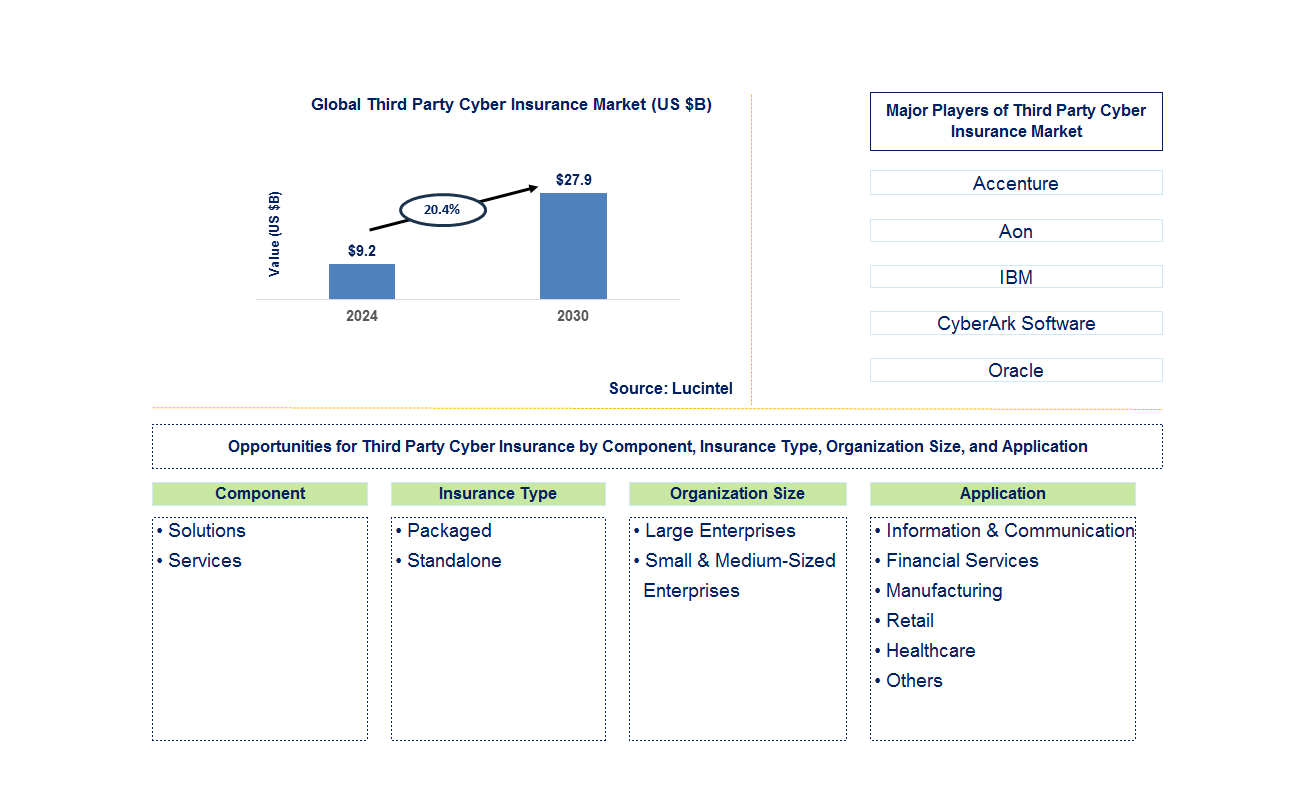
Key data points: The market size in 2030 = $27.9 billion, growth forecast = 20.4% annually for the next 6 years. Scroll below to get more insights. This market report covers trends, opportunities, and forecasts in the global third party cyber insurance market to 2030 by component (solutions and services), insurance type (packaged and standalone), organization size (large enterprises and small & medium-sized enterprises), application (information & communication technology, financial services, manufacturing, retail, healthcare, and others), and region (North America, Europe, Asia Pacific, and the Rest of the World)
We'll send your sample report shortly.
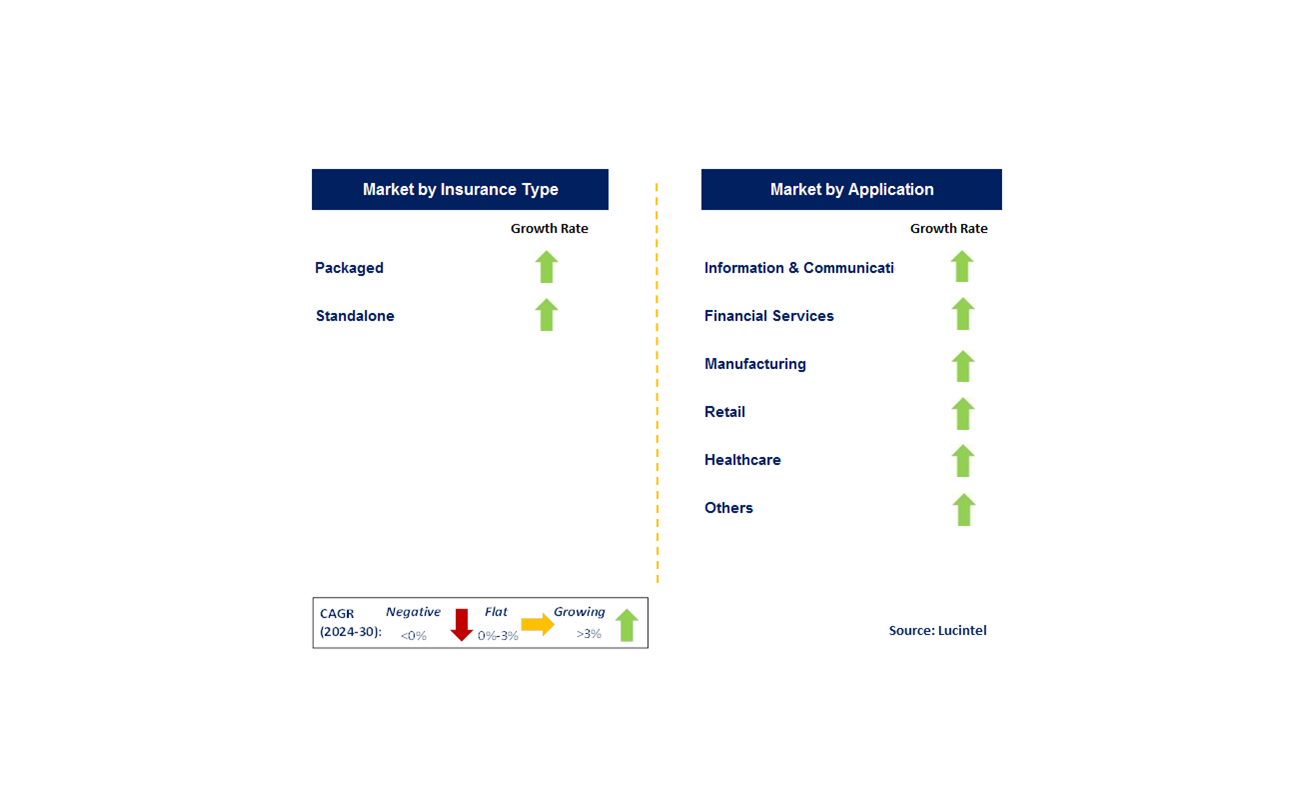
• Lucintel forecasts that, within the component category, solution is expected to witness higher growth over the forecast period.
• Within the application category, information & communication technology is expected to witness the highest growth.
• In terms of regions, North America will remain the largest region over the forecast period due to the existence of market players and increasing awareness amongst small to medium-sized businesses about cyber insurance in the region. Gain valuable insights for your business decisions with our comprehensive 150+ page report.
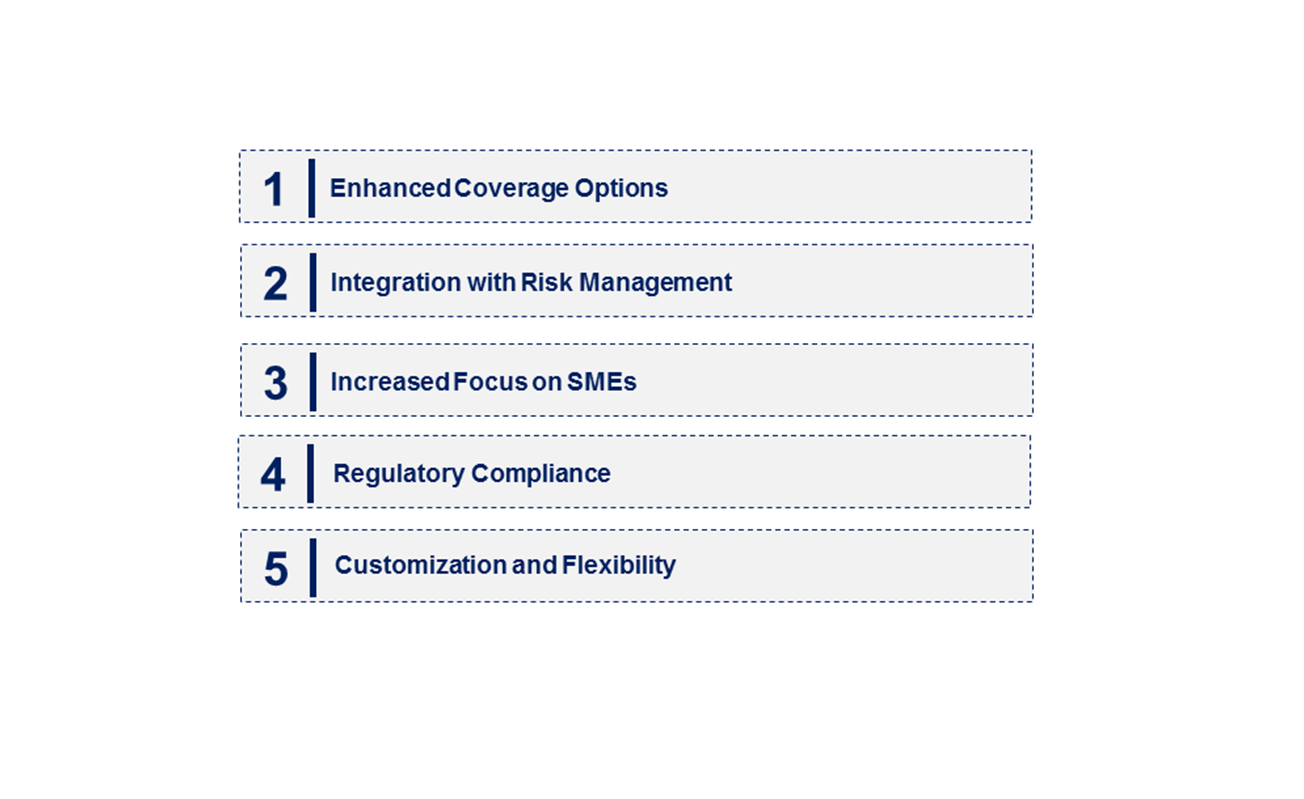
• Enhanced Coverage Options: Insurers are expanding their policy offerings to include coverage for a broader range of cyber threats, such as ransomware and business interruption. This trend reflects the increasing complexity of cyber risks and the need for more comprehensive protection.
• Integration with Risk Management Services: There is a growing emphasis on integrating cyber insurance policies with proactive risk management services. Insurers are offering tools and resources for risk assessment, incident response, and cybersecurity training to help policyholders reduce their exposure to cyber threats.
• Increased Focus on SMEs: The market is seeing a rise in tailored cyber insurance products designed specifically for small and medium-sized enterprises (SMEs). Recognizing the unique challenges faced by SMEs, insurers are developing affordable and accessible coverage options to meet their needs.
• Regulatory Compliance: With evolving data protection regulations, insurers are enhancing their policies to ensure compliance with laws such as GDPR and CCPA. This trend underscores the importance of aligning insurance coverage with legal requirements and industry standards.
• Customization and Flexibility: Insurers are offering more customizable and flexible policy options to cater to the diverse needs of businesses. This includes the ability to tailor coverage limits and terms based on specific risk profiles and industry requirements.
• Advancements in Cyber Risk Modeling: The use of advanced analytics and risk modeling tools is becoming more prevalent in the cyber insurance market. Insurers are leveraging these technologies to better assess and price cyber risks, leading to more accurate and effective policy underwriting.
• Growth in Demand for Incident Response Services: There is increasing demand for cyber insurance policies that include comprehensive incident response services. These services provide critical support during a cyber incident, including legal assistance, forensic investigations, and public relations management. The third-party cyber insurance market is evolving with enhanced coverage options, integrated risk management services, and a focus on SMEs. These emerging trends reflect the need for comprehensive and adaptable solutions in response to the growing complexity of cyber threats and regulatory requirements.
• Policy Innovations: Insurers are introducing new policy features and enhancements to address emerging cyber risks. This includes coverage for ransomware attacks, data breaches, and business interruption, reflecting the evolving nature of cyber threats.
• Increased Underwriting Standards: The market is seeing a rise in stringent underwriting standards as insurers seek to better assess and manage cyber risks. This includes more detailed risk assessments and the incorporation of cybersecurity practices into policy requirements.
• Regulatory Alignment: Insurers are aligning their policies with updated data protection regulations, such as GDPR and CCPA. This ensures that coverage meets legal requirements and provides adequate protection against regulatory fines and penalties.
• Enhanced Risk Management Tools: The integration of advanced risk management tools and services into cyber insurance policies is becoming more common. Insurers are offering resources for risk assessment, incident response, and cybersecurity training to help businesses mitigate cyber threats.
• Market Expansion: The third-party cyber insurance market is expanding to include new geographic regions and industries. This growth is driven by increasing awareness of cyber risks and the need for tailored insurance solutions across different sectors. Recent developments in the third-party cyber insurance market highlight the introduction of innovative policies, increased underwriting standards, and enhanced risk management tools. These changes reflect the industry's response to evolving cyber threats and regulatory demands, driving market growth and adaptation.
• Expansion into Emerging Markets: There are significant opportunities for growth in emerging markets where awareness of cyber risks is increasing. Insurers can develop tailored products to meet the needs of businesses in these regions, driving market expansion.
• Development of Specialized Products: Creating specialized cyber insurance products for specific industries or risk profiles presents growth opportunities. Insurers can address the unique challenges faced by sectors such as healthcare, finance, and manufacturing.
• Integration with Cybersecurity Services: Partnering with cybersecurity firms to offer integrated insurance and cybersecurity solutions can enhance value for policyholders. This approach provides comprehensive protection and risk management, appealing to businesses seeking holistic solutions.
• Focus on Small and Medium-Sized Enterprises (SMEs): Developing affordable and accessible cyber insurance products for SMEs represents a significant growth opportunity. Tailoring coverage to the needs of smaller businesses can address a large and underserved market segment.
• Innovation in Risk Assessment Tools: Investing in advanced risk assessment and modeling tools can improve underwriting accuracy and policy pricing. This innovation enhances insurers' ability to evaluate and manage cyber risks effectively. Strategic growth opportunities in the third-party cyber insurance market include expanding into emerging markets, developing specialized products, and integrating with cybersecurity services. By leveraging these opportunities, insurers can drive market growth and meet the evolving needs of businesses.
• Increasing cyber threats: The rise in cyberattacks and data breaches drives demand for cyber insurance. Businesses are seeking coverage to protect against financial losses and reputational damage resulting from cyber incidents.
• Regulatory requirements: Evolving data protection regulations, such as GDPR and CCPA, create a need for insurance that aligns with legal requirements. Compliance with these regulations encourages businesses to invest in cyber insurance.
• Growing awareness: Increased awareness of cyber risks and their potential impact is driving market growth. Businesses are recognizing the importance of cyber insurance as part of their overall risk management strategy.
• Expansion of digital assets: The growing reliance on digital technologies and data increases the need for cyber insurance. As businesses expand their digital footprint, they face greater exposure to cyber risks and require comprehensive coverage.
• Advancements in risk management: The integration of risk management tools and services into cyber insurance policies enhances their value. Insurers are offering resources for risk assessment and incident response, making policies more attractive to businesses. Challenges in the third-party cyber insurance market include:
• High premium costs: The cost of cyber insurance premiums can be a barrier for some businesses, particularly small and medium-sized enterprises. High premiums may limit accessibility and affordability for certain market segments.
• Complex risk assessment: Assessing and underwriting cyber risks can be complex due to the constantly evolving threat landscape. Insurers must navigate uncertainties and challenges in evaluating and pricing cyber risks.
• Lack of standardization: The lack of standardization in cyber insurance policies can lead to confusion and inconsistency. The absence of industry-wide standards makes it challenging for businesses to compare and evaluate coverage options.
• Evolving threat landscape: The rapid evolution of cyber threats poses challenges for insurers in keeping policies up-to-date. Insurers must continuously adapt their coverage to address new and emerging cyber risks.
• Regulatory compliance: Ensuring compliance with varying data protection regulations and industry standards can be challenging for insurers. Navigating diverse regulatory requirements requires ongoing effort and adaptation. The third-party cyber insurance market is driven by increasing cyber threats, regulatory requirements, and growing awareness. However, challenges such as high premium costs and complex risk assessment must be addressed to ensure continued market growth and accessibility.
• Accenture
• Aon
• IBM
• CyberArk Software
• Oracle
• F5
• FireEye
• Forcepoint
• Fortinet
• Amazon Web Services
• Solutions
• Services
• Packaged
• Standalone
• Large Enterprises
• Small & Medium-Sized Enterprises
• Information & Communication Technology
• Financial Services
• Manufacturing
• Retail
• Healthcare
• Others
• North America
• Europe
• Asia Pacific
• The Rest of the World
• United States: The U.S. has seen significant growth in the third-party cyber insurance market due to increasing cyber threats and regulatory requirements. Recent developments include the introduction of new policies tailored to cover ransomware attacks and business interruption. Insurers are also enhancing their offerings with proactive risk management services, reflecting a shift towards comprehensive coverage that includes incident response and cybersecurity support.
• United Kingdom: In the UK, the third-party cyber insurance market is evolving with increased focus on compliance with the UK General Data Protection Regulation (GDPR) and the Network and Information Systems (NIS) Directive. Insurers are offering policies that cover a wide range of cyber incidents, including data breaches and social engineering attacks. Recent trends include the integration of cyber risk assessments into policy offerings and growing demand for coverage among SMEs.
• Germany: Germany is witnessing advancements in the third-party cyber insurance market with a focus on aligning policies with European Union regulations. The market is seeing an increase in coverage options that address both operational and reputational risks associated with cyber incidents. German insurers are also incorporating advanced risk management tools and services to better support policyholders in mitigating cyber threats.
• Canada: In Canada, the third-party cyber insurance market is expanding as organizations face heightened cyber risks and regulatory pressures. Recent developments include the introduction of cyber insurance policies with enhanced coverage for data breaches and regulatory fines. Canadian insurers are also emphasizing the importance of cybersecurity training and risk mitigation strategies as part of their policy offerings.
• Australia: Australia is experiencing growth in the third-party cyber insurance market driven by increased cybercrime and regulatory changes. Recent trends include the development of policies that address emerging threats such as ransomware and cyber extortion. Australian insurers are also focusing on providing comprehensive support services, including incident response and legal assistance, to help businesses manage cyber incidents effectively.


• Accenture
• Aon
• IBM
• CyberArk Software
• Oracle
• F5
• FireEye
• Forcepoint
• Fortinet
• Amazon Web Services Q6. Which third party cyber insurance market segment will be the largest in future? Answer: Lucintel forecasts that solution is expected to witness the higher growth over the forecast period. Q7. In third party cyber insurance market, which region is expected to be the largest in next 5 years? Answer: North America will remain the largest region over the forecast period due to existence of market players and increasing awareness amongst small to medium sized businesses about cyber insurance in the region. Q.8 Do we receive customization in this report? Answer: Yes, Lucintel provides 10% customization without any additional cost.


Choose a license that fits your team. Instant PDF delivery.
Prices exclude taxes. Instant delivery. Custom licensing available on request.
Market Report · May 16, 2026
Market Report · May 16, 2026
Market Report · May 16, 2026
Trusted partner for strategic intelligence and business growth


Receive a complimentary market analysis tailored to your industry. Our analysts will identify key growth opportunities and competitive dynamics specific to your business.

Market size, growth rate, and key trend analysis for your specific sector.

Top competitor positioning and market share analysis.

Strategic recommendations backed by data-driven insights.
Get curated market intelligence and competitive moves straight to your inbox.
By subscribing, you agree to receive our monthly insights. Unsubscribe anytime.
Receive a complimentary market analysis tailored to your industry. Our analysts will identify key growth opportunities and competitive dynamics specific to your business.
Market size, growth rate, and key trend analysis for your specific sector.
Top competitor positioning and market share analysis.
Strategic recommendations backed by data-driven insights.
Get curated market intelligence, emerging trends, and competitive moves straight to your inbox each month.
By subscribing, you agree to receive our monthly insights. Unsubscribe anytime.
We'll send your sample report shortly.