
Market Report · July 22, 2026

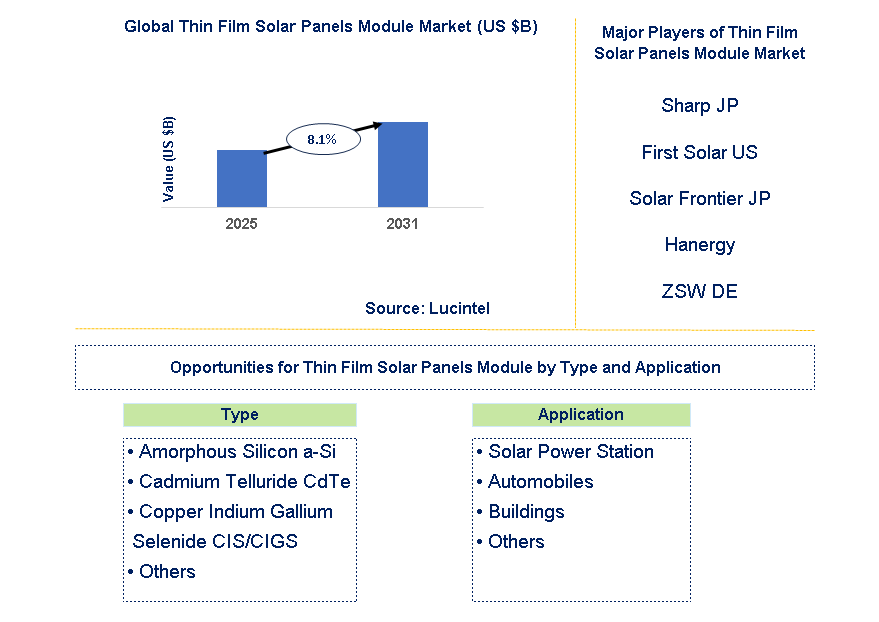
Key data points: The growth forecast = 8.1% annually for the next 7 years. Scroll below to get more insights. This market report covers Trends, opportunities and forecasts in thin film solar panels module market to 2031 by type (amorphous silicon a-si, cadmium telluride CdTe, copper indium gallium selenide CIS/CIGS, and others), application (solar power station, automobiles, buildings, and others), and region (North America, Europe, Asia Pacific, and the Rest of the World)
We'll send your sample report shortly.
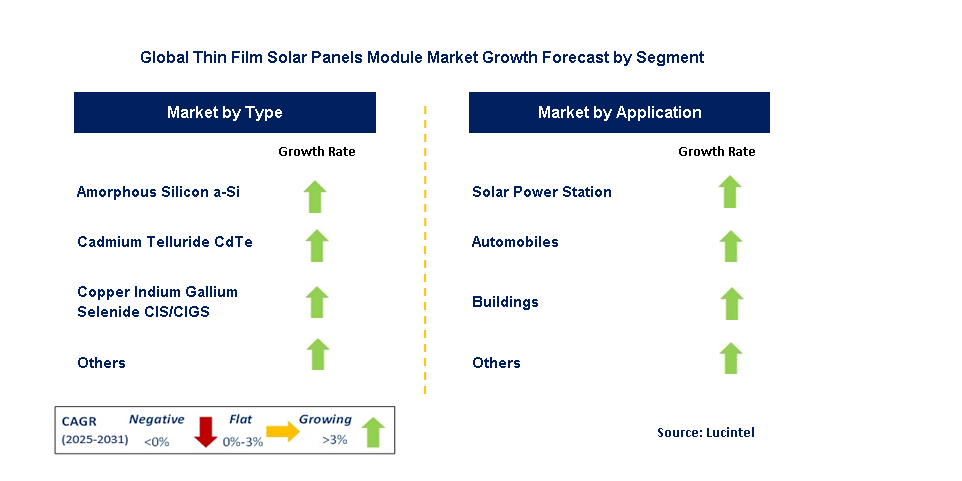
• Lucintel forecasts that, within the type category, cadmium telluride CdTe is expected to witness the highest growth over the forecast period due to growing use in large-scale solar power installations.
• Within the application category, solar power station is expected to witness the highest growth due to their capacity to generate large amounts of renewable energy for grid distribution.
• In terms of region, APAC is expected to witness the highest growth over the forecast period due to growing renewable energy adoption.
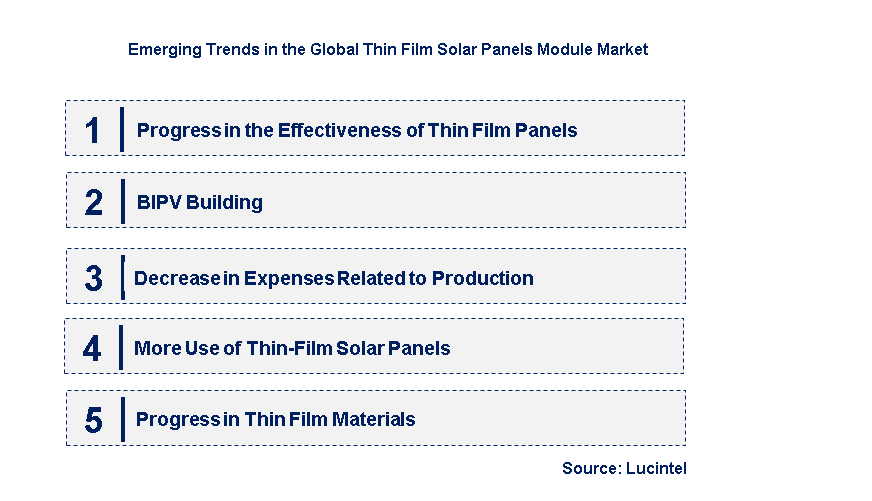
• Progress in the Effectiveness of Thin Film Panels: The recent progress in technology has provoked a rise in the effectiveness of thin-film solar panels, enabling them to better compete against other types of crystalline silicon panels. Enhancements in materials such as cadmium telluride (CdTe) and copper indium gallium selenide (CIGS) allow thin-film panels to absorb and produce increased energy from sunlight. This has broadened their potential uses in markets like residential and commercial installation where efficiency matters. These changes are also aiding in bringing down the total cost per watt, thus making thin film solar panels cost effective for numerous buyers.
• BIPV Building: A notable change in the thin-film solar market is the use of solar building products as materials that combine photovoltaic functions with a building structure, otherwise referred to as Building Integrated Photovoltaics or BIPV. These building integrated solar thin-film solar panels are BIPV components which are easily assembled to roofs, facades, and windows for maximum aesthetic value as well as renewable energy. With the increase in the demand for energy-efficient buildings, the popularity of BIPV solutions is on the rise increasing the consumption of thin-film solar panels in the construction market.
• Decrease in Expenses Related to Production: While analyzing trends for the market of thin-film solar powered panels, it is key to remember that expenses of production are consistently on the decline. Technological improvements in the processes of manufacturing and expansion of market possibilities has led to reduced expenses in the production of thin-film panels. This trend lowers the price of solar electricity for both home and business users, fostering further growth in the use of solar energy. Furthermore, lower production costs contribute to increased competitiveness of thin-film technology in the international solar market, especially in developing countries where cost matters most.
• More Use of Thin-Film Solar Panels: The possibility of these panels being used on nontraditional surfaces makes flexible thin-film solar panels more popular. They can be applied on curved roofs, portable device surfaces and even on skin, providing more options to harness solar energy. The rising need for lightweight solar panels is evident from the automotive industry, which is looking to integrate solar energy into vehicles. This development makes it easier to penetrate new markets, thereby further increasing the scope of application of thin-film solar panels.
• Progress in Thin Film Materials: Unlike many films that directly affect the quality of sunlight transmission, thin-jims are light and efficient. The thin-film production solar industry is set to grow immensely in developed regions that are heavily investing in materials like Perovskite. Perovskite-based thin-film solar cells are inexpensive to produce and use. Alongside, the material presents excellent fabrication yields, making it exceptionally more attractive than traditional thin-film materials. With increased investment, the resources are expected to become even more commercially useful, driving an expansive growth in the thin film solar panel market. Alternative materials can eventually capture a majority of the market share due to its favorable impact on costomer prices, high demand, and low manufacturing cost. In conclusion, it is coming clear in the thin film solar panel market that there is an increase focus on the overall efficiency, flexibility, and integration into varied applications. The incorporation of new materials such as perovskite and cadmium telluride are increasing performance and BIPV and flexible panels offer greater market opportunities. New and emerging supportive policies concerning renewable energgy will also increase the growth rates of thin film technology. Not only are these trends increasing the demand for thin film solar panels, but they are also changing the ways solar energy is incorporated into buildings, vehicles, and daily activities.
• Improvements in Thin Film Materials Technology: Among the most important changes within the market for thin-film solar panels is the development of materials used for solar cell fabrication. The study of CdTe, CIGS, and Perovskite materials has resulted in increased efficiency and better performance of thin film solar panels. These improvements have increased the competitiveness of thin-film technology against traditional crystalline silicon solar panels in terms of costs and manufacturable economies. The most promising advancement has been in the development of perovskite solar cells, which are viable for high-efficiency thin film panels.
• Increased Production Efficiency: The growing popularity of thin film solar panels has resulted in manufacturers being able to lower their premiums and increased production volume. The reduced production costs for the panels have been achieved through changes in the processes employed and higher volumes of production. The increased efficiency increases the accessibility of thin-film solar panels to prospective buyers. This improvement makes it easier to promote the use of solar energy as great supporting the goal of reducing costs of installations at homes and businesses. As these panels gain in value, so too does the expected investment from thin film manufacturers into the greater solar market.
• Expansion of Solar Applications: The use cases for thin film solar modules is proliferating as these modules are increasingly being used on residential and commercial rooftops. Additionally, thin film panels are now used for building integrated photovoltaics (BIPV) and in mobile applications such as solar powered cars. These new applications are broadening the market for thin film solar modules, particularly in areas where there is a high need for renewable energy technologies that are seamlessly integrated within different structures.
• Collaborations and Strategic Partnerships: The collaboration between manufacturers of thin film solar panels, research institutions, and government agencies have helped progress the research as well as commercialization of thin films technologies. These partnerships are strategic in nature and assist in the sharing of information and resources, enabling faster time to market with innovative products. In particular, these arrangements are critical to increasing manufacturing scale and product efficiency. To sustain and spearhead innovation and expand the market, collaborations and joint ventures will help in the growth of thin film solar panels.
• Prioritize in Durability and Functionality: Improving the stamina and life of the thin-film solar panels has been in focus for the last several years. Enhancements in the materials and construction of these panels make them increasingly resistant to environmental factors like temperature and humidity. Consequently, the lifespan of thin-film solar panels is increasing, making them more appealing to long-term investors. In addition, improvement in durability fosters reliability and performance of solar systems, which enhance the overall acceptance and growth of thin-film solar technology. To summarize, the recent changes in the thin film solar panel market showcase striking improvements in technology as well as market uptake. The efficiency of production processes along with the use of thin film panels in residential, commercial, and utility scale projects is on the rise. All of these changes stem from advances in material and manufacturing technology as well as increased regulatory backing in dominant markets. If these trends persist, solar energy harnessed through thin-film panels will be more economically viable for many industries, making it easier to shift towards renewable energy around the globe.
• Installations of Residential Solar: There is growing demand in the residential segment which creates an excellent opportunity for thin-film solar panels. The panels can be easily installed in homes since they are inexpensive and flexible, which leads to decreases in energy usage and carbon emissions. Additionally, as subsidies and incentives persist, the adoption of thin-film solar modules in homes will continue to grow. Innovative companies focusing on residential customers stand to gain from the increasing acceptance of solar technology in residences. These customers tend to become more motivated, increases in the adoption of solar panels within households.
• Commercial Solar Projects: This sector is also another major opportunity for the thin film solar panels. Companies are increasingly trying to find ways to cut down energy expenses and fulfill sustainability targets making the commercial sector another focus area. The benefits of thin-film panels allow for energy efficient solutions on large scale business installations. They are particularly well suited for retrofitting existing structures or installation in new ones because they are flexible and lightweight. Companies can capitalize on the increasing demand for solar panel technologies, especially in the regions rich with incentives and policies supporting solar energy.
• Building Integrated Photovoltaics: The BIPV vertical poses an excellent margin growth opportunity for thin film solar technologies. Windows, handfuls, and rooftops are amongst the structures that can smoothly accept thin film panels. This makes it possible to install solar systems on buildings in a way that covers the structures within all architectural requirements. BIPV systems will gain more importance with the increase in sustainable and energy efficient buildings, which then provides an attractive opportunity for business in the thin film solar market. As a matter of fact, the thin film solar market is poised to benfit from significant growth in demand with the narrow verticals of offering solar glass systems and more BIPV constructions.
• Mobile and Off Grid Applications: Due to its lightweight and flexible design, thin film solar panels are perfect for mobile and off-grid applications. Vehicles, energy systems, and even structures that carry solar energy harnessing capability alongside them have an increasing demand for thin film panels. Companies can capitalize by creating customized products that cater to the mobile powered energy niche. The greater the number of people removing themselves from the grid and looking for switch off able solar products, the growth in demand for inexpensive and light energy sources will provide thin film solar panels appealing for these uses.
• Utility-scale Solar Projects: Another area that is essential for the development of thin-film solar technology is large-scale utility solar projects, as it is large projects that help deploy thin-film solar panels on a global scale. For instance, thin-film solar panels can be economical in large scale installations because they are cheap to produce and can be used in bulk. As utility scale projects continue to grow around the world, especially in developing countries, the market for thin-film modules is predicted to grow. This is an opportunity that companies concentrating on large scale solar farms should take advantage of for expansion into the renewable energy industry. The aforementioned conclusions emanate from the fact that the thin-film solar panel markets have numerous strategic growth opportunities regarding important applications like residential, commercial, and building integrated photovoltaics (BIPV). Flexible, cost-effective, and energy-efficient products are in high demand, and businesses can take advantage of these growth segments. Also, new markets as well as off-grid applications give new opportunities for growth. Companies can focus on capturing bigger shares of the thin-film solar technology markets by adopting collaborative innovation and riding on favorable policies towards clean and sustainable energy solutions to the world.
• Sharp JP
• First Solar US
• Solar Frontier JP
• Hanergy
• ZSW DE
• Sentech De
• CivicSolar
• KANEKA Solar Energy
• SoloPower
• Solar-Facts
• Amorphous Silicon a-Si
• Cadmium Telluride CdTe
• Copper Indium Gallium Selenide CIS/CIGS
• Others
• Solar Power Station
• Automobiles
• Buildings
• Others
• North America
• Europe
• Asia Pacific
• The Rest of the World
• United States: Innovation in manufacturing practices have driven the US thin-film solar panel market, making it much more affordable. The renewable energy incentives offered by the US government, such as tax breaks and clean energy subsidies, have made the adoption of thin-film solar technology easier. Additionally, American manufacturers have sought after increasing the efficiency of their thin-film solar cells, making them more viable than crystalline silicon panels. This efficiency drive has increased the amount of installations in utility scale power plants and large commercial structures.
• China: Remains the world leader in the manufacture of thin film solar panels, with the country’s colossal manufacturing capability lowering prices globally. The Chinese government has established positive policies and measures intended to widen the adoption of renewable energy, including thin film technology, at the residential and commercial levels. China's companies have also funded additional research and development activities to increase the efficiency and longevity of thin film solar panels. China’s efforts on energy self-sufficiency and carbon neutrality goals increased the adoption of thin film solar technology and in turn, greatly expanded its market share both locally and abroad.
• Germany: Germany remains one of the leaders in the European thin film solar market, focusing primarily on sustainability and the reduction of carbon emissions. The government also funds programs in renewable energy like the Renewable Energy Sources Act (EEG) which encourages the use of solar energy. Because of the increasing architectural use of thin film solar blocks, their installation is gaining popularity in the city regions. In Germany, the increasing demand for energy efficient buildings and readily available solar structures is also promoting the rapid use of these thin film solar panels.
• India: India is steadily transforming the thin-film solar market, courtesy of the National Solar Mission which aims to adopt environmental preservation strategies. The thin-film technology is particularly advantageous for India’s rural regions as it is relatively inexpensive and can be easily deployed in off-grid locations. Other Indian businesses are concentrating on the efficiency and durability of thin-film solar panels to ensure that such technologies are practical for mass adoption. With the Indian government actively promoting clean energy, it is only a matter of time before the adoption of thin-film solar technology increases dramatically.
• Japan: In Japan, ever since the Fukushima nuclear disaster, there has been a national shift towards renewable energy, causing the country’s thin film solar panel industry to flourish at a steady pace. More thin-film solar panels are being adopted in both residential and commercial buildings, and even in new large scale solar projects. To further promote the market, the government provides subsidies as incentives to increase the use of solar energy. Additionally, Japanese industries are putting more resources into developing more efficient thin-film solar cells to help maintain the country’s competitiveness in the global solar energy arena.


• Sharp JP
• First Solar US
• Solar Frontier JP
• Hanergy
• ZSW DE
• Sentech De
• CivicSolar
• KANEKA Solar Energy
• SoloPower
• Solar-Facts Q5. Which thin film solar panels module market segment will be the largest in future? Answer: Lucintel forecasts that, within the type category, cadmium telluride CdTe is expected to witness the highest growth over the forecast period due to growing use in large-scale solar power installations. Q6. In thin film solar panels module market, which region is expected to be the largest in next 5 years? Answer: In terms of region, APAC is expected to witness the highest growth over the forecast period due to growing renewable energy adoption. Q7. Do we receive customization in this report? Answer: Yes, Lucintel provides 10% customization without any additional cost.


Choose a license that fits your team. Instant PDF delivery.
Prices exclude taxes. Instant delivery. Custom licensing available on request.
Market Report · July 22, 2026
Market Report · July 22, 2026
Market Report · July 17, 2026
Trusted partner for strategic intelligence and business growth


Receive a complimentary market analysis tailored to your industry. Our analysts will identify key growth opportunities and competitive dynamics specific to your business.

Market size, growth rate, and key trend analysis for your specific sector.

Top competitor positioning and market share analysis.

Strategic recommendations backed by data-driven insights.
Get curated market intelligence and competitive moves straight to your inbox.
By subscribing, you agree to receive our monthly insights. Unsubscribe anytime.
Receive a complimentary market analysis tailored to your industry. Our analysts will identify key growth opportunities and competitive dynamics specific to your business.
Market size, growth rate, and key trend analysis for your specific sector.
Top competitor positioning and market share analysis.
Strategic recommendations backed by data-driven insights.
Get curated market intelligence, emerging trends, and competitive moves straight to your inbox each month.
By subscribing, you agree to receive our monthly insights. Unsubscribe anytime.
We'll send your sample report shortly.