
Market Report · July 22, 2026

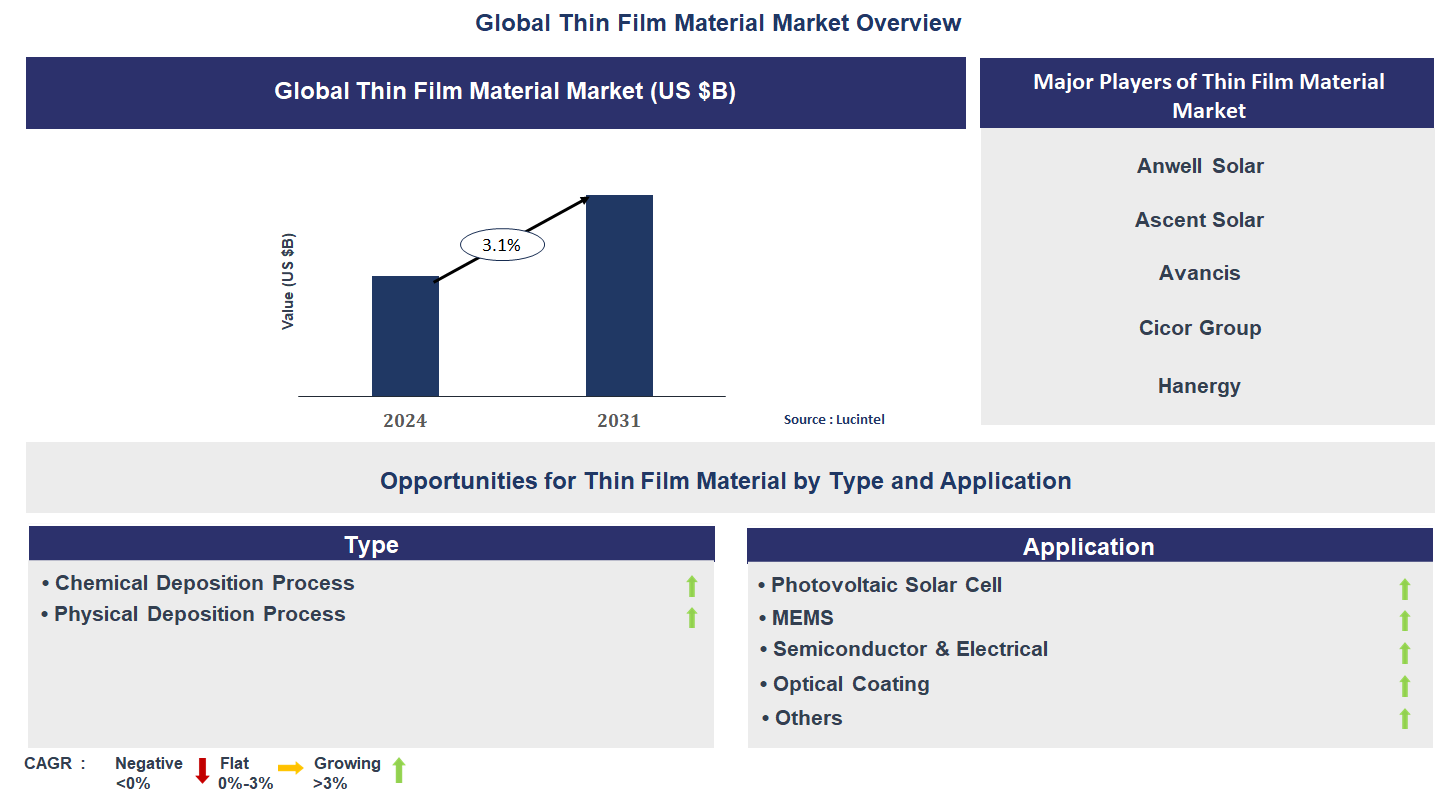
Key data points: The growth forecast = 3.1% annually for the next 7 years. Scroll below to get more insights. This market report covers trends, opportunities and forecasts in thin film material market to 2031 by type (chemical deposition process and physical deposition process), application (photovoltaic solar cell, MEMS, semiconductor & electrical, optical coating, and others), and region (North America, Europe, Asia Pacific, and the Rest of the World)
We'll send your sample report shortly.
• Lucintel forecasts that, within the type category, chemical deposition process is expected to witness higher growth over the forecast period.
• Within the application category, photovoltaic solar cell is expected to witness the highest growth.
• In terms of region, APAC is expected to witness the highest growth over the forecast period. Gain valuable insights for your business decisions with our comprehensive 150+ page report. Sample figures with some insights are shown below.
• Concentration on Two-Dimensional Materials: Utilization of 2D materials such as graphene and transition metal dichalcogenides (TMDs) is a major trend in the making. These are single-atom-thick materials that possess exceptional electrical, optical, and mechanical properties. This trend revolves around the demand for more efficient and flexible components in semiconductors, sensors, and flexible displays. Graphene, for instance, is being researched for its conductivity and transparency, which could transform flexible electronics.
• Growth of Flexible and Wearable Electronics: Flexible and wearable electronic devices, including smartwatches, flexible displays, and health sensors, are a strong trend. Thin film materials for these applications must be not just highly functional but also flexible, durable, and light in weight. This trend is pushing research in new organic and inorganic thin films capable of being bent and twisted without compromising on performance. It is also opening new manufacturing opportunities for flexible display and circuit boards.
• Artificial Intelligence Integration into Manufacturing: AI is being increasingly used in thin film manufacturing. This includes the use of machine learning algorithms to maximize deposition processes, anticipate and avoid defects, and improve quality control. AI can process complex sensor data in real time to modify parameters such as temperature and pressure, ensuring higher uniformity and efficiency. This results in increased yields, reduced production costs, and better product performance.
• Perovskite Thin Film Technology Advances: Perovskite is a game-changer for the solar energy industry. The trend is centered around creating highly efficient, low-cost thin film solar cells from perovskite materials. In contrast to conventional silicon solar cells, perovskite cells can be made using less energy and on flexible substrates, opening up new uses such as solar-powered clothing, windows, and building facades. Although there are still some challenges, quick breakthroughs are turning perovskites into a serious market player.
• Energy Storage and Battery Application: Thin films are not only for electronic applications; they’re also being utilized to make next-generation energy storage devices. The trend here includes utilization of thin films to prepare solid-state batteries and micro-supercapacitors. These are safer, more portable, and longer-lasting compared to conventional batteries. Thin films can be employed as electrolytes, separators, and electrodes, enabling the development of miniature power sources for small electronic devices and implantable medical devices. These trends are revolutionizing the thin film material market by promoting innovation and diversification. They are driving the industry towards a future in which materials are not only functional but also smart, flexible, and sustainable.

• Developments in Atomic Layer Deposition: One significant development is the improvement of ALD technology. This method of deposition enables atomic layers of films to be deposited in a single layer, giving unprecedented thickness and composition control for films. This has a significant effect on the production of semiconductors, allowing smaller and more powerful transistors to be produced for microchips. ALD also plays an important role in the creation of high-end coatings for medical instruments and sensors, where consistency and accuracy are essential.
• Flexible Thin Film Photovoltaics Commercialization: Commercialization of thin film solar panels made of flexible material is a new trend that is revolutionizing the renewable energy market. These panels, unlike conventional silicon panels, are light, robust, and can be embedded in multiple surfaces. This has created new applications in building-integrated photovoltaics (BIPV), electric vehicle rooftops, and consumer electronics. This innovation is making solar energy more versatile and accessible, which is an important step towards a low-carbon economy.
• Transparent Conductive Film Development: There has been tremendous growth in transparent conductive films, which are critical for touchscreens, OLED displays, and smart windows. The market is shifting from the conventional material indium tin oxide (ITO) because of its expense and rarity. Some of the recent advancements are the use of carbon nanotubes, silver nanowires, and graphene as environmentally sustainable and flexible options. These materials are making it possible to manufacture rollable and foldable displays for future consumer electronics.
• Thin Film Integration in Quantum Computing: Thin films are increasingly being incorporated into the newly evolving technology of quantum computing. This is a new trend that has a long-term relevance. Thin film materials with certain electronic characteristics are employed to fabricate superconducting circuits and quantum bits (qubits). The accuracy provided by thin film deposition is required to manage quantum states and develop stable quantum computers. This advancement is putting the thin film industry at the forefront of the next technology revolution.
• Thin Film Encapsulation Innovation: An important innovation for the display and flexible electronics industry is thin film encapsulation innovation. This process entails the deposition of a multi-layer thin film to shield sensitive organic light-emitting diode (OLED) materials from oxygen and moisture. The latest innovations have resulted in thinner yet more efficient encapsulation layers, which are making it possible to make ultra-thin, flexible, and long-lasting displays for smartphones and smart devices. These advancements are all having a cumulative effect on the thin film material industry by propelling innovation across industries as varied as consumer electronics and renewable energy. They are making it possible to develop highly advanced products with higher performance and a lower environmental impact.
• Consumer Electronics: This is a significant growth opportunity, fueled by the insatiable need for thinner, lighter, and more efficient electronic products. Thin films find applications in display (OLED and LCD), touchscreens, and semiconductor devices. Strategic opportunities are to develop high-performance transparent conductive films for flexible and foldable displays, and ultra-pure deposition materials for microchips and sensors. The ongoing innovation in smartphones, tablets, and wearable gadgets creates a continuous and expanding market.
• Renewable Energy and Solar Cells: The renewable energy industry presents a huge growth potential. Thin-film solar cells are a valid substitute to conventional crystalline silicon panels, particularly for building-integrated photovoltaics (BIPV) and flexible uses. Key opportunities are the investments in research and development of next-generation materials such as perovskites and copper indium gallium selenide (CIGS), and putting in place large-scale manufacturing processes to bring these cells within reach in terms of costs for utility-scale installations and niche uses.
• Biomedical and Medical Devices: The biomedical and medical industry is a high-value, high-growth opportunity. Thin films are employed in biocompatibility coatings for implants, diagnostic sensors, and flexible electronics for wearable health monitoring. Strategic opportunities exist in creating specialized thin film materials that are non-toxic, withstanding, and able to integrate with human tissue. A high level of precision and regulatory compliance is demanded for this application, creating a niche market with high entry barriers.
• Transportation and Automotive: The automotive sector is a fast-paced increasing market for thin film materials. They are utilized in anti-reflective glass coatings, sensors for driver-assistance systems (ADAS), and thin film batteries for electric cars. Strategic possibilities involve producing intelligent coatings that can modulate their optical properties and making materials for electric car parts that are lightweight and durable. The trend of autonomous and electric vehicles will continue to boost the demand in this industry.
• Optical Coatings and Photonics: This is an old but growing market. Thin films are employed in producing high-performance anti-glare, anti-reflective, and mirror coatings for telescopes, lenses, and fiber optics. Opportunity lies in the development of coatings for virtual and augmented reality (VR/AR) headsets that enhance display quality and minimize eye fatigue. The heightened demand for sophisticated optics in consumer and industrial products guarantees a consistent market for innovation here. These opportunities are affecting the thin film material market by forcing specialization and diversification. Firms are shifting from a generalist strategy towards a specialized strategy, choosing targeted high-growth applications to maintain competitive advantage and establish a leadership position in the industry.
• Anwell Solar
• Ascent Solar
• Avancis
• Cicor Group
• Hanergy
• Kaneka
• Masdar
• Moser Baer
• Solar Frontier
• Suntech Power
• Chemical Deposition Process
• Physical Deposition Process
• Photovoltaic Solar Cell
• MEMS
• Semiconductor & Electrical
• Optical Coating
• Others
• North America
• Europe
• Asia Pacific
• The Rest of the World
• United States: The U.S. market is dominated by high-tech research and development and the application of thin films in next-generation electronics. Major breakthroughs are observed with respect to the application of thin film materials in semiconductor fabrication, especially for future-generation microchips and memory chips. Heavy investment is also observed in thin film solar cells, particularly flexible and light solar panels for use in building-integrated photovoltaics (BIPV) and electric vehicles.
• China: China is a leading force in the thin film material industry, powered by its enormous electronics production sector and ambitious clean energy targets. Recent trends are characterized by fast capacity building and emphasis on local technological independence. The nation is investing significantly in thin film encapsulation in flexible OLED screens for mobile phones and television sets. China’s efforts at the proliferation of solar energy usage have also driven the expansion of its thin film photovoltaic industry, targeting both rigid and flexible modules.
• Germany: Germany’s thin film material market is dominated by an emphasis on high-value, precision-engineered applications. The most important developments involve the application of thin films in advanced optical coatings for high-performance windows and lenses and in the automotive sector for sensors and smart glass. The nation is also at the forefront of creating complicated deposition technologies such as atomic layer deposition (ALD) to achieve atomic-level precision films. Germany’s leadership in high-tech manufacturing backs the development of the market.
• India: India’s thin film material market is in its growth stage, driven by growing demand for consumer electronics and the government’s initiative for renewable energy. Emerging trends are aimed at accelerating the use of thin film coatings for electronic displays of mobile phones and TVs. Transparent conductive coatings and anti-reflective coatings are seeing increasing demand. Whereas the market is dependent on imports for all advanced materials, there is a growing domestic manufacturing base and expanding research in the area of thin film use for medical devices and solar energy.
• Japan: Japan’s thin film material industry is technically advanced and very innovative. New advancements involve heavy emphasis on perovskite thin film solar cells, which are thin and flexible, ideal for Japan’s peculiar geography. Japan is heavily investing in this technology to dislodge China’s stranglehold in the solar sector. Japan is also at the forefront of creating high-performance displays and next-generation semiconductors’ thin film materials with high precision and reliability.


• Anwell Solar
• Ascent Solar
• Avancis
• Cicor Group
• Hanergy
• Kaneka
• Masdar
• Moser Baer
• Solar Frontier
• Suntech Power Q5. Which thin film material market segment will be the largest in future? Answer: Lucintel forecasts that, within the type category, chemical deposition process is expected to witness higher growth over the forecast period. Q6. In thin film material market, which region is expected to be the largest in next 5 years? Answer: In terms of region, APAC is expected to witness the highest growth over the forecast period. Q7. Do we receive customization in this report? Answer: Yes, Lucintel provides 10% customization without any additional cost.


Choose a license that fits your team. Instant PDF delivery.
Prices exclude taxes. Instant delivery. Custom licensing available on request.
Market Report · July 22, 2026
Market Report · July 22, 2026
Market Report · July 22, 2026
Trusted partner for strategic intelligence and business growth


Receive a complimentary market analysis tailored to your industry. Our analysts will identify key growth opportunities and competitive dynamics specific to your business.

Market size, growth rate, and key trend analysis for your specific sector.

Top competitor positioning and market share analysis.

Strategic recommendations backed by data-driven insights.
Get curated market intelligence and competitive moves straight to your inbox.
By subscribing, you agree to receive our monthly insights. Unsubscribe anytime.
Receive a complimentary market analysis tailored to your industry. Our analysts will identify key growth opportunities and competitive dynamics specific to your business.
Market size, growth rate, and key trend analysis for your specific sector.
Top competitor positioning and market share analysis.
Strategic recommendations backed by data-driven insights.
Get curated market intelligence, emerging trends, and competitive moves straight to your inbox each month.
By subscribing, you agree to receive our monthly insights. Unsubscribe anytime.
We'll send your sample report shortly.