
Market Report · July 31, 2026

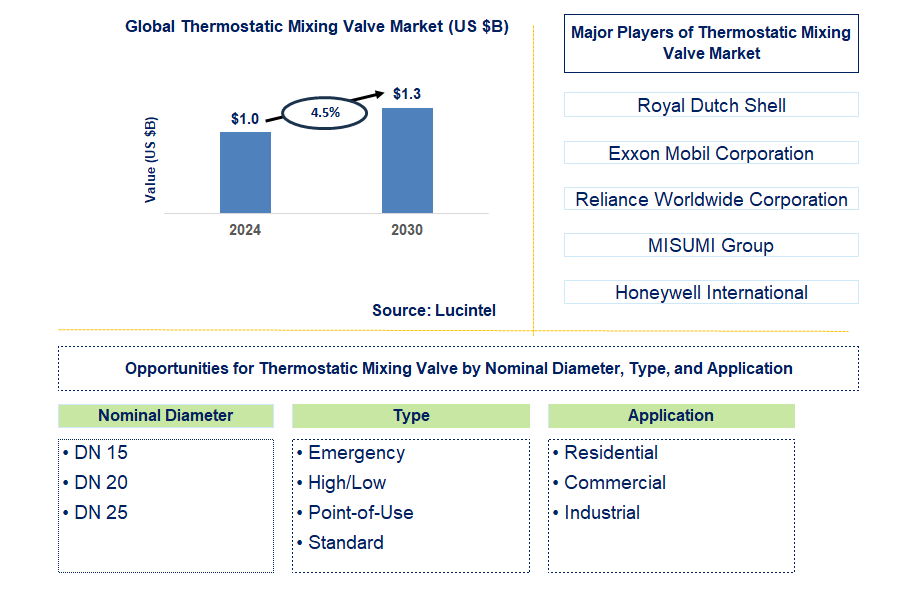
Key data points: The market size in 2030 = $1.3 billion, growth forecast = 4.5% annually for the next 6 years. Scroll below to get more insights. This market report covers trends, opportunities, and forecasts in the global thermostatic mixing valve market to 2030 by nominal diameter (DN 15, DN 20, and DN 25), type (emergency, high/low, point-of-use, and standard), application (residential, commercial, and industrial), and region (North America, Europe, Asia Pacific, and the Rest of the World)
We'll send your sample report shortly.
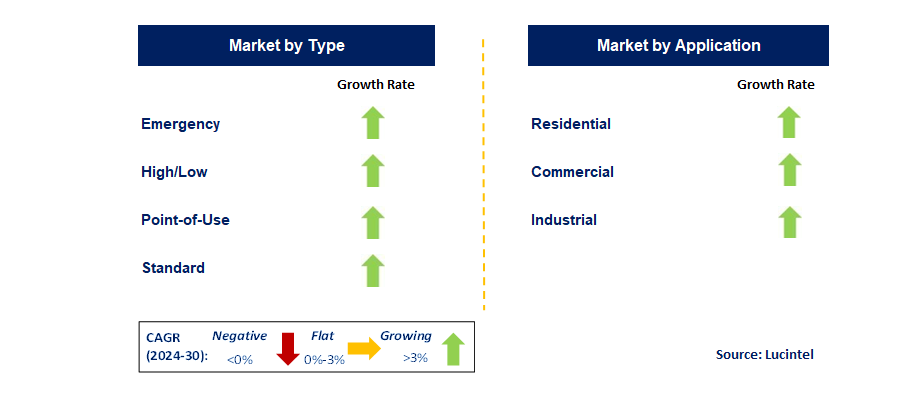
• Lucintel forecasts that, within the type category, emergency segment is expected to witness the highest growth over the forecast period.
• Within the application category, residential will remain the largest segment over the forecast period.
• In terms of regions, North America will remain the largest region over the forecast period. A more than 150-page report is developed to help in your business decisions.
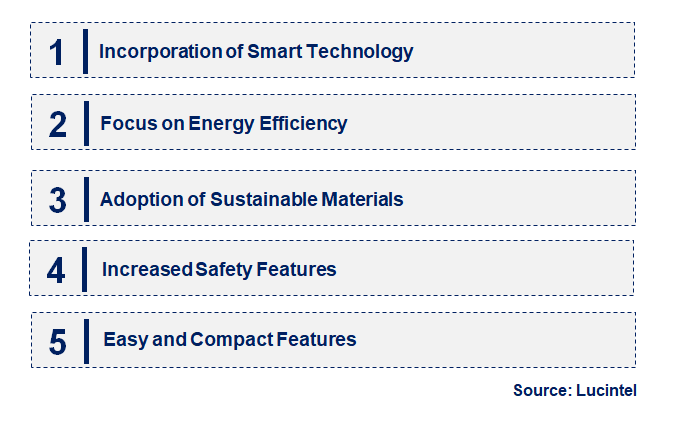
• Incorporation of Smart Technology: Due to the application of IoT in thermostatic mixing valves, the structure can now be monitored and operated remotely. This trend helps in ease of use, cost management, and efficiency of operations.
• Focus on Energy Efficiency: There is a need to develop valves that facilitate the proper utilization of energy. Efforts to improve operational efficiency are leading to the increased production of energy-efficient designs to comply with the latest energy-saving norms.
• Adoption of Sustainable Materials: There is an increased use of environmentally friendly materials in the construction of the valves. This trend complements global aspirations for sustainability and regulations that have been put in place to limit the impact on the ecosystem.
• Increased Safety Features: Some of these new designs are equipped with sophisticated safety features to guard against scalding and excessive temperature variance in water. This trend is driven by the stringent safety standards, which are increasing rapidly, and the market demand for safe products.
• Easy and Compact Features: Due to space limitations, compact and modular valve designs are increasingly being advocated. These designs are advantageous for any kind of installation. The current business is changing these trends by incorporating new technologies, such as advanced thermostatic mixing valve designs, low energy usage strategies, the use of eco-friendly materials, safety considerations, and a shift toward space-saving designs. These changes reflect an industry that is becoming more intelligent, environmentally friendly, and flexible.
• Smart Valve Incorporation: The integration of smart thermostatic mixing valves makes it possible to control and monitor the unit anytime and anywhere, which results in better performance and convenience for end users. This innovation fits into the evolving direction of smart home technology.
• Revision in Statutory Compliance: Newly implemented laws call for more efficient and safer standards during the manufacturing of thermostatic mixing valves. Manufacturers are responding by developing advanced safety features and cutting-edge designs for energy-efficient products.
• Sustainable Material Use: There is an increasing trend of incorporating sustainable materials in the development of thermostatic mixing valves. This encourages the global sustainability goal and meets the growing customer and regulatory demand for environmentally friendly products.
• Increased Automation: The automatic control of thermostatic mixing valves is enhancing efficiency and reliability in their operation. Automated systems are more effective in regulating factors such as water temperature and flow, leading to greater user satisfaction.
• Expansion in Emerging Markets: Growth in India and China, for example, has contributed to the development of cheaper yet more efficient thermostatic mixing valves. Innovations have been made to assist manufacturers in addressing the demands of these emerging markets. These transformations are changing the landscape of the thermostatic mixing valve market by embracing smart technology, meeting new regulatory requirements, practicing corporate social responsibility, investing in automation, and focusing on emerging markets. These trends facilitate the development of improved, efficient, reliable, and eco-friendly solutions.
• Residential Applications: The widening adoption of thermostatic mixing valves in residential installations presents a growth opportunity. New technologies in water usage and smart homes can help address the rising need for improved residential water management systems.
• Commercial Sector: The growing prospects for expansion in the commercial sector, including hotels, hospitals, and office buildings, are evident. Urbanization and the pursuit of better safety and energy efficiency in these types of applications are key drivers.
• Industrial Use: The most critical opportunity for thermostatic mixing valves lies in the industrial sector. The use of high-temperature water in industrial applications creates a sizable market for valves that ensure efficient operations and long service life in high-temperature environments.
• Integration with Smart Buildings: The increasing popularity of online monitoring and control of buildings, supported by thermostatic mixing valve designs, further emphasizes the need for solutions in building automation. This leads to better energy efficiency and improved management.
• Emerging Markets: Emerging economies, such as India and China, present significant opportunities for thermostatic mixing valve companies. Focusing on local demands and ensuring compliance with applicable regulations can help companies succeed in these markets. These strategic growth opportunities highlight the potential for deepening applications in the residential, commercial, and industrial markets, integrating into smart building systems, and penetrating new industries. In the thermostatic mixing valve market, this indicates a shift toward more complex, affordable, and diverse solutions.
• Technological Advancements: The development of new valve technology such as smart and automatic valves fuels the market growth. Such innovations improve the utility and comfort of the users, which spurs growth in the market. These new products provide better and more efficient operational capabilities.
• Increased Safety Regulations: Increased safety requirements are increasing the market for thermostatic mixing valves. Meeting these requirements results in safer and more dependable products, thereby increasing the appetite of the market.
• Energy Efficiency Demands: The growing energy efficiency requirements can be the driving factor for the development of the energy efficient thermostatic mixing valves. Products such as these increase the likelihood of adhering to the new energy conservational policies whiles lowering operational expenses.
• Urbanization and Infrastructure Development: Urbanization and infrastructural development within the largely underserved markets are anticipated to contribute to the demand of sophisticated water management solutions such as thermostatic mixing valves.
• Consumer Awareness: Growth of the market is also influenced by the rise in concern of consumers regarding thermostatic mixing valve benefits, such as safety and comfort. Consumers help in shaping the market by creating the demand for superior and dependable products. Challenges in the thermostatic mixing valve market are:
• High Competition: There are many companies offering thermostatic mixing valves, making the market highly competitive. Offering unique products or maintaining a competitive advantage can be challenging.
• Regulatory Compliance Costs: Compliance with strict regulatory requirements incurs significant costs related to research, development, and quality assurance. Such expenses can impact profitability and market entry in the future.
• Technological Complexity: Incorporating advancements in new valve designs without affecting the main functionality of the valve can increase complexity. Achieving reliability and simplicity in usage while deploying new technologies is difficult. The growth of the thermostatic mixing valve market is driven by factors such as new technologies, safety regulations, energy efficiency, urbanization, and consumer awareness. However, barriers such as high competition, regulatory costs, technological complexity, price pressures, and continuity issues must be addressed to succeed in the market.
• Royal Dutch Shell
• Exxon Mobil Corporation
• Reliance Worldwide Corporation
• MISUMI Group
• Honeywell International
• Watts Water Technologies
• Danfoss
• Bradley Corporation
• Armstrong International
• Caleffi
• DN 15
• DN 20
• DN 25
• Emergency
• High/Low
• Point-of-Use
• Standard
• Residential
• Commercial
• Industrial
• North America
• Europe
• Asia Pacific
• The Rest of the World
• United States: In the U.S., there has been significant development in smart thermostatic mixing valve technology enabled with IoT features. These valves provide control and monitoring to improve energy efficiency and user convenience. Additionally, there is growth in the use of these devices in residential and commercial buildings due to new building codes that require water safety.
• China: In China, the increasing deployment of thermostatic mixing valves in the industrial sector is driven by urbanization and infrastructure development. New challenges are encouraging design changes, making the valves more sophisticated in manufacturing.
• Germany: Germany is advancing the manufacturing of high-precision thermostatic mixing valves, which are more durable and energy-efficient. The market is also witnessing an increase in the use of environmentally friendly materials and production techniques, in line with strict environmental controls.
• India: In India, similar trends are observed, with increasing demand for low-cost, effective, and high-quality thermostatic mixing valves driven by urbanization and infrastructure development. Efforts are being directed toward affordable designs that comply with local regulations and water conservation requirements.
• Japan: Japan, being an advanced country, is actively working on compact and modern thermostatic mixing valves that are suitable for space-restricted environments in cities. Further innovations include the development of valve automation technologies and the integration of smart home systems.


• Royal Dutch Shell
• Exxon Mobil Corporation
• Reliance Worldwide Corporation
• MISUMI Group
• Honeywell International
• Watts Water Technologies
• Danfoss
• Bradley Corporation
• Armstrong International
• Caleffi Q6. Which thermostatic mixing valve market segment will be the largest in future? Answer: Lucintel forecasts that emergency segment is expected to witness the highest growth over the forecast period. Q7. In thermostatic mixing valve market, which region is expected to be the largest in next 5 years? Answer: North America will remain the largest region over the forecast period. Q.8 Do we receive customization in this report? Answer: Yes, Lucintel provides 10% customization without any additional cost.


Choose a license that fits your team. Instant PDF delivery.
Prices exclude taxes. Instant delivery. Custom licensing available on request.
Market Report · July 31, 2026
Market Report · July 22, 2026
Market Report · July 20, 2026
Trusted partner for strategic intelligence and business growth


Receive a complimentary market analysis tailored to your industry. Our analysts will identify key growth opportunities and competitive dynamics specific to your business.

Market size, growth rate, and key trend analysis for your specific sector.

Top competitor positioning and market share analysis.

Strategic recommendations backed by data-driven insights.
Get curated market intelligence and competitive moves straight to your inbox.
By subscribing, you agree to receive our monthly insights. Unsubscribe anytime.
Receive a complimentary market analysis tailored to your industry. Our analysts will identify key growth opportunities and competitive dynamics specific to your business.
Market size, growth rate, and key trend analysis for your specific sector.
Top competitor positioning and market share analysis.
Strategic recommendations backed by data-driven insights.
Get curated market intelligence, emerging trends, and competitive moves straight to your inbox each month.
By subscribing, you agree to receive our monthly insights. Unsubscribe anytime.
We'll send your sample report shortly.