
Market Report · May 18, 2026

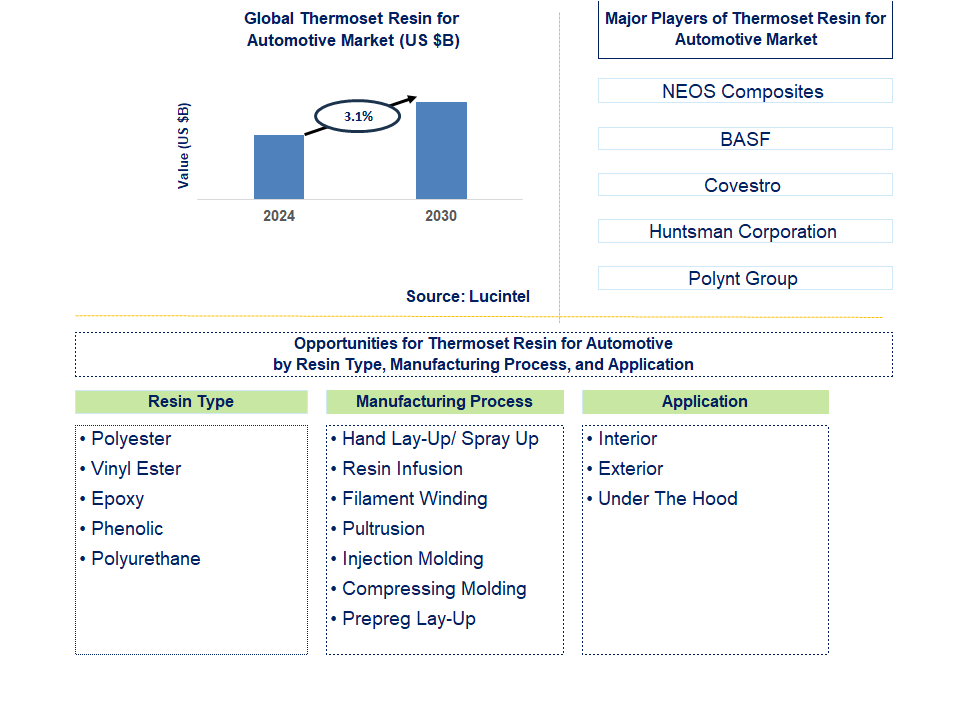
Key data points: The growth forecasts = 3.1% annually for the next 6 years. Scroll below to get more insights. This market report covers trends, opportunities, and forecasts in the global thermoset resin for automotive market to 2030 by resin type (polyester, vinyl ester, epoxy, phenolic, and polyurethane), manufacturing process (hand lay-up/ spray up, resin infusion, filament winding, pultrusion, injection molding, compressing molding, and prepreg lay-up), application (interior, exterior, and under the hood), and region (North America, Europe, Asia Pacific, and the Rest of the World)
We'll send your sample report shortly.
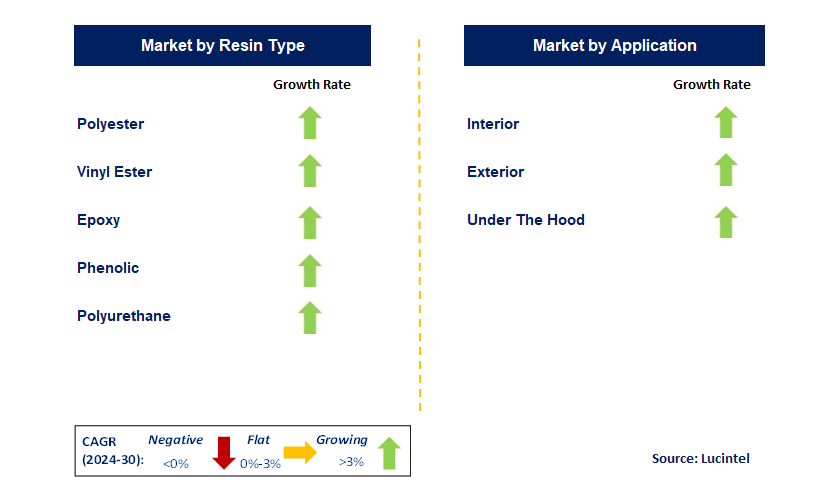
• Lucintel forecasts that, within the resin type category, polyester is expected to witness the highest growth over the forecast period.
• Within the application category, interior is expected to witness the highest growth.
• In terms of regions, APAC is expected to witness the highest growth over the forecast period. A more than 150-page report is developed to help in your business decisions.
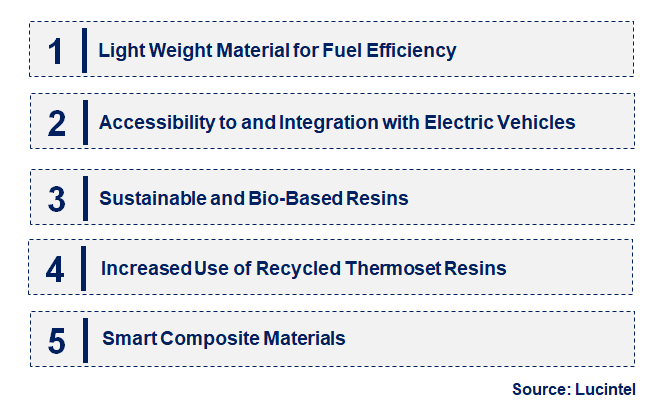
• Light Weight Material for Fuel Efficiency: To achieve enhanced vehicle fuel economy, manufacturers are employing thermoset resins in vehicle construction to offer reduced weight. Demand for lightweight materials to be applied into thermoset composites which are used for structural and exterior and under bonnet components parts has increased tremendously. These resins carry high endurance and toughness as well as considerably weight loading which helps in improving fuel efficiency and reducing cost in emissions features of the vehicles.
• Accessibility to and Integration with Electric Vehicles (EVs): The full scale shift towards electric vehicles is boosting the usage of certain thermoset resins. These resins are critical for designing lightweight battery enclosures and electric motor housings, among other components. Electric Vehicles (EVs) call for materials that can endure elevated temperatures, possess good mechanical properties and meet specific safety requirements; thermoset resins satisfy these conditions.
• Sustainable and Bio-Based Resins: Because of environmental worries, there is a search for bio-based and thermoset resins that are eco-friendly. Corporations are currently developing resins that are made from renewable resources, particularly plant materials, and are relatively carbon efficient compared to resins based on oil. These materials enable automotive manufacturers to comply with strict pollution control norms and provide eco-friendly products to customers.
• Increased Use of Recycled Thermoset Resins: The recycling of thermoset resin is a novel practice that is becoming common in the automotive sector due to the need to manage the waste from composites. Development in recycling technologies is turning thermoset resins into reusable materials thus adding to the circular economy. This trend is pushing producers to use recycled resins in making automotive parts which helps in management of wastages and cuts down on the carbon footprint in the manufacture of motor vehicles.
• Smart Composite Materials: The emergence of smart materials in the production of vehicles is denting the thermoset resins industry. Self-healing, stress or temperature responsive, and real-time data interaction smart composite materials enhance vehicles in operation. This makes it possible to improve advanced safety systems as well as facilitate the evolution of interlinked and self-driving vehicles. These emerging trends suggest that the thermoset resins market for automotive market is approaching new, lightweight, greener and more advanced solutions which are in line with the electric and smart vehicles of the future.
• Bio-Based and Sustainable Resins: The thermoset resins for many automotive applications, especially end of life automotive parts which are often replaced with biobased resins, are being research for replacement by automotive manufacturers. These materials provide a viable alternative to manufactures which will in turn help in saving the environment. More of these resins are essential in easing some pollution effects due to manufacturing capacity in automobile companies.
• Advanced High-Performance Epoxy Resins: Several systems for integrating a polymer with superior mechanical, physical and thermal properties into structural elements and battery housings have recently became available. These advanced resins are very important in enhancing the safety and overall endurance of electric cars (EC) and other high end vehicles. They are fast gaining popularity for use in critical areas of automobile applications owing to their remarkable impact and heat resistance.
• Recyclable Thermoset Composites: To that effect, the development of recycle thermoset composites has advanced over the years. New processes are being developed to help with the recycling of these materials which were otherwise deemed non-recyclable. This is helping decrease the negative environmental effects of automotive industry production as well as making room for new circular economies within the industry.
• Resin Infusion and Automation: The enhancement of the efficiency of automotive parts manufacture through the combination of resin infusion processes and the automated manufacturing is increasing production efficiency. This involves the accurate application of thermoset resins thanks to using mold making techniques such as stereolithography. Still, there is also a trend of manufacturing with automation that is diminishing the costs of labor and rapid progression of the manufacturing schedule thus allowing these materials within more many automakers.
• Smart Thermosetting Resins for Advanced Vehicles: The smart thermosetting resin development process with incorporated sensors is bringing about improvements on vehicle performance. The resins can be helpful in a number of ways that change the future by including supplying information on the condition of the vehicle which is more useful for maintenance predicting and timely usage of automation driving systems. This particular failure may become more significant as current automotive producers start urging closer vehicle smartening progress. The greatest attention is paid to performance, sustainability and smart technologies in these changes in the automotive sector. As the appetite for EVs and advanced materials increases, these innovations foresee the sources thermoset resins as one of the components within the scope of automotive manufacturing.
• Electric Vehicle (EV) Components: The EV market is on a rapid growth phase, ascriptions for battery enclosure, structure parts and motor housing requiring thermoset resins as lightweight and durable components are coming up. This thus opens a lot of opportunities for thermoset resins manufacturers in making of more products that will be used in this high performance EV market which require high temperature resistant materials.
• Lightweight Materials for Fuel Efficiency: Fuel efficiency and emission standards are compelling automobile manufacturers to embrace light materials. Thermoset resins have also weight and strength appropriate to assist replacing heavy metals parts in the automotive sector. The change toward lightweight cars already has trend and will definitely ensure consumption for these resins.
• Eco-Friendly and Renewable Materials: Since there is an emerging urgency from the consumers and regulatory bodies’ perspective on the protection of the ecosystem, it is evident that sustainable thermosetting resins will find a lot of clients. There is a business opportunity in this situation for manufacturers to produce bio-resins of low emissions that will satisfy the requirements of the automotive industry in the provision of green materials.
• Recycling and Circular Economy: And as the recycling of thermoset resins gets better, there is a chance for the circular economy to benefit. Manufacturers can tap into the business of recyclable thermoset materials to assist car makers minimize waste and the costs of operation whilst solving environmental issues.
• Smart Materials for Advanced Automotive Applications: The use of smart materials in the automotive industry such as thermoset resins that are integrated with sensors is one of the areas that is set to lead to substantial growth for the automotive industry. These materials can be utilized in systems aid for safe driving, in vehicle safety systems, and in autonomous driving hence the market for new composite materials will be created. It is these opportunities that suggest that the future growth in the thermoset resins in automotive market can be attributed to EVs, lightweighting, sustainability, and smart materials in the recycling of the thermosetting resins.
• Demand for Lightweight Materials: Lightweight automobile thermosetting composites are pivotal in achieving weight reduction and creating fuel economy, hence easing automobile manufacturers to comply with strict emission regulations.
• Growth of Electric Vehicles (EVs): The demand for such materials is fueled by the needs of EV producers, who need high-performance thermoset resins for battery cover, structural parts, and thermal management of the battery pack.
• Sustainability and Eco-Friendly Products: Rise in the concerns about environmental sustainability has increased the demand for bio-based and recyclable thermoset resins, which is consistent with the global trend of developing green automobiles.
• Technological Innovation in Composite Materials: Ongoing technological advancement towards synthesizing different resin compositions results in improved features such as heat tolerance, strength, and recycling efficiency of thermosetting resins, thus encouraging their usage in automobiles.
• Automation and Advanced Manufacturing: There is a transformation from conventional to more automated processes that cheapen the cost of production as well as enhance the productivity of thermoset resins for automotive parts. Challenges in the thermoset resin for automotive market are:
• High Costs of Production: Advanced thermoset resins especially those that are bio-based and eco-friendly in nature are also characterized by high production costs and thus can inhibit their broad acceptance.
• Recycling and Waste Management: Another challenge faced with thermoset resins is recycling due to the thermosetting nature of the composites and thus reducing the waste produced from the automobile industry becomes compromise due to the sustainability resolution.
• Supply Chain Disruptions: Disruption of availability of raw supply across the world can also inhibit production and delivery of thermosetting resins in the automotive market. In addition to lightweighting, EV adoption and sustainability as drivers of the market extensiveness are other parameters which will necessitate cost mitigation, recycling challenges and unstable supply factors for the automotive thermoset resin market to grow.
• NEOS Composites
• BASF
• Covestro
• Huntsman Corporation
• Polynt Group
• AOC
• Swancor
• Hexion
• Resonac
• Sino Polymer
• Polyester
• Vinyl Ester
• Epoxy
• Phenolic
• Polyurethane
• Hand Lay-Up/ Spray Up
• Resin Infusion
• Filament Winding
• Pultrusion
• Injection Molding
• Compressing Molding
• Prepreg Lay-Up
• Interior
• Exterior
• Under The Hood
• North America
• Europe
• Asia Pacific
• The Rest of the World
• United States: In the United States, the automotive industry has been heavily investing in the application of thermoset resins, particularly for structural and interior components. In a nutshell, the improvement in resin formulations is aimed at making cars more lightweight to enhance fuel economy and minimize emissions. Companies are also working on biopolymer-based resins, such as low-VOC and other types of resins that have little to no impact on the environment. This, in turn, is driving the production of advanced thermoset composites required for battery enclosures and other critical parts, due to the increase in electric vehicle production.
• China: Thermoset resins have been gaining rapid acceptance in China’s automobile industry, including for structural and exterior automotive parts. The government’s policies encouraging the introduction of electric vehicles, along with concerns about reducing harmful emissions, have led manufacturers to adopt new composites, including thermoset resins. This is supported by provisions for EV production and Clean Energy programs. Additionally, thermosetting resins in the country’s automotive industry are being developed to improve properties such as durability, weight reduction, and vehicle safety.
• Germany: Germany, as a heavyweight in the automotive market, has seen a growing demand for thermoset resins in lightweight polymer composite construction. Developing these capabilities, German automobile manufacturers focus their efforts on enhancing the properties of thermoset composites, including structural components such as chassis and body panels, as well as their recyclability. Moreover, there is a global shift toward environmentally friendly materials such as bio-based thermoset resins and resource-conserving methods like recycling.
• India: The automotive market in India is now focusing on lightweight and economical materials, including thermoset resins. Fuel efficiency and manufacturing restrictions have driven Indian automotive industries to incorporate these resins into the structural and interior parts of vehicles. Given the growth of the automotive industry in India, with increasing production levels from both local and foreign manufacturers, thermosetting resins serve as lightweight materials to improve fuel economy and safety.
• Japan: The Japanese automotive industry is focused on new innovations and tackling sustainability challenges, and thermoset resins play an important role in this effort. Japan is seeing greater use of advanced materials, particularly advanced composites, in vehicles, especially for structural, thermal, and electrical applications, as automakers seek to achieve efficient, lightweight designs. Japan has also led advancements in bio-based and recyclable thermoset resins as part of its efforts to reduce carbon emissions.


• NEOS Composites
• BASF
• Covestro
• Huntsman Corporation
• Polynt Group
• AOC
• Swancor
• Hexion
• Resonac
• Sino Polymer Q5. Which thermoset resin for automotive market segment will be the largest in future? Answer: Lucintel forecasts that polyester is expected to witness the highest growth over the forecast period. Q6. In thermoset resin for automotive market, which region is expected to be the largest in next 5 years? Answer: APAC is expected to witness highest growth over the forecast period. Q.7 Do we receive customization in this report? Answer: Yes, Lucintel provides 10% customization without any additional cost.


Choose a license that fits your team. Instant PDF delivery.
Prices exclude taxes. Instant delivery. Custom licensing available on request.
Market Report · May 18, 2026
Market Report · May 16, 2026
Market Report · May 16, 2026
Trusted partner for strategic intelligence and business growth


Receive a complimentary market analysis tailored to your industry. Our analysts will identify key growth opportunities and competitive dynamics specific to your business.

Market size, growth rate, and key trend analysis for your specific sector.

Top competitor positioning and market share analysis.

Strategic recommendations backed by data-driven insights.
Get curated market intelligence and competitive moves straight to your inbox.
By subscribing, you agree to receive our monthly insights. Unsubscribe anytime.
Receive a complimentary market analysis tailored to your industry. Our analysts will identify key growth opportunities and competitive dynamics specific to your business.
Market size, growth rate, and key trend analysis for your specific sector.
Top competitor positioning and market share analysis.
Strategic recommendations backed by data-driven insights.
Get curated market intelligence, emerging trends, and competitive moves straight to your inbox each month.
By subscribing, you agree to receive our monthly insights. Unsubscribe anytime.
We'll send your sample report shortly.