
Thermal Imager Market Report: Trends, Forecast and Competitive Analysis to 2035

Key data points: The market size in 2035 = $8 billion, growth forecast = 6.6% annually for the next 8 years. Scroll below to get more insights. This market report covers trends, opportunities and forecasts in thermal imager market to 2035 by type (handheld thermal imaging cameras and standalone thermal imaging cameras), technology (cooled and uncooled), application (military & defense, industrial, commercial, healthcare, automotive, and others), and region (North America, Europe, Asia Pacific, and the Rest of the World)

Publisher: Lucintel Last Updated: July 2026
See Pricing

Download Sample Report

| ✨ New Download Sample report — Get instant insights! | ✨ New Download Sample report — Get instant insights!

Thermal Imager Market Report: Trends, Forecast and Competitive Analysis to 2035

Thermal Imager Market

The future of the global thermal imager market looks promising with opportunities in the military & defense, industrial, commercial, healthcare, and automotive markets. The global thermal imager market is expected to reach an estimated $8 billion by 2035 with a CAGR of 6.6% from 2026 to 2035. The major drivers for this market are the increasing demand for advanced infrared imaging systems, the rising adoption of security surveillance technologies, and the growing need for enhanced night vision solutions.

  • Lucintel forecasts that, within the type category, the handheld thermal imaging camera is expected to witness higher growth over the forecast period due to increasing demand for portable, real-time night vision and inspection tools.
  • Within the application category, military & defense is expected to witness the highest growth due to rising use in surveillance, target detection, and border security operations.
  • In terms of regions, APAC is expected to witness the highest growth over the forecast period due to expanding defense modernization and growing security infrastructure investments.

Gain valuable insights for your business decisions with our comprehensive 150+ page report. Sample figures with some insights are shown below.
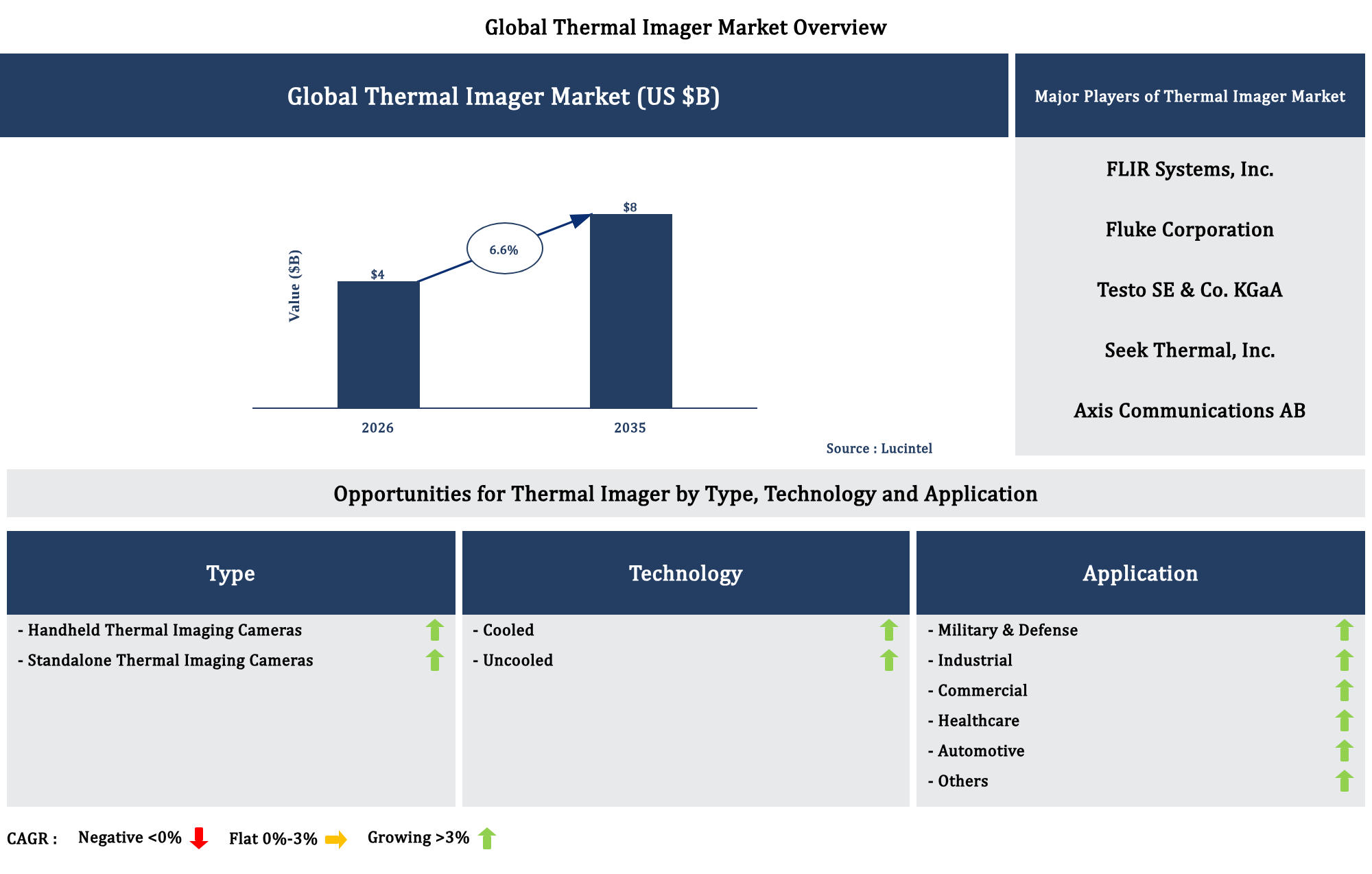
Thermal Imager Market

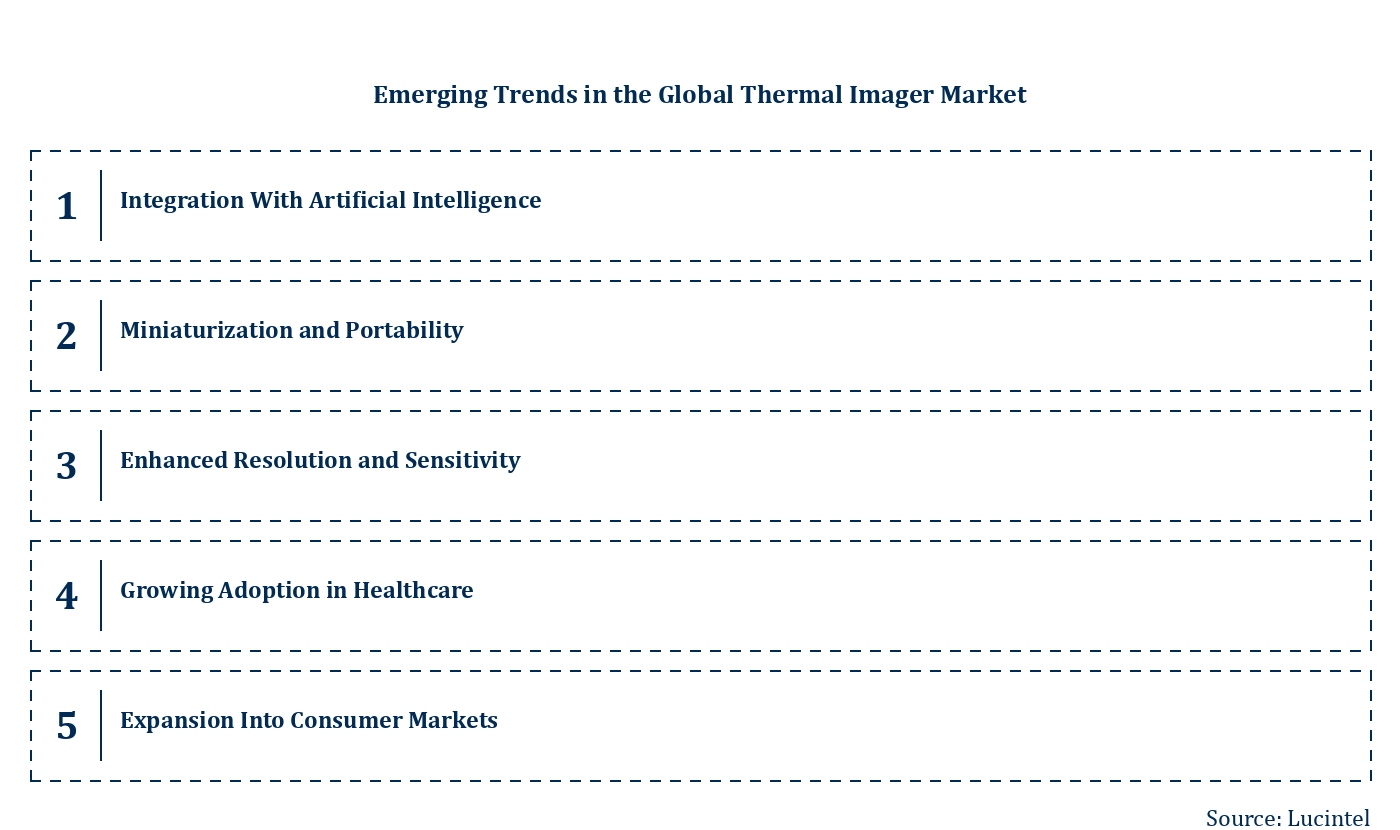
Emerging Trends in the Thermal Imager Market

The thermal imager market is experiencing rapid growth driven by technological advancements, increasing demand across various industries, and a focus on safety and security. As industries such as healthcare, automotive, defense, and industrial manufacturing adopt thermal imaging technology, new trends are emerging that are shaping the future of this market. These developments are not only enhancing the capabilities of thermal imagers but also expanding their applications and accessibility. Understanding these trends is crucial for stakeholders to capitalize on opportunities and stay competitive in this evolving landscape.

  • Integration with Artificial Intelligence: AI integration is revolutionizing thermal imaging by enabling real-time data analysis, pattern recognition, and predictive analytics. This trend enhances the accuracy and efficiency of thermal imagers, especially in security, surveillance, and predictive maintenance. AI-powered thermal imagers can automatically detect anomalies, reducing human error and response time. This integration is also facilitating the development of smart systems that can operate autonomously, making thermal imaging more accessible and effective across various sectors.
  • Miniaturization and Portability: Advances in materials and sensor technology are leading to smaller, lighter, and more portable thermal imagers. This trend is expanding their use in field inspections, firefighting, military operations, and personal safety devices. Portable thermal imagers allow for quick deployment and ease of use in diverse environments, increasing their adoption in both professional and consumer markets. The miniaturization also reduces costs, making thermal imaging technology more accessible to small and medium-sized enterprises.
  • Enhanced Resolution and Sensitivity: Improvements in sensor technology are resulting in higher resolution and greater sensitivity in thermal imagers. These enhancements enable more detailed thermal images, which are critical for applications like medical diagnostics, industrial inspection, and research. Higher resolution thermal images improve defect detection, early disease diagnosis, and precise temperature measurement. This trend is driving the adoption of thermal imagers in high-precision fields, where detailed thermal data can significantly impact outcomes.
  • Growing Adoption in Healthcare: The healthcare sector is increasingly utilizing thermal imaging for non-invasive diagnostics, fever screening, and monitoring physiological changes. This trend is driven by the need for quick, contactless, and accurate diagnostic tools, especially highlighted during global health crises. Thermal imagers are now being integrated into medical devices and screening stations, improving early detection and patient monitoring. The expanding use in healthcare is opening new revenue streams and encouraging innovation in thermal imaging technology tailored for medical applications.
  • Expansion Into Consumer Markets: The affordability and ease of use of thermal imagers are leading to their entry into consumer markets. Applications include home security, outdoor activities, and personal safety devices. Consumer-grade thermal cameras are now available at lower costs, driven by advancements in sensor manufacturing and miniaturization. This trend is democratizing access to thermal imaging technology, fostering innovation in new product categories, and increasing overall market size. As consumer awareness grows, demand for versatile, user-friendly thermal imaging solutions is expected to rise significantly.

These trends are collectively transforming the thermal imager market by enhancing technological capabilities, broadening application areas, and making thermal imaging more accessible and efficient. This evolution is not only expanding market opportunities but also driving innovation that will shape the future landscape of thermal imaging technology across multiple sectors.
Thermal Imager Market by country

Recent Developments in the Thermal Imager Market

The thermal imager market is experiencing rapid growth driven by technological advancements and expanding applications across various industries. Increasing demand for security, surveillance, and industrial inspection solutions is fueling innovation and market expansion. Governments and private sectors are investing heavily in thermal imaging technology for safety and efficiency. As the market evolves, new opportunities emerge in healthcare, automotive, and consumer electronics, shaping a dynamic landscape with significant growth potential. These developments are transforming how industries utilize thermal imaging for enhanced safety, efficiency, and innovation.

  • Growing Adoption in Security and Surveillance: The increasing need for security solutions has driven the adoption of thermal imagers in surveillance systems. These devices provide enhanced night vision and threat detection capabilities, especially in remote or challenging environments. Governments and private organizations are investing in advanced thermal imaging for border security, military applications, and critical infrastructure protection. This trend boosts market growth, encourages technological innovation, and expands the application scope of thermal imagers, making them essential tools for safety and security.
  • Expansion in Healthcare Diagnostics: Thermal imaging is increasingly used in healthcare for non-invasive diagnostics, such as detecting inflammation, circulatory issues, and fever screening. The technology offers quick, contactless assessments, improving patient comfort and safety. Recent developments include portable and high-resolution thermal cameras, making medical diagnostics more accessible and accurate. This expansion enhances early detection, reduces healthcare costs, and opens new revenue streams for manufacturers, positioning thermal imagers as vital tools in modern medical practices.
  • Advancements in Automotive Safety Systems: The automotive industry is integrating thermal imaging for driver assistance and autonomous vehicle systems. These sensors improve night vision, obstacle detection, and collision avoidance, enhancing safety and driving experience. Recent innovations include compact, high-resolution thermal cameras compatible with existing vehicle architectures. The adoption of thermal imaging in vehicles is expected to grow significantly, driven by safety regulations and consumer demand for advanced driver-assistance systems (ADAS). This trend positions thermal imagers as critical components in future mobility solutions.
  • Increasing Use in Industrial Inspection and Maintenance: Industries utilize thermal imagers for predictive maintenance, energy audits, and equipment monitoring. They detect heat anomalies, preventing failures and reducing downtime. Recent developments include rugged, high-precision thermal cameras suitable for harsh environments and real-time data integration with IoT systems. This application improves operational efficiency, safety, and cost savings. As industries prioritize automation and preventive maintenance, the demand for thermal imaging solutions continues to rise, fostering innovation and market expansion in industrial sectors.
  • Rising Demand in Consumer Electronics and Smart Devices: Thermal imaging is increasingly incorporated into consumer gadgets, such as smartphones and wearable devices, for health monitoring and personal security. Recent advancements include miniaturized, affordable thermal sensors enabling mass-market adoption. These developments enhance user experience, facilitate remote health assessments, and support innovative applications like gesture recognition. The consumer electronics segment is expected to see substantial growth, driven by technological miniaturization and increasing consumer interest in personal safety and health, further broadening the market scope.

These recent developments are significantly impacting the thermal imager market by expanding its application base, enhancing technological capabilities, and driving industry-specific innovations. The integration of thermal imaging into security, healthcare, automotive, industrial, and consumer sectors is fostering market growth and creating new revenue opportunities. As these trends continue, the market is poised for sustained expansion, with increased adoption and technological advancements shaping a competitive and dynamic landscape.

Strategic Growth Opportunities in the Thermal Imager Market

The thermal imager market is experiencing rapid growth driven by technological advancements and expanding applications across various industries. Increasing demand for safety, security, and maintenance solutions is fueling market expansion. Innovations in sensor technology, miniaturization, and integration with other systems are creating new opportunities. Additionally, rising adoption in sectors like healthcare, automotive, and defense is further propelling growth. Companies are focusing on developing cost-effective, high-resolution thermal imaging devices to meet diverse customer needs and capitalize on emerging markets.

  • Advancements in Sensor Technology Enable Higher Resolution and Better Accuracy: Innovations in sensor materials and design are significantly improving thermal imager resolution and sensitivity. This allows for more precise detection of temperature variations, essential in applications like predictive maintenance, medical diagnostics, and security. Enhanced sensor performance also supports miniaturization, making devices more portable and user-friendly. As sensor technology continues to evolve, manufacturers can offer more sophisticated products, opening new markets and increasing adoption across various sectors.
  • Growing Adoption in Healthcare for Diagnostic Imaging and Patient Monitoring: Thermal imagers are increasingly used in healthcare for non-invasive diagnostics, such as detecting inflammation, circulatory issues, and fever screening. They provide quick, contactless assessments, improving patient comfort and safety. The integration of thermal imaging with AI and machine learning enhances diagnostic accuracy. Rising healthcare expenditure and technological acceptance are driving market growth, with sub-segments like wearable thermal devices and portable diagnostic tools gaining popularity in clinics and hospitals.
  • Expansion of Thermal Imaging in Automotive and Autonomous Vehicles: The automotive industry is adopting thermal imaging for driver assistance, night vision, and autonomous vehicle navigation. Thermal cameras improve visibility in low-light or adverse weather conditions, enhancing safety. Automakers are integrating thermal sensors into advanced driver-assistance systems (ADAS) and autonomous platforms. This expansion is supported by increasing safety regulations and consumer demand for advanced features. As vehicle automation progresses, the role of thermal imaging is expected to grow, creating significant opportunities in automotive sub-segments like night vision systems and pedestrian detection.
  • Increasing Use in Security, Surveillance, and Military Applications: Thermal imagers are vital for perimeter security, border control, and military reconnaissance due to their ability to detect heat signatures in complete darkness or challenging environments. The demand for high-performance, rugged thermal systems is rising among defense agencies and private security firms. Sub-segments such as handheld thermal devices, vehicle-mounted systems, and drone-based thermal sensors are expanding rapidly. Growing geopolitical tensions and the need for enhanced security infrastructure are key drivers fueling this market segment.
  • Rising Demand for Cost-Effective and Compact Thermal Imaging Devices: The market is witnessing a shift towards affordable, portable thermal imagers suitable for industrial, commercial, and consumer use. Miniaturization and technological improvements are reducing costs, making thermal imaging accessible to small businesses and individual consumers. Applications include building inspections, firefighting, and outdoor activities. The development of smartphone-compatible thermal cameras and compact handheld devices is opening new avenues. This trend is expected to boost adoption rates and diversify the market landscape, fostering innovation and competitive pricing.

These growth opportunities are collectively transforming the thermal imager market by enhancing device capabilities, expanding application areas, and making thermal imaging more accessible. Technological innovations and increasing industry demand are driving market expansion, fostering competitive advancements, and opening new revenue streams. As these opportunities mature, the market is poised for sustained growth, with diverse sectors benefiting from improved safety, efficiency, and diagnostic capabilities.

Thermal Imager Market Drivers and Challenges

The thermal imager market is influenced by a variety of technological, economic, and regulatory factors that shape its growth trajectory. Advances in imaging technology, increasing demand across sectors such as defense, healthcare, and industrial inspection, along with supportive government policies, are key drivers. However, the market also faces challenges including high costs, regulatory hurdles, and technological limitations that could impede expansion. Understanding these drivers and challenges is essential for stakeholders to navigate the evolving landscape effectively and capitalize on emerging opportunities.

The factors responsible for driving the thermal imager market include:-

  • Technological Innovation: Rapid advancements in thermal sensor technology and image processing algorithms have significantly improved the accuracy, resolution, and affordability of thermal imagers. These innovations enable applications in diverse fields such as surveillance, firefighting, and medical diagnostics, fueling market growth. As technology continues to evolve, the integration of AI and IoT with thermal imaging is expected to open new avenues, making devices smarter and more efficient. This ongoing innovation sustains competitive advantages and attracts investments, thereby expanding the market.
  • Increasing Defense and Security Spending: Governments worldwide are increasing their budgets for defense and homeland security, recognizing the importance of thermal imaging for surveillance, target detection, and night vision. Military applications require high-performance thermal imagers, which drives demand for advanced products. Additionally, border security and counter-terrorism initiatives further boost market growth. This sustained investment ensures a steady demand pipeline, encouraging manufacturers to innovate and expand their product offerings, ultimately propelling the market forward.
  • Growing Industrial and Commercial Applications: Industries such as manufacturing, oil and gas, and electrical maintenance are increasingly adopting thermal imaging for predictive maintenance, quality control, and safety inspections. The ability to detect heat anomalies early prevents equipment failure and reduces downtime, leading to cost savings. Commercial applications in building inspections, HVAC, and energy audits are also expanding, driven by the need for energy efficiency and safety compliance. This broadening application base significantly contributes to market expansion and diversification.
  • Rising Healthcare and Medical Diagnostics Demand: Thermal imaging is gaining traction in healthcare for non-invasive diagnostics, fever screening, and monitoring physiological conditions. The COVID-19 pandemic accelerated the adoption of thermal cameras in public spaces for temperature screening, highlighting their importance in health security. As healthcare providers seek quick, contactless diagnostic tools, the demand for portable and high-resolution thermal imagers increases. This trend is expected to continue, supporting market growth through technological improvements and increased healthcare spending.
  • Regulatory Support and Standards Development: Governments and industry bodies are establishing standards and regulations to ensure the safety, quality, and interoperability of thermal imaging devices. Regulatory frameworks facilitate market entry and foster consumer confidence. Incentives and subsidies for security and healthcare applications further promote adoption. As standards evolve, manufacturers are encouraged to innovate within compliant parameters, which helps expand the market while ensuring product reliability and safety.

The challenges facing the thermal imager market are:-

  • High Cost of Advanced Thermal Imagers: Despite technological improvements, high-end thermal imagers remain expensive, limiting accessibility for small and medium-sized enterprises and certain end-user segments. The cost factor affects widespread adoption, especially in developing regions where budget constraints are significant. Manufacturers face pressure to reduce prices without compromising quality, which can impact profit margins. Additionally, the high cost of maintenance and calibration adds to the total cost of ownership, potentially hindering market growth and limiting the reach of thermal imaging technology.
  • Regulatory and Certification Barriers: The market faces complex regulatory environments across different regions, with stringent certification requirements for military, medical, and industrial applications. Navigating these regulations can be time-consuming and costly, delaying product launches and increasing compliance expenses. Variability in standards and approval processes across countries creates barriers to international trade and market expansion. Manufacturers must invest heavily in compliance, which can slow innovation and increase barriers for new entrants.
  • Technological Limitations and Integration Challenges: While thermal imaging technology has advanced, limitations such as lower resolution compared to optical cameras, sensitivity to environmental conditions, and issues with image clarity in certain scenarios persist. Integrating thermal imagers with other systems like drones, AI, and IoT devices presents technical challenges. These limitations can restrict application scope and reliability, especially in critical sectors like healthcare and defense. Overcoming these technological hurdles requires ongoing R&D investment, which can be resource-intensive and slow down market growth.

The thermal imager market is driven by rapid technological advancements, increasing defense and industrial applications, and supportive regulatory frameworks. However, high costs, regulatory complexities, and technological limitations pose significant challenges. These factors collectively influence market dynamics, requiring stakeholders to innovate continuously and navigate regulatory landscapes carefully. Overall, the markets growth potential remains strong, provided these drivers are harnessed effectively and challenges addressed strategically.

List of Thermal Imager Market Companies

Companies in the market compete on the basis of product quality offered. Major players in this market focus on expanding their manufacturing facilities, R&D investments, infrastructural development, and leverage integration opportunities across the value chain. Through these strategies thermal imager market companies cater increasing demand, ensure competitive effectiveness, develop innovative products & technologies, reduce production costs, and expand their customer base. Some of the thermal imager market companies profiled in this report include-

  • FLIR Systems, Inc.
  • Fluke Corporation
  • Testo SE & Co. KGaA
  • Seek Thermal, Inc.
  • Axis Communications AB
  • InfraTec GmbH
  • Opgal Optronic Industries Ltd.
  • Leonardo S.p.A.
  • Thermoteknix Systems Ltd.
  • Teledyne FLIR LLC

Thermal Imager Market by Segment

The study includes a forecast for the global thermal imager market by type, technology, application, and region.

  • Thermal Imager Market by Type [Value from 2019 to 2035]:
    • Handheld Thermal Imaging Cameras
    • Standalone Thermal Imaging Cameras
  • Thermal Imager Market by Technology [Value from 2019 to 2035]:
    • Cooled
    • Uncooled
  • Thermal Imager Market by Application [Value from 2019 to 2035]:
    • Military & Defense
    • Industrial
    • Commercial
    • Healthcare
    • Automotive
    • Others
  • Thermal Imager Market by Region [Value ($B) from 2019 to 2035]:
    • North America
    • Europe
    • Asia Pacific
    • The Rest of the World

Country Wise Outlook for the Thermal Imager Market

The thermal imager market has experienced significant growth driven by technological advancements, increased demand across various sectors, and expanding applications in security, healthcare, automotive, and industrial monitoring. As countries invest in innovative solutions to enhance safety, efficiency, and automation, the market landscape continues to evolve rapidly. Key players are focusing on developing more accurate, compact, and affordable thermal imaging devices, which are increasingly integrated with AI and IoT technologies. This global trend reflects a competitive environment where innovation and strategic partnerships are crucial for market expansion. Here is a country-specific overview of recent developments in this dynamic market.

  • United States: The US market has seen substantial growth due to increased adoption in defense, healthcare, and industrial sectors. Major companies are investing in AI-enabled thermal imaging systems for enhanced image processing and predictive maintenance. The government’s focus on homeland security and military modernization has driven demand for advanced thermal sensors. Additionally, the healthcare sector is utilizing thermal imagers for fever screening and diagnostic applications, especially amid ongoing health concerns. The integration of thermal imaging with smart city initiatives is also gaining momentum.
  • China: China is rapidly expanding its thermal imager market, driven by government initiatives to improve public safety and infrastructure. The country is witnessing increased adoption in surveillance, firefighting, and industrial automation. Domestic manufacturers are focusing on cost-effective, high-performance devices to compete globally. The government’s emphasis on smart city projects and urban security has accelerated demand. Moreover, China is investing heavily in R&D to develop AI-powered thermal imaging solutions, aiming to enhance real-time analytics and autonomous systems.
  • Germany: Germany’s market is characterized by a focus on high-precision, industrial-grade thermal imagers used in manufacturing, automotive, and energy sectors. The country’s emphasis on Industry 4.0 and automation has led to innovations in thermal imaging for predictive maintenance and quality control. German companies are also advancing in medical thermal imaging, particularly for diagnostics and research. The integration of thermal sensors with IoT platforms is a key trend, supporting smart factory initiatives and sustainable energy management.
  • India: India’s thermal imager market is witnessing rapid growth driven by government initiatives for public safety, healthcare, and infrastructure development. The demand for thermal cameras in COVID-19 screening and surveillance has surged. The country is also focusing on affordable, portable thermal imaging solutions for rural healthcare and industrial applications. Local manufacturers are expanding their product portfolios, and international players are entering the market to capitalize on emerging opportunities. The government’s push for smart cities and digital infrastructure further supports market expansion.
  • Japan: Japan’s market is characterized by advanced technological integration and high-quality standards. The country is utilizing thermal imagers extensively in automotive manufacturing, robotics, and disaster management. Japan’s focus on innovation has led to developments in compact, energy-efficient thermal sensors with enhanced resolution. The healthcare sector is adopting thermal imaging for non-invasive diagnostics and elderly care. Additionally, Japan is investing in research to improve thermal imaging capabilities for autonomous vehicles and smart infrastructure, aligning with its emphasis on safety and technological excellence.

Features of the Thermal Imager Market

  • Market Size Estimates: Thermal imager market size estimation in terms of value ($B).
  • Trend and Forecast Analysis: Market trends (2019 to 2025) and forecast (2026 to 2035) by various segments and regions.
  • Segmentation Analysis: Thermal imager market size by type, technology, application, and region in terms of value ($B).
  • Regional Analysis: Thermal imager market breakdown by North America, Europe, Asia Pacific, and Rest of the World.
  • Growth Opportunities: Analysis of growth opportunities in different types, technologies, applications, and regions for the thermal imager market.
  • Strategic Analysis: This includes M&A, new product development, and competitive landscape of the thermal imager market.
  • Analysis of competitive intensity of the industry based on Porter’s Five Forces model.

Top 5 Companies

  • FLIR Systems, Inc.
  • Fluke Corporation
  • Testo SE & Co. KGaA
  • Seek Thermal, Inc.
  • Axis Communications AB

Table of Contents

1. Executive Summary
14.1 Competitive Analysis Overview

List of Figures

List of Tables

Methodology

Lucintel has been in the business of market research and management consulting since 2000 and has published over 1000 market intelligence reports in various markets / applications and served over 1,000 clients worldwide. This study is a culmination of four months of full-time effort performed by Lucintel's analyst team. The analysts used the following sources for the creation and completion of this valuable report:

  • In-depth interviews of the major players in this market
  • Detailed secondary research from competitors' financial statements and published data
  • Extensive searches of published works, market, and database information pertaining to industry news, company press releases, and customer intentions
  • A compilation of the experiences, judgments, and insights of Lucintel's professionals, who have analyzed and tracked this market over the years.

Extensive research and interviews are conducted across the supply chain of this market to estimate market share, market size, trends, drivers, challenges, and forecasts. Below is a brief summary of the primary interviews that were conducted by job function for this report.

Lucintel's methodology for market research

Thus, Lucintel compiles vast amounts of data from numerous sources, validates the integrity of that data, and performs a comprehensive analysis. Lucintel then organizes the data, its findings, and insights into a concise report designed to support the strategic decision-making process. The figure below is a graphical representation of Lucintel's research process.

Primary interviews by job function

Buy Now

Choose a license that fits your team. Instant PDF delivery.

Market Report

1 User PDF

$4,850
Buy Now

Market Report

2-5 Users PDF

$6,700
Buy Now

Market Report

Corporate PDF

$8,850
Buy Now

Market Report

Global PDF

$10,000
Buy Now

Prices exclude taxes. Instant delivery. Custom licensing available on request.

Frequently Asked Questions

What is the thermal imager market size?
The global thermal imager market is expected to reach an estimated $8 billion by 2035.
What is the growth forecast for thermal imager market?
The global thermal imager market is expected to grow with a CAGR of 6.6% from 2026 to 2035.
What are the major drivers influencing the growth of the thermal imager market?
The major drivers for this market are the increasing demand for advanced infrared imaging systems, the rising adoption of security surveillance technologies, and the growing need for enhanced night vision solutions.
What are the major segments for thermal imager market?
The future of the thermal imager market looks promising with opportunities in the military & defense, industrial, commercial, healthcare, and automotive markets.
Who are the key thermal imager market companies?

Some of the key thermal imager companies are as follows:

  • FLIR Systems, Inc.
  • Fluke Corporation
  • Testo SE & Co. KGaA
  • Seek Thermal, Inc.
  • Axis Communications AB
  • InfraTec GmbH
  • Opgal Optronic Industries Ltd.
  • Leonardo S.p.A.
  • Thermoteknix Systems Ltd.
  • Teledyne FLIR LLC
Which thermal imager market segment will be the largest in future?
Lucintel forecasts that, within the type category, handheld thermal imaging camera is expected to witness higher growth over the forecast period.
In thermal imager market, which region is expected to be the largest in next 8 years?
In terms of region, APAC is expected to witness the highest growth over the forecast period.
Do we receive customization in this report?
Yes, Lucintel provides 10% customization without any additional cost.

Key Questions

  • What are some of the most promising, high-growth opportunities for the thermal imager market by type (handheld thermal imaging cameras and standalone thermal imaging cameras), technology (cooled and uncooled), application (military & defense, industrial, commercial, healthcare, automotive, and others), and region (North America, Europe, Asia Pacific, and the Rest of the World)?
  • Which segments will grow at a faster pace and why?
  • Which region will grow at a faster pace and why?
  • What are the key factors affecting market dynamics? What are the key challenges and business risks in this market?
  • What are the business risks and competitive threats in this market?
  • What are the emerging trends in this market and the reasons behind them?
  • What are some of the changing demands of customers in the market?
  • What are the new developments in the market? Which companies are leading these developments?
  • Who are the major players in this market? What strategic initiatives are key players pursuing for business growth?
  • What are some of the competing products in this market and how big of a threat do they pose for loss of market share by material or product substitution?
  • What M&A activity has occurred in the last 5 years and what has its impact been on the industry?
Why Choose Us

The Lucintel Advantage

Trusted partner for strategic intelligence and business growth

25+ Years Excellence

25+ Years Excellence

Quarter century of proven expertise in management consulting and market research across global markets.
Game-Changer Ideas

Game-Changer Ideas

Innovative strategies and actionable insights that help clients become the smartest in their industry.
Global Reach

Global Reach

Extensive coverage across 50+ industries and markets worldwide with localized expertise.
Start Your Growth Journey

Get Your Free
Market Intelligence
Briefing

Receive a complimentary market analysis tailored to your industry. Our analysts will identify key growth opportunities and competitive dynamics specific to your business.

Custom Market Snapshot

Market size, growth rate, and key trend analysis for your specific sector.

Competitive Landscape Overview

Top competitor positioning and market share analysis.

Growth Opportunity Identification

Strategic recommendations backed by data-driven insights.

Subscribe

Subscribe to our Newsletter

Get curated market intelligence and competitive moves straight to your inbox.

By subscribing, you agree to receive our monthly insights. Unsubscribe anytime.

Industry Trends Market Signals Opportunities Competitor Moves
