
Market Report · May 18, 2026

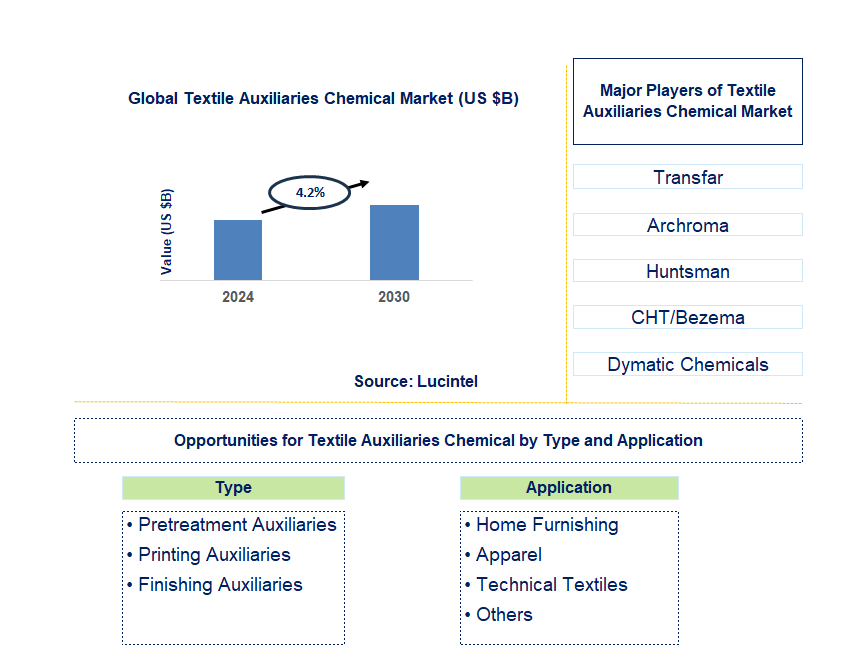
Key data points: The growth forecast = 4.2% annually next 6 years. Scroll below to get more insights. This market report covers trends, opportunities, and forecast in the global textile auxiliaries chemical market to 2030 by type (pretreatment auxiliaries, printing auxiliaries, and finishing auxiliaries), application (home furnishing, apparel, technical textiles, and others), and region (North America, Europe, Asia Pacific, and the Rest of the World)
We'll send your sample report shortly.
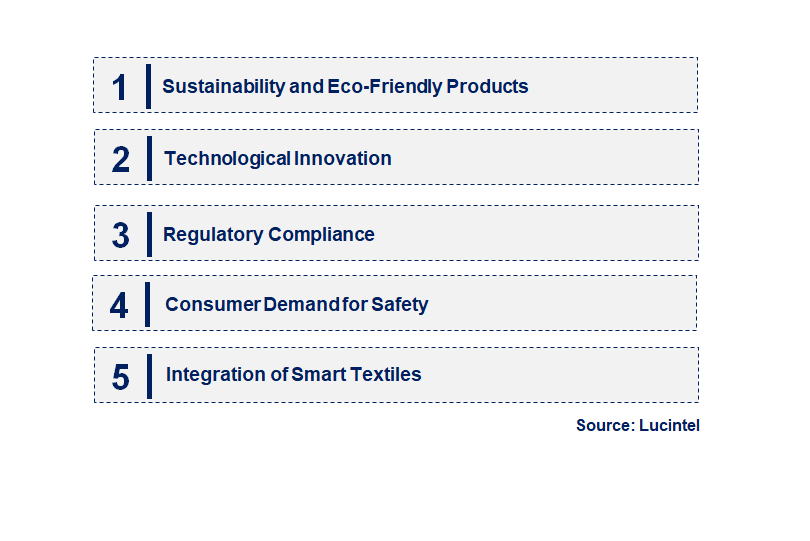
• Sustainability and Eco-Friendly Products: There is a strong positive shift toward sustainability and introduction of environmentally based textile chemicals. Hence, there is guided movement toward creating non-toxic, environmentally friendly and even bio-degradable compounds.
• Technological Innovation: New technology is a driving force that leads to the creation of better and newer textile auxiliary substances. Such performance-based innovations comprise enhanced enduring characteristic where water repellency, stain resistant, and durability are improved.
• Regulatory Compliance: In order to sustain operations, manufacturers are being forced to modify and adhere to new requirements considering that there is an increase in the applicable regulations. This trend reinforces the point of fulfilling the requirements including the environment and health offshore.
• Consumer Demand for Safety: The modern approach of consumers towards safety of textile chemicals is impacting the market’s current dynamics. More and more people look for products that do not contain toxic materials and are less hazardous to the end users.
• Integration of Smart Textiles: The increasing use of technology in the textiles is also increasing the need for other specialty auxiliary products. It is the creation of chemicals that will act in support of smart textiles like those with sensors or responsive chemicals embedded in them. All these trends are bringing changes in the textile auxiliary chemicals market in terms of innovation, sustainability, and compliance with the modern world. With these trends, companies must learn to focus on greener products, new technologies and compliance with certain regulations to be relevant in the market and satisfy consumers.
• Regulatory Changes: New rules and legislation are coming into play concerning harmful chemicals and their management practices as well as encouraging safer substitutions. Also include ChemEnvironmental scrutiny which results in new sustainable products.
• Advancements in Sustainable Chemistry: Interest in the creation of active and green textile auxiliaries is increasing. There is an increase in the development of biodegradable chemicals as well as a decrease in the usage of toxic materials.
• Technological Innovations: New auxetic technologies are improving the efficacies of crimped textile auxiliaries. Among the advances were new and better performing chemical formulations that provide more desirable fabric characteristics including water and stain resistant.
• Consumer Demand for Transparency: Increased public awareness of chemical additives in formulation products has led to some market changes. Information about the safety and environmental impact of the products is disclosed by manufacturers.
• Growth in Emerging Markets: The textile auxiliaries chemical market is experiencing growth in developing economies chasing the improvements in manufacturing and the increasing appetite for textile products. Firms are concentrating on these regions to harness new market potentials and meet the local market's requirements. These key developments are spearheading transformational shifts in the textile auxiliary chemicals market. Regulatory requirements, improving technology, and changing consumers are making companies more creative and flexible affecting design, processes, and applications in the market of textile auxiliaries.
• Green Finishing Agents: Sustainable and environmentally friendly finishing agents are in great demand. There are prospects for the formulation and commercialization of such chemicals that do not cause environmental pollution and are also degradable.
• Performance Enhancers: Exploring new performance-enhancing chemicals brings great opportunities for technology development. This relates to the chemicals that improve water repellency, anti-soiling and overall untethered performance of fabrics.
• Smart Textiles: The emergence of smart textiles that incorporates technology for advanced functionality creates potential for special auxiliaries. This could potentially lead to evolution in this vertical if the chemicals which enhance the embedding/ feeder technologies or the chemicals that endow stimuli responsive effect.
• Environmentally Friendly Compliance Solutions: As regulations tighten, manufacturers are looking for answers that will help them make their products compliant with the new regulations. Opportunities encompass formulations that will meet the current rules and regulations while providing safer replaced options.
• Emerging market development: Entering new markets with developing textile business is a potential market opportunity as well. Companies are able to concentrate less on exports more on local supply of products and having to adjust their products touch to local needs and legal measures. This is a unique opportunity for companies to innovate and grow within the scope of the textile auxiliary chemicals market. Sample opportunities are when companies seek to capitalize on evolving markets and changing consumer’s needs and increasing regulations on environmental issues, performance, and sustainability of smart textiles.
• Transfar
• Archroma
• Huntsman
• CHT/Bezema
• Dymatic Chemicals
• Lonsen
• Rudolf
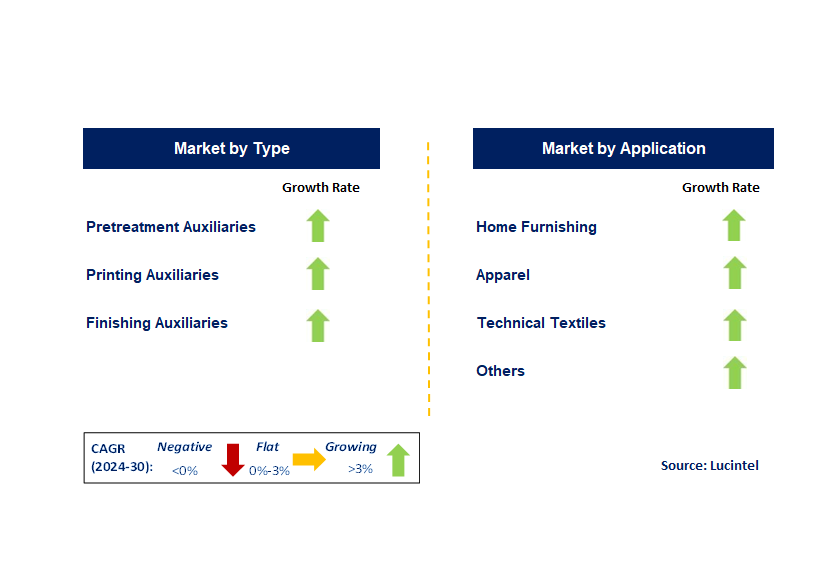
• Pretreatment Auxiliaries
• Printing Auxiliaries
• Finishing Auxiliaries
• Home Furnishing
• Apparel
• Technical Textiles
• Others
• North America
• Europe
• Asia Pacific
• The Rest of the World
• United States: In the U.S. are eminent due to additional regulatory requirements and consideration of eco-friendliness. The EPA further has made restrictions on the usage of certain chemicals banishing the manufacturers from slacking but instead to think green. It is equally towards this trend of rising consumer insistence demand non- toxic and non-biodegradable textile auxiliaries.
• China: Growth rate of within China textile auxiliaries chemical market will remain high owing to its growing textile industry and growing export capacities. Others include progressive changes in the processes of production and the emphasis placed on the environmental performance of chemicals. At the same time, the Chinese administration encourages and enforces stricter environmental policies, hence more environmentally friendly and less toxic industrial products.
• Germany: Germany dominates to a greater extent in how sustainability practices are applied especially in the textile auxiliaries chemical market. Other attempts have been making it illegal for manufacturers within the European Union to use some harmful chemicals in line with the requirements specified in the REACH (Registration, Evaluation, Authorization and Restriction of Chemicals) regulations. Focus is on development and practical application of aesthetically attractive and functional textile auxiliaries with the environmental and health of Jurong eco-centric.
• India: In India, the demand for textile aids chemicals is on the increase due to rapid growth in the industry and evolving local and foreign demand for textiles. Other recent advancements include incorporation of other chemicals into formulations to improve performance without contravening the policy. Indian manufacturers have also shifted attention to the production of stain resistant and eco-friendly polyester fabrics that are not harmful to the environment.
• Japan: Japan is concentrating on new generation textile auxiliary agents which enhance better performance as well as sustainability of the products being manufactured. Recent developments include the efforts put in on the chemical formulations so as to most likely improve the quality and the durability of the materials. The Japanese market also factors in the gaseous emissions and a predominant attitude towards the safety which has resulted the market implementing the better and effective textile chemical additives as per the requirements of the customers and regulators.
• Transfar
• Archroma
• Huntsman
• CHT/Bezema
• Dymatic Chemicals
• Lonsen
• Rudolf Q5. Which textile auxiliaries chemical market segment will be the largest in future? Answer: Lucintel forecasts that pretreatment auxiliaries will remain the largest segment over the forecast period because it eliminates all extraneous and obstructive materials from the fabric, as well as, desizing, scouring, and bleaching other preliminary treatment procedures encompass optical brightening, alkalization, and mercerization. Q6. In textile auxiliaries chemical market, which region is expected to be the largest in next 5 years? Answer: APAC will remain the largest region due to swift urban expansion, economic adaptability amid the COVID-19 crisis, and the modernization of textile and chemical production methods. Q.7. Do we receive customization in this report? Answer: Yes, Lucintel provides 10% customization without any additional cost.


Choose a license that fits your team. Instant PDF delivery.
Prices exclude taxes. Instant delivery. Custom licensing available on request.
Market Report · May 18, 2026
Market Report · May 18, 2026
Market Report · May 18, 2026
Trusted partner for strategic intelligence and business growth


Receive a complimentary market analysis tailored to your industry. Our analysts will identify key growth opportunities and competitive dynamics specific to your business.

Market size, growth rate, and key trend analysis for your specific sector.

Top competitor positioning and market share analysis.

Strategic recommendations backed by data-driven insights.
Get curated market intelligence and competitive moves straight to your inbox.
By subscribing, you agree to receive our monthly insights. Unsubscribe anytime.
Receive a complimentary market analysis tailored to your industry. Our analysts will identify key growth opportunities and competitive dynamics specific to your business.
Market size, growth rate, and key trend analysis for your specific sector.
Top competitor positioning and market share analysis.
Strategic recommendations backed by data-driven insights.
Get curated market intelligence, emerging trends, and competitive moves straight to your inbox each month.
By subscribing, you agree to receive our monthly insights. Unsubscribe anytime.
We'll send your sample report shortly.