
Market Report · July 29, 2026

We'll send your sample report shortly.
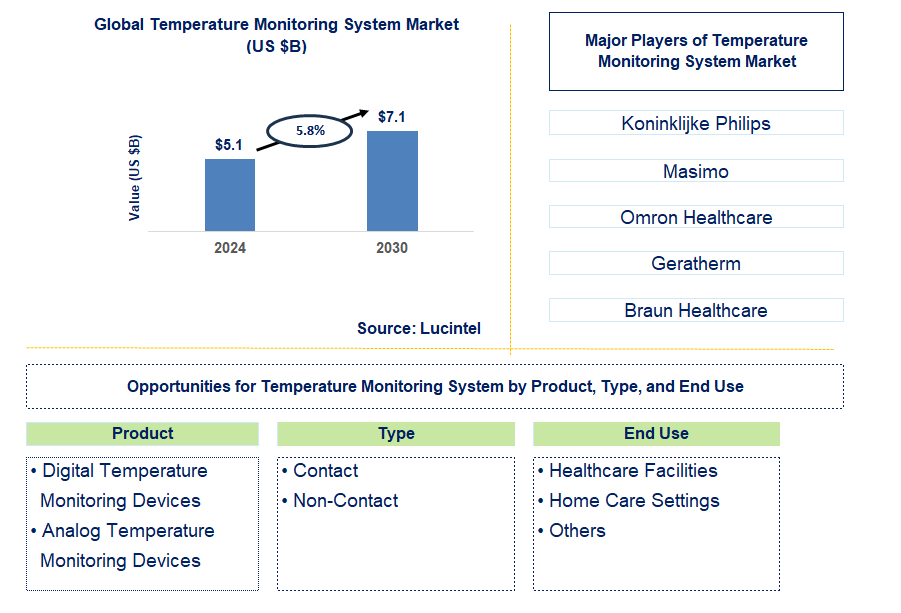
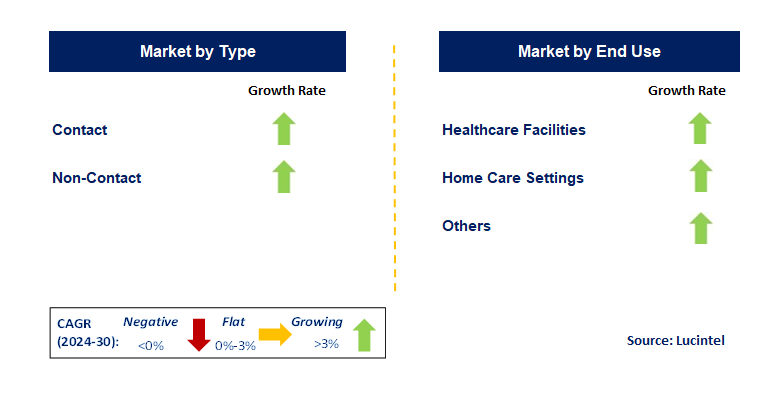
• Lucintel forecasts that, within the type category, non-contact is expected to witness a higher growth over the forecast period due to the growing number of partnerships among various market players to manufacture such devices.
• Within the ens use category, healthcare facilities is expected to remain the largest segment due to increasing number of patients in hospitals and growing adoption of advanced temperature measurement systems.
• In terms of region, North America will remain the largest region during the forecast period due to the increasing number of stringent regulatory guidelines, presence of major market players, and rising investment in R&D activities by biotechnology and pharmaceutical companies of the region. A more than 150-page report is developed to help in your business decisions.
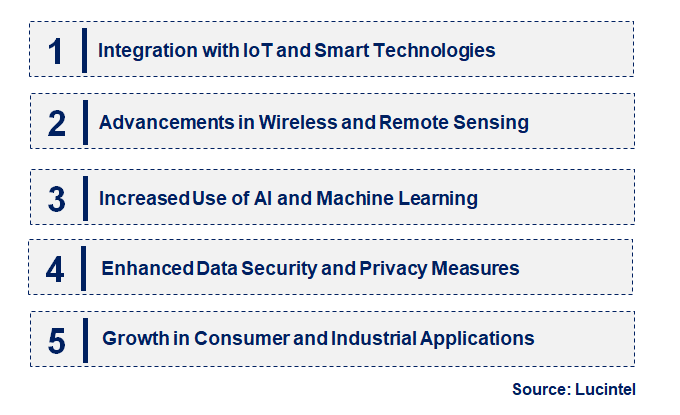
• Integration with IoT and Smart Technologies: More and more, the control subsystem of temperature monitoring systems is being integrated with emerging IoT and smart technologies. This enables real-time data collection, remote monitoring, and automatic notifications, further optimizing system performance in healthcare and industrial management.
• Advancements in Wireless and Remote Sensing: The development of remote and wireless technologies in temperature sensing is improving efficiency and reducing installation challenges. These technologies lead to better performance in monitoring difficult environments and enhance data integration efficiency across various applications.
• Increased Use of AI and Machine Learning: New tools and technologies have facilitated the integration of AI and machine learning into temperature monitoring systems for predictive and automated decision-making. This trend is advantageous in that it anticipates potential risks and addresses them before they materialize, thereby improving maintenance schedules and system performance.
• Enhanced Data Security and Privacy Measures: With the evolution of temperature monitoring systems, greater attention is now being placed on data privacy and security. Security measures such as encryption and secure data communication methods are being implemented to protect confidential information and meet required regulations.
• Growth in Consumer and Industrial Applications: The applications of temperature monitoring systems are increasing, including in consumer electronics and industrial processes. This trend reflects the growing demand for accurate temperature control in various applications, such as food and drug safety, as well as climate control. These trends are changing the dynamics of the temperature monitoring system market, particularly in terms of functionality, communication, and security. Further advancements in technology will also expand the market scope through greater innovations.
• Deployment of IoT-Enabled Systems: There has been a growing trend toward integrating IoT technology into temperature monitoring systems. These systems provide real-time monitoring, geolocation, quick notifications, and more, supporting effectiveness and precision in performance across industries such as healthcare and manufacturing.
• Advancements in Thermal Imaging Technology: Improvements in thermal imaging technology in recent years have enabled effective, high-resolution temperature monitoring. This is particularly important for detecting temperature variations in security, manufacturing, and environmental monitoring applications.
• Introduction of Wireless Sensors: The introduction of wireless temperature sensors has made installation easier and enhanced the adaptability of monitoring systems. These sensors have become particularly prevalent in industries like food safety and pharmaceuticals, where precise temperature management is critical.
• Enhanced Data Analytics Capabilities: Advanced data analytics features and functionalities are now being integrated into temperature monitoring systems. These capabilities allow organizations to avoid operational issues by enabling better trend analysis, predictive maintenance, and the timely dissemination of system data.
• Regulatory Compliance and Standards: Expanding monitoring requirements are driving innovation in temperature monitoring systems. Recent advancements include the certification of these systems to ensure that performance and reliability are not compromised, especially in sectors like healthcare and food security. These advancements have brought about significant changes in the temperature monitoring system market by enhancing technology, broadening the scope of applications, and ensuring compliance with regulatory standards. These factors are making the market more complex and dynamic, as future improvements continue to enhance efficiency and accuracy.
• Expansion of the Healthcare Sector: The healthcare sector is the largest revenue generator in the temperature monitoring system market due to the increasing need for patient care and equipment management. This includes designing systems for continuous monitoring and integrating them with patients' electronic medical records (EMR).
• Food Safety and Quality Control: Temperature monitoring systems play a crucial role in the food industry, ensuring safety and quality control. Opportunities include developing products and services designed to monitor and ensure the availability and compliance of quality standards in the food industry, thus promoting safety and integrity in the food supply chain.
• Industrial Automation and Control: The industrial sector is increasingly adopting temperature monitoring systems for automation and control of processes. Opportunities exist for developing solutions that can be integrated into industrial setups to provide real-time data, thereby enhancing productivity.
• Regulations: Temperature monitoring and telemonitoring are intertwined activities requiring careful handling of patient data. This includes detecting discomfort caused by external physical factors, discomfort related to various settings or situations, and children's repositioning.
• Logistics and Supply Chain Management: Temperature monitoring systems are essential for maintaining the required temperature conditions during the transportation and storage of products. Feasible opportunities involve improving real-time temperature monitoring methods throughout the supply chain to ensure product quality and compliance.
• Consumer Electronics and Smart Home Applications: In the consumer market, temperature monitoring solutions are increasingly being integrated into smart home systems. Opportunities include creating simple devices that work with users to manage home temperatures, in conjunction with other smart systems. These growth opportunities are driving new applications in temperature monitoring systems, stimulating innovation in products and services, and shaping the market. Companies that capitalize on these areas are likely to see higher rates of return and continued market growth.
• Technological advancements: The growth of the temperature monitoring market can be attributed to advancements in sensors, data analysis, and wireless technologies. These developments enhance temperature monitoring systems in terms of accuracy, efficiency, and integration across different applications.
• Increasing regulatory standards: The growing regulation on temperature substantiation in sectors such as healthcare and food safety is increasing the need for enhanced systems that monitor temperatures more effectively. Adherence to nutrient quality standards is fundamental to marketing and the design of high-accuracy systems.
• Growing demand for automation: The rise in automation across industries such as manufacturing and logistics warrants the use of temperature monitoring systems. The increasing demand for such systems is driven by their ability to enhance operational efficiency and minimize unnecessary surveillance.
• Expansion of IoT and smart technologies: The growing presence of IoT and smart features in temperature monitoring systems, used for collecting data and remotely controlling systems, extends the scope of these devices. This makes the systems more comprehensive and broadens the market for their application.
• Rising awareness of environmental and health concerns: Greater accuracy in monitoring dangerously high or low temperatures is being driven by increased emphasis on how production processes may impact health and the environment. This is particularly evident in industries such as pharmaceuticals, food, and healthcare, where maintaining steady temperatures is crucial. Challenges in the temperature monitoring system market include:
• High costs of advanced systems: Many of the latest temperature monitoring systems may go underutilized due to the high capital required for implementation. This can be a significant setback, particularly for smaller companies or those with limited budgets. Affordability will remain a key barrier to widespread adoption.
• Data security and privacy issues: As temperature monitoring systems increase in functionality, the need for data security and privacy also increases. Adhering to proper data transmission and storage practices is important for managing risks and meeting legal requirements.
• Complexity of integration: Integrating temperature monitoring systems with existing technologies and infrastructure may pose challenges. Bottlenecks and technical requirements can serve as barriers to implementation and may affect the performance of the systems. These drivers and challenges play an important role in the temperature monitoring systems market, impacting both growth opportunities and the market as a whole. Organizations should consider these factors to remain competitive and take advantage of new developments and opportunities.
• Koninklijke Philips
• Masimo
• Omron Healthcare
• Geratherm
• Braun Healthcare
• A&D Company
• Toshiba
• Digital Temperature Monitoring Devices
• Analog Temperature Monitoring Devices
• Contact
• Non-Contact
• Healthcare Facilities
• Home Care Settings
• Others
• North America
• Europe
• Asia Pacific
• The Rest of the World
• United States: Advanced temperature monitoring systems connected to the internet and embedded with artificial intelligence have dramatically increased in the market. These systems are widely used to provide predictive maintenance and real-time analytics features, which have made their way into sectors including healthcare and industries that strive to optimize productivity and safety. Stricter regulations are also driving the uptake of more accurate and reliable systems.
• China: The focus in China is on the construction of additional facilities for temperature-based monitoring in industries and logistics. New developments include the use of high-temperature thermal imaging devices and intelligent sensors to enhance temperature monitoring in industrial and logistical operations. Market growth is also being boosted by government programs and funding for smart city development projects.
• Germany: In Germany, temperature monitoring systems are focused on improving their accuracy while also advancing Industry 4.0 initiatives. Recent innovations cover a range of technologies, including wireless devices and management systems based on previously unfamiliar cloud solutions. This trend is becoming evident in the German market, where more systems are being adopted in the automotive and manufacturing sectors due to the demand for enhanced and automated temperature regulation.
• India: In India, the market for temperature monitoring systems is growing due to emerging factors such as increased awareness and regulatory policies in the pharmaceutical and food safety industries. Developments include the marketing of reasonably priced, high-performance sensors and internet-integrated devices that respond to market requirements, improving temperature control in critical areas.
• Japan: In Japan, the advancement of temperature monitoring technology has been focused on achieving enhanced accuracy and interconnection with other smart devices. Significant innovation in this area includes the introduction of miniaturized geometric electronic devices with advanced sensing technology, as well as cognitive automation incorporating robotics control. The healthcare and manufacturing sectors in Japan are growing, with reliability requirements and data integration driving these markets.


• Koninklijke Philips
• Masimo
• Omron Healthcare
• Geratherm
• Braun Healthcare
• A&D Company
• Toshiba Q6. Which temperature monitoring system segment will be the largest in future? Answer: Lucintel forecasts that non-contact will remain the larger segment over the forecast period due to the increasing number of partnerships among various companies to manufacture such devices. Q7. In temperature monitoring system, which region is expected to be the largest in next 6 years? Answer: North America will remain the largest region during the forecast period due to the increasing number of stringent regulatory guidelines, presence of major market players, and rising investment in R&D activities by biotechnology and pharmaceutical companies of the region. Q.8 Do we receive customization in this report? Answer: Yes, Lucintel provides 10% customization without any additional cost.


Choose a license that fits your team. Instant PDF delivery.
Prices exclude taxes. Instant delivery. Custom licensing available on request.
Market Report · July 29, 2026
Market Report · July 20, 2026
Market Report · July 20, 2026
Trusted partner for strategic intelligence and business growth


Receive a complimentary market analysis tailored to your industry. Our analysts will identify key growth opportunities and competitive dynamics specific to your business.

Market size, growth rate, and key trend analysis for your specific sector.

Top competitor positioning and market share analysis.

Strategic recommendations backed by data-driven insights.
Get curated market intelligence and competitive moves straight to your inbox.
By subscribing, you agree to receive our monthly insights. Unsubscribe anytime.
Receive a complimentary market analysis tailored to your industry. Our analysts will identify key growth opportunities and competitive dynamics specific to your business.
Market size, growth rate, and key trend analysis for your specific sector.
Top competitor positioning and market share analysis.
Strategic recommendations backed by data-driven insights.
Get curated market intelligence, emerging trends, and competitive moves straight to your inbox each month.
By subscribing, you agree to receive our monthly insights. Unsubscribe anytime.
We'll send your sample report shortly.