
Market Report · July 31, 2026

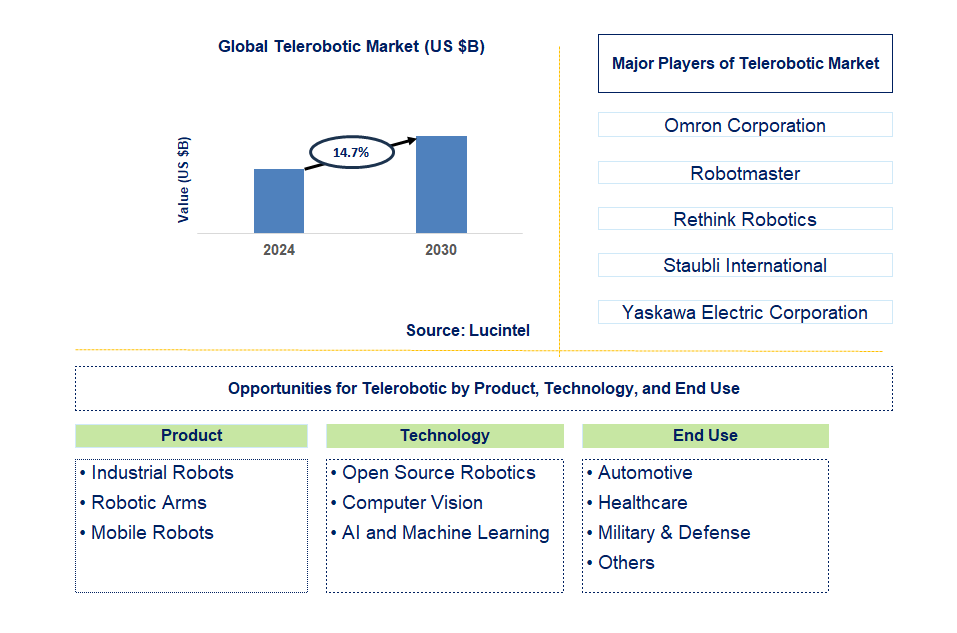
Key data points: The growth forecast = 14.7% annually for the next 6 years. Scroll below to get more insights. This market report covers trends, opportunities, and forecasts in the global telerobotic market to 2030 by product (industrial robots, robotic arms, and mobile robots), technology (open source robotics, computer vision, and ai and machine learning), end use (automotive, healthcare, military & defense, and others), and region (North America, Europe, Asia Pacific, and the Rest of the World)
We'll send your sample report shortly.
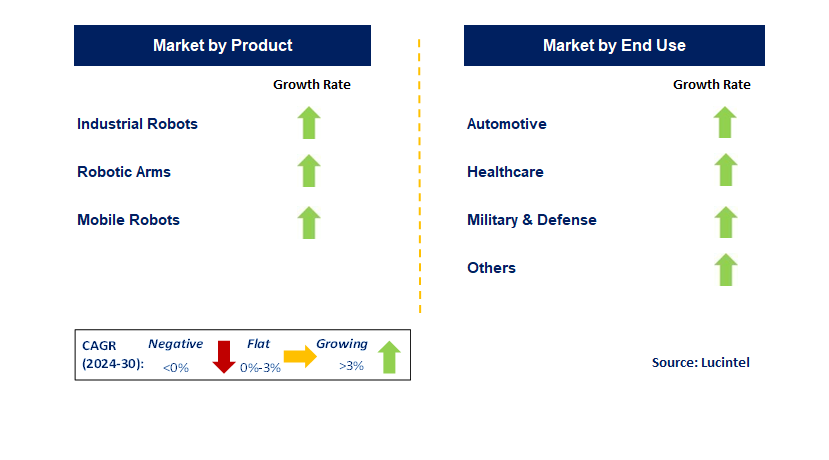
• Lucintel forecasts that, within the product category, industrial robot is expected to witness the highest growth over the forecast period.
• Within the end use category, automotive is expected to witness the highest growth.
• In terms of region, APAC is expected to witness the highest growth over the forecast period. A more than 150-page report is developed to help in your business decisions.
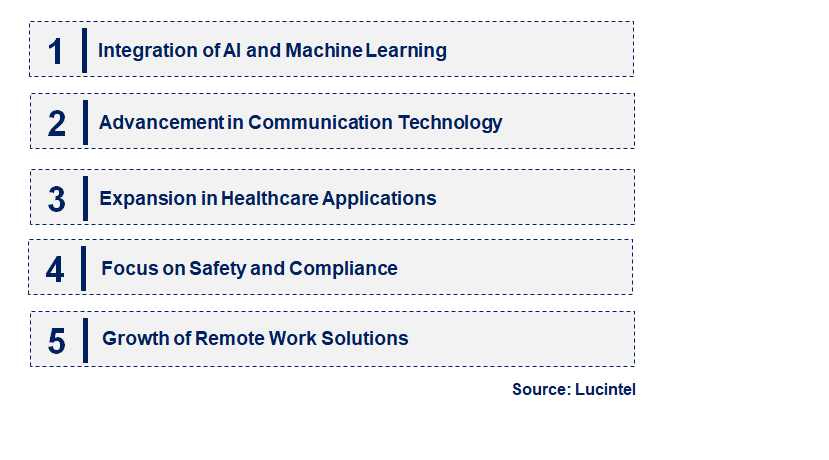
• Integration of AI and Machine Learning: The incorporation of AI and machine learning into telerobotic systems is enabling smarter operations. These technologies enhance decision-making capabilities, allowing robots to adapt to dynamic environments and improve efficiency across various applications, from healthcare to industrial operations.
• Advancement in Communication Technology: The application of 5G technology will revolutionize telerobotics because of its speed and low-latency communication. It enables real-time control and monitoring, leading to highly precise operations in fields that require critical and immediate feedback, such as remote surgery and autonomous vehicles.
• Expansion in Healthcare Applications: Telerobotics has quickly found its place in healthcare applications, particularly in telemedicine and remote surgery. Hospitals are looking to expand patient access and improve outcomes, and robotic systems allow surgeons to perform operations remotely, which expands the reach of specialized care and significantly enhances patient safety.
• Focus on Safety and Compliance: In telerobotics applications, especially in hazard-prone environments, safety has become a major emphasis. Companies are now developing safety protocols and compliance measures to ensure the reliability and security of robotic systems and promote their use in potentially hazardous sectors, such as construction and mining.
• Growth of Remote Work Solutions: The trend toward remote work is boosting the demand for telerobotics solutions that enable remote collaboration and operation. Businesses are leveraging telerobots for tasks such as inspection, maintenance, and training, facilitating operations without the need for on-site personnel. All these trends are fundamentally changing the telerobotics market, triggering innovation, and broadening applications across industries.
• Development of Telepresence Robots: Recent innovations in telepresence robots are enhancing remote communication and collaboration. These robots allow users to interact with environments and teams from afar, proving beneficial in industries such as healthcare, where doctors can consult with patients remotely.
• Improvements in Robotic Surgery Systems: The latest technologies and innovations in robotic surgery systems allow surgeons to perform complex procedures remotely with increased precision. These systems are combined with newer imaging technologies and AI to make better real-time decisions for patients while continuously improving healthcare outcomes.
• Increased Use of Drones in Telerobotics: Telerobotics applications in inspection, monitoring, and delivery are increasingly infused with drones due to their ability to access hard-to-reach areas, making them invaluable for industries such as agriculture, construction, and emergency services.
• Telerobotics Collaboration in Defense Applications: The defense sector utilizes telerobotics for remote operations in surveillance and combat missions. Innovations in unmanned aerial vehicles and unmanned ground vehicles have enabled missions to be accomplished with lower risks to personnel.
• Investments in Niche Telerobotics Applications: There has been a strong surge in investments targeted at niche applications for telerobotics startups. Such capital flows are driving innovations and making the development of more affordable, application-specific solutions for common industry needs possible. These developments have heavily impacted the telerobotics market, making growth possible and expanding remote operations across sectors.
• Healthcare and Telemedicine: The demand for telemedicine solutions is increasing steadily, presenting a significant opportunity in the domain of telerobotics. Robotic systems, which allow surgeries and consultations to be performed remotely, can continue simplifying access to healthcare, improving patient outcomes, and addressing the needs of underserved areas.
• Industrial Automation: With automation spreading across industries, the demand for telerobotics products is increasing as production processes become more efficient. The industrial and logistics sectors can employ robotic systems to either automate complex workflows or significantly reduce labor requirements for certain tasks.
• Disaster Response and Recovery: Telerobotics technologies play a significant role in disaster response by enabling operations to be carried out remotely, away from hazardous environments. Companies can develop specialized robots for search and rescue operations, enhancing safety and making crisis management more efficient.
• Precision Agriculture: Telerobotics will enable precision agriculture. Sensor-equipped robots could monitor crops and perform planting and harvesting tasks to maximize yield and resource utilization.
• Remote Inspection and Maintenance: With its increasing popularity in remote inspection and maintenance applications, telerobotics is expanding across various industries. Companies now use robotic systems for inspections in places that cannot be accessed by humans, thus saving on downtime and reducing safety hazards. In a nutshell, these strategic growth opportunities are transforming the telerobotics market, and innovation is spreading into diverse sectors with increasing breadth.
• Technology: Telerobotics will be spurred by continuous innovations in robotics and AI technologies that advance the performance of robots, enabling them to accomplish more complex tasks in less time and with greater efficiency.
• Growing Demand for Remote Operations: The rising need for remote operations, particularly in healthcare and industrial sectors, is boosting the demand for telerobotics solutions. Companies are seeking technologies that enhance operational efficiency while ensuring safety and reliability in challenging environments.
• Increased R&D Investment in Robotics: Large investments are being made to encourage research and development in robotics. Both the government and private sectors are investing in building advanced technologies that drive growth and enhance capabilities in the marketplace.
• Increased Focus on Safety and Efficiency: The telerobotics market is driven by the need for safe and efficient solutions. Organizations are using robotic systems to minimize human exposure to hazardous environments while maximizing resource usage and promoting operational efficiency. Challenges in the telerobotics market include:
• High Initial Investment Costs: The development and implementation costs of telerobotics systems are extremely high. This could prevent organizations from adopting them. High costs are a major challenge to adoption, especially for smaller enterprises with limited budgets.
• Compatibility with Existing Systems: One of the major issues is integrating new telerobotics technologies with existing systems. Compatibility, along with intense training requirements, could act as obstacles to acceptance across different industries.
• Regulatory Compliance: Issues related to safety and other regulatory standards may complicate matters in the telerobotics market. Companies must navigate complex regulations, which can create difficulties in implementing and developing novel robotic systems. Overall, drivers such as technological advancements and growing demand for remote operations are fueling the telerobotics market, while challenges like high costs, system compatibility, and regulatory compliance need to be addressed for continued growth.
• Omron Corporation
• Robotmaster
• Rethink Robotics
• Staubli International
• Yaskawa Electric Corporation
• Schunk
• Fanuc
• Industrial Robots
• Robotic Arms
• Mobile Robots
• Open Source Robotics
• Computer Vision
• AI and Machine Learning
• Automotive
• Healthcare
• Military & Defense
• Others
• North America
• Europe
• Asia Pacific
• The Rest of the World
• United States: The United States telerobotics market is highly innovative, especially in healthcare and defense applications. Companies are developing advanced concepts like telepresence robots to support remote surgeries and military operations. Collaborations between technology firms and universities enhance research in AI integration, making robotic systems smarter and more autonomous.
• China: Strong government support for robotics initiatives is driving the growth of telerobotics in China. The focus is on high-tech systems for the remote operation of manufacturing and logistics industries. Investments in 5G technology are also enhancing real-time remote control capabilities, improving industrial efficiency, and ensuring operational safety.
• Germany: The German engineering sector is dominant, and the telerobotics market largely depends on this robust sector. Innovations in AGVs and robotic arms are changing Germany's manufacturing processes. German companies are focusing on precision and reliability, applying telerobotics in automotive and aerospace industries to provide safer and more efficient remote operations.
• India: India is just emerging in the telerobotics space, with a surge in investments in healthcare and agriculture. Key startups are experimenting with telerobotics for remote patient monitoring and precision farming. Government initiatives around digital transformation are encouraging innovation and will likely lead to the development of affordable robotic systems for local needs.
• Japan: Japan is a leader in robotics, and significant developments in telerobotics are taking place, especially for applications in disaster response and elderly care. Japanese companies are incorporating AI into telerobotic systems, enabling complex navigation. Increased efforts on user-friendly interfaces are making telerobotics more accessible for non-experts in the sectors where it is applied.


• Omron Corporation
• Robotmaster
• Rethink Robotics
• Staubli International
• Yaskawa Electric Corporation
• Schunk
• Fanuc Q5. Which telerobotic market segment will be the largest in future? Answer: Lucintel forecasts that industrial robot is expected to witness the highest growth over the forecast period. Q6. In telerobotic market, which region is expected to be the largest in next 5 years? Answer: APAC is expected to witness highest growth over the forecast period. Q.7 Do we receive customization in this report? Answer: Yes, Lucintel provides 10% customization without any additional cost.


Choose a license that fits your team. Instant PDF delivery.
Prices exclude taxes. Instant delivery. Custom licensing available on request.
Market Report · July 31, 2026
Market Report · July 31, 2026
Market Report · July 31, 2026
Trusted partner for strategic intelligence and business growth


Receive a complimentary market analysis tailored to your industry. Our analysts will identify key growth opportunities and competitive dynamics specific to your business.

Market size, growth rate, and key trend analysis for your specific sector.

Top competitor positioning and market share analysis.

Strategic recommendations backed by data-driven insights.
Get curated market intelligence and competitive moves straight to your inbox.
By subscribing, you agree to receive our monthly insights. Unsubscribe anytime.
Receive a complimentary market analysis tailored to your industry. Our analysts will identify key growth opportunities and competitive dynamics specific to your business.
Market size, growth rate, and key trend analysis for your specific sector.
Top competitor positioning and market share analysis.
Strategic recommendations backed by data-driven insights.
Get curated market intelligence, emerging trends, and competitive moves straight to your inbox each month.
By subscribing, you agree to receive our monthly insights. Unsubscribe anytime.
We'll send your sample report shortly.