
Report Feature
Telemedicine Stethoscope Market Trends and Forecast
The future of the global telemedicine stethoscope market looks promising with opportunities in the hospital, private doctor markets. The global telemedicine stethoscope market is expected to grow with a CAGR of 5.3% from 2025 to 2031. The major drivers for this market are growing focus on remote patient monitoring, rising healthcare expenditure, and regulatory support and reimbursement policies. Lucintel forecasts that, within the type category, wireless stethoscope is expected to witness higher growth over the forecast period due to more flexible, efficient, and user-friendly telemedicine tools. Within the application category, hospital is expected to witness the higher growth due to higher patient volume and need for remote monitoring. In terms of region, North America is expected to witness the highest growth over the forecast period due to healthcare system, high adoption of telemedicine, and technological advancements. Gain valuable insights for your business decisions with our comprehensive 150+ page report. Sample figures with some insights are shown below.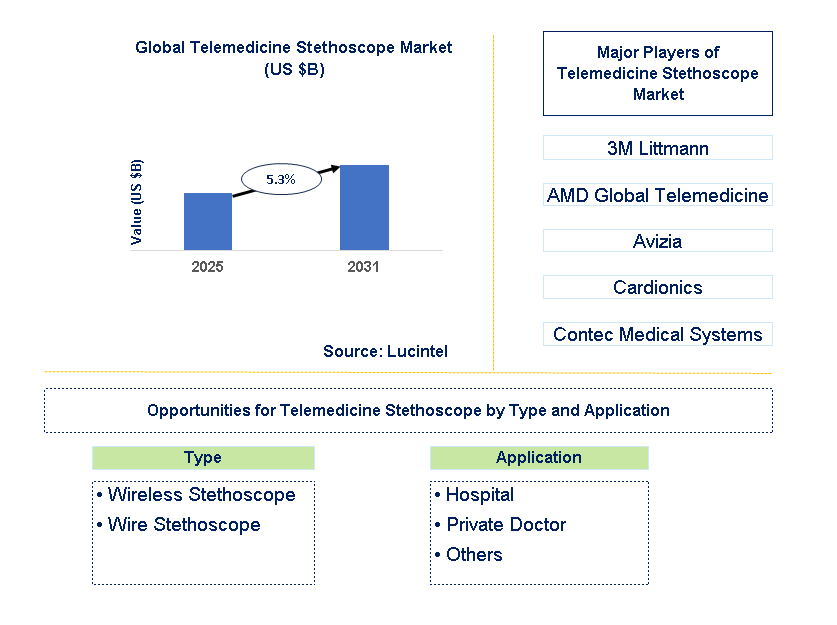
Telemedicine Stethoscope Market by Segment
• Wireless and Mobile Integration: Wireless and mobile integration is transforming telemedicine stethoscopes, enabling healthcare providers to use these devices in conjunction with smartphones and tablets. This development enhances the portability and accessibility of telemedicine stethoscopes, making them ideal for use in remote and rural areas. The ability to connect directly to mobile apps also allows healthcare providers to transmit patient data securely, facilitating remote consultations with specialists. As telemedicine adoption increases globally, this feature is expected to play a significant role in expanding access to quality healthcare.
• Focus on Portability and Affordability: Portability and affordability are becoming increasingly important in the telemedicine stethoscope market, especially in emerging markets like India and China. Manufacturers are focusing on creating lightweight, compact, and cost-effective telemedicine stethoscopes that are easy to carry and use in low-resource settings. This trend is enabling healthcare providers in rural or underserved areas to access remote diagnostic tools, improving healthcare delivery and patient outcomes. As the market grows, more affordable options are expected to become available, further driving adoption in developing regions.
• Integration with Electronic Health Records: Integration with Electronic Health Records (EHR) is becoming a critical trend in telemedicine stethoscope development. By seamlessly syncing auscultator data with EHR systems, healthcare providers can maintain accurate patient records and ensure that diagnostic information is available for future consultations. This integration helps streamline workflows, improve efficiency, and enhance the quality of care by ensuring that all relevant data is readily accessible. As healthcare systems globally continue to digitize, this trend is expected to strengthen the role of telemedicine stethoscopes in integrated care models.
• Real-Time Collaboration and Remote Consultation: Real-time collaboration and remote consultation are growing trends in the telemedicine stethoscope market, as these devices allow for immediate, remote diagnosis by specialists. Healthcare providers can use telemedicine stethoscopes to transmit heart and lung sounds to specialists, who can offer advice or a second opinion. This trend is especially important in regions with limited access to specialized care, allowing general practitioners and remote healthcare workers to collaborate with specialists in real time, ensuring better patient outcomes. The trends of AI integration, wireless and mobile capabilities, affordability, EHR integration, and real-time consultation are reshaping the telemedicine stethoscope market. These trends are enhancing the functionality, accessibility, and effectiveness of telemedicine stethoscopes, improving remote patient care and expanding access to healthcare services worldwide." src="Emerging Trends in the Telemedicine Stethoscope Market" style="height: auto;width: auto;" title="The telemedicine stethoscope market is evolving with emerging trends that are enhancing the functionality and adoption of these devices. As healthcare becomes increasingly digital, telemedicine stethoscopes are playing a crucial role in remote patient care, diagnostic support, and improving access to healthcare services. The following are key trends reshaping the market, from AI integration to the growing focus on portability and cost efficiency.
• AI Integration for Enhanced Diagnostics: AI integration is a key trend in the telemedicine stethoscope market. AI algorithms are being integrated into these devices to assist healthcare providers in making accurate diagnoses by analyzing auscultators sounds. These smart stethoscopes can automatically detect abnormal heart or lung sounds, aiding in early detection of conditions like pneumonia, heart murmurs, or arrhythmias. As AI capabilities improve, telemedicine stethoscopes are becoming even more reliable in supporting healthcare providers, allowing them to deliver more precise diagnoses remotely.
• Wireless and Mobile Integration: Wireless and mobile integration is transforming telemedicine stethoscopes, enabling healthcare providers to use these devices in conjunction with smartphones and tablets. This development enhances the portability and accessibility of telemedicine stethoscopes, making them ideal for use in remote and rural areas. The ability to connect directly to mobile apps also allows healthcare providers to transmit patient data securely, facilitating remote consultations with specialists. As telemedicine adoption increases globally, this feature is expected to play a significant role in expanding access to quality healthcare.
• Focus on Portability and Affordability: Portability and affordability are becoming increasingly important in the telemedicine stethoscope market, especially in emerging markets like India and China. Manufacturers are focusing on creating lightweight, compact, and cost-effective telemedicine stethoscopes that are easy to carry and use in low-resource settings. This trend is enabling healthcare providers in rural or underserved areas to access remote diagnostic tools, improving healthcare delivery and patient outcomes. As the market grows, more affordable options are expected to become available, further driving adoption in developing regions.
• Integration with Electronic Health Records: Integration with Electronic Health Records (EHR) is becoming a critical trend in telemedicine stethoscope development. By seamlessly syncing auscultator data with EHR systems, healthcare providers can maintain accurate patient records and ensure that diagnostic information is available for future consultations. This integration helps streamline workflows, improve efficiency, and enhance the quality of care by ensuring that all relevant data is readily accessible. As healthcare systems globally continue to digitize, this trend is expected to strengthen the role of telemedicine stethoscopes in integrated care models.
• Real-Time Collaboration and Remote Consultation: Real-time collaboration and remote consultation are growing trends in the telemedicine stethoscope market, as these devices allow for immediate, remote diagnosis by specialists. Healthcare providers can use telemedicine stethoscopes to transmit heart and lung sounds to specialists, who can offer advice or a second opinion. This trend is especially important in regions with limited access to specialized care, allowing general practitioners and remote healthcare workers to collaborate with specialists in real time, ensuring better patient outcomes. The trends of AI integration, wireless and mobile capabilities, affordability, EHR integration, and real-time consultation are reshaping the telemedicine stethoscope market. These trends are enhancing the functionality, accessibility, and effectiveness of telemedicine stethoscopes, improving remote patient care and expanding access to healthcare services worldwide." />
Emerging Trends in the Telemedicine Stethoscope Market
Recent Development in the Telemedicine Stethoscope Market
The telemedicine stethoscope market is undergoing significant developments that are improving remote patient diagnostics and care. From advanced AI capabilities to seamless integration with other healthcare technologies, these innovations are transforming the way healthcare providers use stethoscopes in telemedicine. The following outlines key developments that are shaping the telemedicine stethoscope market, particularly in terms of technology and adoption.• AI-Powered Diagnostic Capabilities: AI-powered diagnostic capabilities have become a major development in the telemedicine stethoscope market. Advanced algorithms are now able to analyze auscultator sounds, helping healthcare providers diagnose conditions such as heart murmurs or respiratory issues. This integration of AI into telemedicine stethoscopes enhances diagnostic accuracy, especially in remote consultations where specialists are not physically present. As AI continues to evolve, it is expected that these devices will provide even more precise diagnostic support, improving patient outcomes.
• Improved Wireless Connectivity and Mobile Integration: Recent advancements in wireless connectivity have significantly enhanced the functionality of telemedicine stethoscopes. These devices now feature Bluetooth and Wi-Fi capabilities that allow healthcare providers to connect the stethoscope to mobile devices or computers for real-time data sharing. This development allows for seamless communication between healthcare providers and specialists, making remote consultations more efficient and accurate. The mobile integration also supports cloud storage, ensuring that patient data is easily accessible for future reference.
• Enhanced Audio Quality for Remote Consultations: The audio quality of telemedicine stethoscopes has seen significant improvements, making remote consultations more reliable. Manufacturers are focusing on ensuring high-definition sound transmission, which is crucial for accurate diagnoses. Enhanced audio quality allows healthcare providers to hear heart and lung sounds more clearly, even in noisy environments or over long distances. This development has been particularly important in ensuring that telemedicine stethoscopes remain effective in diverse healthcare settings, from urban hospitals to remote rural areas.
• Expansion of Telemedicine Platforms and Integration with EHR: Telemedicine stethoscopes are increasingly being integrated into broader telemedicine platforms, which include video consultations, patient monitoring tools, and EHR systems. This integration allows healthcare providers to have a comprehensive view of the patient’s health data, improving decision-making. By syncing auscultator data with EHR, telemedicine stethoscopes help streamline workflows, reduce errors, and ensure that all relevant information is available for clinicians during remote consultations. This development is critical in ensuring that telemedicine is as effective as in-person consultations.
• Regulatory Approvals and Reimbursement Policies: Telemedicine stethoscopes are receiving more regulatory approvals, which are helping to increase their adoption. In countries like the U.S., the FDA has approved several telemedicine stethoscopes for clinical use. Additionally, reimbursement policies have expanded, making it easier for healthcare providers to incorporate these devices into their practices. The support from regulatory bodies is fostering confidence in telemedicine stethoscopes, encouraging wider adoption across healthcare systems. Recent developments in AI integration, wireless connectivity, audio quality, platform integration, and regulatory support are driving the growth of the telemedicine stethoscope market. These advancements are enhancing the accuracy, accessibility, and efficiency of remote patient diagnostics, ultimately improving healthcare delivery worldwide.
Strategic Growth Opportunities in the Telemedicine Stethoscope Market
The telemedicine stethoscope market is witnessing a range of strategic growth opportunities driven by advancements in technology and the increasing adoption of digital health solutions. From expanding telehealth services to addressing the needs of underserved regions, these opportunities are helping to shape the future of remote healthcare. Below are key growth opportunities across various applications of telemedicine stethoscopes.• Remote Healthcare Services Expansion: The expansion of remote healthcare services presents a significant opportunity for telemedicine stethoscope manufacturers. As more healthcare providers embrace telemedicine, there is an increasing demand for high-quality diagnostic tools like telemedicine stethoscopes. This opportunity is particularly relevant in rural areas where access to healthcare specialists is limited. By developing affordable and reliable stethoscopes, manufacturers can support the expansion of remote healthcare services, ensuring that patients in underserved regions have access to accurate diagnostics.
• Integration with Wearable Devices for Comprehensive Monitoring: The integration of telemedicine stethoscopes with wearable devices is a growing opportunity in the market. By connecting stethoscopes with health tracking devices such as smartwatches or fitness trackers, healthcare providers can monitor patients’ health more comprehensively. This allows for real-time data collection on heart rate, respiratory function, and other vital signs, which can be shared with healthcare professionals for better diagnosis and treatment. This trend is especially beneficial for patients with chronic conditions who require continuous monitoring.
• Adoption in Home Healthcare Settings: The increasing demand for home healthcare services presents a growth opportunity for telemedicine stethoscopes. Home healthcare providers are increasingly adopting remote diagnostic tools, including telemedicine stethoscopes, to monitor patients’ conditions. These devices are critical for providing accurate diagnoses and enabling healthcare professionals to offer timely interventions without the need for patients to travel to clinics or hospitals. This growth opportunity is particularly relevant in the context of aging populations and the growing preference for in-home care.
• AI and Machine Learning Integration for Advanced Diagnostics: The integration of AI and machine learning technologies into telemedicine stethoscopes presents an opportunity for enhanced diagnostic capabilities. These technologies can help stethoscopes analyze heart and lung sounds more accurately, detect irregularities, and provide recommendations for further action. As the AI and machine learning sectors continue to evolve, telemedicine stethoscopes with these capabilities will become even more valuable tools for healthcare providers, offering more accurate remote diagnostics and improving patient outcomes.
• Education and Training in Telehealth Technologies: The growing need for education and training in telemedicine and telehealth technologies presents an opportunity for telemedicine stethoscope providers. By offering specialized training and support, companies can help healthcare providers better understand how to use telemedicine stethoscopes effectively. Additionally, educating healthcare professionals about the benefits of remote diagnostics can drive adoption and encourage the integration of telemedicine stethoscopes into daily practice. Growth opportunities in remote healthcare services, wearable device integration, home healthcare, AI-driven diagnostics, and education are shaping the future of the telemedicine stethoscope market. As these opportunities are explored, telemedicine stethoscopes will play a pivotal role in enhancing the accessibility and efficiency of remote healthcare delivery.
Telemedicine Stethoscope Market Driver and Challenges
The telemedicine stethoscope market is influenced by various drivers and challenges, which include technological advancements, economic factors, and regulatory developments. As healthcare continues to shift toward digital solutions, telemedicine stethoscopes have become crucial tools in remote diagnosis and patient monitoring. These drivers have accelerated the adoption of telemedicine stethoscopes, making them essential in expanding access to healthcare. However, challenges such as cost, data privacy concerns, and regulatory hurdles remain, posing barriers to widespread adoption. Understanding these drivers and challenges is key to shaping the future of the telemedicine stethoscope market. The factors responsible for driving the Telemedicine Stethoscope market include: 1. Advancement in Telemedicine and Digital Health: The rapid expansion of telemedicine and digital health platforms is a significant driver of the telemedicine stethoscope market. As healthcare providers increasingly use virtual consultations, the demand for tools that allow remote diagnostic capabilities, such as telemedicine stethoscopes, has surged. These devices enable clinicians to conduct auscultator assessments remotely, expanding access to care, especially in rural or underserved areas. The broader adoption of telehealth solutions is pushing the growth of telemedicine stethoscopes, improving the efficiency and accessibility of healthcare services. 2. Increased Demand for Remote Healthcare Solutions: The demand for remote healthcare solutions has accelerated due to factors like the COVID-19 pandemic, which forced healthcare systems worldwide to rapidly adopt telemedicine technologies. Telemedicine stethoscopes have become a critical tool in these remote consultations, allowing healthcare professionals to assess heart and lung sounds without being physically present. This trend of increasing remote healthcare services, driven by the need for safety and convenience, continues to push the growth of the telemedicine stethoscope market, with more healthcare providers seeking reliable diagnostic tools for virtual consultations. 3. Technological Advancements in Stethoscope Design: Technological innovations in stethoscope design, such as high-definition audio, wireless connectivity, and integration with mobile devices, have significantly improved the capabilities of telemedicine stethoscopes. The development of features like noise reduction, enhanced sound clarity, and integration with AI for automatic diagnosis support has made telemedicine stethoscopes more accurate and user-friendly. These advancements have led to the increased adoption of telemedicine stethoscopes as healthcare providers prioritize tools that enhance remote diagnostic capabilities and patient care. 4. Government Support and Regulatory Approvals: Government initiatives and regulatory support are significant drivers of the telemedicine stethoscope market. In many countries, policies promoting the adoption of telemedicine and digital health solutions, such as reimbursement for telehealth services, have facilitated the growth of the market. For example, in the United States, the expansion of reimbursement policies for telehealth consultations has driven the integration of telemedicine stethoscopes into clinical practice. 5. Growing Healthcare Access in Remote Areas: One of the key drivers of the telemedicine stethoscope market is the increasing demand for healthcare in remote and underserved areas. Telemedicine stethoscopes enable healthcare providers to perform remote diagnoses, providing access to medical expertise where specialists may not be available. This is particularly important in countries with large rural populations, where healthcare access has traditionally been limited. As governments and healthcare organizations prioritize improving access to care in these regions, the adoption of telemedicine stethoscopes continues to rise. Challenges in the Telemedicine Stethoscope market are: 1. High Initial Costs of Equipment: One of the primary challenges in the telemedicine stethoscope market is the high initial cost of the devices. Many healthcare providers, particularly in developing countries or smaller clinics, may find it difficult to afford the investment required to equip their practices with telemedicine stethoscopes. While the long-term benefits of remote diagnostics can outweigh the costs, the upfront expense remains a significant barrier for adoption, especially in cost-sensitive healthcare systems. 2. Data Privacy and Security Concerns: Telemedicine stethoscopes involve the transmission of sensitive patient data, raising concerns about data privacy and security. Healthcare providers must ensure that the devices comply with strict data protection regulations, such as HIPAA in the United States or GDPR in Europe. Any breaches in patient data security can lead to legal and reputational risks. The market for telemedicine stethoscopes faces challenges in ensuring that these devices and the platforms they connect to are secure enough to protect patient confidentiality. 3. Regulatory and Certification Hurdles: Navigating the regulatory landscape is a significant challenge for telemedicine stethoscope manufacturers. The certification process for medical devices can be lengthy and complex, with different regulations in each country. Manufacturers must ensure their devices meet the standards set by regulatory bodies like the FDA in the United States or the European Medicines Agency (EMA) in Europe. These regulatory hurdles can delay the entry of new products into the market and limit their availability to healthcare providers, thus slowing the overall growth of the telemedicine stethoscope market. The telemedicine stethoscope market is driven by technological innovations, increasing demand for remote healthcare, government support, and the need for better healthcare access in rural areas. However, challenges such as high initial costs, data privacy concerns, and regulatory hurdles continue to impact its growth. Addressing these challenges while capitalizing on the drivers will be essential for maximizing the market’s potential. With the right policies, technological advancements, and strategic investment, the telemedicine stethoscope market can expand, improving healthcare accessibility and the quality of remote patient care worldwide.List of Telemedicine Stethoscope Companies
Companies in the market compete on the basis of product quality offered. Major players in this market focus on expanding their manufacturing facilities, R&D investments, infrastructural development, and leverage integration opportunities across the value chain. With these strategies telemedicine stethoscope companies cater increasing demand, ensure competitive effectiveness, develop innovative products & technologies, reduce production costs, and expand their customer base. Some of the telemedicine stethoscope companies profiled in this report include-• 3M Littmann Stethoscopes
• AMD Global Telemedicine
• Avizia
• Cardionics
• Contec Medical Systems
• Ekuore
• Globalmed
• Thinklabs
• Hill-Rom
• Clinicloud
Telemedicine Stethoscope Market by Segment
The study includes a forecast for the global telemedicine stethoscope market by type, application, and region.Telemedicine Stethoscope Market by Type [Value from 2019 to 2031]:
• Wireless Stethoscope
• Wire Stethoscope
Telemedicine Stethoscope Market by Application [Value from 2019 to 2031]:
• Hospital
• Private Doctor
• Others
Telemedicine Stethoscope Market by Region [Value from 2019 to 2031]:
• North America
• Europe
• Asia Pacific
• The Rest of the World
Country Wise Outlook for the Telemedicine Stethoscope Market
The telemedicine stethoscope market has witnessed significant growth due to advancements in medical technology, particularly in the context of remote patient monitoring and digital health. The COVID-19 pandemic has accelerated the demand for tools that allow healthcare professionals to conduct remote diagnoses while maintaining accuracy and patient safety. Telemedicine stethoscopes, which enable clinicians to listen to heart and lung sounds remotely, have become essential in virtual care settings. As the technology continues to evolve, several regions, including the United States, China, Germany, India, and Japan, are seeing unique developments in how these devices are utilized.• United States: In the U.S., telemedicine stethoscopes have been rapidly integrated into telehealth services due to increased demand for remote healthcare solutions. Healthcare providers are increasingly adopting devices that support wireless transmission of auscultator sounds to specialists, facilitating remote consultations. Regulatory support through initiatives like the 21st Century Cures Act and expanded reimbursement policies for telehealth has further boosted adoption. Furthermore, American companies are incorporating advanced features, such as AI-powered diagnostic support and integration with electronic health records (EHR), making these devices more effective for remote patient monitoring and diagnosis.
• China: China is witnessing significant growth in the telemedicine stethoscope market, driven by the country’s focus on expanding telehealth services to rural and underserved areas. With a large population and varying healthcare access, China is integrating telemedicine stethoscopes into its broader digital health initiatives. The government is also pushing for innovation in telemedicine, with policies supporting remote healthcare infrastructure. Local manufacturers are introducing cost-effective, portable stethoscopes that are compatible with smartphones and cloud-based systems, making them more accessible for healthcare professionals and enhancing their use in rural areas.
• Germany: Germany’s telemedicine stethoscope market is evolving rapidly, supported by the country’s strong healthcare infrastructure and a growing focus on digitalization. The German government’s Digital Healthcare Act has incentivized the adoption of digital health tools, including telemedicine stethoscopes. These devices are increasingly being integrated into telehealth systems to improve patient care, particularly in rural areas where access to specialists may be limited. German manufacturers are focusing on high-quality audio transmission and enhancing the devices’ connectivity with other medical technologies. The market is also witnessing a rise in demand for multi-functional devices that combine stethoscope capabilities with other diagnostic tools.
• India: India’s telemedicine stethoscope market is growing as the country’s healthcare system embraces digital health solutions. With a vast rural population and limited access to healthcare professionals, telemedicine stethoscopes have become essential for providing remote consultations. The Indian government has introduced initiatives like the Telemedicine Practice Guidelines and the National Digital Health Mission to support the adoption of digital health technologies. Affordable, portable, and easy-to-use stethoscopes are being introduced, allowing healthcare providers to extend their reach to underserved areas. The use of mobile-based apps to transmit auscultators data is also gaining traction, enhancing patient care delivery.
• Japan: Japan’s telemedicine stethoscope market is expanding as the country faces challenges associated with an aging population and limited healthcare personnel in rural areas. Telemedicine stethoscopes are being used to address these challenges by enabling remote diagnostics and consultations. The Japanese government’s push for digital health transformation is further driving the adoption of telemedicine tools. Manufacturers in Japan are focusing on high-quality audio technology, ensuring that remote consultations are accurate and reliable. Japan is also at the forefront of integrating telemedicine stethoscopes with advanced technologies like AI for improved diagnostics, aligning with its reputation for healthcare innovation.

Features of the Global Telemedicine Stethoscope Market
Market Size Estimates: Telemedicine stethoscope market size estimation in terms of value ($B). Trend and Forecast Analysis: Market trends (2018 to 2023) and forecast (2025 to 2031) by various segments and regions. Segmentation Analysis: Telemedicine stethoscope market size by type, application, and region in terms of value ($B). Regional Analysis: Telemedicine stethoscope market breakdown by North America, Europe, Asia Pacific, and Rest of the World. Growth Opportunities: Analysis of growth opportunities in different type, application, and regions for the telemedicine stethoscope market. Strategic Analysis: This includes M&A, new product development, and competitive landscape of the telemedicine stethoscope market. Analysis of competitive intensity of the industry based on Porter’s Five Forces model.
FAQ
Q1. What is the growth forecast for telemedicine stethoscope market? Answer: The global telemedicine stethoscope market is expected to grow with a CAGR of 5.3% from 2025 to 2031. Q2. What are the major drivers influencing the growth of the telemedicine stethoscope market? Answer: The major drivers for this market are growing focus on remote patient monitoring, rising healthcare expenditure, and regulatory support and reimbursement policies. Q3. What are the major segments for telemedicine stethoscope market? Answer: The future of the telemedicine stethoscope market looks promising with opportunities in the hospital, private doctor markets. Q4. Who are the key telemedicine stethoscope market companies? Answer: Some of the key telemedicine stethoscope companies are as follows:• 3M Littmann Stethoscopes
• AMD Global Telemedicine
• Avizia
• Cardionics
• Contec Medical Systems
• Ekuore
• Globalmed
• Thinklabs
• Hill-Rom
• Clinicloud Q5. Which telemedicine stethoscope market segment will be the largest in future? Answer: Lucintel forecasts that wireless stethoscope is expected to witness higher growth over the forecast period due to more flexible, efficient, and user-friendly telemedicine tools. Q6. In telemedicine stethoscope market, which region is expected to be the largest in next 5 years? Answer: North America is expected to witness the highest growth over the forecast period due to healthcare system, high adoption of telemedicine, and technological advancements. Q7. Do we receive customization in this report? Answer: Yes, Lucintel provides 10% customization without any additional cost.
Table of Contents
Methodology
- In-depth interviews of the major players in this market
- Detailed secondary research from competitors’ financial statements and published data
- Extensive searches of published works, market, and database information pertaining to industry news, company press releases, and customer intentions
- A compilation of the experiences, judgments, and insights of Lucintel’s professionals, who have analyzed and tracked this market over the years.


Buy Now
Choose a license that fits your team. Instant PDF delivery.
Prices exclude taxes. Instant delivery. Custom licensing available on request.
Key Questions
- • What are some of the most promising, high-growth opportunities for the telemedicine stethoscope market by type (wireless stethoscope and wire stethoscope), application (hospital, private doctor, and others), and region (North America, Europe, Asia Pacific, and the Rest of the World)?
- • Which segments will grow at a faster pace and why?
- • Which region will grow at a faster pace and why?
- • What are the key factors affecting market dynamics? What are the key challenges and business risks in this market?
- • What are the business risks and competitive threats in this market?
- • What are the emerging trends in this market and the reasons behind them?
- • What are some of the changing demands of customers in the market?
- • What are the new developments in the market? Which companies are leading these developments?
- • Who are the major players in this market? What strategic initiatives are key players pursuing for business growth?
- • What are some of the competing products in this market and how big of a threat do they pose for loss of market share by material or product substitution?
- • What M&A activity has occurred in the last 5 years and what has its impact been on the industry? For any questions related to Telemedicine Stethoscope Market, Telemedicine Stethoscope Market Size, Telemedicine Stethoscope Market Growth, Telemedicine Stethoscope Market Analysis, Telemedicine Stethoscope Market Report, Telemedicine Stethoscope Market Share, Telemedicine Stethoscope Market Trends, Telemedicine Stethoscope Market Forecast, Telemedicine Stethoscope Companies, write Lucintel analyst at email: helpdesk@lucintel.com. We will be glad to get back to you soon.


