
Telecom Cable Market Trends and Forecast
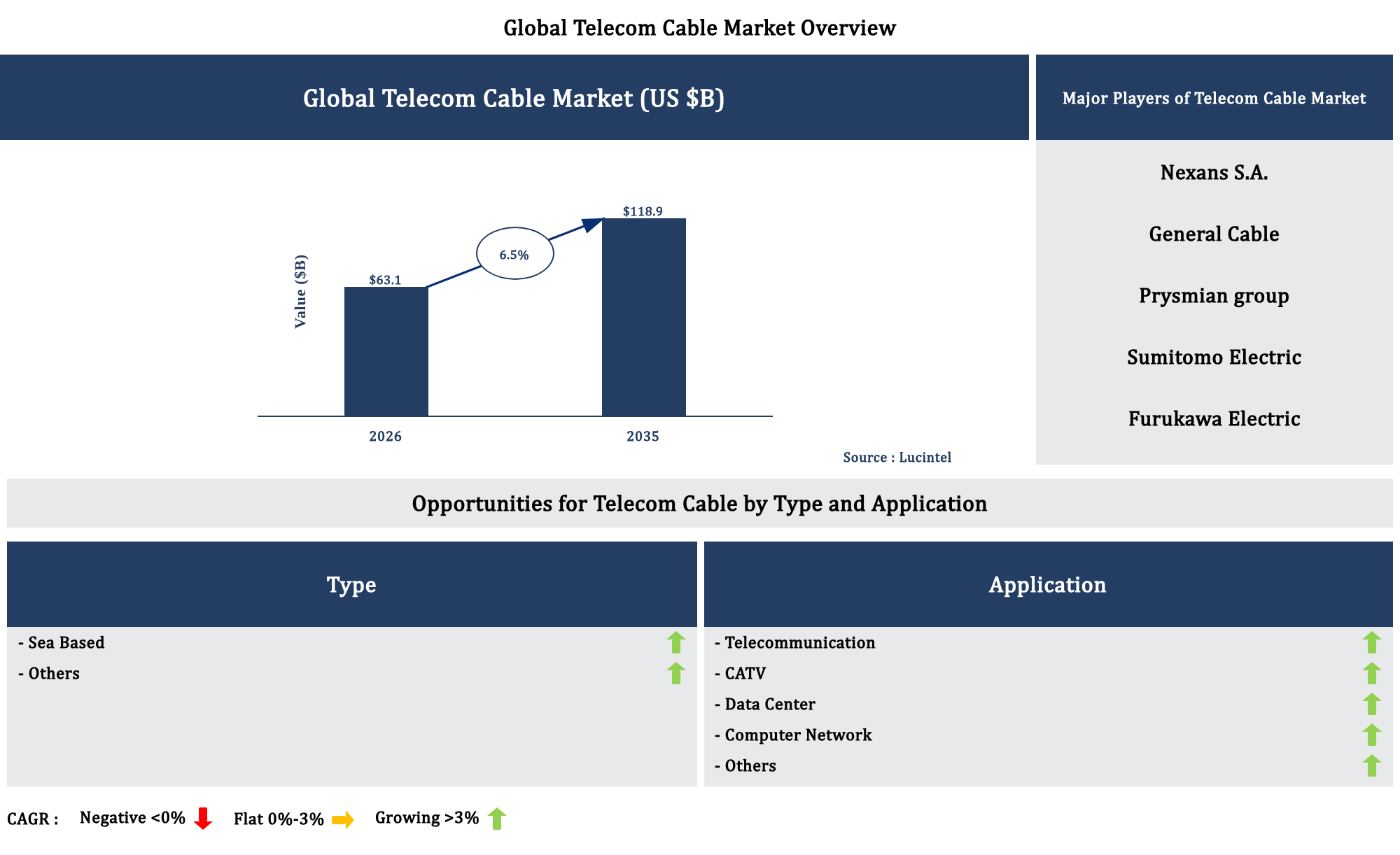
The future of the global telecom cable market looks promising with opportunities in the telecommunication, catv, data center, and computer network markets. The global telecom cable market is expected to reach an estimated $118977 million by 2035 with a CAGR of 6.5% from 2026 to 2035. The major drivers for this market are the increasing demand for investments in telecom infrastructure development, the rising demand for fiber optic cable installations, and the growing demand for broadband in rural areas.
• Lucintel forecasts that, within the type category, sea based will remain the largest segment over the forecast period.
• Within the application category, telecommunication is expected to witness the highest growth.
• In terms of region, APAC is expected to witness the highest growth over the forecast period.
Gain valuable insights for your business decisions with our comprehensive 150+ page report. Sample figures with some insights are shown below.
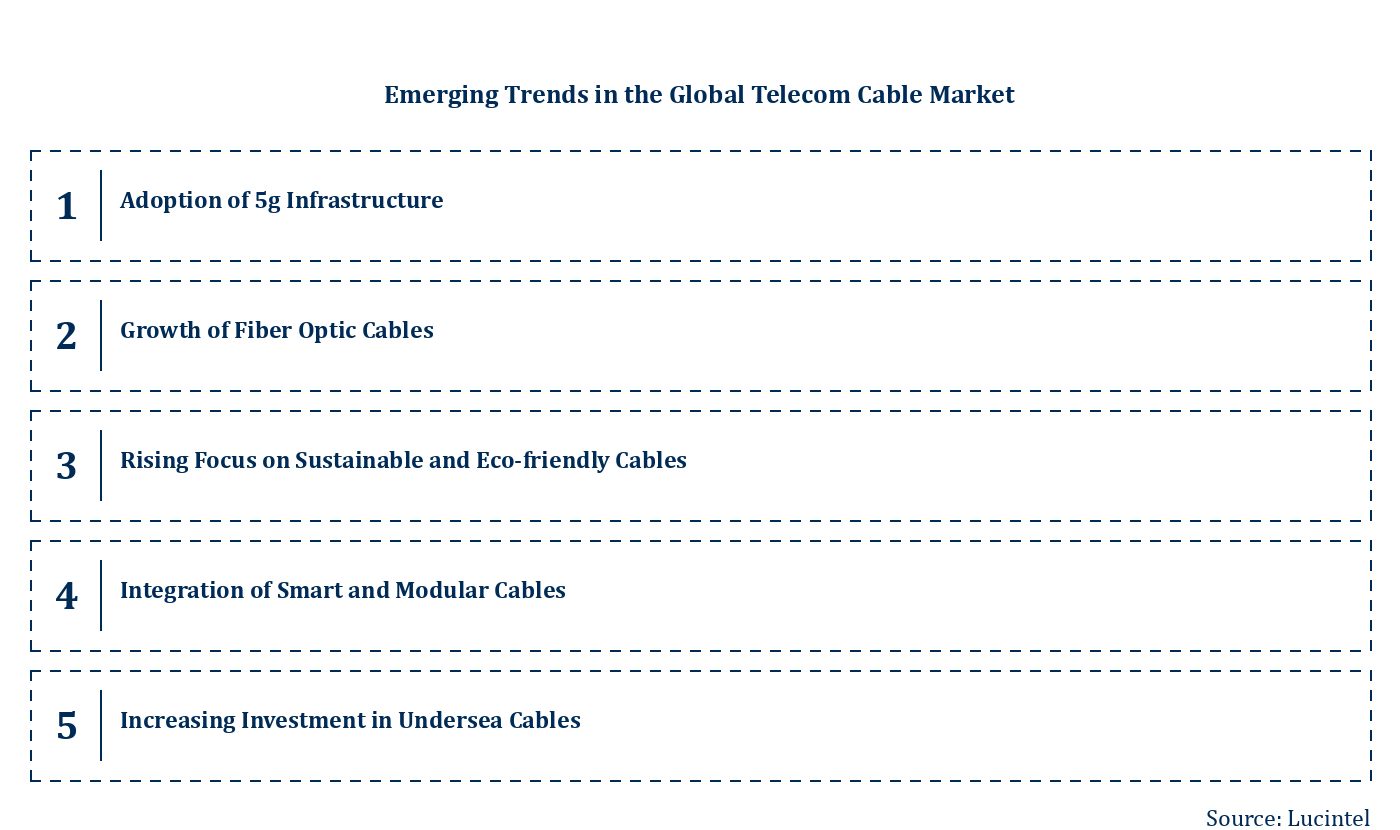
Emerging Trends in the Telecom Cable Market
The telecom cable market is experiencing rapid evolution driven by technological advancements, increasing demand for high-speed connectivity, and the proliferation of digital services. As consumers and businesses demand more reliable and faster communication networks, the market is adapting through innovation and strategic investments. Emerging trends are shaping the future landscape, influencing product development, deployment strategies, and competitive dynamics. These developments are not only expanding market opportunities but also creating new challenges for stakeholders. Understanding these key trends is essential for industry players to stay competitive and capitalize on upcoming growth prospects in this dynamic environment.
• Adoption of 5G Infrastructure: Accelerating network upgrades and new deployments are driving demand for specialized telecom cables. 5G technology requires dense network infrastructure with high-capacity cables capable of supporting increased data transfer speeds and lower latency. This trend is prompting manufacturers to develop innovative cable solutions that meet the stringent technical specifications of 5G networks, thereby expanding market opportunities and fostering technological innovation.
• Growth of Fiber Optic Cables: The shift from traditional copper cables to fiber optic cables is gaining momentum due to their superior bandwidth and longer transmission distances. Fiber optic cables are essential for supporting high-speed internet, cloud computing, and data centers. This trend is significantly impacting the market by increasing demand for high-performance cables, encouraging investments in fiber infrastructure, and driving technological advancements in cable manufacturing.
• Rising Focus on Sustainable and Eco-Friendly Cables: Environmental concerns and regulatory pressures are prompting manufacturers to develop sustainable cable solutions. These include cables made from recyclable materials, reduced hazardous substances, and energy-efficient manufacturing processes. This trend is influencing product development strategies, enhancing brand reputation, and aligning the market with global sustainability goals, thereby opening new avenues for eco-conscious consumers and clients.
• Integration of Smart and Modular Cables: The market is witnessing a shift towards smart cables embedded with sensors and modular designs for easier installation and maintenance. These cables enable real-time monitoring of network performance and facilitate quick troubleshooting, reducing downtime. This trend enhances network reliability and operational efficiency, providing a competitive edge to providers and supporting the growth of intelligent network infrastructure.
• Increasing Investment in Undersea Cables: The demand for global connectivity is fueling investments in undersea cable projects. These cables are critical for international data transfer, cloud services, and global internet coverage. Advances in cable technology, such as improved durability and capacity, are making undersea cables more viable and cost-effective. This trend is expanding the market geographically and enabling faster, more reliable international communication networks.
These trends are collectively transforming the telecom cable market by fostering innovation, enhancing network capabilities, and emphasizing sustainability. They are enabling faster, more reliable, and environmentally responsible communication infrastructure, which is essential for supporting the digital economy and global connectivity. As these trends continue to evolve, they will shape the future landscape of the telecom cable industry, creating new opportunities and challenges for market participants.
Recent Development in the Telecom Cable Market
The telecom cable market is experiencing rapid evolution driven by technological advancements, increasing demand for high-speed connectivity, and expanding infrastructure projects worldwide. These developments are reshaping the industry landscape, creating new opportunities for growth and innovation. Stakeholders are focusing on enhancing product offerings, adopting sustainable practices, and expanding into emerging markets to capitalize on these trends. The following key developments highlight the current trajectory and future potential of the telecom cable market.
• Technological Innovation in Cable Materials: Advancements in materials such as ultra-low loss dielectric and improved insulation are enhancing cable performance. These innovations enable higher data transmission speeds, better signal integrity, and increased durability, which are critical for supporting 5G networks and fiber-optic deployments. The market benefits from reduced maintenance costs and longer lifespan of cables, attracting telecom providers seeking reliable infrastructure solutions. This progress is fostering a competitive edge and accelerating network expansion globally.
• Growing Adoption of Fiber Optic Cables: The shift towards fiber optic technology is driven by the need for faster, more reliable internet connections. Fiber cables offer higher bandwidth, lower latency, and greater scalability compared to traditional copper cables. As governments and private sectors invest heavily in fiber infrastructure, the market experiences significant growth. This trend is particularly prominent in urban areas and developing regions, where digital transformation initiatives are prioritized, boosting overall market demand and encouraging innovation in fiber optic manufacturing.
• Expansion of 5G Infrastructure: The deployment of 5G networks is a major catalyst for telecom cable demand. 5G requires dense networks of small cells and extensive fiber backhaul, increasing the need for specialized cables capable of supporting high frequencies and data loads. Telecom companies are investing heavily in upgrading existing infrastructure and deploying new cables to meet 5G requirements. This expansion is creating substantial opportunities for cable manufacturers and is expected to sustain market growth over the coming years, transforming connectivity standards worldwide.
• Focus on Sustainable and Eco-Friendly Cables: Environmental concerns are prompting industry players to develop sustainable cable solutions. Innovations include biodegradable insulation, recyclable materials, and energy-efficient manufacturing processes. These eco-friendly cables reduce environmental impact and align with global sustainability goals. Adoption is driven by regulatory pressures and consumer preferences for green products. The market benefits from increased demand for sustainable infrastructure, opening avenues for new product development and positioning companies as environmentally responsible leaders in the telecom sector.
• Strategic Market Expansion into Emerging Economies: Telecom cable manufacturers are increasingly targeting emerging markets with expanding digital infrastructure needs. Investments in rural connectivity, urban development, and smart city projects are fueling demand. Companies are establishing local manufacturing facilities and forming strategic partnerships to penetrate these regions effectively. This expansion not only boosts sales volumes but also diversifies revenue streams and mitigates risks associated with mature markets. The trend is expected to continue, significantly influencing global market dynamics and fostering inclusive digital growth.
These developments are significantly transforming the telecom cable market by enhancing technological capabilities, expanding infrastructure, and emphasizing sustainability. The focus on fiber optics and 5G deployment is driving rapid growth, while eco-friendly innovations and emerging market strategies are broadening industry horizons. Collectively, these trends are fostering a more resilient, efficient, and sustainable market landscape, positioning the telecom cable industry for sustained expansion and technological leadership in the evolving digital era.
Strategic Growth Opportunities in the Telecom Cable Market
The telecom cable market is experiencing rapid expansion driven by increasing demand for high-speed internet, 5G deployment, and digital transformation initiatives worldwide. Technological advancements and infrastructure investments are creating new opportunities for growth across various applications. As telecom providers seek reliable, scalable, and efficient cabling solutions, market players are exploring innovative strategies to capture emerging segments. This dynamic environment offers significant potential for companies to enhance their market share and develop competitive advantages through targeted growth initiatives.
• Expansion into Rural and Underserved Areas: Telecom cable providers can capitalize on the need for reliable connectivity in rural regions by deploying advanced cabling infrastructure. Government initiatives and subsidies support this growth, enabling companies to tap into new customer bases. Enhanced broadband access in these areas not only boosts revenue streams but also promotes digital inclusion, fostering long-term market stability and growth opportunities for telecom cable manufacturers and service providers.
• Adoption of Fiber Optic Cables for 5G Infrastructure: The rollout of 5G networks necessitates extensive fiber optic cabling to support high data rates and low latency. Telecom companies are investing heavily in fiber deployment to meet 5G demands, creating a surge in demand for high-capacity, durable fiber optic cables. This trend offers manufacturers opportunities to innovate with advanced materials and designs, positioning themselves as key suppliers in the rapidly expanding 5G ecosystem.
• Integration of Smart and IoT-Enabled Cabling Solutions: The rise of IoT devices and smart infrastructure requires intelligent cabling solutions capable of supporting increased data traffic and real-time communication. Telecom cable providers are developing integrated, flexible, and scalable cabling systems that facilitate seamless connectivity for smart cities, industrial automation, and connected homes. This opportunity allows companies to differentiate their offerings and establish a foothold in the growing IoT market segment.
• Focus on Sustainable and Eco-Friendly Cable Solutions: Environmental concerns and regulatory pressures are driving demand for sustainable telecom cabling options. Companies are investing in recyclable, biodegradable, and energy-efficient materials to reduce carbon footprints. Developing eco-friendly cables not only aligns with global sustainability goals but also appeals to environmentally conscious clients, opening new market segments and enhancing brand reputation in a competitive landscape.
• Strategic Mergers and Acquisitions to Expand Market Presence: Market players are pursuing M&A activities to strengthen their product portfolios, access new markets, and achieve economies of scale. Acquiring or partnering with regional or specialized cable manufacturers enables rapid expansion and diversification. These strategic moves facilitate technological innovation, improve supply chain efficiencies, and position companies as dominant players in the evolving telecom cable industry, ensuring sustained growth and competitive advantage.
The telecom cable market‘s growth opportunities are poised to significantly influence industry dynamics, fostering innovation and expanding reach. Companies that strategically leverage these opportunities can enhance their market position, meet evolving customer demands, and contribute to global digital infrastructure development. Overall, these initiatives will drive robust growth, technological advancement, and increased connectivity worldwide.
Telecom Cable Market Driver and Challenges
The telecom cable market is influenced by a variety of technological, economic, and regulatory factors that shape its growth trajectory. Rapid advancements in communication technologies, increasing demand for high-speed internet, and expanding digital infrastructure are key drivers. Economic factors such as rising investments in telecom infrastructure and the proliferation of smart devices further propel market expansion. Conversely, regulatory challenges, including compliance with international standards and geopolitical tensions, pose hurdles. Market players must navigate these complex dynamics to capitalize on opportunities while mitigating risks. Understanding these drivers and challenges is essential for strategic planning and sustainable growth in the evolving telecom cable landscape.
The factors responsible for driving the telecom cable market include:-
• Technological Advancements: The telecom cable industry benefits significantly from innovations such as fiber-optic technology, which offers higher bandwidth and faster data transmission. As demand for high-speed internet and data-intensive applications grows, telecom providers are investing heavily in upgrading their infrastructure. These technological improvements enable better network performance, lower latency, and increased reliability, which are critical for supporting emerging technologies like 5G and IoT. The continuous evolution of cable manufacturing processes and materials also reduces costs and enhances durability, further fueling market growth. Overall, technological progress remains a primary driver, enabling telecom companies to meet increasing consumer and enterprise demands efficiently.
• Rising Demand for High-Speed Internet: The surge in remote work, online education, streaming services, and cloud computing has exponentially increased the need for high-speed internet connectivity. Telecom cables, especially fiber-optic cables, are essential for delivering the bandwidth required for these applications. Governments and private sector investments are focused on expanding broadband access to underserved regions, boosting demand for advanced cabling solutions. This trend is expected to continue as digital transformation accelerates globally. The demand for reliable, high-capacity telecom cables directly correlates with the expansion of digital services, making it a vital growth driver for the market.
• Expansion of 5G Networks: The rollout of 5G technology is a significant catalyst for the telecom cable market. 5G networks require dense infrastructure with extensive fiber-optic cabling to support increased data speeds and lower latency. Telecom operators are deploying new cables to connect 5G base stations and data centers, creating a substantial demand for specialized cables capable of handling high-frequency signals. This expansion not only boosts current market growth but also opens avenues for future innovations in network architecture. The integration of 5G with IoT, smart cities, and autonomous vehicles further amplifies the need for advanced telecom cabling solutions, solidifying its role as a key growth driver.
• Growing Investments in Digital Infrastructure: Governments and private enterprises worldwide are investing heavily in digital infrastructure to foster economic development and technological innovation. These investments include expanding fiber-optic networks, upgrading existing telecom systems, and deploying new data centers. Such initiatives require extensive cabling infrastructure, which directly benefits the telecom cable market. The push for smart cities, e-governance, and digital healthcare also contributes to increased demand. As infrastructure projects scale up, the need for durable, high-capacity, and cost-effective telecom cables becomes more pronounced, driving market growth and innovation.
• Increasing Adoption of IoT and Smart Devices: The proliferation of Internet of Things (IoT) devices and smart technologies necessitates robust telecom infrastructure. These devices generate massive amounts of data that require high-capacity, reliable cabling solutions for seamless connectivity. Telecom cables form the backbone of IoT ecosystems, supporting applications in smart homes, industrial automation, and connected vehicles. As IoT adoption accelerates, the demand for specialized cables that can handle high data loads and ensure security increases. This trend not only expands the market but also encourages the development of innovative cabling solutions tailored for IoT applications.
The challenges facing this Market include:-
• Regulatory and Compliance Issues: The telecom cable industry faces complex regulatory environments across different regions. Compliance with international standards, safety regulations, and environmental policies can increase costs and delay project timelines. Variations in regulations regarding electromagnetic interference, cable disposal, and material usage require manufacturers to adapt their products, which can hinder rapid market expansion. Additionally, geopolitical tensions and trade restrictions may impact supply chains and access to key raw materials. Navigating these regulatory landscapes demands significant resources and strategic planning, posing ongoing challenges for market players seeking to operate efficiently and competitively.
• High Capital Expenditure and Cost Fluctuations: Developing and deploying telecom infrastructure involves substantial capital investment in manufacturing, installation, and maintenance. Fluctuations in raw material prices, such as copper and fiber-optic components, can significantly impact overall costs. Economic uncertainties, inflation, and supply chain disruptions further complicate budgeting and project planning. These financial pressures may limit the ability of smaller players to compete and can slow down infrastructure expansion. Managing costs while maintaining quality and technological standards remains a critical challenge for sustaining growth in the telecom cable market.
• Rapid Technological Obsolescence: The fast-paced evolution of communication technologies means that telecom cables can quickly become outdated. Manufacturers must continuously innovate to keep pace with new standards like 5G, IoT, and beyond. This rapid obsolescence increases R&D costs and risks of inventory obsolescence, impacting profitability. Additionally, upgrading existing infrastructure to accommodate new technologies can be costly and complex. Market players need to balance innovation with cost management, ensuring their products remain compatible with future technological developments to avoid becoming obsolete prematurely.
The telecom cable market is driven by technological innovations, increasing demand for high-speed connectivity, and expanding digital infrastructure investments. However, regulatory complexities, high capital costs, and rapid technological changes pose significant challenges. These factors collectively influence market dynamics, requiring industry players to adopt strategic approaches to capitalize on growth opportunities while mitigating risks. The ongoing evolution of digital technologies promises continued growth, but success will depend on navigating regulatory landscapes, managing costs, and innovating swiftly to stay ahead in a competitive environment.
List of Telecom Cable Companies
Companies in the market compete on the basis of product quality offered. Major players in this market focus on expanding their manufacturing facilities, R&D investments, infrastructural development, and leverage integration opportunities across the value chain. With these strategies telecom cable companies cater increasing demand, ensure competitive effectiveness, develop innovative products & technologies, reduce production costs, and expand their customer base. Some of the telecom cable companies profiled in this report include-
• Nexans S.A.
• General Cable
• Prysmian group
• Sumitomo Electric
• Furukawa Electric
• LEONI
• Fujikura
• Hitachi Cable
• LS Cable
• CommScope
Telecom Cable Market by Segment
The study includes a forecast for the global telecom cable market by type, application, and region.
Telecom Cable Market by Type [Value from 2019 to 2035]:
• Sea Based
• Others
Telecom Cable Market by Application [Value from 2019 to 2035]:
• Telecommunication
• CATV
• Data Center
• Computer Network
• Others
Telecom Cable Market by Region [Value from 2019 to 2035]:
• North America
• Europe
• Asia Pacific
• The Rest of the World
Country Wise Outlook for the Telecom Cable Market
The telecom cable market has experienced significant shifts driven by technological advancements, increasing demand for high-speed connectivity, and expanding infrastructure projects worldwide. Countries are investing heavily in upgrading their telecommunications networks to support 5G, fiber-optic expansion, and digital transformation initiatives. These developments are shaping the competitive landscape, influencing supply chains, and fostering innovation. As nations prioritize connectivity, the market‘s growth prospects remain robust, with regional players adopting new strategies to capture emerging opportunities. The following summaries highlight recent key developments in the United States, China, Germany, India, and Japan, reflecting their unique market dynamics and strategic initiatives.
• United States: The US telecom cable market has seen increased investment in 5G infrastructure and fiber-optic networks, driven by government initiatives and private sector expansion. Major telecom providers are deploying advanced cables to enhance broadband speeds and coverage, especially in rural areas. Regulatory policies favoring infrastructure upgrades have accelerated market growth, with a focus on reducing digital divides. Innovations in cable technology, such as lightweight and high-capacity fibers, are gaining traction, supporting the country‘s push toward smarter, more connected cities.
• China: China continues to lead in telecom cable deployment, with extensive investments in 5G networks and fiber-optic infrastructure. The government’s strategic initiatives aim to achieve nationwide high-speed connectivity, fostering digital economy growth. Domestic manufacturers are expanding their production capacities, introducing advanced cables that support higher bandwidths and durability. The market also benefits from large-scale infrastructure projects, including smart city developments and rural broadband expansion, positioning China as a dominant player in the global telecom cable industry.
• Germany: Germany‘s telecom cable market is characterized by modernization efforts to upgrade existing networks and expand fiber-optic coverage across urban and rural areas. The country emphasizes sustainable and energy-efficient cable solutions, aligning with its environmental policies. Collaborations between telecom operators and technology providers are fostering innovation in cable design and deployment. Germany’s focus on digital infrastructure for industrial automation and smart cities is driving demand for high-performance cables, supporting its position as a technological hub within Europe.
• India: India’s telecom cable market is experiencing rapid growth due to government initiatives like Digital India and the expansion of 4G and 5G networks. The increasing demand for reliable internet connectivity in rural and urban regions is fueling infrastructure development. Local manufacturers are investing in advanced cable technologies to meet rising demand, while foreign players are entering the market through joint ventures. The focus on affordable, durable, and high-capacity cables is critical to supporting India’s digital transformation and economic growth objectives.
• Japan: Japan’s telecom cable market is evolving with a focus on high-speed internet and next-generation network infrastructure. The country is investing in fiber-optic deployment to support 5G and IoT applications. Innovations in cable materials and installation techniques are enhancing network reliability and performance. Japan’s emphasis on disaster-resilient infrastructure influences cable design, ensuring durability in earthquake-prone regions. The market also benefits from government policies promoting smart city projects and digital innovation, positioning Japan as a leader in advanced telecom infrastructure development.
Features of the Global Telecom Cable Market
Market Size Estimates: Telecom cable market size estimation in terms of value ($M).
Trend and Forecast Analysis: Market trends (2019 to 2025) and forecast (2026 to 2035) by various segments and regions.
Segmentation Analysis: Telecom cable market size by type, application, and region in terms of value ($M).
Regional Analysis: Telecom cable market breakdown by North America, Europe, Asia Pacific, and Rest of the World.
Growth Opportunities: Analysis of growth opportunities in different type, application, and regions for the telecom cable market.
Strategic Analysis: This includes M&A, new product development, and competitive landscape of the telecom cable market.
Analysis of competitive intensity of the industry based on Porter’s Five Forces model.
FAQ
Q1. What is the telecom cable market size?
Answer: The global telecom cable market is expected to reach an estimated $118977 million by 2035.
Q2. What is the growth forecast for telecom cable market?
Answer: The global telecom cable market is expected to grow with a CAGR of 6.5% from 2026 to 2035.
Q3. What are the major drivers influencing the growth of the telecom cable market?
Answer: The major drivers for this market are the increasing demand for investments in telecom infrastructure development, the rising demand for fiber optic cable installations, and the growing demand for broadband in rural areas.
Q4. What are the major segments for telecom cable market?
Answer: The future of the telecom cable market looks promising with opportunities in the telecommunication, catv, data center, and computer network markets.
Q5. Who are the key telecom cable market companies?
Answer: Some of the key telecom cable companies are as follows:
• Nexans S.A.
• General Cable
• Prysmian group
• Sumitomo Electric
• Furukawa Electric
• LEONI
• Fujikura
• Hitachi Cable
• LS Cable
• CommScope
Q6. Which telecom cable market segment will be the largest in future?
Answer: Lucintel forecasts that, within the type category, sea based will remain the largest segment over the forecast period.
Q7. In telecom cable market, which region is expected to be the largest in next 8 years?
Answer: In terms of region, APAC is expected to witness the highest growth over the forecast period.
Q8. Do we receive customization in this report?
Answer: Yes, Lucintel provides 10% customization without any additional cost.
This report answers following 11 key questions:
Q.1. What are some of the most promising, high-growth opportunities for the telecom cable market by type (sea based and others), application (telecommunication, catv, data center, computer network, and others), and region (North America, Europe, Asia Pacific, and the Rest of the World)?
Q.2. Which segments will grow at a faster pace and why?
Q.3. Which region will grow at a faster pace and why?
Q.4. What are the key factors affecting market dynamics? What are the key challenges and business risks in this market?
Q.5. What are the business risks and competitive threats in this market?
Q.6. What are the emerging trends in this market and the reasons behind them?
Q.7. What are some of the changing demands of customers in the market?
Q.8. What are the new developments in the market? Which companies are leading these developments?
Q.9. Who are the major players in this market? What strategic initiatives are key players pursuing for business growth?
Q.10. What are some of the competing products in this market and how big of a threat do they pose for loss of market share by material or product substitution?
Q.11. What M&A activity has occurred in the last 7 years and what has its impact been on the industry?
For any questions related to Telecom Cable Market, Telecom Cable Market Size, Telecom Cable Market Growth, Telecom Cable Market Analysis, Telecom Cable Market Report, Telecom Cable Market Share, Telecom Cable Market Trends, Telecom Cable Market Forecast, Telecom Cable Companies, write Lucintel analyst at email: helpdesk@lucintel.com. We will be glad to get back to you soon.
