
Market Report · July 16, 2026

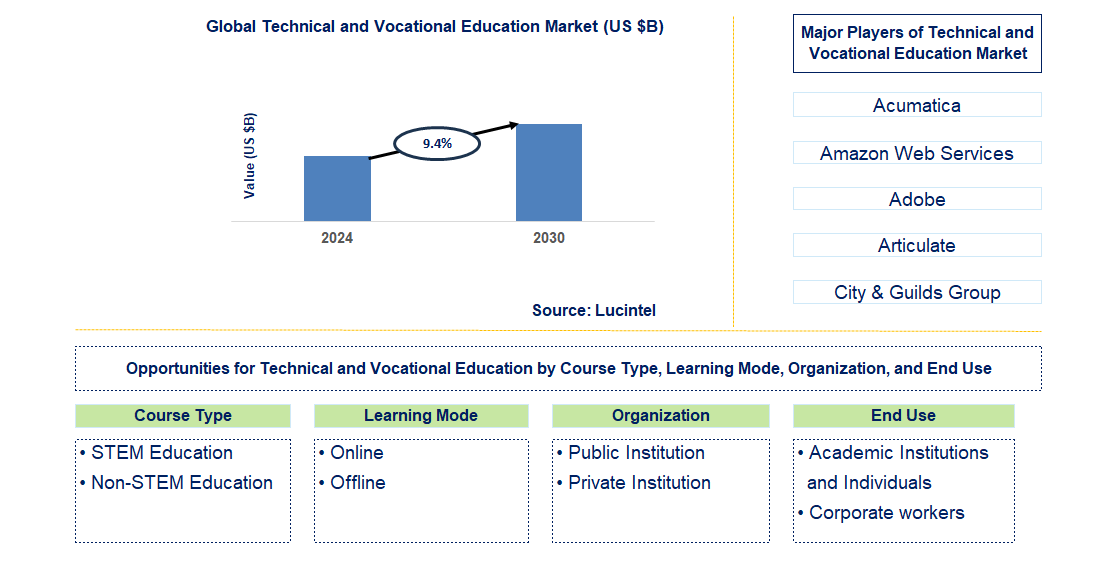
Key data points: The growth forecast = 9.4% annually for the next 6 years. Scroll below to get more insights. This market report covers trends, opportunities, and forecast in the global technical and vocational education market to 2030 by course type (stem education and non-stem education), learning mode (online and offline), organization (public institution and private institution), end use (academic institutions and individuals and corporate workers), and region (North America, Europe, Asia Pacific, and the Rest of the World)
We'll send your sample report shortly.
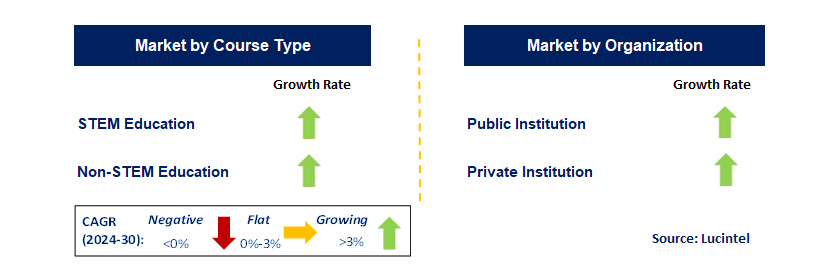
• Lucintel forecasts that, within the course type category, stem education will remain the larger segment over the forecast period.
• Within the organization category, public institutions will remain the larger segment as they provide access to skills for underprivileged, rural areas and bridge the skill gap themselves.
• In terms of regions, Europe will remain the largest region over the forecast period due to rising awareness regarding vocational education in the region. A more than 150-page report is developed to help in your business decisions.
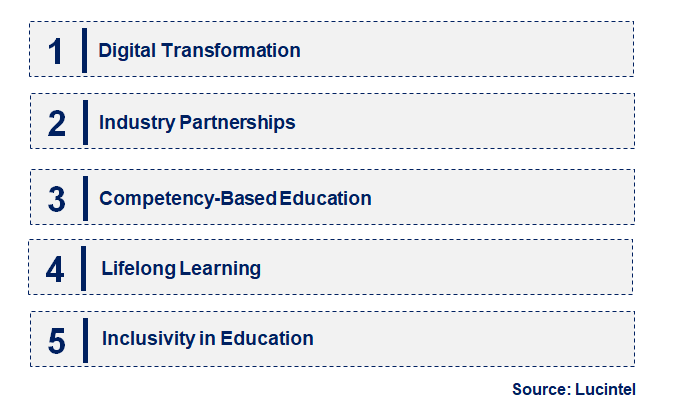
• Digital Transformation: With digital tools and platforms emerging in vocational training, accessibility and engagement are improving. Students can use online learning environments and digital simulations, preparing them for the modern workplace.
• Industry Partnerships: More collaborations between educational institutions and industries are required. These collaborations help align curricula with industrial needs while providing students with relevant skills and making the transition between education and work easier.
• Competency-Based Education: This approach focuses on time on task rather than hours spent in a classroom. It creates personalized learning pathways where students can progress at their own pace, making education more relevant to the needs of industries.
• Lifelong Learning: The fast pace of technology dictates that new skills must be constantly acquired, so continuous upgrades are critical. Education systems have adopted flexible, modular courses suited for working professionals who need to remain competitive in their fields.
• Inclusivity in Education: This trend calls for and implements providing vocational education to a broader audience, including underrepresented demographics. Programs designed for populations that would otherwise be excluded offer fair access to quality training. Together, these changes fuel a more responsive and vibrant technical and vocational education landscape, better positioning learners to face current and future challenges in an ever-changing job marketplace.
• Higher Government Investment: Governments worldwide are investing more in vocational training programs to promote relevance in economic development. These investments support curriculum modernization, infrastructure improvements, and increased student access, especially in marginalized areas.
• Focus on STEM Education: There is a growing emphasis on STEM education within vocational training. This prepares students for high-demand fields that promote innovation and align educational outcomes with market demands, thus enhancing employability.
• Hybrid Models for Adoption: The COVID-19 pandemic introduced hybrid learning models, combining online and offline instruction. Vocational training programs can now reach and educate a larger number of people by offering flexible curriculums, learning styles, and schedules.
• Growing Scale of Apprenticeship Programs: Apprenticeships have become a popular form of work-integrated learning. More countries are expanding these programs to various industries, creating a direct link between education and employment and better preparing workers for jobs.
• International Cooperation in Skills Development: International cooperation is facilitating the exchange of best practices and resources in vocational education. Cross-border joint projects standardize training processes, enabling students to obtain qualifications recognized globally, thereby increasing competitiveness in the labor market. These trends are transforming the technical and vocational education market, making it more versatile and responsive to both local and global human resource needs. Educational institutions are developing reserves to meet future challenges.
• Digital Learning Platforms: E-learning solutions present a huge growth opportunity, as online platforms offer flexible and scalable access to vocational training. These platforms enable institutions to reach more customers and be more responsive to industry needs.
• Tailored Training Solutions: There is an increasing demand for training solutions tailored to specific industry requirements. Bespoke vocational courses improve employability and student satisfaction by offering relevant training that meets employer needs.
• Green Skills Training: With changes in industries, training programs that teach green skills are becoming more important. Curricula focused on renewable energy, sustainable agriculture, and environmental management position institutions at the forefront of an emerging market.
• International Student Recruitment: Due to the global demand for skilled workers, countries can attract international students to vocational programs. Improved marketing strategies and support services can help institutions attract international students and create profitable markets.
• Industry-Funded Programs: Collaboration with the private sector can provide critical funding for training programs. This support enables students to gain hands-on practical experience while keeping training relevant. These collaborations enhance job placement and align educational outcomes with labor market requirements. These growth opportunities signify a shifting landscape within technical and vocational education, offering potential avenues for both educational institutions and students to achieve success.
• Acumatica
• Amazon Web Services
• Adobe
• Articulate
• City & Guilds Group
• TUV Rheinland
• Babcock International Group
• STEM Education
• Non-STEM Education
• Online
• Offline
• Public Institution
• Private Institution
• Academic Institutions and Individuals
• Corporate workers
• North America
• Europe
• Asia Pacific
• The Rest of the World
• United States: The U.S. focus on competency-based education encourages students to progress step-by-step, mastering skills before moving on to the next. The Strengthening Career and Technical Education for the 21st Century Act promotes partnerships between educational institutions and industries to improve job placement rates and ensure curriculum relevancy.
• China: China continues to invest heavily in vocational education reforms as it modernizes curricula and increases business-to-business partnerships. Vocational training is a government priority as they address youth unemployment and skill mismatches with advanced manufacturing and technology industries.
• Germany: Germany remains a leader in dual education systems, which combine classroom learning with on-the-job instruction at companies. Currently, the focus is on digitalization and Industry 4.0 competencies, preparing students for emerging industries while fostering strong employer engagement.
• India: India’s National Education Policy supports vocational education alongside mainstream education. The Skill India program outlines the role of public-private partnerships in skill development, particularly in construction and IT sectors.
• Japan: Japan is updating its vocational training programs to fill labor gaps created by an aging society. New initiatives include lifetime learning and re-training, encouraging workers to develop skills in high technology areas to meet rising industrial demand.


• Acumatica
• Amazon Web Services
• Adobe
• Articulate
• City & Guilds Group
• TUV Rheinland
• Babcock International Group Q5. Which technical and vocational education market segment will be the largest in the future? Answer: Lucintel forecasts that stem education will remain the larger segment over the forecast period. Q6. In the technical and vocational education market, which region is expected to be the largest in the next 5 years? Answer: Europe will remain the largest region over the forecast period due to rising awareness regarding vocational education in the region. Q.7 Do we receive customization in this report? Answer: Yes, Lucintel provides 10% customization without any additional cost.


Choose a license that fits your team. Instant PDF delivery.
Prices exclude taxes. Instant delivery. Custom licensing available on request.
Market Report · July 16, 2026
Market Report · May 18, 2026
Market Report · May 18, 2026
Trusted partner for strategic intelligence and business growth


Receive a complimentary market analysis tailored to your industry. Our analysts will identify key growth opportunities and competitive dynamics specific to your business.

Market size, growth rate, and key trend analysis for your specific sector.

Top competitor positioning and market share analysis.

Strategic recommendations backed by data-driven insights.
Get curated market intelligence and competitive moves straight to your inbox.
By subscribing, you agree to receive our monthly insights. Unsubscribe anytime.
Receive a complimentary market analysis tailored to your industry. Our analysts will identify key growth opportunities and competitive dynamics specific to your business.
Market size, growth rate, and key trend analysis for your specific sector.
Top competitor positioning and market share analysis.
Strategic recommendations backed by data-driven insights.
Get curated market intelligence, emerging trends, and competitive moves straight to your inbox each month.
By subscribing, you agree to receive our monthly insights. Unsubscribe anytime.
We'll send your sample report shortly.