
Market Report · July 22, 2026

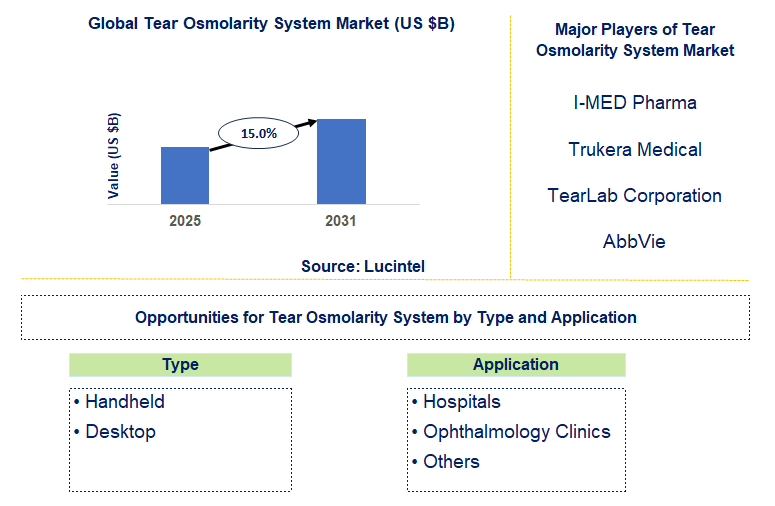
Key data points: The growth forecast = 15% annually for the next 7 years. Scroll below to get more insights. This market report covers trends, opportunities and forecasts in tear osmolarity system market to 2031 by type (handheld and desktop), application (hospitals, ophthalmology clinics, and others), and region (North America, Europe, Asia Pacific, and the Rest of the World)
We'll send your sample report shortly.
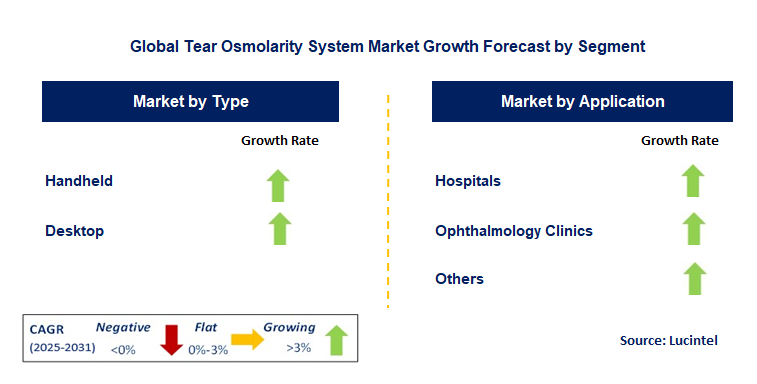
• Lucintel forecasts that, within the type category, handheld is expected to witness higher growth over the forecast period.
• Within the application category, ophthalmology clinic is expected to witness higher growth.
• In terms of region, APAC is expected to witness the highest growth over the forecast period. Gain valuable insights for your business decisions with our comprehensive 150+ page report. Sample figures with some insights are shown below.
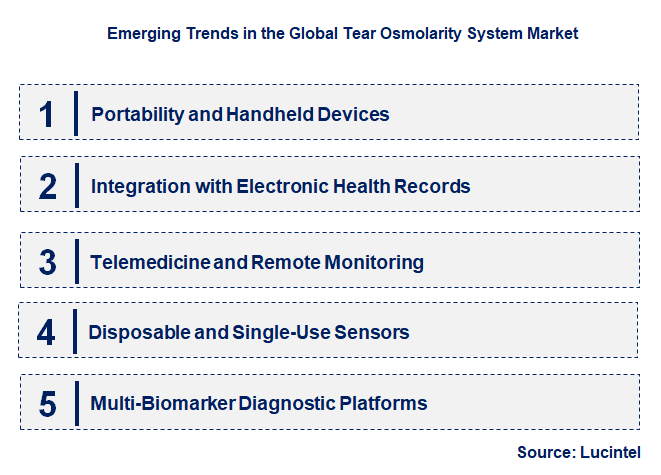
• Portability and Handheld Devices: This trend involves developing compact, battery-operated, handheld tear osmolarity systems. The goal is to move testing from specialized labs to the point of care, such as a doctor's office or even a mobile clinic. The impact is a significant increase in accessibility and convenience. This allows for quick, on-the-spot diagnoses, enabling immediate discussion of results and treatment options with patients.
• Integration with Electronic Health Records: There is a growing focus on developing systems that can wirelessly transmit test results directly to a patient's electronic health record (EHR). This eliminates manual data entry and reduces the risk of human error. The impact is a more streamlined and efficient clinical workflow. It ensures that objective data is a permanent part of the patient's record, enabling better long-term monitoring and personalized treatment plans.
• Telemedicine and Remote Monitoring: This trend involves creating systems that enable remote tear osmolarity testing and data sharing. While not yet widespread, the concept is to allow patients to test at home and send the data to their doctor. The impact is a significant expansion of care beyond the clinic. This technology could enable more frequent monitoring for patients with chronic dry eye, leading to better management of their condition and fewer in-person visits.
• Disposable and Single-Use Sensors: This trend focuses on developing single-use, disposable microfluidic sensors or test cards. These sensors are designed to be used once and then discarded, ensuring sterility and eliminating the need for complex cleaning procedures. The impact is enhanced patient safety and convenience. This design significantly reduces the risk of cross-contamination and simplifies the testing process for healthcare professionals.
• Multi-Biomarker Diagnostic Platforms: This trend involves developing integrated systems that can measure not only tear osmolarity but also other key biomarkers of dry eye disease, such as inflammatory markers like MMP-9. The impact is a more comprehensive diagnostic picture. This provides clinicians with a more complete understanding of a patient's condition, enabling a more targeted and effective treatment strategy. These trends are collectively reshaping the market by transforming tear osmolarity systems from a specialized diagnostic tool into an integrated, efficient, and data-driven component of routine eye care. The focus has shifted to a holistic approach that prioritizes diagnostic accuracy, user convenience, and the seamless integration of technology into the clinical workflow.
• Introduction of Handheld and Portable Devices: The commercial launch of smaller, handheld tear osmolarity systems has been a key development. This allows for testing to be conducted in a wider range of clinical settings, including small optometry practices. The impact is a significant increase in the accessibility of this diagnostic tool, moving it from specialized clinics to the point-of-care.
• Advancements in Microfluidic Technology: Recent developments in microfluidic technology have allowed for the collection and analysis of a minimal tear sample (less than 100 nanoliters). This makes the test less invasive and more comfortable for patients. The impact is a major improvement in the patient experience, which is crucial for encouraging wider adoption of the diagnostic test.
• FDA Clearance for New Systems: The U.S. market has seen recent FDA clearances for new tear osmolarity systems. This regulatory approval provides a strong signal of trust and safety to healthcare providers. The impact is an acceleration of market adoption and a boost in confidence among ophthalmologists and optometrists regarding the clinical utility of the device.
• Use of Impedance Spectroscopy: Many of the new systems are using impedance spectroscopy to measure tear osmolarity. This method is highly accurate and provides rapid results. The impact is a more reliable and efficient diagnostic process. The quantitative, objective data from these systems helps to remove the subjectivity often associated with traditional dry eye tests.
• Strategic Partnerships and Acquisitions: The market is witnessing a trend of major medical device companies forming strategic partnerships with or acquiring smaller, innovative startups. This consolidation allows market leaders to quickly integrate new technologies and expand their product portfolios. The impact is a faster path to market for innovative products and a more concentrated, competitive landscape. These developments are collectively impacting the market by fostering a shift towards a more patient-centric and technology-driven approach to dry eye diagnosis. They are not only improving the quality of the diagnostic data but are also making the process more convenient, accessible, and integrated into modern clinical practice.
• Ophthalmology and Optometry Clinics: This is the largest and most significant growth opportunity. As more ophthalmologists and optometrists recognize tear osmolarity as a "gold standard" for DED diagnosis, the demand for systems in their clinics is soaring. The impact is a focus on developing user-friendly, portable, and reliable systems that can seamlessly integrate into a busy practice.
• Hospitals and Surgical Centers: This application presents a major growth opportunity as hospitals use tear osmolarity to screen patients for DED before cataract and refractive surgeries. Undiagnosed DED can negatively impact surgical outcomes. The impact is a focus on providing high-quality, reliable systems for a high-volume, pre-operative screening environment.
• Clinical Research: This application is a niche but high-growth opportunity. Tear osmolarity systems are crucial for clinical trials of new dry eye therapies, as they provide an objective endpoint for measuring treatment efficacy. The impact is a focus on developing highly accurate, validated systems for a specialized market segment that requires a strong emphasis on data integrity.
• Home-based Monitoring: The trend of home-based care presents a major growth opportunity. The market can grow by providing user-friendly systems for patients to monitor their tear osmolarity at home. The impact is a shift from clinical to consumer-driven products, leading to a broader consumer base and a focus on convenience, privacy, and ease of use.
• Emerging Economies: The markets in China, India, and other emerging economies represent a major growth opportunity. The focus is on providing cost-effective and high-quality tear osmolarity systems to meet the rising demand for eye care. The impact is a long-term growth strategy that requires a strong focus on local manufacturing, accessible pricing, and building a local distribution network. These opportunities are impacting the market by encouraging diversification and specialization. Companies are now able to create products and services that cater to the unique needs of different applications, leading to a more segmented and competitive market that is better equipped to serve the distinct needs of a wide range of patients and healthcare providers.
• I-MED Pharma
• Trukera Medical
• TearLab Corporation
• AbbVie
• Handheld
• Desktop
• Hospitals
• Ophthalmology Clinics
• Others
• North America
• Europe
• Asia Pacific
• The Rest of the World
• United States: The U.S. market is a leader in product innovation, driven by a high volume of DED patients and a well-established healthcare infrastructure. Recent developments include FDA clearance for new portable, handheld systems that offer faster and more efficient testing at the point of care. Favorable reimbursement policies also continue to support the adoption of advanced diagnostic tools.
• China: The Chinese market is experiencing rapid growth, driven by an expanding middle class, rising healthcare expenditure, and a large population with increasing screen time. Recent developments are focused on domestic production of affordable tear osmolarity systems to meet the high demand. There is also a growing emphasis on educating healthcare professionals about the value of objective DED diagnosis.
• Germany: Germany's market is characterized by a strong emphasis on high-quality, precision-engineered medical devices. Key developments include a push for systems with advanced data analytics and integration with electronic health records (EHR). The market is also seeing an increase in R&D for more advanced, non-invasive systems that provide superior accuracy and reliability.
• India: The Indian market is witnessing significant growth, fueled by a large patient pool and improving eye care infrastructure. A key development is the rising demand for affordable diagnostic devices. There is a focus on local manufacturing to reduce costs and make tear osmolarity testing more accessible in a wide range of clinics, including in semi-urban areas.
• Japan: The Japanese market is distinguished by its high adoption of sophisticated medical technologies and a rapidly aging population. Recent developments include the use of miniaturization and advanced materials to create highly portable and easy-to-use systems. The market is also seeing a strong demand for products that are compatible with telemedicine, reflecting a national focus on aging in place and remote patient care.


• I-MED Pharma
• Trukera Medical
• TearLab Corporation
• AbbVie Q5. Which tear osmolarity system market segment will be the largest in future? Answer: Lucintel forecasts that, within the type category, handheld is expected to witness higher growth over the forecast period. Q6. In tear osmolarity system market, which region is expected to be the largest in next 5 years? Answer: In terms of region, APAC is expected to witness the highest growth over the forecast period. Q7. Do we receive customization in this report? Answer: Yes, Lucintel provides 10% customization without any additional cost.


Choose a license that fits your team. Instant PDF delivery.
Prices exclude taxes. Instant delivery. Custom licensing available on request.
Market Report · July 22, 2026
Market Report · July 22, 2026
Market Report · July 22, 2026
Trusted partner for strategic intelligence and business growth


Receive a complimentary market analysis tailored to your industry. Our analysts will identify key growth opportunities and competitive dynamics specific to your business.

Market size, growth rate, and key trend analysis for your specific sector.

Top competitor positioning and market share analysis.

Strategic recommendations backed by data-driven insights.
Get curated market intelligence and competitive moves straight to your inbox.
By subscribing, you agree to receive our monthly insights. Unsubscribe anytime.
Receive a complimentary market analysis tailored to your industry. Our analysts will identify key growth opportunities and competitive dynamics specific to your business.
Market size, growth rate, and key trend analysis for your specific sector.
Top competitor positioning and market share analysis.
Strategic recommendations backed by data-driven insights.
Get curated market intelligence, emerging trends, and competitive moves straight to your inbox each month.
By subscribing, you agree to receive our monthly insights. Unsubscribe anytime.
We'll send your sample report shortly.