
Report Feature
Tactile Sensor Market Trends and Forecast
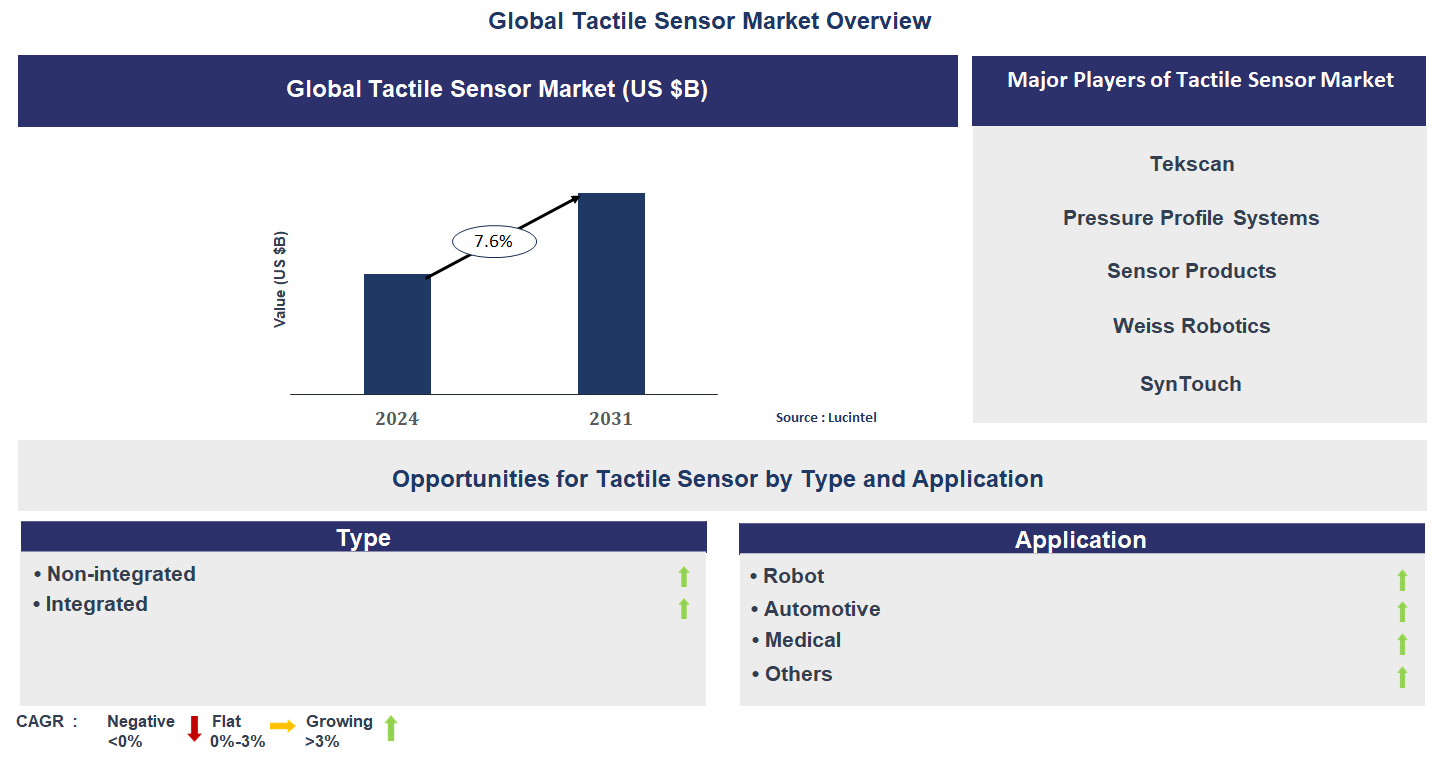
The future of the global tactile sensor market looks promising with opportunities in the robot, automotive, and medical markets. The global tactile sensor market is expected to grow with a CAGR of 7.6% from 2025 to 2031. The major drivers for this market are the increasing demand for touch-sensitive devices, the rising adoption of robotic automation systems, and the growing need for advanced human-machine interfaces.• Lucintel forecasts that, within the type category, integrated is expected to witness higher growth over the forecast period.
• Within the application category, robot is expected to witness the highest growth.
• In terms of region, APAC is expected to witness the highest growth over the forecast period. Gain valuable insights for your business decisions with our comprehensive 150+ page report. Sample figures with some insights are shown below.
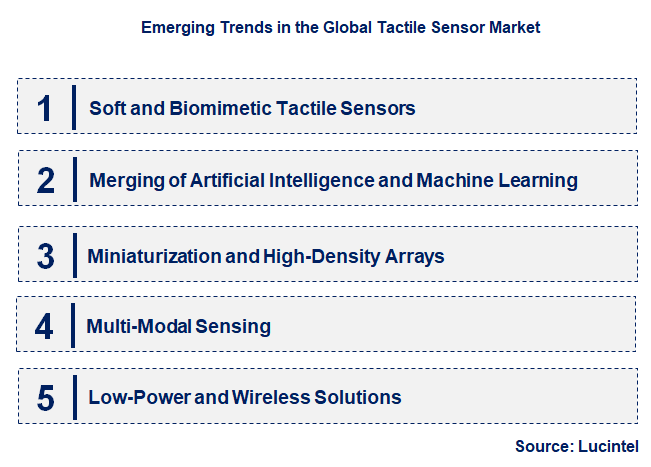
Emerging Trends in the Tactile Sensor Market
The tactile sensor market is being transformed by a number of key emerging trends that are encouraging the industry towards increased technology sophistication and wider application. These trends are a direct reflection of the world’s need for smarter, safer, and more intuitive human-machine interfaces. The industry is breaking away from basic pressure sensing to deliver a rich, multi-dimensional sense of touch. This fundamentally alters how robots, intelligent devices, and all manner of other systems interact with the physical world and is presenting new opportunities for automation and user experience.• Soft and Biomimetic Tactile Sensors: One of the top trends is the creation of biomimetic and soft tactile sensors that can replicate the sensitivity and softness of human skin. The sensors are constructed from soft materials and are programmed to sense a variety of stimuli, such as pressure, shear force, and temperature. The effect is a more flexible and able sensor system, which is needed in applications where robots have to deal gently with humans or work with fragile items.
• Merging of Artificial Intelligence and Machine Learning: A current trend is merging AI and machine learning (ML) for interpreting tactile data. Rather than just gauging pressure, these systems are able to read sophisticated sensor data to identify object shape, texture, and slip. The result is an smarter, more independent system. Artificial intelligence-based tactile sensors can be trained to distinguish between different materials and surfaces, allowing a robot to execute duties that involve a high level of dexterity and flexibility, like sorting fruits and vegetables or executing intricate assembly operations.
• Miniaturization and High-Density Arrays: There is increasing movement towards miniaturization and the development of high-density tactile sensor arrays. This entails reducing the size of each individual sensor element and concentrating them in a limited space to offer an improved resolution sense of touch. The effect is a smaller, more powerful sensor system. This is a crucial trend in applications where there is a lack of space, e.g., on the fingertips of robotic grippers, surgical instruments, or haptic feedback systems in consumer products.
• Multi-Modal Sensing: Another important trend is the creation of multi-modal tactile sensors that are able to sense several different types of stimuli in parallel. It is possible to measure pressure, temperature, and vibration at the same time using these sensors, and give a richer sense of the environment. The effect is a more powerful and adaptive sensor solution. With the ability to offer several data streams, these sensors can be applied to more types of applications, from health diagnostics to sophisticated robotics, where one form of input is not enough to get the job done.
• Low-Power and Wireless Solutions: One of the trends is the creation of wireless and low-power tactile sensor solutions. These sensors are meant to run without a wired link and with low power consumption, making them suitable for mobile and battery-operated devices. The effect is an increased flexibility in design and an increased use area. This trend is essential for the development of wearable electronics, smart fabrics, and a new generation of mobile robots that need a sense of touch but without the drawbacks of wire entanglement or high rates of battery charging. These trends are together transforming the market and making tactile sensors smarter, more sensitive, and integrated into an extremely diverse set of technologies, setting the industry up for substantial future growth.
Recent Development in the Tactile Sensor Market
The market for tactile sensor is experiencing a time of dynamic growth, mirroring a high demand for functional and intelligent sensing solutions on a global level. These advancements are not only stepwise improvements but are actually revolutionizing the face of the industry. There is emphasis on enhancing the accuracy of sensors, bringing their applications to new industries, and developing cheaper ways of manufacturing. This is an important phase for the market as it continues to expand in significance in different industries, ranging from healthcare and robotics to automotive and consumer electronics.• Flexible and Stretchable Materials Advancements: One significant advancement is the achievement of flexible and stretchable materials utilized in tactile sensors, e.g., conductive polymers, graphene, and carbon nanotubes. These materials enable the production of sensors that can wrap around intricate shapes and be repeatedly bent without deteriorating. The result is the possibility to produce electronic skins and wearable sensors that can be placed on robotic hands, human prosthetics, and even on clothing, enabling a new scope of applications that were not before possible.
• Integration with Machine Vision: One of the most important developments is the integration of tactile sensors with machine vision systems. Merging visual information with a sense of touch enables robots to better sense, locate, and manipulate objects. The effect is a more intelligent and durable robotic system capable of accomplishing intricate tasks, such as sorting objects with different textures or picking and placing fragile items on an assembly line. This blending of senses is an important milestone on the way to developing robots capable of functioning with the same dexterity as humans.
• Use in Collaborative Robots (Cobots): Another development that has been recently observed is the growing use of tactile sensors in Cobots. They are employed for detecting human contact and presence, enabling the Cobots to interact with human workers in a safe environment without the support of old-fashioned safety cages. The effect is a secure and more productive factory floor. By giving the robot a sense of touch, tactile sensors allow Cobots to halt or alter their motion when they make contact with an individual, which is vital in order to provide a safe workplace.
• Miniaturization for Medical Devices: One of the significant advancements is the miniaturizing of tactile sensors to be incorporated into medical and surgical tools. These small sensors can be incorporated in catheter tips, graspers used in surgery, and robotic devices to give a surgeon instant feedback about force and pressure. The effect is increased accuracy and safety during surgery. This innovation is most relevant for minimally invasive surgery, where a surgeon has limited touch, and a robotic system with tactile feedback can do a lot to improve patient outcomes.
• High-Resolution Sensor Array Development: One of the major developments is developing high-resolution tactile sensor arrays with a densely distributed set of sensing points. The arrays offer a high-resolution pressure map of an object, which can be employed to recognize its shape, texture, and grip stability. The effect is a more advanced sense of touch that enables robots to carry out sensitive tasks, like lifting an egg or dealing with a soft-fleshed fruit, without damaging them. This is an important development for automation in consumer goods and food industries. These advances are working together to influence the market and make tactile sensors more accurate, flexible, and necessary to a vast number of industries, setting the industry on the path toward a future of essential and widespread use.
Strategic Growth Opportunities in the Tactile Sensor Market
The market for tactile sensor presents many strategic growth opportunities in leading applications based on the growing worldwide need for sophisticated automation and smart systems. Firms that are able to address these opportunities will be well-poised for future success. Opportunities reach into niche areas demanding the singular capabilities of tactile sensors. Strategic growth will arise from the capacity to innovate data analysis, miniaturization, and service provision to address the changing needs of industries.• Advanced Robotics and Automation: One of the important strategic growth opportunities is offering tactile sensor solutions for advanced robotics and automation. This involves creating sensors for industrial robots to carry out assembly and quality control functions that are complex and for service robots to interact with the environment in a more natural way. The payoff is the potential to access a high-margin B2B market that relies on accurate sensor data to enhance efficiency, accuracy, and safety on the factory floor and beyond.
• Medical and Healthcare Devices: The medical and healthcare industry is a significant strategic growth opportunity. There is increasing need for surgical robots, prosthetics, and diagnostic equipment to integrate tactile sensors that stimulate a professional’s sense of touch and offer real-time feedback. The result is a high-revenue, high-stakes market segment where sensor accuracy and reliability are essential to patient safety and positive health outcomes. The market can be leveraged with solutions that pass demanding medical-grade standards.
• Haptic Interfaces and Consumer Electronics: Consumer electronics is a high-growth strategic segment. Consumer electronics have a heightened need for tactile sensors to power smartphones, wearables, and gaming devices to enrich the consumer experience through lifelike haptic feedback and force-sensitive touchscreens. The result is an enormous, consumer-driven market that emphasizes natural and immersive interaction.
• Automotive and Autonomous Vehicles: One of the most important strategic growth areas is the automotive and autonomous vehicle space. Tactile sensors will find applications in infotainment systems for more intuitive interfaces, in seats to monitor drivers, and on the body of a car for impact sensing during minor collisions or contact when parking autonomously. The influence is a huge and high-volume market that is more and more dependent upon sensor data for user experience and safety. Businesses can offer solutions that are reliable and durable for the harsh automotive environment.
• Smart Textiles and Wearables: The wearable and smart textiles market is an emerging strategic growth opportunity. Tactile sensors are suitable for integration into apparel, gloves, and sporting equipment to track pressure distribution, body position, and grip force. The potential is a broad market with the ability to establish new product classes for fitness and health monitoring, physical rehabilitation, and virtual reality. By including a sense of touch in wearable technology, businesses can unleash a new generation of connected and intelligent products. These strategic growth prospects are affecting the market by fueling specialization and innovation. The sector is headed toward a future where customized, high-performance tactile sensor solutions are responsible for success across several, high-impact industries.
Tactile Sensor Market Driver and Challenges
The tactile sensor market is influenced by a combination of strong drivers and major challenges. The drivers are largely a response to world trend towards automation and the demand for smarter systems. The challenges, however, pertain to the technical intricacies of production, cost, and lack of standardization. The long-term success of the markets will depend on how well it is able to utilize its drivers for growth while methodically addressing its challenges. The interaction of these forces will tell us the rate and direction of the industry’s development. The factors responsible for driving the tactile sensor market include: 1. Fast Expansion of Robotics and Automation: The greatest single driver is the growing use of robotics and automation in a wide range of industries. With firms looking for increased efficiency and safety, they are ever more dependent on robots that are capable of doing complex tasks, which implies the sense of touch to manipulate objects and make contact with the world. Tactile sensors are at the forefront of this development. 2. Increasing Need for Human-Machine Interfaces: One of the key drivers is the need for more natural and intuitive human-machine interfaces. Tactile sensors allow devices to sense touch, pressure, and force in a more realistic manner, which improves the user experience in everything from smartphones and gaming consoles to medical devices and prosthetics. 3. Medical Technology Advances: Ongoing development in medical and surgical robotics is a strong propellant. Tactile sensors are required for giving surgeons a sense of touch for minimally invasive surgery, enhancing accuracy and minimizing patient risk. This is driving a strong and steady demand for high-performance, medical-grade sensors. 4. Reduced Size and Better Performance: The constantly evolving trend of reduced size and better performance is a major influencer. The smaller the sensors, more sensitive they become, and the more reliable they are, the more applications they can be integrated into, ranging from wearable electronics to industrial machinery, which is broadening the market and opening new doors. 5. Emphasis on Employee Safety in Manufacturing: One major driver is the increasing emphasis on employee safety in manufacturing environments. Tactile sensor-enabled collaborative robots can work with humans without the necessity of significant safety barriers, which is enhancing efficiency and minimizing the potential for accidents, which is a major selling factor for many types of manufacturers. Challenges in the tactile sensor market are: 1. High Cost of Production: A significant issue is the high production cost of high-performance tactile sensors. The use of specialized materials, intricate fabrication processes, and the requirement for precision engineering may make them very costly, and thus a hindrance to mass adoption in cost-sensitive markets. 2. Technical Sophistication and Robustness: One of the main challenges is technical sophistication and robustness, particularly in sensors developed from flexible materials. Providing sensors with the ability to handle repeated usage, withstand environmental damage, and retain their accuracy over a period of time is a serious engineering challenge that their developers are continually trying to address. 3. Absence of Standardization: There is a serious lack of global standards for performance metrics and tactile sensor data, which is a major issue. This creates a problem for various systems and manufacturers to talk to one another and can create a barrier to the general adoption of the technology because so much custom integration effort is needed. In summary, the market for tactile sensors is led by strong forces of automation and user interface design. But it has to prevail over issues concerning production cost, technical complexity, and a lack of standardization to reach its full potential. The future success of the industry will be driven by whether it can offer solutions that are not only high-performance but also cost-effective, rugged, and compatible for more applications.List of Tactile Sensor Companies
Companies in the market compete on the basis of product quality offered. Major players in this market focus on expanding their manufacturing facilities, R&D investments, infrastructural development, and leverage integration opportunities across the value chain. With these strategies tactile sensor companies cater increasing demand, ensure competitive effectiveness, develop innovative products & technologies, reduce production costs, and expand their customer base. Some of the tactile sensor companies profiled in this report include-• Tekscan
• Pressure Profile Systems
• Sensor Products
• Weiss Robotics
• SynTouch
Tactile Sensor Market by Segment
The study includes a forecast for the global tactile sensor market by type, application, and region.Tactile Sensor Market by Type [Value from 2019 to 2031]:
• Non-integrated
• Integrated
Tactile Sensor Market by Application [Value from 2019 to 2031]:
• Robot
• Automotive
• Medical
• Others
Tactile Sensor Market by Region [Value from 2019 to 2031]:
• North America
• Europe
• Asia Pacific
• The Rest of the World
Country Wise Outlook for the Tactile Sensor Market
The tactile sensor market is in a phase of substantial and fast development, fueled by the growing connectivity of robotic and intelligent systems in various industries. Tactile sensors, which provide machines with a sense of touch, are no longer a niche technology but are increasingly emerging as a key element for precision, safety, and human-machine interaction. Emerging developments focus on enhancing sensor materials and production, miniaturization, and the use of artificial intelligence to interpret data. This development is radically transforming how robots and other devices interact with the physical world and is empowering new uses in healthcare, consumer electronics, and industrial automation.• United States: In the US, emerging developments are prompted by heavy investment in robotics and advanced manufacturing. There is emphasis placed on high-resolution tactile sensor arrays for use in robotic surgical instruments and prosthetics. One of the main advancements is the creation of flexible, stretchable electronic skins that can be implemented on robotic hands to gain a sense of touch for fine manipulation tasks. The market also is experiencing growth in university spin-offs and startups that are commercializing novel tactile sensor technologies, usually in partnership with leading tech companies to create next-gen human-machine interfaces.
• China: The market for China’s tactile sensors is growing explosively, driven by fast industrial automation and a red-hot consumer electronics market. Current advances are aimed at mass production and low-cost manufacturing of sensor elements. There is a robust government drive to develop the robotics sector, and as a result, there is huge demand for tactile sensors for industrial robots as well as collaborative robots. One of the significant developments is significant investment in research and development of flexible and wearable tactile sensors that can be used in smart devices to provide haptic feedback and improve user experience.
• Germany: Germany’s market is one of high-precision engineering and industrial automation. Current trends are centered around high-quality, heavy-duty, and reliable tactile sensors for applications in next-generation manufacturing and automotive systems. The demand is increasing for sensors capable of withstanding aggressive industrial environments and delivering high-accuracy feedback for quality control and robotic assembly. German makers lead the way in creating tactile sensor systems built into industrial robots to perform tasks that need to be sensed with force and pressure, thereby ensuring efficiency and safety on the shop floor.
• India: The Indian tactile sensor market is in an early but high-growth stage, stimulated by the growth of its manufacturing and healthcare industries. Current developments center on delivering cost-effective and capable sensor solutions for an expanding domestic market. Tactile sensors for medical instruments and surgical instruments are in increasing demand. The industry is witnessing increased collaborations between local producers and international technology companies to enhance the ability to produce and widen the scope of applications, making India the leading force behind low-cost high-performance sensing.
• Japan: Japan boasts a mature and very innovative tactile sensor market, with innovation stimulated by its global leadership in robotics and consumer electronics. Most recent advances are focused on biomimetic sensors that replicate human skin and on advanced multi-modal sensing. Japan is at the forefront of advancing tactile sensors for humanoid and service robots that can undertake sophisticated tasks, like care for the elderly or handling fragile objects. The market also is heavily emphasized on sensor miniaturization and integration into high-end consumer electronics, bettering user experience in smart devices and gaming.

Features of the Global Tactile Sensor Market
Market Size Estimates: Tactile sensor market size estimation in terms of value ($B). Trend and Forecast Analysis: Market trends (2019 to 2024) and forecast (2025 to 2031) by various segments and regions. Segmentation Analysis: Tactile sensor market size by type, application, and region in terms of value ($B). Regional Analysis: Tactile sensor market breakdown by North America, Europe, Asia Pacific, and Rest of the World. Growth Opportunities: Analysis of growth opportunities in different types, applications, and regions for the tactile sensor market. Strategic Analysis: This includes M&A, new product development, and competitive landscape of the tactile sensor market. Analysis of competitive intensity of the industry based on Porter’s Five Forces model.
FAQ
Q1. What is the growth forecast for tactile sensor market? Answer: The global tactile sensor market is expected to grow with a CAGR of 7.6% from 2025 to 2031. Q2. What are the major drivers influencing the growth of the tactile sensor market? Answer: The major drivers for this market are the increasing demand for touch-sensitive devices, the rising adoption of robotic automation systems, and the growing need for advanced human-machine interfaces. Q3. What are the major segments for tactile sensor market? Answer: The future of the tactile sensor market looks promising with opportunities in the robot, automotive, and medical markets. Q4. Who are the key tactile sensor market companies? Answer: Some of the key tactile sensor companies are as follows:• Tekscan
• Pressure Profile Systems
• Sensor Products
• Weiss Robotics
• SynTouch Q5. Which tactile sensor market segment will be the largest in future? Answer: Lucintel forecasts that, within the type category, integrated is expected to witness higher growth over the forecast period. Q6. In tactile sensor market, which region is expected to be the largest in next 5 years? Answer: In terms of region, APAC is expected to witness the highest growth over the forecast period. Q7. Do we receive customization in this report? Answer: Yes, Lucintel provides 10% customization without any additional cost.
Table of Contents
List of Figures
List of Tables
Methodology
- In-depth interviews of the major players in this market
- Detailed secondary research from competitors’ financial statements and published data
- Extensive searches of published works, market, and database information pertaining to industry news, company press releases, and customer intentions
- A compilation of the experiences, judgments, and insights of Lucintel’s professionals, who have analyzed and tracked this market over the years.


Buy Now
Choose a license that fits your team. Instant PDF delivery.
Prices exclude taxes. Instant delivery. Custom licensing available on request.
Key Questions
- • What are some of the most promising, high-growth opportunities for the tactile sensor market by type (non-integrated and integrated), application (robot, automotive, medical, and others), and region (North America, Europe, Asia Pacific, and the Rest of the World)?
- • Which segments will grow at a faster pace and why?
- • Which region will grow at a faster pace and why?
- • What are the key factors affecting market dynamics? What are the key challenges and business risks in this market?
- • What are the business risks and competitive threats in this market?
- • What are the emerging trends in this market and the reasons behind them?
- • What are some of the changing demands of customers in the market?
- • What are the new developments in the market? Which companies are leading these developments?
- • Who are the major players in this market? What strategic initiatives are key players pursuing for business growth?
- • What are some of the competing products in this market and how big of a threat do they pose for loss of market share by material or product substitution?
- • What M&A activity has occurred in the last 5 years and what has its impact been on the industry? For any questions related to Tactile Sensor Market, Tactile Sensor Market Size, Tactile Sensor Market Growth, Tactile Sensor Market Analysis, Tactile Sensor Market Report, Tactile Sensor Market Share, Tactile Sensor Market Trends, Tactile Sensor Market Forecast, Tactile Sensor Companies, write Lucintel analyst at email: helpdesk@lucintel.com. We will be glad to get back to you soon.


