
Report Feature
Surveillance Drone Market Trends and Forecast
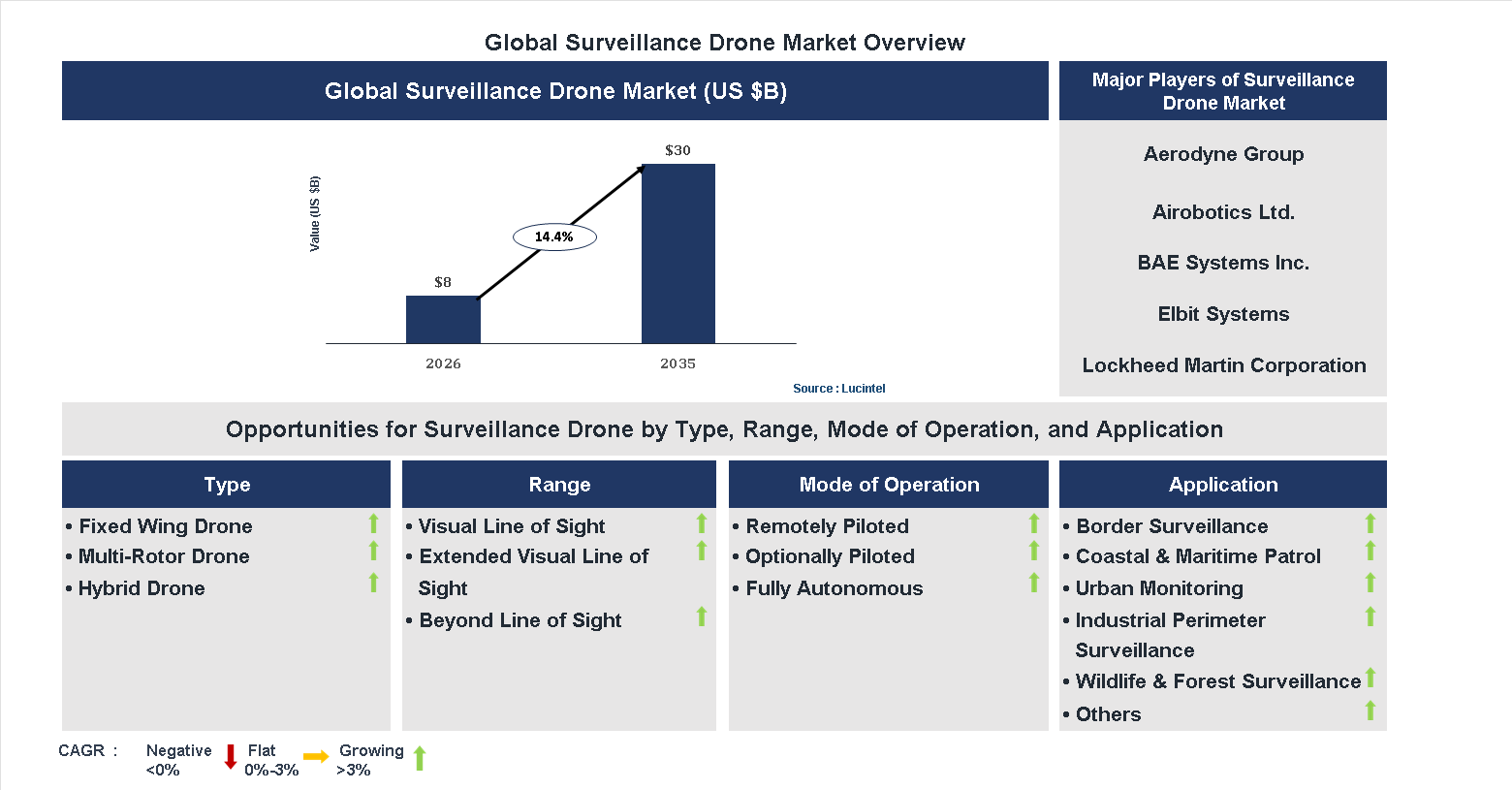
The future of the global surveillance drone market looks promising with opportunities in the border surveillance, coastal & maritime patrol, urban monitoring, industrial perimeter surveillance, and wildlife & forest surveillance markets. The global surveillance drone market is expected to reach an estimated $30 billion by 2035 with a CAGR of 14.4% from 2026 to 2035. The major drivers for this market are the increasing demand for security surveillance solutions, the rising adoption of drones in defense, and the growing use in commercial monitoring applications.• Lucintel forecasts that, within the type category, multi-rotor drone is expected to witness the highest growth over the forecast period.
• Within the application category, border surveillance is expected to witness the highest growth.
• In terms of region, North America is expected to witness the highest growth over the forecast period. Gain valuable insights for your business decisions with our comprehensive 150+ page report. Sample figures with some insights are shown below.
Emerging Trends in the Surveillance Drone Market
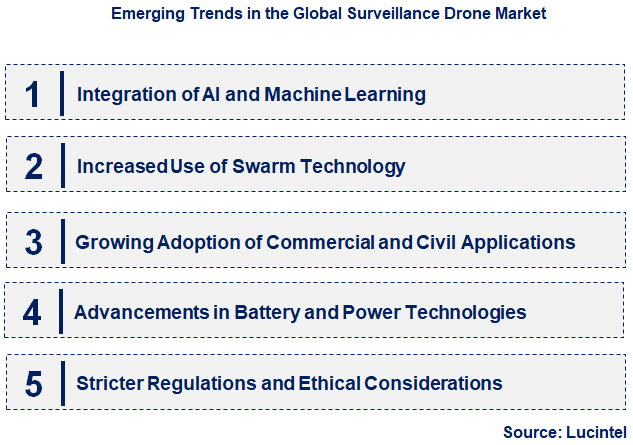
The surveillance drone market is experiencing rapid growth driven by technological advancements, increasing demand for security, and expanding applications across various sectors. As industries and governments seek more efficient, cost-effective, and versatile surveillance solutions, emerging trends are shaping the future landscape of this market. These developments are not only enhancing operational capabilities but also redefining regulatory and ethical considerations. Understanding these key trends is essential for stakeholders aiming to capitalize on opportunities and navigate challenges in this evolving environment. The following five trends highlight the most significant shifts currently influencing the surveillance drone market.• Integration of AI and Machine Learning: The incorporation of AI and machine learning algorithms into surveillance drones is revolutionizing data processing and analysis. These technologies enable real-time object detection, facial recognition, and predictive analytics, significantly improving accuracy and response times. AI-powered drones can autonomously identify threats, track targets, and adapt to changing environments without human intervention. This trend enhances operational efficiency, reduces manpower costs, and opens new possibilities for complex surveillance tasks across security, law enforcement, and military sectors.
• Increased Use of Swarm Technology: Swarm technology involves deploying multiple drones that operate collaboratively to cover larger areas and perform complex tasks. This trend allows for scalable, flexible, and resilient surveillance systems capable of functioning even if individual units fail. Swarm drones can coordinate to monitor large events, conduct search and rescue missions, or provide persistent surveillance in high-risk zones. The development of communication protocols and decentralized control systems is critical to this trend, which promises to significantly enhance coverage, redundancy, and operational effectiveness.
• Growing Adoption of Commercial and Civil Applications: Beyond military and defense, surveillance drones are increasingly being adopted in commercial and civil sectors. Industries such as agriculture, infrastructure inspection, disaster management, and environmental monitoring are leveraging drone technology for cost-effective, high-resolution data collection. This diversification broadens the market scope, stimulates innovation, and drives demand for specialized drone models tailored to specific applications. As regulatory frameworks evolve, civil use cases are expected to expand further, making surveillance drones more accessible and versatile.
• Advancements in Battery and Power Technologies: Improvements in battery life and power management are enabling longer flight durations and enhanced operational capabilities for surveillance drones. Innovations such as high-capacity batteries, solar-powered systems, and energy-efficient motors extend mission times and reduce downtime. These advancements are crucial for applications requiring persistent surveillance, such as border monitoring or large-scale infrastructure inspection. Enhanced power solutions also facilitate the deployment of heavier payloads, including advanced sensors and communication equipment, thereby expanding the functional scope of surveillance drones.
• Stricter Regulations and Ethical Considerations: As drone usage proliferates, governments and regulatory bodies are implementing stricter rules concerning privacy, airspace management, and safety standards. This trend influences market dynamics by necessitating compliance measures, certification processes, and operational limitations. Ethical concerns related to surveillance, data security, and civil liberties are prompting discussions and policy development. While regulation may pose challenges, it also encourages innovation in privacy-preserving technologies and responsible drone deployment, shaping a more sustainable and socially acceptable market environment. These emerging trends are fundamentally transforming the surveillance drone market by enhancing technological capabilities, expanding application areas, and fostering responsible usage. They are driving increased adoption, improving operational efficiency, and prompting regulatory evolution, ultimately reshaping the landscape into a more sophisticated, versatile, and ethically conscious industry.
Recent Development in the Surveillance Drone Market
The surveillance drone market has experienced rapid growth driven by technological advancements, increasing security concerns, and expanding applications across various sectors. As governments and private organizations seek efficient, cost-effective solutions for monitoring and data collection, the market is poised for significant development. Innovations in drone technology, regulatory adaptations, and integration with AI are shaping the future landscape. These developments are creating new opportunities, enhancing operational capabilities, and expanding market reach, ultimately transforming surveillance practices worldwide.• Technological Advancements in Drone Capabilities: Enhanced sensors, longer flight times, and improved stability are expanding surveillance efficiency. These innovations enable drones to cover larger areas with higher precision, making them indispensable for security, agriculture, and disaster management. As technology progresses, costs decrease, and accessibility increases, fostering broader adoption across sectors. This growth boosts market size, encourages new entrants, and accelerates the deployment of advanced surveillance solutions globally.
• Integration of Artificial Intelligence and Data Analytics: AI integration allows drones to analyze data in real-time, identify anomalies, and make autonomous decisions. This capability significantly improves response times and operational accuracy, especially in security and military applications. The ability to process vast data sets enhances situational awareness and reduces human oversight. As AI becomes more sophisticated, the market will see increased demand for intelligent surveillance systems, driving innovation and expanding application scope.
• Regulatory Frameworks and Policy Developments: Governments worldwide are establishing clearer regulations for drone operations, balancing safety with innovation. These policies facilitate legal commercial use, encourage investment, and promote standardization. Evolving regulations reduce operational risks and foster market confidence. As regulatory environments mature, more organizations will adopt drone surveillance solutions, leading to market expansion and increased integration into public safety and commercial sectors.
• Growing Demand in Commercial and Public Sectors: Security agencies, infrastructure, agriculture, and disaster response are increasingly adopting surveillance drones for their efficiency and cost-effectiveness. The ability to access hard-to-reach areas and gather real-time data enhances decision-making processes. This rising demand is driving market growth, encouraging product diversification, and fostering partnerships between drone manufacturers and end-users. The expanding application base is broadening market opportunities and accelerating industry development.
• Innovations in Drone Design and Payload Technologies: New lightweight materials, modular payloads, and advanced cameras are improving drone performance and versatility. These innovations enable customized solutions for specific surveillance needs, from high-resolution imaging to thermal sensing. Enhanced payload capabilities extend operational range and data quality. As design innovations continue, the market will see increased adoption of specialized drones, fostering competitive differentiation and opening new revenue streams for manufacturers. The surveillance drone market's rapid evolution, driven by technological, regulatory, and application-based developments, is significantly impacting the industry landscape. These opportunities are expanding market size, improving operational efficiency, and fostering innovation. As a result, the market is poised for sustained growth, with increased adoption across diverse sectors, ultimately transforming surveillance practices and enhancing security and data collection capabilities worldwide.
Strategic Growth Opportunities in the Surveillance Drone Market
The surveillance drone market is experiencing rapid expansion driven by technological advancements, increasing security concerns, and diverse application needs across sectors such as defense, law enforcement, agriculture, and infrastructure. Growing demand for real-time data collection, improved flight capabilities, and autonomous operations are fueling innovation and market penetration. Strategic growth opportunities are emerging as companies and governments seek cost-effective, efficient, and versatile drone solutions to enhance surveillance, safety, and operational efficiency in various environments worldwide.• Integration of AI and Machine Learning for Enhanced Data Analysis: Incorporating AI and ML into surveillance drones enables real-time image processing, object recognition, and predictive analytics. This advancement improves accuracy, reduces human oversight, and allows autonomous decision-making. As AI technology becomes more accessible, drones can perform complex surveillance tasks, identify threats faster, and adapt to dynamic environments, creating significant growth opportunities in security, disaster management, and border control sectors.
• Expansion into Commercial and Civil Applications: Beyond defense, surveillance drones are increasingly adopted in agriculture, infrastructure inspection, environmental monitoring, and disaster response. These applications benefit from high-resolution imaging, thermal sensing, and data collection capabilities. As regulatory frameworks evolve and technology becomes more affordable, commercial sectors are expected to invest heavily in drone solutions, opening new markets and driving diversification of revenue streams for manufacturers.
• Development of Longer Flight Time and Enhanced Payload Capabilities: Improving battery technology and power management systems allows drones to fly longer distances and carry heavier payloads. This capability is crucial for large-scale surveillance operations, extended monitoring, and complex data collection tasks. Innovations in energy efficiency and hybrid power systems will enable drones to operate in remote or challenging environments, expanding their utility and market reach significantly.
• Adoption of Swarm Technology for Coordinated Surveillance: Swarm technology enables multiple drones to operate collaboratively, covering larger areas efficiently and with redundancy. This approach enhances surveillance coverage, reduces response times, and improves resilience against failures. Advances in communication protocols and autonomous coordination algorithms are making drone swarms more feasible, especially for military, border security, and large infrastructure monitoring, representing a transformative growth avenue in the market.
• Increasing Focus on Regulatory Frameworks and Standardization: As drone usage proliferates, establishing comprehensive regulations and standards is vital for safe and legal operations. Governments and industry bodies are working to develop policies that facilitate commercial deployment while ensuring safety and privacy. Clear regulatory pathways will encourage investment, innovation, and market expansion, providing a stable environment for growth and fostering trust among users and stakeholders. The overall market growth will be significantly influenced by these opportunities, fostering innovation, expanding application scope, and enabling more efficient, autonomous, and reliable surveillance solutions across multiple sectors worldwide.
Surveillance Drone Market Driver and Challenges
The surveillance drone market is influenced by a variety of technological, economic, and regulatory factors that shape its growth trajectory. Advances in drone technology, such as improved battery life, enhanced sensors, and autonomous capabilities, are expanding application possibilities across sectors like security, agriculture, and infrastructure inspection. Economic factors, including decreasing manufacturing costs and increasing demand from government and commercial sectors, further propel market expansion. However, regulatory challenges related to airspace restrictions, privacy concerns, and safety standards pose significant hurdles. Balancing innovation with compliance is crucial for sustainable growth. Overall, these drivers and challenges collectively determine the market's evolution, influencing investment, innovation, and adoption rates. The factors responsible for driving the surveillance drone market include:• Technological Advancements: The rapid development of drone technology, including longer battery life, high-resolution cameras, and autonomous flight capabilities, has significantly expanded the scope of surveillance applications. These innovations enable drones to operate more efficiently, cover larger areas, and provide real-time data, making them indispensable for security, disaster management, and infrastructure monitoring. As technology continues to evolve, the market is expected to see increased adoption and new use cases, fueling growth and competition among manufacturers.
• Increasing Security and Defense Spending: Governments worldwide are investing heavily in surveillance and defense systems to enhance national security. Drones offer a cost-effective, flexible, and scalable solution for border patrol, military reconnaissance, and urban surveillance. Rising defense budgets and strategic priorities are driving demand for advanced surveillance drones, fostering innovation and expanding market opportunities across military and homeland security sectors.
• Growing Commercial and Industrial Applications: The expanding use of surveillance drones in agriculture, construction, oil and gas, and infrastructure inspection is a major growth driver. These drones facilitate efficient monitoring, data collection, and analysis, reducing operational costs and improving safety. As industries recognize the benefits of drone-based surveillance, investments increase, and new business models emerge, further propelling market expansion.
• Regulatory Developments and Support: Progressive regulatory frameworks and government initiatives aimed at integrating drones into national airspace are facilitating market growth. Policies that promote drone testing, certification, and commercial use help reduce barriers to entry. Supportive regulations encourage innovation, attract investments, and enable broader adoption of surveillance drones across various sectors. The challenges facing the surveillance drone market include:
• Regulatory and Legal Barriers: Strict airspace regulations, privacy laws, and safety standards pose significant challenges to drone deployment. Navigating complex legal frameworks varies across regions, often leading to restrictions on flight zones, altitude limits, and data collection. These barriers hinder rapid deployment, increase compliance costs, and slow down market growth, especially in densely populated areas where privacy concerns are heightened.
• Privacy and Ethical Concerns: The widespread use of surveillance drones raises serious privacy issues, leading to public apprehension and resistance. Unauthorized data collection and potential misuse of surveillance footage can result in legal disputes and reputational damage for operators. Addressing these concerns requires robust data protection policies and transparent operational practices, which can be resource-intensive and impact market expansion.
• Technological and Operational Limitations: Despite advancements, drones still face challenges related to limited flight time, payload capacity, and susceptibility to weather conditions. These technical limitations restrict operational efficiency and reliability, especially in complex or adverse environments. Overcoming these hurdles requires ongoing research and development, which involves significant investment and time, potentially delaying market growth. The surveillance drone market is driven by technological innovations, increased security spending, expanding industrial applications, and supportive regulations. However, regulatory complexities, privacy issues, and technical limitations present notable challenges. The interplay of these factors will shape the market’s future, requiring stakeholders to innovate responsibly and navigate legal landscapes carefully. Overall, the market's growth potential remains strong, provided that technological and regulatory hurdles are effectively managed.
List of Surveillance Drone Companies
Companies in the market compete on the basis of product quality offered. Major players in this market focus on expanding their manufacturing facilities, R&D investments, infrastructural development, and leverage integration opportunities across the value chain. With these strategies surveillance drone companies cater increasing demand, ensure competitive effectiveness, develop innovative products & technologies, reduce production costs, and expand their customer base. Some of the surveillance drone companies profiled in this report include-• Aerodyne Group
• Airobotics Ltd.
• BAE Systems Inc.
• Elbit Systems
• Lockheed Martin Corporation
• Thales Group
• FLIR Systems
• Teledyne FLIR
• Raytheon Technologies
• Leonardo S.p.A.
Surveillance Drone Market by Segment
The study includes a forecast for the global surveillance drone market by type, range, mode of operation, application, and region.Surveillance Drone Market by Type [Value from 2019 to 2035]:
• Fixed Wing Drone
• Multi-Rotor Drone
• Hybrid Drone
Surveillance Drone Market by Range [Value from 2019 to 2035]:
• Visual Line of Sight
• Extended Visual Line of Sight
• Beyond Line of Sight
Surveillance Drone Market by Mode of Operation [Value from 2019 to 2035]:
• Remotely Piloted
• Optionally Piloted
• Fully Autonomous
Surveillance Drone Market by Application [Value from 2019 to 2035]:
• Border Surveillance
• Coastal & Maritime Patrol
• Urban Monitoring
• Industrial Perimeter Surveillance
• Wildlife & Forest Surveillance
• Others
Surveillance Drone Market by Region [Value from 2019 to 2035]:
• North America
• Europe
• Asia Pacific
• The Rest of the World
Country Wise Outlook for the Surveillance Drone Market
The surveillance drone market has experienced rapid growth driven by technological advancements, increasing security concerns, and expanding applications across various sectors. Governments and private entities are investing heavily in drone technology to enhance surveillance capabilities, improve safety, and support military and civilian operations. Regulatory frameworks are evolving to accommodate this growth, balancing innovation with privacy and security considerations. As the market matures, countries are focusing on developing more sophisticated, autonomous, and longer-endurance drones. The following summaries highlight recent developments in the surveillance drone market for the United States, China, Germany, India, and Japan.• United States: The US has seen significant advancements in autonomous drone technology, with increased integration into military and law enforcement operations. Major defense contractors are developing high-end, long-range surveillance drones equipped with AI and advanced sensors. Regulatory agencies are working on frameworks to facilitate commercial drone use while ensuring security. The US government is also investing in counter-drone technologies to mitigate potential threats from hostile drones. Private sector innovation continues to drive market growth, with startups developing specialized surveillance solutions for various industries.
• China: China has rapidly expanded its surveillance drone capabilities, focusing on both military and civilian applications. The country has developed a range of high-end drones with enhanced endurance, payload capacity, and AI-driven analytics. Chinese firms are actively exporting surveillance drones to international markets, strengthening their global presence. Domestic regulations are evolving to support commercial drone deployment, especially in urban surveillance and infrastructure monitoring. China’s government emphasizes technological self-reliance, investing heavily in research and development to maintain its competitive edge in drone technology.
• Germany: Germany is emphasizing the integration of surveillance drones within its security and infrastructure sectors. Recent developments include the deployment of drones for border security, disaster management, and urban surveillance. The country is also focusing on establishing robust regulatory standards to ensure safe and privacy-compliant drone operations. German companies are innovating in sensor technology and data processing to enhance drone effectiveness. Collaboration between government agencies and private firms is fostering the development of sophisticated, reliable surveillance drone systems tailored to European security needs.
• India: India has seen a surge in surveillance drone adoption for border security, disaster response, and urban surveillance. The government has launched initiatives to promote indigenous drone manufacturing, reducing reliance on imports. Recent developments include the deployment of drones for monitoring sensitive areas and supporting military operations along borders. Regulatory reforms are underway to streamline drone registration and operation procedures. Indian startups and defense organizations are investing in developing affordable, high-performance surveillance drones to address domestic security challenges and expand export potential.
• Japan: Japan is focusing on integrating surveillance drones into disaster management, urban security, and infrastructure inspection. Recent advancements include the deployment of drones for monitoring earthquake-prone areas and maintaining critical infrastructure. The country emphasizes safety standards and privacy regulations to facilitate drone operations. Japanese firms are innovating in sensor technology and autonomous navigation systems. Collaboration between government agencies and private companies is fostering the development of reliable, high-precision surveillance drones suited to Japan’s unique security and environmental needs.

Features of the Global Surveillance Drone Market
Market Size Estimates: Surveillance drone market size estimation in terms of value ($B). Trend and Forecast Analysis: Market trends (2019 to 2025) and forecast (2026 to 2035) by various segments and regions. Segmentation Analysis: Surveillance drone market size by various segments, such as by type, range, mode of operation, application, and region in terms of value ($B). Regional Analysis: Surveillance drone market breakdown by North America, Europe, Asia Pacific, and Rest of the World. Growth Opportunities: Analysis of growth opportunities in different types, range, modes of operation, applications, and regions for the surveillance drone market. Strategic Analysis: This includes M&A, new product development, and competitive landscape of the surveillance drone market. Analysis of competitive intensity of the industry based on Porter’s Five Forces model.
FAQ
Q1. What is the surveillance drone market size? Answer: The global surveillance drone market is expected to reach an estimated $30 billion by 2035. Q2. What is the growth forecast for surveillance drone market? Answer: The global surveillance drone market is expected to grow with a CAGR of 14.4% from 2026 to 2035. Q3. What are the major drivers influencing the growth of the surveillance drone market? Answer: The major drivers for this market are the increasing demand for security surveillance solutions, the rising adoption of drones in defense, and the growing use in commercial monitoring applications. Q4. What are the major segments for surveillance drone market? Answer: The future of the surveillance drone market looks promising with opportunities in the border surveillance, coastal & maritime patrol, urban monitoring, industrial perimeter surveillance, and wildlife & forest surveillance markets. Q5. Who are the key surveillance drone market companies? Answer: Some of the key surveillance drone companies are as follows:• Aerodyne Group
• Airobotics Ltd.
• BAE Systems Inc.
• Elbit Systems
• Lockheed Martin Corporation
• Thales Group
• FLIR Systems
• Teledyne FLIR
• Raytheon Technologies
• Leonardo S.p.A. Q6. Which surveillance drone market segment will be the largest in future? Answer: Lucintel forecasts that, within the type category, multi-rotor drone is expected to witness the highest growth over the forecast period. Q7. In surveillance drone market, which region is expected to be the largest in next 8 years? Answer: In terms of region, North America is expected to witness the highest growth over the forecast period. Q8. Do we receive customization in this report? Answer: Yes, Lucintel provides 10% customization without any additional cost.
Table of Contents
List of Figures
List of Tables
Methodology
- In-depth interviews of the major players in this market
- Detailed secondary research from competitors’ financial statements and published data
- Extensive searches of published works, market, and database information pertaining to industry news, company press releases, and customer intentions
- A compilation of the experiences, judgments, and insights of Lucintel’s professionals, who have analyzed and tracked this market over the years.


Buy Now
Choose a license that fits your team. Instant PDF delivery.
Prices exclude taxes. Instant delivery. Custom licensing available on request.
Key Questions
- • What are some of the most promising, high-growth opportunities for the surveillance drone market by type (fixed wing drone, multi-rotor drone, and hybrid drone), range (visual line of sight, extended visual line of sight, and beyond line of sight), mode of operation (remotely piloted, optionally piloted, and fully autonomous), application (border surveillance, coastal & maritime patrol, urban monitoring, industrial perimeter surveillance, wildlife & forest surveillance, and others), and region (North America, Europe, Asia Pacific, and the Rest of the World)?
- • Which segments will grow at a faster pace and why?
- • Which region will grow at a faster pace and why?
- • What are the key factors affecting market dynamics? What are the key challenges and business risks in this market?
- • What are the business risks and competitive threats in this market?
- • What are the emerging trends in this market and the reasons behind them?
- • What are some of the changing demands of customers in the market?
- • What are the new developments in the market? Which companies are leading these developments?
- • Who are the major players in this market? What strategic initiatives are key players pursuing for business growth?
- • What are some of the competing products in this market and how big of a threat do they pose for loss of market share by material or product substitution?
- • What M&A activity has occurred in the last 7 years and what has its impact been on the industry? For any questions related to Surveillance Drone Market, Surveillance Drone Market Size, Surveillance Drone Market Growth, Surveillance Drone Market Analysis, Surveillance Drone Market Report, Surveillance Drone Market Share, Surveillance Drone Market Trends, Surveillance Drone Market Forecast, Surveillance Drone Companies, write Lucintel analyst at email: helpdesk@lucintel.com. We will be glad to get back to you soon.


