
Market Report · July 31, 2026

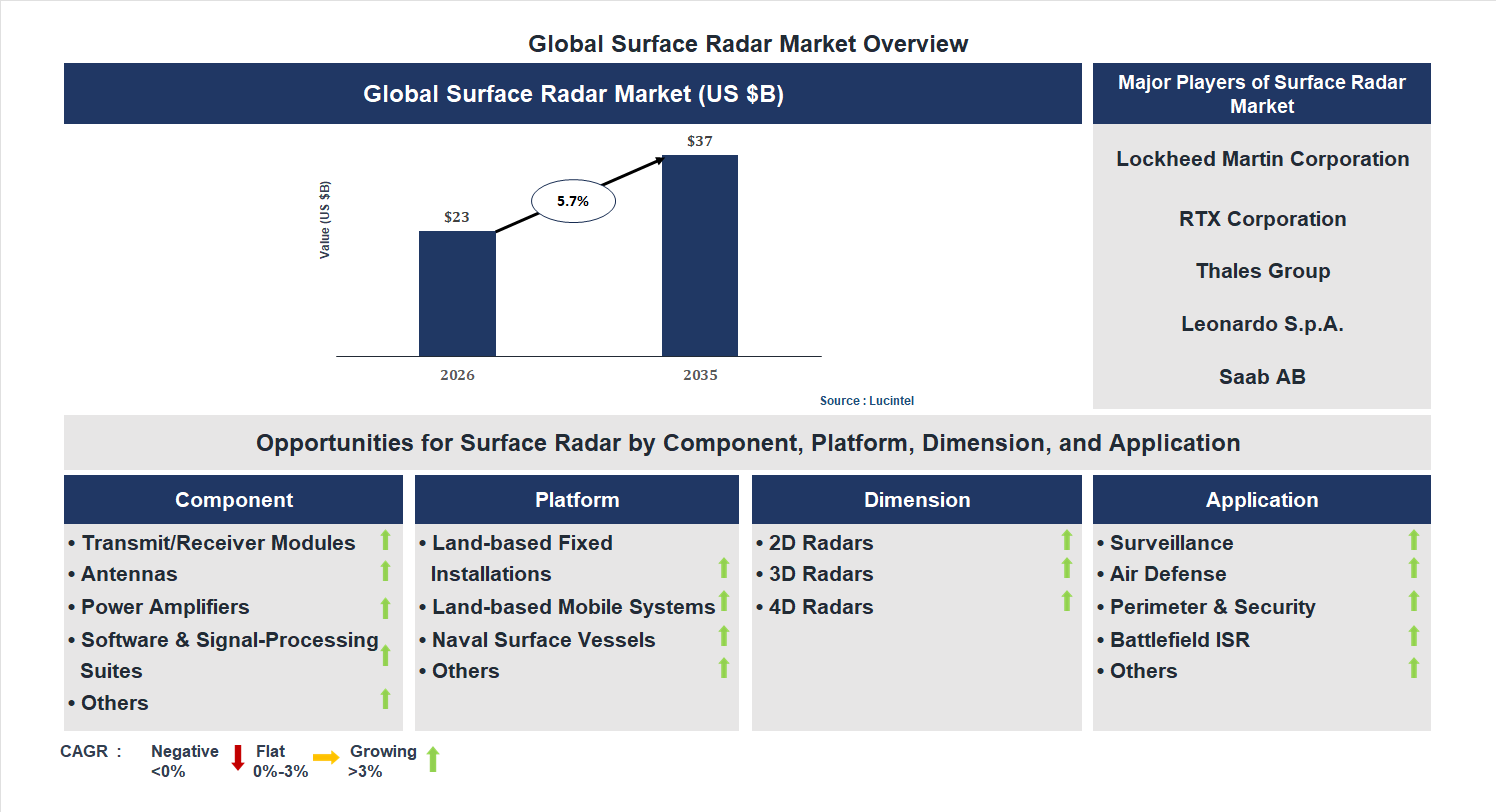
Key data points: The market size in 2035 = $37 billion, growth forecast = 5.7% annually for the next 8 years. Scroll below to get more insights. This market report covers trends, opportunities and forecasts in surface radar market to 2035 by component (transmit/receiver modules, antennas, power amplifiers, software & signal-processing suites, and others), platform (land-based fixed installations, land-based mobile systems, naval surface vessels, and others), dimension (2d radars, 3d radars, and 4d radars), application (surveillance, air defense, perimeter & security, battlefield ISR, and others), and region (North America, Europe, Asia Pacific, and the Rest of the World)
We'll send your sample report shortly.
• Lucintel forecasts that, within the component category, software & signal-processing suite is expected to witness the highest growth over the forecast period.
• Within the application category, air defense is expected to witness the highest growth.
• In terms of region, APAC is expected to witness the highest growth over the forecast period. Gain valuable insights for your business decisions with our comprehensive 150+ page report. Sample figures with some insights are shown below.
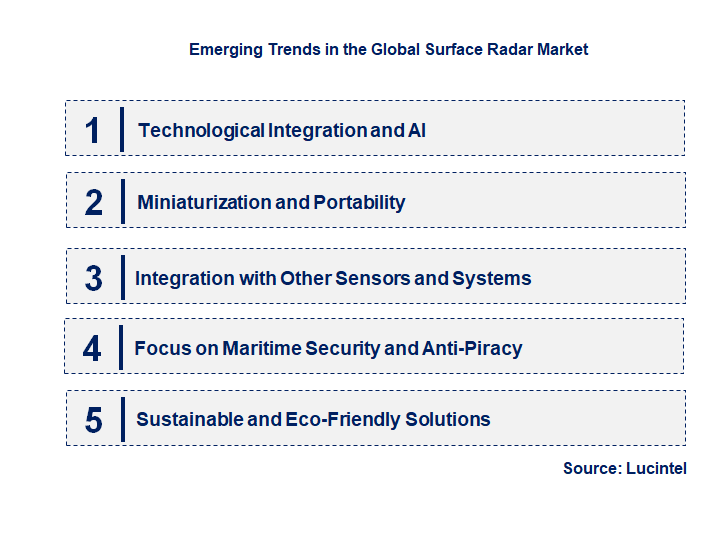
• Technological Integration and AI: The incorporation of artificial intelligence and machine learning into surface radar systems is revolutionizing detection and tracking capabilities. AI algorithms enable real-time data analysis, predictive maintenance, and autonomous operation, significantly enhancing system efficiency and accuracy. This trend reduces false alarms and improves target identification, which is crucial for defense and maritime security. As AI becomes more sophisticated, surface radars will increasingly support autonomous vessels and automated surveillance, leading to smarter, more responsive systems that can adapt to complex environments and threats.
• Miniaturization and Portability: Advances in materials and electronics are leading to smaller, lightweight radar units that are easier to deploy in diverse environments. Portable surface radars are now used for quick deployment in border security, coastal surveillance, and tactical operations. This miniaturization allows for flexible installation on smaller vessels, drones, or mobile platforms, expanding operational versatility. The impact is a broader adoption in remote or challenging terrains, enabling rapid response and enhanced coverage without the need for extensive infrastructure, thus broadening market reach and application scope.
• Integration with Other Sensors and Systems: Surface radars are increasingly being integrated with other surveillance and communication systems, such as sonar, infrared, and satellite data. This multi-sensor approach provides comprehensive situational awareness, improving detection accuracy and operational coordination. Integrated systems facilitate real-time data sharing across military, maritime, and security agencies, enabling faster decision-making. This trend enhances the overall effectiveness of surveillance networks, reduces operational gaps, and supports complex mission requirements, thereby driving demand for interoperable and scalable radar solutions.
• Focus on Maritime Security and Anti-Piracy: Rising maritime threats, including piracy, smuggling, and illegal fishing, are prompting increased investment in surface radar systems tailored for maritime security. These radars offer long-range detection, high-resolution imaging, and tracking of vessels, even in adverse weather conditions. Governments and private entities are deploying advanced radars to safeguard shipping lanes, ports, and offshore assets. The market is witnessing growth in specialized maritime radars, with features like automatic target recognition and integration with AIS (Automatic Identification System), which significantly enhance maritime domain awareness and security.
• Sustainable and Eco-Friendly Solutions: Environmental concerns and regulatory pressures are pushing the surface radar industry toward greener technologies. Manufacturers are developing energy-efficient systems with lower power consumption and reduced electromagnetic interference. Innovations include the use of sustainable materials and designs that minimize environmental impact during manufacturing and operation. This trend aligns with global sustainability goals and appeals to eco-conscious clients, expanding market opportunities. The adoption of sustainable solutions is expected to foster long-term growth by ensuring compliance with environmental standards and reducing operational costs. These emerging trends are fundamentally reshaping the surface radar market by enhancing system capabilities, expanding application areas, and promoting sustainable practices. The integration of AI, miniaturization, multi-sensor systems, maritime security focus, and eco-friendly innovations are collectively driving market growth, improving operational efficiency, and enabling more comprehensive surveillance solutions. As these trends continue to evolve, stakeholders will benefit from increased opportunities for innovation, strategic expansion, and competitive advantage in a rapidly changing landscape.
• Growing Defense Spending: Increased military budgets worldwide are fueling surface radar development, leading to advanced surveillance and threat detection systems. Countries are investing heavily in upgrading existing infrastructure and deploying new radar technologies to enhance national security. This surge in defense expenditure is driving innovation, expanding market size, and creating opportunities for manufacturers to develop more sophisticated, integrated radar solutions for naval and land-based applications.
• Maritime Security Enhancement: The rising need for maritime surveillance to combat piracy, smuggling, and illegal fishing is boosting surface radar deployment. Enhanced radar systems enable real-time tracking of vessels, improving maritime domain awareness. This development supports coast guards and naval forces in maintaining security and sovereignty. The market benefits from increased adoption of long-range, high-resolution radars, fostering growth in both commercial and defense maritime sectors.
• Technological Innovations in Radar Systems: Advances in phased-array, AESA, and solid-state radar technologies are transforming the surface radar landscape. These innovations offer better target detection, higher resolution, and faster response times. They also enable multi-functionality and integration with other sensors, improving operational efficiency. The adoption of AI and machine learning further enhances data processing and threat identification, opening new avenues for market expansion and application diversification.
• Integration of Artificial Intelligence and Data Analytics: Incorporating AI and data analytics into surface radar systems improves threat detection accuracy and operational decision-making. These technologies enable predictive maintenance, automated threat recognition, and real-time data processing, reducing human error. The integration enhances system capabilities, making radars more adaptable to complex environments. This development attracts defense and commercial sectors seeking smarter, more efficient surveillance solutions, thereby expanding market reach and technological sophistication.
• Expansion in Commercial Applications: Beyond defense, surface radars are increasingly used in air traffic control, weather monitoring, and offshore oil exploration. These applications demand high reliability and precision, driving innovation in sensor technology and system integration. The commercial sectors growth is supported by regulatory requirements and safety standards, leading to increased investments. This diversification broadens the market scope, creating new revenue streams and fostering cross-sector collaborations. The surface radar market is significantly impacted by these developments, leading to increased technological capabilities, broader application areas, and heightened competition. These opportunities are driving market growth, attracting investments, and fostering innovation, ultimately shaping a more resilient and versatile industry poised for sustained expansion.
• Integration of Artificial Intelligence for Enhanced Detection and Tracking: Incorporating AI into surface radar systems improves accuracy, reduces false alarms, and enables real-time data analysis. AI-driven algorithms facilitate better target identification, predictive maintenance, and autonomous operation, making radars more efficient and adaptable. This advancement is crucial for defense, maritime security, and air traffic management, providing a competitive edge and opening new revenue streams for manufacturers investing in smart radar solutions.
• Expansion into Emerging Markets with Growing Defense Budgets: Countries in Asia-Pacific, Middle East, and Africa are increasing defense budgets, creating substantial opportunities for surface radar deployment. These regions seek modern surveillance systems for border security, maritime patrol, and airspace management. Local partnerships, customized solutions, and cost-effective products are key strategies to penetrate these markets. The expansion supports global market growth and diversifies revenue sources for industry players.
• Development of Multi-Function and Multi-Mode Radar Systems: The demand for versatile radar systems capable of performing multiple functions—such as navigation, surveillance, and target tracking—is rising. Multi-mode radars enhance operational efficiency by reducing equipment costs and simplifying logistics. Innovations include phased-array technology and hybrid systems that adapt to various scenarios. These systems are particularly valuable in defense and commercial sectors, offering comprehensive situational awareness and operational flexibility.
• Adoption of Compact and Lightweight Radar Systems for Naval and UAV Applications: Miniaturization of surface radar technology enables deployment on smaller platforms like unmanned aerial vehicles (UAVs) and naval vessels. Compact radars improve mobility, reduce installation costs, and expand operational capabilities in confined or challenging environments. This trend supports military reconnaissance, border patrol, and maritime security missions, fostering growth in defense and commercial UAV markets, and encouraging innovation in lightweight, high-performance radar designs.
• Enhancement of Data Integration and Connectivity for Real-Time Situational Awareness: Advanced surface radars are increasingly integrated with other sensors and communication networks to provide comprehensive, real-time situational awareness. Data fusion from multiple sources improves decision-making and operational response times. Cloud-based platforms and IoT connectivity enable remote monitoring and management. This integration is vital for defense, maritime, and air traffic sectors, driving market growth through improved efficiency, safety, and strategic capabilities. These growth opportunities are poised to significantly influence the surface radar market by fostering technological innovation, expanding geographic reach, and enhancing operational versatility. Embracing these avenues will enable industry players to meet evolving customer demands, strengthen competitive positioning, and accelerate market expansion across diverse applications. The overall impact will be a more dynamic, integrated, and resilient surface radar industry.
• Technological Innovation: The continuous development of advanced radar systems, such as phased-array and multi-mode radars, enhances detection accuracy, range, and reliability. These innovations enable better surveillance, navigation, and threat detection, making surface radar systems more effective for military and civilian applications. As technology progresses, the market benefits from increased adoption of sophisticated radar solutions, driving growth and competitiveness.
• Rising Defense Budgets: Governments worldwide are increasing their defense spending to modernize military capabilities and ensure national security. This surge in defense budgets leads to higher procurement of surface radar systems for naval vessels, border security, and maritime surveillance. The demand for reliable, high-performance radar systems is thus bolstered, fueling market expansion across regions.
• Geopolitical Tensions and Security Concerns: Heightened geopolitical tensions and regional conflicts necessitate enhanced surveillance and defense mechanisms. Countries invest in surface radar systems to monitor maritime borders, detect unauthorized activities, and safeguard strategic assets. These security concerns directly contribute to increased market demand, especially in sensitive and high-risk areas.
• Growing Maritime Trade and Port Security: The expansion of global maritime trade increases the need for effective port security and vessel tracking systems. Surface radars play a crucial role in monitoring maritime traffic, preventing illegal activities, and ensuring safety. This trend supports market growth as ports and shipping companies seek advanced radar solutions to meet security standards.
• Integration with Other Defense Systems: The integration of surface radar with other military systems such as missile defense, command and control, and electronic warfare enhances operational efficiency. This interoperability drives demand for multi-functional radar systems and promotes technological convergence, further propelling market growth. The challenges facing the surface radar market include:
• High Deployment and Maintenance Costs: The installation of advanced surface radar systems involves significant capital expenditure, including equipment costs, infrastructure, and skilled personnel. Ongoing maintenance and upgrades add to operational expenses, which can be a barrier for some regions or organizations with limited budgets, potentially slowing market adoption.
• Technological Complexity and Integration Issues: Developing and deploying sophisticated radar systems require overcoming complex technological challenges, including signal processing, clutter management, and environmental adaptability. Integrating these systems with existing military or civilian infrastructure can be difficult, leading to delays and increased costs.
• Regulatory and Export Restrictions: Stringent government regulations and export controls on military-grade radar technology can limit market access and international trade. Compliance with various standards and restrictions may hinder the deployment of radar systems across different regions, impacting global market growth and collaboration. The surface radar market is driven by technological advancements, increased defense spending, security concerns, maritime trade growth, and system integration benefits. However, high costs, technological complexities, and regulatory restrictions pose significant challenges. These factors collectively influence the markets trajectory, requiring stakeholders to navigate a complex landscape to capitalize on emerging opportunities while managing risks effectively.
• Lockheed Martin Corporation
• RTX Corporation
• Thales Group
• Leonardo S.p.A.
• Saab AB
• Northrop Grumman Corporation
• HENSOLDT AG
• Israel Aerospace Industries Ltd.
• BAE Systems plc
• Indra Sistemas S.A.
• Transmit/Receiver Modules
• Antennas
• Power Amplifiers
• Software & Signal-Processing Suites
• Others
• Land-based Fixed Installations
• Land-based Mobile Systems
• Naval Surface Vessels
• Others
• 2D Radars
• 3D Radars
• 4D Radars
• Surveillance
• Air Defense
• Perimeter & Security
• Battlefield ISR
• Others
• North America
• Europe
• Asia Pacific
• The Rest of the World
• United States: The US surface radar market has seen substantial growth due to increased defense spending and technological innovation. Key developments include the deployment of advanced phased-array radars and integration with AI for improved target detection. The US military is investing in next-generation radar systems to enhance maritime and aerial surveillance capabilities, with a focus on homeland security and defense modernization. Private sector players are also expanding their offerings, emphasizing automation and networked systems to improve operational efficiency.
• China: China has rapidly advanced its surface radar technology, emphasizing self-reliance and strategic dominance. The country has developed sophisticated radar systems for maritime surveillance, missile defense, and naval applications. Recent developments include the deployment of multi-function phased-array radars and the expansion of coastal defense networks. China’s focus on indigenous technology and large-scale military modernization programs has significantly boosted its surface radar capabilities, aligning with its broader geopolitical ambitions and regional security strategies.
• Germany: Germany’s surface radar market is characterized by a focus on high-precision, integrated systems for both military and civilian applications. Recent advancements include the development of multi-mission radars capable of tracking multiple targets simultaneously and improved weather resilience. Germany is also investing in radar systems that support NATO operations, emphasizing interoperability and technological innovation. The country’s emphasis on export-oriented solutions and collaboration within the European defense industry has driven recent market growth.
• India: India has made notable progress in enhancing its surface radar infrastructure to bolster national security and maritime domain awareness. Recent developments include the deployment of advanced phased-array radars along its coastlines and border areas. The country is also focusing on indigenous radar technology development, reducing reliance on foreign suppliers. India’s efforts are driven by regional security concerns, including maritime security in the Indian Ocean, and are supported by government initiatives aimed at modernizing the armed forces’ surveillance capabilities.
• Japan: Japan’s surface radar market is evolving with a focus on advanced surveillance and missile defense systems. Recent developments include the deployment of sophisticated phased-array radars for ballistic missile detection and tracking. Japan is also investing in integrated radar systems that support its national security and defense strategies amid regional tensions. The country emphasizes technological innovation, including the integration of AI and networked systems, to enhance its maritime and air defense capabilities, aligning with its strategic goal of maintaining regional stability.


• Lockheed Martin Corporation
• RTX Corporation
• Thales Group
• Leonardo S.p.A.
• Saab AB
• Northrop Grumman Corporation
• HENSOLDT AG
• Israel Aerospace Industries Ltd.
• BAE Systems plc
• Indra Sistemas S.A. Q6. Which surface radar market segment will be the largest in future? Answer: Lucintel forecasts that, within the component category, software & signal-processing suite is expected to witness the highest growth over the forecast period. Q7. In surface radar market, which region is expected to be the largest in next 8 years? Answer: In terms of region, APAC is expected to witness the highest growth over the forecast period. Q8. Do we receive customization in this report? Answer: Yes, Lucintel provides 10% customization without any additional cost.


Choose a license that fits your team. Instant PDF delivery.
Prices exclude taxes. Instant delivery. Custom licensing available on request.
Market Report · July 31, 2026
Market Report · July 31, 2026
Market Report · July 31, 2026
Trusted partner for strategic intelligence and business growth


Receive a complimentary market analysis tailored to your industry. Our analysts will identify key growth opportunities and competitive dynamics specific to your business.

Market size, growth rate, and key trend analysis for your specific sector.

Top competitor positioning and market share analysis.

Strategic recommendations backed by data-driven insights.
Get curated market intelligence and competitive moves straight to your inbox.
By subscribing, you agree to receive our monthly insights. Unsubscribe anytime.
Receive a complimentary market analysis tailored to your industry. Our analysts will identify key growth opportunities and competitive dynamics specific to your business.
Market size, growth rate, and key trend analysis for your specific sector.
Top competitor positioning and market share analysis.
Strategic recommendations backed by data-driven insights.
Get curated market intelligence, emerging trends, and competitive moves straight to your inbox each month.
By subscribing, you agree to receive our monthly insights. Unsubscribe anytime.
We'll send your sample report shortly.