
Market Report · July 31, 2026

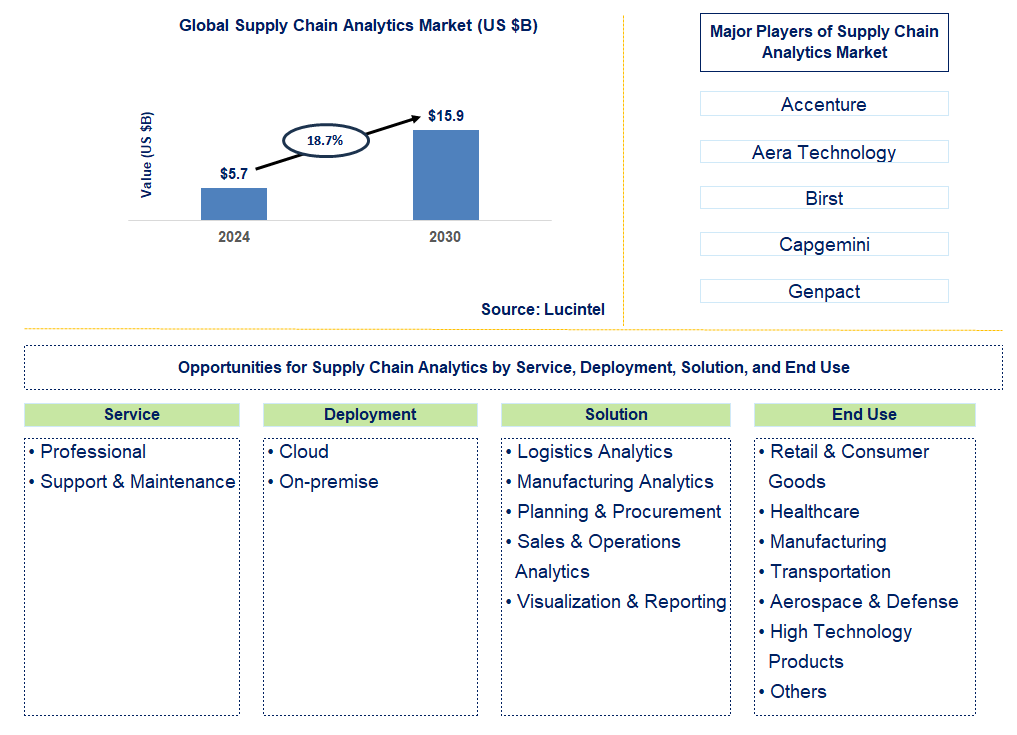
Key data points: The market size in 2030 = $15.9 billion, growth forecast = 18.7% annually for the next 6 years. Scroll below to get more insights. This market report covers trends, opportunities, and forecasts in the global supply chain analytics market to 2030 by service (professional and support & maintenance), deployment (cloud and on-premise), solution (logistics analytics, manufacturing analytics, planning & procurement, sales & operations analytics, and visualization & reporting), end use (retail & consumer goods, healthcare, manufacturing, transportation, aerospace & defense, high technology products, and others), and region (North America, Europe, Asia Pacific, and the Rest of the World)
We'll send your sample report shortly.
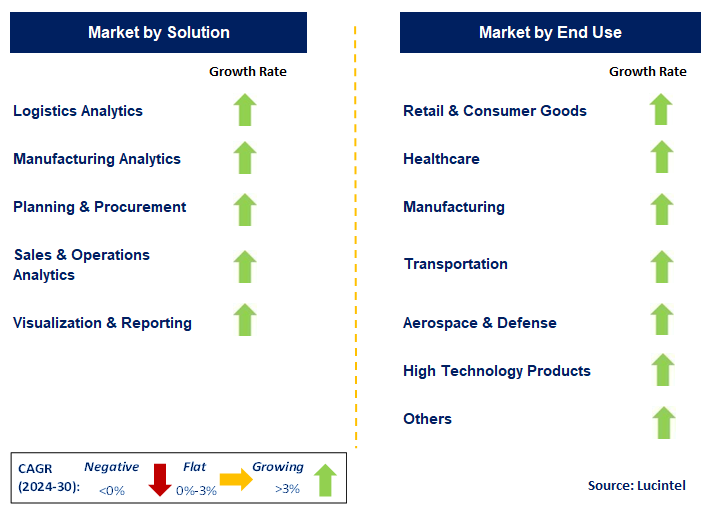
• Lucintel forecasts that, within the solution category, sales & operations analytics will remain the largest segment over the forecast period because of the aim to maximize resource usage and client gains from an economical, adaptable, and personalized SCA solution that can be tailored to changing requirements.
• In terms of regions, North America will remain the largest region over the forecast period due to the increasing complexity of business operations, North American industrial firms are placing more emphasis on the operational data's visual representation. Gain valuable insights for your business decisions with our comprehensive 150+ page report
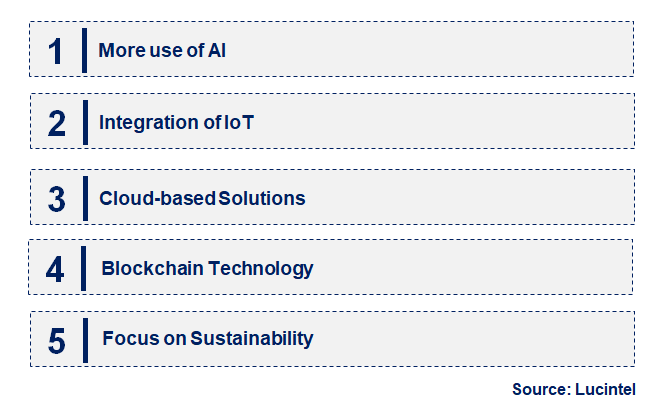
• Increased Use of AI: AI is revolutionizing supply chain analytics by enhancing predictive capabilities and automating processes. It improves forecast accuracy, optimizes inventory management, reduces operational costs, and boosts decision-making efficiency.
• Integration of IoT: IoT technology is providing real-time data that enables better visibility and control over the entire supply chain. From tracking shipments and monitoring inventory to predicting equipment failures, IoT devices empower supply chain professionals to respond more proactively
• Cloud-based Solutions: Cloud technologies are accelerating the adoption of agile, scalable supply chain analytics platforms. These solutions enable seamless data integration, real-time insights, and collaboration across global teams, making supply chains more flexible and responsive.
• Blockchain Technology: Blockchain is enhancing transparency and traceability in supply chains by providing secure, immutable transaction records. This reduces fraud, ensures accountability, and fosters trust between supply chain partners.
• Focus on Sustainability: Analytics is playing a central role in driving sustainable supply chain practices. Companies are leveraging data to reduce waste, optimize resource use, and minimize their carbon footprint, aligning with global sustainability goals. These trends are reshaping the supply chain analytics landscape by improving operational efficiency, transparency, and agility while meeting evolving technological and environmental requirements.
• Predictive Analytics: Advances in predictive analytics are enabling more accurate demand forecasting, inventory optimization, and risk management. These tools allow companies to better anticipate fluctuations in demand and prepare for potential disruptions.
• Real-Time Data Analytics: Real-time data is becoming the backbone of modern supply chain management. Companies are increasingly adopting technologies that provide instant visibility into supply chain activities, enabling quicker decision-making and more agile responses.
• Machine Learning Algorithms: Machine learning algorithms are transforming the analysis of complex supply chain data. These algorithms can identify patterns, predict outcomes, and automate decision-making, leading to greater efficiency and accuracy across the supply chain.
• Adoption of Digital Twins: Digital twins are gaining traction in supply chain management for visualization, scenario analysis, and risk management. By creating virtual models of their supply chains, businesses can better understand operations, identify risks, and optimize processes.
• Cybersecurity Emphasis: As supply chains become more digitized, companies are investing in robust cybersecurity measures to protect sensitive data and maintain operational integrity. This increased focus on security is crucial to prevent data breaches and cyber-attacks. These developments are enhancing the predictive, real-time, and operational capabilities of supply chains, reflecting a growing reliance on advanced technologies to manage complex global logistics.
• E-commerce Logistics: As e-commerce continues to grow, the demand for sophisticated analytics solutions for route optimization, inventory management, and customer satisfaction is increasing. Companies are leveraging analytics to improve delivery efficiency and enhance the customer experience, presenting a large growth opportunity in this sector.
• Manufacturing Optimization: The application of analytics in manufacturing is creating opportunities to optimize production data, reduce downtime, and improve quality. As manufacturers seek to improve efficiency and reduce costs, the use of supply chain analytics will be key in driving improvements.
• Demand Forecasting: Accurate demand forecasting is critical for efficient supply chain management. By utilizing analytics, companies can better align inventory levels with demand, reduce waste, and improve service levels.
• Supplier Risk Management: Analytics can help companies assess and mitigate supplier risks by analyzing performance data, market conditions, and other variables. This helps ensure a stable, resilient supply chain, minimizing disruptions.
• Sustainability Initiatives: Analytics solutions are crucial for supporting sustainability efforts, helping companies track resource utilization, reduce environmental impact, and optimize supply chains for more sustainable operations. These opportunities highlight the expanding role of analytics in various sectors and the growing demand for data-driven strategies in addressing the challenges of modern supply chain management.
• Technological Advancements: Fast growth in AI, machine learning, and IoT has been widely responsible for innovations in supply chain analytics. It enhances the capability of data processing and makes better decisions thereby fostering the growth of the market.
• Increased Demand for Real-Time Data: The need for real-time insight into supply chain operations is one of the major reasons that forces the adoption of advanced analytics solutions. Each business requires timely information to act in a timely manner against changes and disruptions occurring within the marketplace.
• Growing E-commerce Sector: The expansion of e-commerce is driving demand for sophisticated supply chain analytics. Companies need advanced tools to manage complex logistics and inventory challenges associated with online retail.
• Operational Efficiency and Cost Reduction: Companies are increasingly utilizing analytics to attain a state of high operational efficiency while pursuing cost-reduction measures simultaneously. Strong insights provided by data help attain efficiency in the supply chain functions and increase cost savings.
• Compliance Requirements: Increasing requirements toward regulatory compliance are forcing companies to implement advanced analytics solutions. Analytics smoothened the path for meeting standards with better transparency in the supply chain. Challenges in the supply chain analytics market are:
• Data Security Concerns: As supply chains become more digitized, the risk of cyber threats and data breaches increases. Protecting sensitive supply chain data requires significant investments in cybersecurity.
• Integration Complexity: Integrating advanced analytics solutions with existing systems can be complex and costly. Many companies face challenges in ensuring seamless data flow across various platforms, which can hinder the effective use of analytics.
• Lack of Skilled Talent: There is a growing demand for skilled data analysts who can interpret complex supply chain data. The shortage of skilled professionals with expertise in data analytics poses a challenge for many organizations. Despite these challenges, the market for supply chain analytics continues to grow, driven by technological advancements, the demand for real-time insights, and the need for more efficient and sustainable supply chain practices. .
• Accenture
• Aera Technology
• Birst
• Capgemini
• Genpact
• International Business Machines
• JDA Software Group
• Kinaxis
• Lockheed Martin
• Maersk Group
• Professional
• Support & Maintenance
• Cloud
• On-premise
• Logistics Analytics
• Manufacturing Analytics
• Planning & Procurement
• Sales & Operations Analytics
• Visualization & Reporting
• Retail & Consumer Goods
• Healthcare
• Manufacturing
• Transportation
• Aerospace & Defense
• High Technology Products
• Others
• North America
• Europe
• Asia Pacific
• The Rest of the World
• United States: The U.S. is leading the integration of AI and machine learning in supply chain analytics. Companies are focusing on real-time data processing and predictive analytics to enhance decision-making, improve operational efficiency, and reduce costs.
• China: China is leveraging big data and IoT technologies to optimize supply chain management. The government’s focus on digital transformation and smart logistics is accelerating advancements in supply chain analytics, particularly in inventory and logistics management.
• Germany: Germany's focus on Industry 4.0 technologies is propelling the growth of supply chain analytics. Automation, smart manufacturing, and predictive maintenance are central to German supply chain innovations, enhancing operational efficiency and reducing downtime.
• India: India is seeing rapid adoption of cloud-based supply chain analytics, driven by the growth of the e-commerce sector. Companies are using analytics for demand forecasting and logistics optimization to address the needs of a rapidly expanding domestic market.
• Japan: Japan is integrating robotics and AI into traditional supply chain analytics, focusing on precision, speed, and responsiveness. The country is aiming to develop smart supply chains that can quickly adapt to market dynamics and disruptions.


• Accenture
• Aera Technology
• Birst
• Capgemini
• Genpact
• International Business Machines
• JDA Software Group
• Kinaxis
• Lockheed Martin
• Maersk Group Q6. Which supply chain analytics market segment will be the largest in future? Answer: Lucintel forecasts that sales & operations analytics will remain the largest segment over the forecast period because of the aim to maximize resource usage and client gains from an economical, adaptable, and personalized SCA solution that can be tailored to changing requirements. Q7. In supply chain analytics market, which region is expected to be the largest in next 5 years? Answer: North America will remain the largest region over the forecast period due to the increasing complexity of business operations, North American industrial firms are placing more emphasis on the operational data's visual representation. Q.8 Do we receive customization in this report? Answer: Yes, Lucintel provides 10% customization without any additional cost.


Choose a license that fits your team. Instant PDF delivery.
Prices exclude taxes. Instant delivery. Custom licensing available on request.
Market Report · July 31, 2026
Market Report · July 31, 2026
Market Report · July 31, 2026
Trusted partner for strategic intelligence and business growth


Receive a complimentary market analysis tailored to your industry. Our analysts will identify key growth opportunities and competitive dynamics specific to your business.

Market size, growth rate, and key trend analysis for your specific sector.

Top competitor positioning and market share analysis.

Strategic recommendations backed by data-driven insights.
Get curated market intelligence and competitive moves straight to your inbox.
By subscribing, you agree to receive our monthly insights. Unsubscribe anytime.
Receive a complimentary market analysis tailored to your industry. Our analysts will identify key growth opportunities and competitive dynamics specific to your business.
Market size, growth rate, and key trend analysis for your specific sector.
Top competitor positioning and market share analysis.
Strategic recommendations backed by data-driven insights.
Get curated market intelligence, emerging trends, and competitive moves straight to your inbox each month.
By subscribing, you agree to receive our monthly insights. Unsubscribe anytime.
We'll send your sample report shortly.