
Superfine Talc Market Trends and Forecast
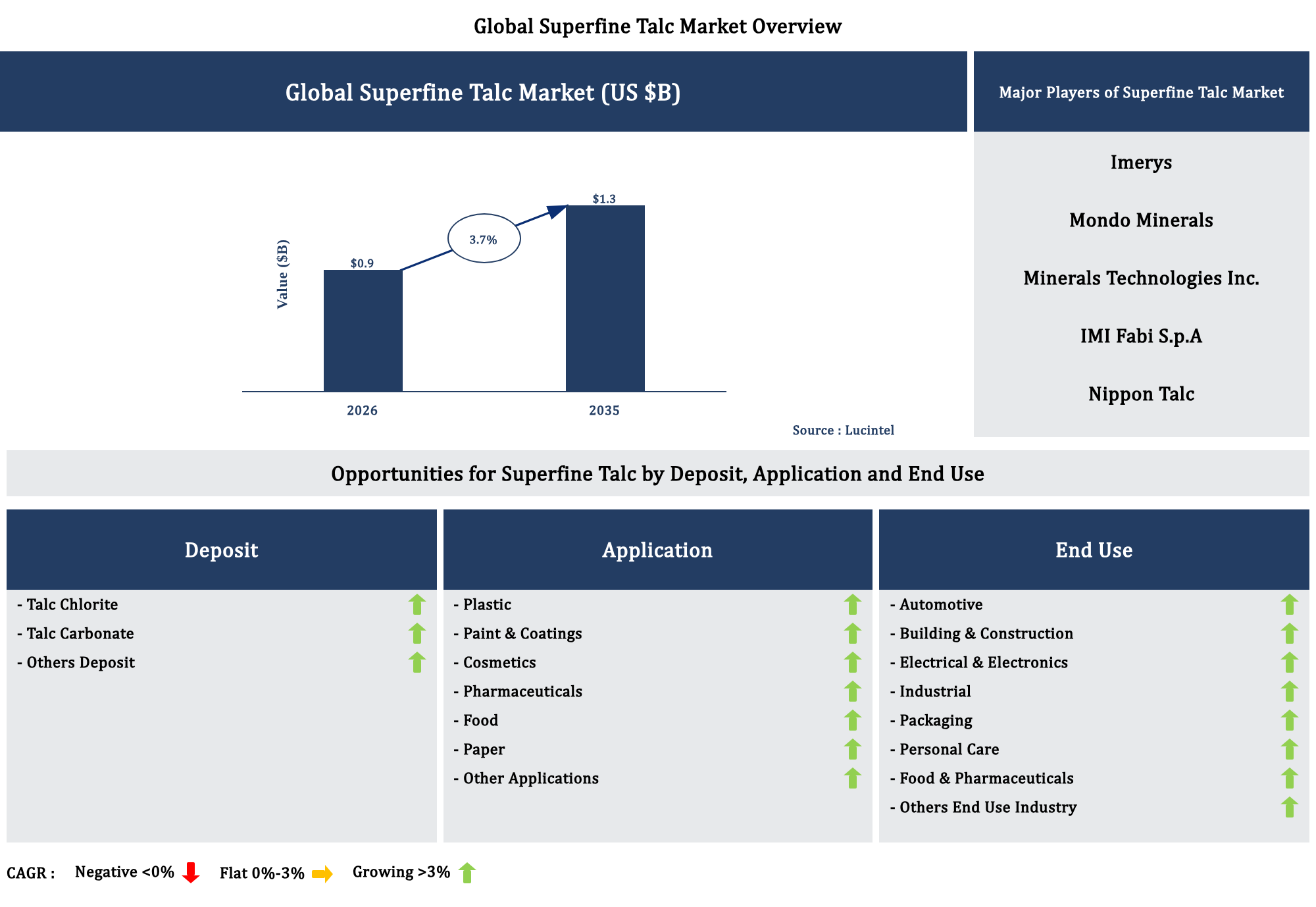
The future of the global superfine talc market looks promising with opportunities in the automotive, building & construction, electrical & electronic, industrial, packaging, personal care, and food & pharmaceutical markets. The global superfine talc market is expected to reach an estimated $1,300 million by 2035 with a CAGR of 3.7% from 2026 to 2035. The major drivers for this market are the increasing demand from plastics industry for lightweight materials, the growing demand in paints & coatings for better finish, and the rising demand for high purity & fine particle minerals.
• Lucintel forecasts that, within the deposit category, talc chlorite is expected to witness higher growth over the forecast period.
• Within the end use category, is expected to witness the highest growth.
• In terms of region, APAC is expected to witness the highest growth over the forecast period.
Gain valuable insights for your business decisions with our comprehensive 150+ page report. Sample figures with some insights are shown below.
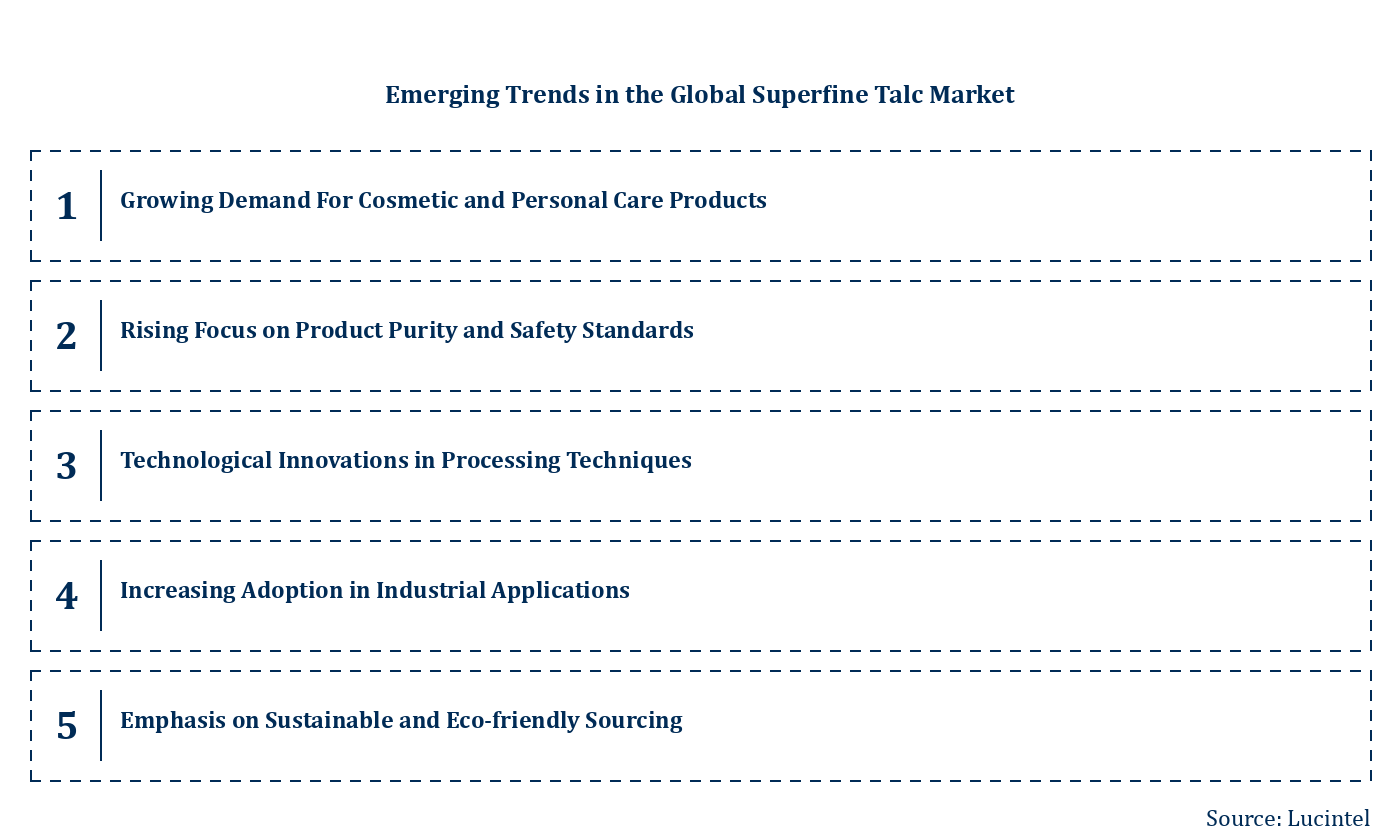
Emerging Trends in the Superfine Talc Market
The superfine talc market is experiencing significant transformation driven by technological advancements, changing consumer preferences, and increasing regulatory scrutiny. As industries such as cosmetics, plastics, and paints seek higher quality and sustainable solutions, market dynamics are shifting rapidly. Emerging trends are shaping the future landscape, influencing product development, supply chain strategies, and regulatory compliance. Companies are innovating to meet these evolving demands, leading to a more competitive and sustainable market environment. Understanding these key trends is essential for stakeholders aiming to capitalize on growth opportunities and navigate potential challenges effectively.
• Growing Demand for Cosmetic and Personal Care Products: The increasing popularity of natural and mineral-based cosmetics is boosting superfine talc consumption. Consumers seek products with smooth textures, safety, and eco-friendly attributes, prompting manufacturers to develop high-quality superfine talc that enhances product performance and safety. This trend is expanding the market, especially in emerging economies where beauty standards are evolving rapidly.
• Rising Focus on Product Purity and Safety Standards: Regulatory agencies worldwide are imposing stricter guidelines on talc products due to health concerns. This has led to a demand for superfine talc that is free from asbestos and other contaminants. Companies are investing in advanced purification and testing technologies to ensure compliance, which enhances consumer trust and opens new markets. This trend emphasizes safety and quality as critical differentiators in the market.
• Technological Innovations in Processing Techniques: Advances in milling and micronization technologies are enabling the production of superfine talc with consistent particle size and superior quality. These innovations improve the material‘s performance in various applications, such as plastics, paints, and rubber. Enhanced processing methods also reduce waste and energy consumption, aligning with sustainability goals and reducing production costs.
• Increasing Adoption in Industrial Applications: Superfine talc is gaining traction in industries like plastics, rubber, and paints due to its excellent reinforcement properties and smooth finish. Its ability to improve product durability and aesthetic appeal makes it a preferred additive. This diversification into industrial sectors is expanding the market beyond traditional cosmetic uses, creating new revenue streams and growth opportunities.
• Emphasis on Sustainable and Eco-Friendly Sourcing: Consumers and regulators are demanding environmentally responsible sourcing and production practices. Companies are adopting sustainable mining practices and exploring alternative sources to reduce environmental impact. This trend is driving innovation in eco-friendly processing and certification standards, which can enhance brand reputation and meet the growing demand for green products.
These emerging trends are reshaping the superfine talc market by emphasizing safety, innovation, sustainability, and diversification. They are fostering a more competitive environment where quality and environmental responsibility are paramount, ultimately leading to a more resilient and dynamic industry landscape.
Recent Development in the Superfine Talc Market
The superfine talc market is experiencing rapid growth driven by technological advancements, increasing demand across various industries, and evolving consumer preferences. Innovations in processing techniques have enhanced talc purity and fineness, expanding its application scope. Growing awareness of health and environmental standards is prompting manufacturers to adopt safer, eco-friendly practices. Additionally, the rise in construction, cosmetics, and plastics sectors is fueling demand. Market players are focusing on strategic collaborations and product diversification to capitalize on these opportunities, shaping a dynamic landscape with significant growth potential.
• Technological Advancements in Talc Processing: Improved techniques have increased purity and fineness, enabling broader industrial applications and enhancing product quality, which attracts new customers and boosts market expansion.
• Rising Demand from Cosmetics and Personal Care Industries: The increasing use of superfine talc in powders, creams, and skincare products is driven by consumer preferences for smooth textures and safety, significantly expanding market size and encouraging innovation.
• Growth in Construction and Plastics Sectors: Superfine talc‘s properties as a filler and flame retardant are increasingly utilized in construction materials and plastics, leading to higher demand and encouraging manufacturers to develop specialized grades.
• Adoption of Eco-Friendly and Health-Conscious Practices: Stricter regulations and consumer awareness are prompting companies to produce safer, environmentally friendly talc products, which enhances brand reputation and opens new market segments.
• Strategic Collaborations and Product Diversification: Market players are forming alliances and expanding product portfolios to meet diverse industry needs, fostering innovation, increasing market share, and driving overall industry growth.
These developments are collectively transforming the superfine talc market by enhancing product quality, expanding application areas, and aligning with health and environmental standards. The market is becoming more competitive and innovative, with increased opportunities for growth and diversification. As a result, industry stakeholders are poised to benefit from sustained demand across multiple sectors, ensuring long-term market expansion and resilience.
Strategic Growth Opportunities in the Superfine Talc Market
The superfine talc market is experiencing significant growth driven by increasing demand across various industries such as cosmetics, plastics, and paints. Innovations in processing techniques and expanding applications are creating new opportunities for market players. Rising awareness of the benefits of superfine talc, including its smooth texture and chemical stability, further fuels market expansion. Strategic investments and technological advancements are expected to enhance production capacity and product quality, positioning superfine talc as a vital component in diverse industrial applications worldwide.
• Growing Demand for Superfine Talc in Cosmetics and Personal Care Products: The cosmetics industry increasingly relies on superfine talc for its smooth texture, oil absorption, and safety profile. It is used in powders, foundations, and skincare formulations, driven by consumer preferences for lightweight, non-irritating products. As beauty standards evolve and demand for natural, safe ingredients rises, manufacturers are investing in superfine talc to meet quality and safety standards, expanding its application scope and boosting market growth.
• Expansion of Superfine Talc use in Plastics and Rubber Industries: Superfine talc enhances the mechanical properties, heat resistance, and dimensional stability of plastics and rubber products. Its use in automotive parts, electrical components, and packaging materials is increasing due to its ability to improve product performance and reduce manufacturing costs. Innovations in compounding techniques and the demand for lightweight, durable materials are propelling superfine talc’s adoption, creating new growth avenues in these sectors.
• Increasing Application of Superfine Talc in Paints and Coatings: The paint and coatings industry utilizes superfine talc for its excellent thixotropic properties, chemical inertness, and ability to improve surface finish. It is used in architectural paints, industrial coatings, and primers to enhance durability and aesthetic appeal. Rising construction activities and infrastructure development globally are driving demand for high-quality coatings, thereby expanding superfine talc’s role as a functional additive in this sector.
• Technological Advancements in Superfine Talc Production Processes: Innovations such as jet milling and ultrafine grinding techniques are enabling the production of higher purity, finer talc particles. These advancements improve product consistency, reduce impurities, and lower production costs. Enhanced processing technologies are facilitating the development of specialized superfine talc grades tailored for specific applications, thereby broadening market potential and encouraging industry players to invest in research and development.
• Rising Environmental and Regulatory Focus on Natural Mineral Ingredients: Increasing environmental awareness and stricter regulations on synthetic additives are boosting demand for natural mineral-based products like superfine talc. Manufacturers are adopting eco-friendly mining and processing practices to meet compliance standards. This shift enhances consumer trust and opens new markets in regions with stringent environmental policies, positioning superfine talc as a sustainable and safe ingredient across multiple industries.
The overall market outlook indicates that these growth opportunities will significantly influence the expansion and diversification of the superfine talc market, fostering innovation and strengthening its presence across various industrial sectors.
Superfine Talc Market Driver and Challenges
The superfine talc market is influenced by a variety of technological, economic, and regulatory factors that shape its growth trajectory. Advances in processing technologies have enabled the production of finer, higher-quality talc powders, expanding their application scope. Economic factors such as industrial growth and construction activities drive demand, while regulatory standards concerning safety and environmental impact influence market operations. Additionally, innovations in end-use industries like cosmetics, plastics, and paints contribute to market expansion. However, challenges such as regulatory restrictions, environmental concerns, and fluctuating raw material prices pose significant hurdles. Understanding these drivers and challenges is essential for stakeholders to navigate the market effectively and capitalize on emerging opportunities.
The factors responsible for driving the superfine talc market include:
• Technological Advancements: The development of advanced milling and processing technologies has enabled producers to create superfine talc powders with consistent quality and purity. These innovations have expanded applications in cosmetics, pharmaceuticals, and high-performance plastics, where particle size and purity are critical. Enhanced processing efficiency reduces costs and improves product quality, making superfine talc more competitive. As R&D continues, new methods are expected to further refine talc production, opening up additional markets and increasing overall demand.
• Growing End-Use Industries: The expansion of industries such as cosmetics, paints and coatings, plastics, and paper significantly boosts superfine talc demand. In cosmetics, superfine talc is used in powders and skincare products for its softness and absorbent properties. The construction sector‘s growth increases demand for paints and coatings that incorporate superfine talc for improved durability and finish. The automotive and packaging industries also utilize superfine talc for lightweight, high-strength materials, further propelling market growth.
• Regulatory and Safety Standards: Stringent regulations concerning the safety and environmental impact of mineral extraction and processing influence the market. Governments and industry bodies impose standards to limit asbestos contamination and ensure product safety, prompting manufacturers to adopt cleaner, safer processing methods. Compliance with these standards can increase production costs but also enhances product credibility and consumer trust, ultimately benefiting the market by encouraging responsible practices and expanding consumer acceptance.
• Rising Demand for Eco-Friendly and Sustainable Products: Increasing consumer awareness and environmental concerns drive demand for eco-friendly superfine talc products. Manufacturers are adopting sustainable mining practices and eco-conscious processing techniques to meet regulatory and consumer expectations. The shift towards environmentally sustainable products enhances market reputation and opens new opportunities in green industries, including biodegradable packaging and eco-friendly cosmetics, thereby supporting long-term growth.
• Innovation in Product Applications: Continuous innovation in product formulations and applications fuels superfine talc market expansion. The development of specialized talc grades for specific industries, such as pharmaceutical-grade talc or high-purity grades for electronics, broadens market scope. Additionally, integrating superfine talc into new composite materials and nanotechnology applications offers significant growth potential, encouraging manufacturers to invest in research and development to stay competitive.
The challenges facing the superfine talc market include:
• Regulatory Restrictions and Environmental Concerns: Increasing regulations aimed at reducing asbestos contamination and minimizing environmental impact pose significant challenges. Stricter standards require substantial investments in cleaner extraction and processing technologies, which can increase operational costs. Non-compliance risks include legal penalties and damage to brand reputation. Additionally, environmental concerns related to mining activities, such as land degradation and water pollution, necessitate sustainable practices, which may limit supply and increase costs.
• Fluctuating Raw Material Prices: The price volatility of raw talc mineral due to geopolitical issues, supply chain disruptions, and demand-supply imbalances affects profitability. Sudden price hikes can increase production costs, forcing manufacturers to either absorb costs or pass them to consumers, potentially reducing competitiveness. Conversely, price drops may impact profit margins, discouraging investment in innovation and capacity expansion, thereby hindering market growth.
• Limited Availability of High-Quality Talc Deposits: The scarcity of high-purity, superfine talc deposits restricts supply and increases extraction costs. Many deposits contain impurities or asbestos contamination, requiring extensive processing and quality control measures. This limitation constrains the ability to meet rising demand, especially for pharmaceutical and cosmetic applications that demand the highest purity standards. It also encourages illegal mining activities, which pose safety and environmental risks, further complicating market development.
The superfine talc market is driven by technological innovations, expanding end-use industries, regulatory compliance, sustainability trends, and product innovation. However, it faces challenges from strict regulations, environmental concerns, raw material price fluctuations, and resource limitations. These factors collectively influence market dynamics, requiring stakeholders to adopt sustainable practices, invest in R&D, and navigate regulatory landscapes carefully. Overall, the market‘s growth potential remains significant, provided these challenges are managed effectively through innovation and responsible practices.
List of Superfine Talc Companies
Companies in the market compete on the basis of product quality offered. Major players in this market focus on expanding their manufacturing facilities, R&D investments, infrastructural development, and leverage integration opportunities across the value chain. With these strategies superfine talc companies cater increasing demand, ensure competitive effectiveness, develop innovative products & technologies, reduce production costs, and expand their customer base. Some of the superfine talc companies profiled in this report include-
• Imerys
• Mondo Minerals
• Minerals Technologies Inc.
• IMI Fabi S.p.A
• Nippon Talc
• American Talc Company
• Golcha Group
Superfine Talc Market by Segment
The study includes a forecast for the global superfine talc market by deposit, application, end use, and region.
Superfine Talc Market by Deposit [Value from 2019 to 2035]:
• Talc Chlorite
• Talc Carbonate
• Others Deposit
Superfine Talc Market by Application [Value from 2019 to 2035]:
• Plastic
• Paint & Coatings
• Cosmetics
• Pharmaceuticals
• Food
• Paper
• Other Applications
Superfine Talc Market by End Use [Value from 2019 to 2035]:
• Automotive
• Building & Construction
• Electrical & Electronics
• Industrial
• Packaging
• Personal Care
• Food & Pharmaceuticals
• Others End Use Industry
Superfine Talc Market by Region [Value from 2019 to 2035]:
• North America
• Europe
• Asia Pacific
• The Rest of the World
Country Wise Outlook for the Superfine Talc Market
The superfine talc market has experienced significant shifts driven by technological advancements, regulatory changes, and evolving consumer demands across major economies. As industries such as cosmetics, plastics, and pharmaceuticals expand, the demand for high-quality superfine talc has increased. Countries are focusing on sustainable sourcing, innovation in processing techniques, and expanding applications to maintain competitive advantages. These developments reflect broader trends toward eco-friendly practices and product diversification, shaping the future landscape of the superfine talc industry globally.
• United States: The US market has seen increased adoption of superfine talc in cosmetics and personal care products, driven by consumer demand for natural and safe ingredients. Innovations in environmentally friendly processing methods have gained traction, reducing environmental impact. Regulatory standards are becoming stricter, prompting companies to improve purity and safety measures. The US also witnesses growth in the pharmaceutical sector, utilizing superfine talc as an excipient. Market players are investing in R&D to develop high-performance, sustainable talc products, expanding applications in various industrial sectors.
• China: China remains the largest producer and consumer of superfine talc, with rapid industrial growth fueling demand. The country has focused on upgrading processing technologies to produce higher purity and finer grades, catering to cosmetics and ceramics industries. Government policies emphasize sustainable mining practices and environmental protection, influencing supply chains. Chinese companies are expanding their export markets, leveraging cost advantages. Additionally, domestic demand for superfine talc in electronics and automotive sectors is rising, prompting innovation in product quality and application diversity.
• Germany: Germany‘s superfine talc market is characterized by high-quality standards and technological innovation. The country emphasizes eco-friendly extraction and processing techniques, aligning with stringent EU regulations. The cosmetics and pharmaceutical industries are primary consumers, with a focus on natural and organic products. German companies invest heavily in research to develop superfine talc with enhanced properties such as improved dispersibility and safety. The market also benefits from collaborations within the European Union, fostering sustainable practices and expanding application scopes in industrial and consumer goods.
• India: India is witnessing rapid growth in superfine talc demand, mainly driven by expanding cosmetics, paints, and plastics sectors. The country is investing in modernizing mining and processing facilities to produce finer, purer grades. Government initiatives promoting mineral beneficiation and sustainable practices are shaping industry standards. Domestic consumption is increasing, and India is becoming a key exporter to neighboring markets. The focus on quality improvement and diversification into new applications like rubber and paper industries is strengthening India‘s position in the global superfine talc market.
• Japan: Japan‘s superfine talc market is characterized by high technological standards and a focus on innovation. The country emphasizes environmentally sustainable extraction and processing methods to meet strict regulations. The cosmetics, pharmaceutical, and electronics sectors are major consumers, with ongoing R&D to develop specialized grades with enhanced safety and performance. Japanese companies are exploring new applications, including advanced ceramics and functional materials. The market benefits from a mature industrial base, fostering collaborations for sustainable development and technological advancements, ensuring Japan remains a key player in the superfine talc industry.
Features of the Global Superfine Talc Market
Market Size Estimates: Superfine talc market size estimation in terms of value ($M).
Trend and Forecast Analysis: Market trends (2019 to 2025) and forecast (2026 to 2035) by various segments and regions.
Segmentation Analysis: Superfine talc market size by deposit, application, end use, and region in terms of value ($M).
Regional Analysis: Superfine talc market breakdown by North America, Europe, Asia Pacific, and Rest of the World.
Growth Opportunities: Analysis of growth opportunities in different deposit, application, end use, and regions for the superfine talc market.
Strategic Analysis: This includes M&A, new product development, and competitive landscape of the superfine talc market.
Analysis of competitive intensity of the industry based on Porter’s Five Forces model.
FAQ
Q1. What is the superfine talc market size?
Answer: The global superfine talc market is expected to reach an estimated $1,300 million by 2035.
Q2. What is the growth forecast for superfine talc market?
Answer: The global superfine talc market is expected to grow with a CAGR of 3.7% from 2026 to 2035.
Q3. What are the major drivers influencing the growth of the superfine talc market?
Answer: The major drivers for this market are the increasing demand from plastics industry for lightweight materials, the growing demand in paints & coatings for better finish, and the rising demand for high purity & fine particle minerals.
Q4. What are the major segments for superfine talc market?
Answer: The future of the superfine talc market looks promising with opportunities in the automotive, building & construction, electrical & electronic, industrial, packaging, personal care, and food & pharmaceutical markets.
Q5. Who are the key superfine talc market companies?
Answer: Some of the key superfine talc companies are as follows:
• Imerys
• Mondo Minerals
• Minerals Technologies Inc.
• IMI Fabi S.p.A
• Nippon Talc
• American Talc Company
• Golcha Group
Q6. Which superfine talc market segment will be the largest in future?
Answer: Lucintel forecasts that, within the deposit category, talc chlorite is expected to witness higher growth over the forecast period.
Q7. In superfine talc market, which region is expected to be the largest in next 8 years?
Answer: In terms of region, APAC is expected to witness the highest growth over the forecast period.
Q8. Do we receive customization in this report?
Answer: Yes, Lucintel provides 10% customization without any additional cost.
This report answers following 11 key questions:
Q.1. What are some of the most promising, high-growth opportunities for the superfine talc market by deposit (talc chlorite, talc carbonate, and others deposit), application (plastic, paint & coatings, cosmetics, pharmaceuticals, food, paper, and other applications), end use (automotive, building & construction, electrical & electronics, industrial, packaging, personal care, food & pharmaceuticals, and others end use industry), and region (North America, Europe, Asia Pacific, and the Rest of the World)?
Q.2. Which segments will grow at a faster pace and why?
Q.3. Which region will grow at a faster pace and why?
Q.4. What are the key factors affecting market dynamics? What are the key challenges and business risks in this market?
Q.5. What are the business risks and competitive threats in this market?
Q.6. What are the emerging trends in this market and the reasons behind them?
Q.7. What are some of the changing demands of customers in the market?
Q.8. What are the new developments in the market? Which companies are leading these developments?
Q.9. Who are the major players in this market? What strategic initiatives are key players pursuing for business growth?
Q.10. What are some of the competing products in this market and how big of a threat do they pose for loss of market share by material or product substitution?
Q.11. What M&A activity has occurred in the last 7 years and what has its impact been on the industry?
For any questions related to Superfine Talc Market, Superfine Talc Market Size, Superfine Talc Market Growth, Superfine Talc Market Analysis, Superfine Talc Market Report, Superfine Talc Market Share, Superfine Talc Market Trends, Superfine Talc Market Forecast, Superfine Talc Companies, write Lucintel analyst at email: helpdesk@lucintel.com. We will be glad to get back to you soon.