
Report Feature
Superconducting Magnetic Resonance Imaging System Market Trends and Forecast
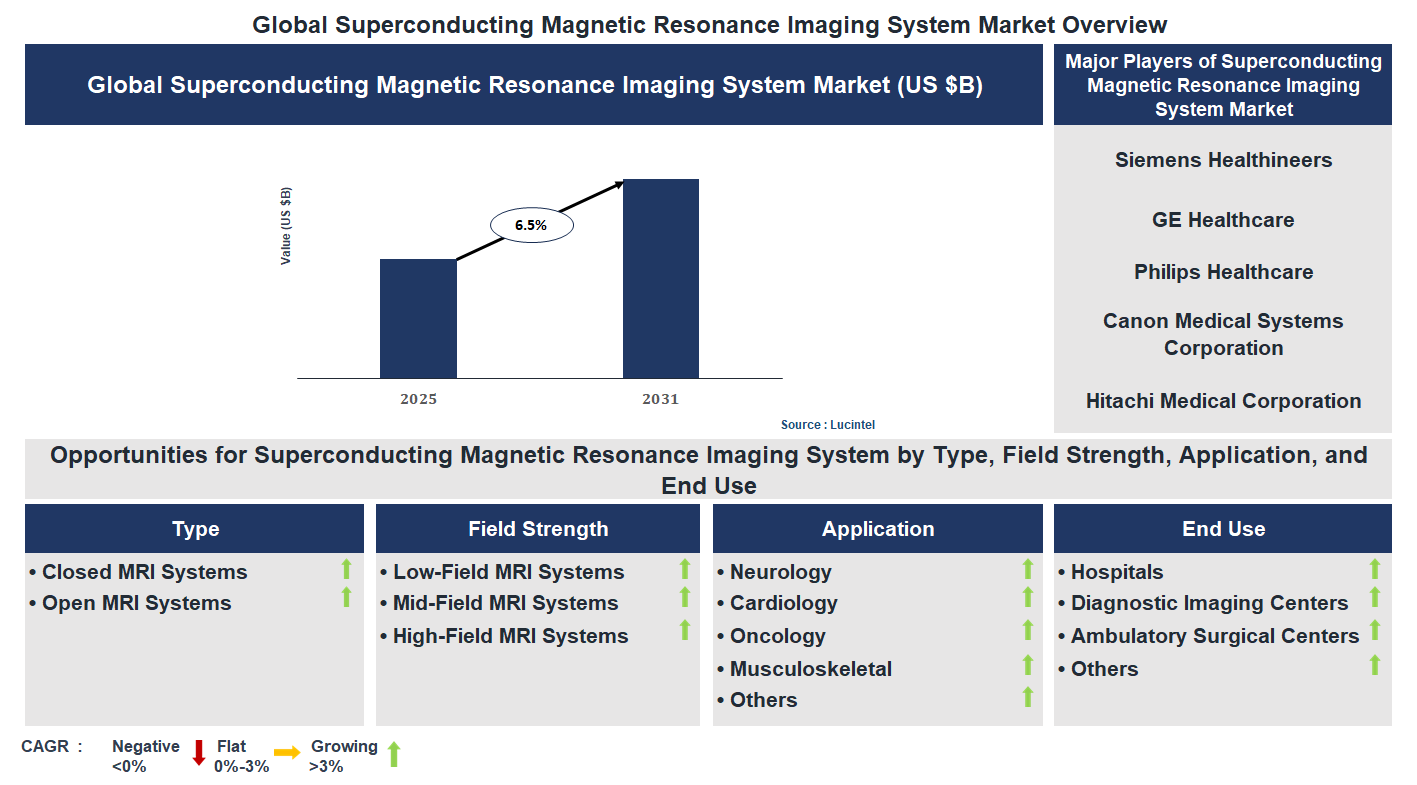
The future of the global superconducting magnetic resonance imaging system market looks promising with opportunities in the hospital, diagnostic imaging center, and ambulatory surgical center markets. The global superconducting magnetic resonance imaging system market is expected to grow with a CAGR of 6.5% from 2025 to 2031. The major drivers for this market are the increasing prevalence of chronic diseases, the rising demand for advanced diagnostic imaging, and the growing adoption of non-invasive medical procedures.• Lucintel forecasts that, within the type category, closed MRI system is expected to witness higher growth over the forecast period.
• Within the end use category, hospital is expected to witness the highest growth.
• In terms of region, North America is expected to witness the highest growth over the forecast period. Gain valuable insights for your business decisions with our comprehensive 150+ page report. Sample figures with some insights are shown below.
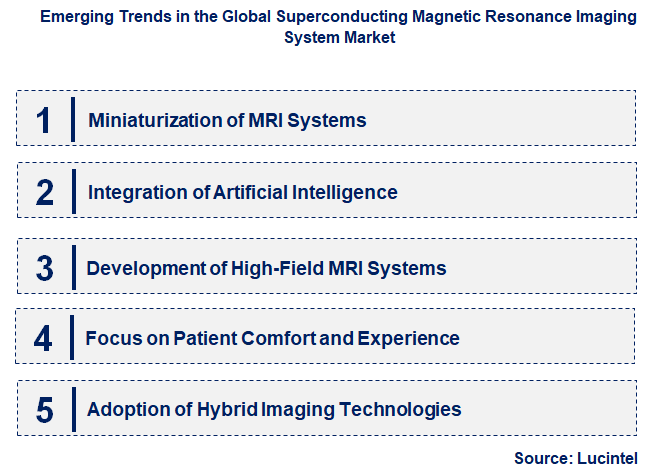
Emerging Trends in the Superconducting Magnetic Resonance Imaging System Market
The superconducting magnetic resonance imaging system market is experiencing rapid evolution driven by technological advancements, increasing healthcare demands, and a focus on precision diagnostics. As medical imaging becomes more sophisticated, the market is witnessing innovative trends that enhance imaging quality, reduce costs, and improve patient outcomes. These developments are shaping the future landscape of MRI systems, making them more accessible, efficient, and capable of providing detailed insights into complex medical conditions. Understanding these emerging trends is crucial for stakeholders aiming to stay competitive and leverage new opportunities in this dynamic market.• Miniaturization of MRI Systems: Smaller, portable MRI devices are emerging to improve accessibility and reduce costs. These compact systems are designed for point-of-care diagnostics, emergency settings, and remote locations, expanding the reach of advanced imaging. The trend enhances patient convenience and allows for quicker diagnosis, especially in underserved areas. Technological innovations in superconducting materials and cooling systems are enabling these miniaturized units without compromising image quality, thus broadening the application scope of MRI technology.
• Integration of Artificial Intelligence: AI is increasingly integrated into MRI systems to enhance image analysis, automate workflows, and improve diagnostic accuracy. Machine learning algorithms assist radiologists by providing real-time image interpretation, detecting anomalies, and reducing human error. AI-driven tools also optimize scan protocols, decreasing scan times and improving patient throughput. This trend is transforming MRI from a purely imaging tool into an intelligent diagnostic platform, leading to faster, more accurate diagnoses and personalized treatment planning.
• Development of High-Field MRI Systems: The market is witnessing a shift towards ultra-high-field MRI systems (7 Tesla and above) that offer superior spatial resolution and better tissue contrast. These systems are particularly valuable in neurological, musculoskeletal, and oncological imaging, providing detailed insights into complex structures. The increased magnetic field strength enhances the detection of subtle abnormalities, aiding early diagnosis and research. However, high costs and technical challenges remain, but ongoing innovations are making high-field MRI more feasible and widespread.
• Focus on Patient Comfort and Experience: New MRI designs prioritize patient comfort through noise reduction, shorter scan times, and open or wide-bore configurations. These improvements aim to reduce anxiety and claustrophobia, making MRI procedures more tolerable, especially for pediatric and claustrophobic patients. Enhanced comfort features also lead to better image quality by minimizing patient movement. As patient-centric care becomes a priority, manufacturers are innovating to create more welcoming and less intimidating MRI environments, thereby increasing patient compliance and satisfaction.
• Adoption of Hybrid Imaging Technologies: Combining MRI with other imaging modalities, such as PET or CT, is gaining traction to provide comprehensive diagnostic information. Hybrid systems enable simultaneous acquisition of functional and anatomical data, improving disease detection and treatment monitoring. This integrated approach reduces the need for multiple appointments and enhances diagnostic accuracy. The development of such multimodal systems is driven by technological compatibility and clinical demand for more detailed, multi-faceted insights into complex conditions, ultimately improving patient outcomes and streamlining clinical workflows. In summary, these emerging trends are significantly reshaping the Superconducting MRI System Market by making imaging more accessible, accurate, and patient-friendly. The integration of advanced technologies like AI and hybrid systems, along with innovations in system design, is driving growth and expanding the capabilities of MRI technology. As these trends continue to evolve, they will lead to more personalized, efficient, and effective diagnostic solutions, ultimately transforming healthcare delivery worldwide.
Recent Development in the Superconducting Magnetic Resonance Imaging System Market
The superconducting magnetic resonance imaging system market has experienced significant advancements driven by technological innovations, increasing healthcare demands, and expanding applications in medical diagnostics. As the global healthcare infrastructure evolves, the demand for more precise, faster, and cost-effective imaging solutions continues to grow. Recent developments reflect a focus on improving image quality, reducing costs, and expanding accessibility, which collectively influence market dynamics. These innovations are shaping the future landscape of MRI systems, making them more efficient and patient-friendly. The following are five key recent developments in this market that highlight its ongoing evolution and potential growth trajectory.• Enhanced Magnet Technology: Development of higher-field superconducting magnets has led to improved image resolution and faster scan times, significantly enhancing diagnostic accuracy and patient throughput.
• Cost-Effective Cryogen-Free Systems: Introduction of cryogen-free MRI systems reduces operational costs and maintenance, making advanced imaging more accessible to smaller healthcare facilities and expanding market reach.
• AI Integration for Image Analysis: Incorporation of artificial intelligence algorithms improves image processing, diagnosis accuracy, and workflow efficiency, thereby increasing the systems clinical utility and adoption.
• Portable MRI Systems: Advances in portable and compact MRI devices enable imaging in remote or underserved areas, broadening access to advanced diagnostics and opening new market segments.
• Regulatory Approvals and Collaborations: Increased approvals from regulatory bodies and strategic collaborations between manufacturers and healthcare providers accelerate product deployment and market penetration. These developments are collectively transforming the Superconducting MRI System Market by enhancing performance, reducing costs, and expanding accessibility. As a result, the market is experiencing accelerated growth, with increased adoption across diverse healthcare settings, ultimately improving patient outcomes and diagnostic capabilities.
Strategic Growth Opportunities in the Superconducting Magnetic Resonance Imaging System Market
The superconducting magnetic resonance imaging system market is experiencing rapid growth driven by technological advancements, increasing healthcare investments, and rising demand for precise diagnostic tools. As medical imaging becomes more sophisticated, key applications are expanding into new areas, creating significant opportunities for market players. These developments not only enhance diagnostic accuracy but also improve patient outcomes and operational efficiencies. The following are five key growth opportunities across different applications that are shaping the future of this market, offering substantial benefits to healthcare providers and patients alike.• Neuroimaging: Advances in superconducting MRI systems enable higher resolution imaging of brain structures, facilitating early detection of neurological disorders such as Alzheimer’s and Parkinson’s. This improves treatment planning and patient prognosis, driving increased adoption in neurology clinics and research institutions.
• Oncology: Superconducting MRI systems provide superior soft tissue contrast, allowing for accurate tumor localization and assessment. This supports personalized treatment strategies, reduces invasive procedures, and enhances patient outcomes, fueling growth in cancer diagnostics.
• Cardiology: The ability to visualize cardiac structures with high clarity helps in diagnosing complex heart conditions. These systems enable detailed functional and anatomical assessments, leading to better management of cardiovascular diseases and expanding their use in cardiology centers.
• Musculoskeletal Imaging: Advanced superconducting MRI systems improve imaging of joints, muscles, and bones, aiding in the diagnosis of sports injuries, arthritis, and other musculoskeletal conditions. This broadens the application scope in orthopedic and sports medicine practices.
• Pediatric and Fetal Imaging: The development of child-friendly MRI systems with reduced scan times and enhanced safety features allows for detailed fetal and pediatric imaging. This reduces the need for invasive procedures and improves early diagnosis, expanding market opportunities in pediatric healthcare. In summary, these growth opportunities are significantly impacting the superconducting MRI system market by expanding its application scope, improving diagnostic accuracy, and enhancing patient care. As technological innovations continue, the market is poised for sustained growth, driven by increasing demand for advanced, non-invasive imaging solutions across diverse medical fields.
Superconducting Magnetic Resonance Imaging System Market Driver and Challenges
The superconducting magnetic resonance imaging system market is influenced by a variety of technological, economic, and regulatory factors. Advances in superconducting materials and imaging technology are driving innovation, while increasing healthcare expenditure and demand for non-invasive diagnostic tools are expanding market opportunities. Regulatory approvals and safety standards also shape market dynamics, ensuring quality and compliance. However, challenges such as high costs, technological complexities, and regulatory hurdles pose significant barriers. Understanding these drivers and challenges is essential for stakeholders to navigate the evolving landscape and capitalize on growth prospects effectively. The factors responsible for driving the superconducting magnetic resonance imaging system market include:-• Technological Innovation: The continuous development of superconducting materials and imaging techniques enhances image quality, reduces scan times, and improves patient comfort. These innovations attract healthcare providers seeking advanced diagnostic tools, thereby expanding market adoption. Additionally, integration with AI and machine learning further optimizes imaging processes, making MRI systems more efficient and accessible. As technology advances, manufacturers can offer more sophisticated, reliable, and cost-effective systems, fueling market growth.
• Increasing Healthcare Expenditure: Rising healthcare spending worldwide, especially in emerging economies, boosts demand for advanced diagnostic equipment like superconducting MRI systems. Governments and private healthcare providers invest heavily in modern medical infrastructure to improve patient outcomes. This financial commitment supports the procurement of high-end imaging systems, driving market expansion. Moreover, the growing prevalence of chronic diseases necessitates early and accurate diagnosis, further propelling demand for superior imaging solutions.
• Growing Prevalence of Chronic Diseases: The increasing incidence of conditions such as cancer, neurological disorders, and cardiovascular diseases necessitates precise diagnostic tools. Superconducting MRI systems offer high-resolution imaging crucial for early detection and treatment planning. As the burden of these diseases escalates globally, healthcare providers prioritize investing in advanced imaging technology, thereby expanding the market. This trend underscores the importance of superconducting MRI systems in improving diagnostic accuracy and patient management.
• Regulatory Approvals and Standards: Stringent regulatory frameworks ensure the safety, efficacy, and quality of superconducting MRI systems. Approval from agencies like the FDA and EMA facilitates market entry and builds trust among healthcare providers. Compliance with safety standards also minimizes risks associated with high magnetic fields and superconducting materials. These regulatory processes, while challenging, ultimately promote innovation and ensure that only reliable, safe systems reach the market, fostering long-term growth.
• Strategic Collaborations and Partnerships: Collaborations between technology developers, healthcare providers, and research institutions accelerate innovation and market penetration. Partnerships facilitate the sharing of expertise, resources, and technological advancements, leading to the development of more effective MRI systems. Additionally, joint ventures help manufacturers navigate regulatory landscapes and expand into new markets. These strategic alliances are vital for sustaining competitive advantage and fostering continuous innovation in the superconducting MRI market. The challenges facing this superconducting magnetic resonance imaging system market include:-
• High Capital and Operational Costs: Superconducting MRI systems require significant investment in infrastructure, superconducting magnets, and maintenance. The high costs limit adoption among smaller healthcare facilities and in developing regions. Operational expenses, including cooling systems and specialized personnel, further add to the financial burden. These economic barriers hinder widespread deployment, restricting market growth primarily to well-funded institutions and developed countries.
• Technological Complexity and Maintenance: The sophisticated nature of superconducting MRI systems demands specialized knowledge for installation, operation, and maintenance. Ensuring system stability and performance over time involves complex procedures and frequent calibration. Technological failures or downtime can disrupt diagnostic services, impacting patient care and increasing costs. Overcoming these complexities requires ongoing training and technical support, which can be resource-intensive and limit adoption in resource-constrained settings.
• Regulatory and Safety Challenges: Navigating the complex regulatory landscape for high-field MRI systems involves extensive testing, documentation, and compliance measures. Ensuring safety standards related to magnetic fields and cryogenic systems is critical but challenging. Delays in approvals and evolving regulations can hinder product launches and market expansion. Additionally, safety concerns related to magnetic exposure and cryogen handling necessitate rigorous safety protocols, adding to the operational challenges faced by manufacturers and healthcare providers. In summary, the superconducting magnetic resonance imaging system market is shaped by rapid technological advancements, increasing healthcare investments, and the rising burden of chronic diseases, all of which drive growth. However, high costs, technological complexities, and regulatory hurdles pose significant challenges. These factors collectively influence market dynamics, requiring stakeholders to innovate continuously and navigate regulatory landscapes carefully. The overall impact is a market poised for growth, provided that technological and regulatory challenges are effectively managed, ensuring broader access and improved diagnostic capabilities worldwide.
List of Superconducting Magnetic Resonance Imaging System Companies
Companies in the market compete on the basis of product quality offered. Major players in this market focus on expanding their manufacturing facilities, R&D investments, infrastructural development, and leverage integration opportunities across the value chain. With these strategies superconducting magnetic resonance imaging system companies cater increasing demand, ensure competitive effectiveness, develop innovative products & technologies, reduce production costs, and expand their customer base. Some of the superconducting magnetic resonance imaging system companies profiled in this report include-• Siemens Healthineers
• GE Healthcare
• Philips Healthcare
• Canon Medical Systems Corporation
• Hitachi Medical Corporation
• Fujifilm Holdings Corporation
• Toshiba Medical Systems Corporation
• Bruker Corporation
• Elekta AB
• Neusoft Medical Systems
Superconducting Magnetic Resonance Imaging System Market by Segment
The study includes a forecast for the global superconducting magnetic resonance imaging system market by type, field strength, application, end use, and region.Superconducting Magnetic Resonance Imaging System Market by Type [Value from 2019 to 2031]:
• Closed MRI Systems
• Open MRI Systems
Superconducting Magnetic Resonance Imaging System Market by Field Strength [Value from 2019 to 2031]:
• Low-Field MRI Systems
• Mid-Field MRI Systems
• High-Field MRI Systems
Superconducting Magnetic Resonance Imaging System Market by Application [Value from 2019 to 2031]:
• Neurology
• Cardiology
• Oncology
• Musculoskeletal
• Others
Superconducting Magnetic Resonance Imaging System Market by End Use [Value from 2019 to 2031]:
• Hospitals
• Diagnostic Imaging Centers
• Ambulatory Surgical Centers
• Others
Superconducting Magnetic Resonance Imaging System Market by Region [Value from 2019 to 2031]:
• North America
• Europe
• Asia Pacific
• The Rest of the World
Country Wise Outlook for the Superconducting Magnetic Resonance Imaging System Market
The superconducting magnetic resonance imaging system market has experienced significant technological advancements and increased adoption across the globe. As healthcare demands grow and technological innovations emerge, countries are investing heavily in research, infrastructure, and new product development. The markets evolution is driven by the need for more precise diagnostics, improved patient outcomes, and cost-effective solutions. Regulatory approvals and strategic collaborations further accelerate growth. The United States, China, Germany, India, and Japan are key players, each contributing uniquely to the markets expansion through innovation, policy support, and increasing healthcare infrastructure.• United States: The US market has seen rapid adoption of advanced superconducting MRI systems with higher magnetic field strengths, such as 7 Tesla models, enhancing diagnostic accuracy. Major players like GE Healthcare and Siemens are investing in research to develop more efficient, lower-cost systems. Regulatory agencies have streamlined approval processes, facilitating faster market entry. The US also emphasizes integrating AI with MRI technology for improved image analysis and workflow efficiency. Growing healthcare infrastructure and a focus on personalized medicine are further driving demand for high-end MRI systems.
• China: China is experiencing rapid growth in the superconducting MRI market, driven by government initiatives to upgrade healthcare infrastructure and increase access to advanced diagnostic tools. Local manufacturers are investing in R&D to develop cost-effective MRI systems tailored to regional needs. The country is also witnessing a surge in private healthcare facilities adopting high-field MRI systems. Strategic collaborations with international firms are fostering technology transfer and innovation. Additionally, government policies supporting medical device manufacturing are boosting domestic production, making China a significant emerging market for superconducting MRI systems.
• Germany: Germany remains a leader in medical technology innovation, with a focus on developing high-performance superconducting MRI systems that offer superior image quality and patient comfort. The country’s strong healthcare infrastructure and emphasis on research and development support the deployment of cutting-edge MRI solutions. German companies are actively involved in European and global markets, emphasizing sustainable and energy-efficient systems. Regulatory standards in Germany ensure high safety and quality, fostering trust among healthcare providers. The integration of AI and advanced imaging techniques continues to be a key focus, maintaining Germany’s competitive edge in the market.
• India: India’s superconducting MRI market is expanding rapidly due to increasing healthcare awareness, rising income levels, and government initiatives to improve medical infrastructure. The country is witnessing a surge in the installation of high-field MRI systems in urban hospitals and diagnostic centers. Local manufacturers are focusing on cost-effective, portable MRI solutions to cater to rural and semi-urban areas. Public-private partnerships and government schemes like Ayushman Bharat are facilitating wider access to advanced imaging technologies. The market growth is also driven by a rising prevalence of chronic diseases requiring precise diagnostic tools, making India a promising emerging market.
• Japan: Japan’s market for superconducting MRI systems is characterized by high adoption of innovative, high-field MRI technologies with enhanced imaging capabilities. The country’s aging population increases demand for advanced diagnostic tools, prompting investments in next-generation MRI systems. Japanese companies are leading in integrating AI and robotics into MRI technology to improve efficiency and patient experience. Regulatory frameworks support the rapid approval and deployment of new systems. Japan’s focus on healthcare quality and technological innovation sustains its position as a key market for high-end superconducting MRI systems, with ongoing research collaborations fostering further advancements.

Features of the Global Superconducting Magnetic Resonance Imaging System Market
Market Size Estimates: Superconducting magnetic resonance imaging system market size estimation in terms of value ($B). Trend and Forecast Analysis: Market trends (2019 to 2024) and forecast (2025 to 2031) by various segments and regions. Segmentation Analysis: Superconducting magnetic resonance imaging system market size by various segments, such as by type, field strength, application, end use, and region in terms of value ($B). Regional Analysis: Superconducting magnetic resonance imaging system market breakdown by North America, Europe, Asia Pacific, and Rest of the World. Growth Opportunities: Analysis of growth opportunities in different types, field strength, applications, end uses, and regions for the superconducting magnetic resonance imaging system market. Strategic Analysis: This includes M&A, new product development, and competitive landscape of the superconducting magnetic resonance imaging system market. Analysis of competitive intensity of the industry based on Porter’s Five Forces model.
FAQ
Q1. What is the growth forecast for superconducting magnetic resonance imaging system market? Answer: The global superconducting magnetic resonance imaging system market is expected to grow with a CAGR of 6.5% from 2025 to 2031. Q2. What are the major drivers influencing the growth of the superconducting magnetic resonance imaging system market? Answer: The major drivers for this market are the increasing prevalence of chronic diseases, the rising demand for advanced diagnostic imaging, and the growing adoption of non-invasive medical procedures. Q3. What are the major segments for superconducting magnetic resonance imaging system market? Answer: The future of the superconducting magnetic resonance imaging system market looks promising with opportunities in the hospital, diagnostic imaging center, and ambulatory surgical center markets. Q4. Who are the key superconducting magnetic resonance imaging system market companies? Answer: Some of the key superconducting magnetic resonance imaging system companies are as follows:• Siemens Healthineers
• GE Healthcare
• Philips Healthcare
• Canon Medical Systems Corporation
• Hitachi Medical Corporation
• Fujifilm Holdings Corporation
• Toshiba Medical Systems Corporation
• Bruker Corporation
• Elekta AB
• Neusoft Medical Systems Co., Ltd. Q5. Which superconducting magnetic resonance imaging system market segment will be the largest in future? Answer: Lucintel forecasts that, within the type category, closed MRI system is expected to witness higher growth over the forecast period. Q6. In superconducting magnetic resonance imaging system market, which region is expected to be the largest in next 5 years? Answer: In terms of region, North America is expected to witness the highest growth over the forecast period. Q7. Do we receive customization in this report? Answer: Yes, Lucintel provides 10% customization without any additional cost.
Table of Contents
List of Figures
List of Tables
Methodology
- In-depth interviews of the major players in this market
- Detailed secondary research from competitors’ financial statements and published data
- Extensive searches of published works, market, and database information pertaining to industry news, company press releases, and customer intentions
- A compilation of the experiences, judgments, and insights of Lucintel’s professionals, who have analyzed and tracked this market over the years.


Buy Now
Choose a license that fits your team. Instant PDF delivery.
Prices exclude taxes. Instant delivery. Custom licensing available on request.
Key Questions
- • What are some of the most promising, high-growth opportunities for the superconducting magnetic resonance imaging system market by type (closed MRI systems and open MRI systems), field strength (low-field MRI systems, mid-field MRI systems, and high-field MRI systems), application (neurology, cardiology, oncology, musculoskeletal, and others), end use (hospitals, diagnostic imaging centers, ambulatory surgical centers, and others), and region (North America, Europe, Asia Pacific, and the Rest of the World)?
- • Which segments will grow at a faster pace and why?
- • Which region will grow at a faster pace and why?
- • What are the key factors affecting market dynamics? What are the key challenges and business risks in this market?
- • What are the business risks and competitive threats in this market?
- • What are the emerging trends in this market and the reasons behind them?
- • What are some of the changing demands of customers in the market?
- • What are the new developments in the market? Which companies are leading these developments?
- • Who are the major players in this market? What strategic initiatives are key players pursuing for business growth?
- • What are some of the competing products in this market and how big of a threat do they pose for loss of market share by material or product substitution?
- • What M&A activity has occurred in the last 5 years and what has its impact been on the industry? For any questions related to Superconducting Magnetic Resonance Imaging System Market, Superconducting Magnetic Resonance Imaging System Market Size, Superconducting Magnetic Resonance Imaging System Market Growth, Superconducting Magnetic Resonance Imaging System Market Analysis, Superconducting Magnetic Resonance Imaging System Market Report, Superconducting Magnetic Resonance Imaging System Market Share, Superconducting Magnetic Resonance Imaging System Market Trends, Superconducting Magnetic Resonance Imaging System Market Forecast, Superconducting Magnetic Resonance Imaging System Companies, write Lucintel analyst at email: helpdesk@lucintel.com. We will be glad to get back to you soon.


