
Market Report · July 31, 2026

Key data points: The market size in 2030 = $4 billion, growth forecast = 3.2% annually for the next 6 years. Scroll below to get more insights. This market report covers trends, opportunities, and forecasts in the global superconducting magnet market to 2030 by material (low-temperature superconducting material and high-temperature superconducting material), application (medical devices & equipments, mass spectrometers, transportation, and others), and region (North America, Europe, Asia Pacific, and the Rest of the World)
We'll send your sample report shortly.
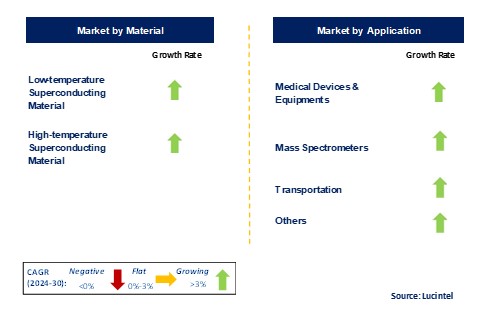
• Lucintel forecasts that, within the material category, low-temperature superconducting material will remain the larger segment over the forecast period.
• Within the application category, medical devices & equipment will remain the largest segment due to widespread use in magnetic resonance imaging machines.
• In terms of regions,APAC will remain the largest region due to increased infrastructure spending and rapid economic expansion, especially in China and India.
Gain valuable insights for your business decisions with our comprehensive 150+ page report.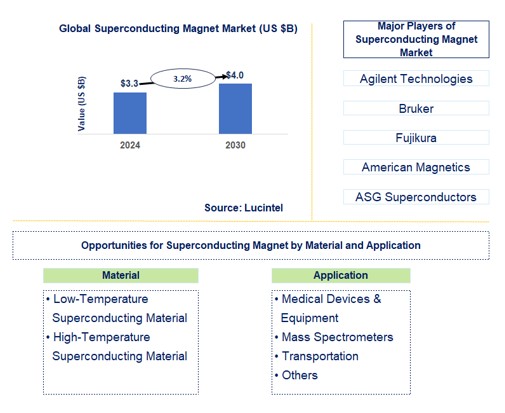
• Development of High-Temperature Superconductors (HTS): The adoption of high-temperature superconductors (HTS) is one major trend seen in the market for superconducting magnets. HTS materials like YBCO and BSCCO enable the development of magnets that operate at higher temperatures compared to traditional low-temperature superconductors. This saves on cooling costs and enhances the efficiency of magnets. As such, there is a growing demand for better-performing and more affordable superconductive solutions, with HTS technology being commonly employed in applications such as maglev trains and MRI machines.
• Advancements in Magnet Cooling Technologies: Innovations in magnet cooling technologies have resulted in more efficient and superior performance of superconductive magnets. New ways to cool down these devices are being developed using advanced cryocoolers along with innovative liquid helium management systems aimed at improving thermal management while reducing operating expenses. Such improved devices can be utilized across various application fields that were once limited by cooling problems or stability concerns, thus expanding their potential sales into different markets.
• Expansion into Medical Imaging and Diagnostics: There is an ever-increasing use of superconductive magnets within sophisticated medical imaging and diagnostic settings. Increased spatial resolution along with faster imaging times are just some innovations credited to MRI technology. Thus, hospitals and research institutions striving towards enhanced imaging quality coupled with patient care increasingly require high-field magnets. This trend is driving growth within the superconductive magnet market while fostering medical technology developments.
• Integration into Transportation Systems: The use of superconducting magnets in transportation systems such as maglev trains and advanced rail systems has increased. They provide strong magnetic levitation and propulsion for high-speed, frictionless transport. Such applications are being embraced in various countries as governments and companies invest in next-generation transport infrastructure. According to industry analysts, this trend will witness considerable advancements driven by superconducting magnet applications within the transportation system.
• Focus on Sustainable and Cost-Effective Solutions: Superconducting magnet solutions are increasingly expected to be sustainable and cost-effective. Researchers and manufacturers are engaged in attempts to minimize the environmental impacts associated with superconducting magnet production and operation, including reducing liquid helium usage rates as well as improving materials recycling. These broader trends towards greener technologies, alongside cost containment, make superconducting magnets more accessible and environmentally friendly, thus supporting their sustainability goals and promoting market growth.
This article outlines several developing trends in the superconductive magnet market, such as advances in high-temperature dimensions, cooling methods, integration into medical devices, and transportation. The adoption of sustainable approaches that also tend to be cost-effective indicates how successful we have been at introducing these new technologies into our societies. These trends show that the market is shifting towards more efficient, versatile, and greener alternatives, thereby attracting innovations and expanding areas of application. As these emerging trends continue to shape up, they will determine where the future lies for advanced technology by influencing further developments in superconducting magnet markets.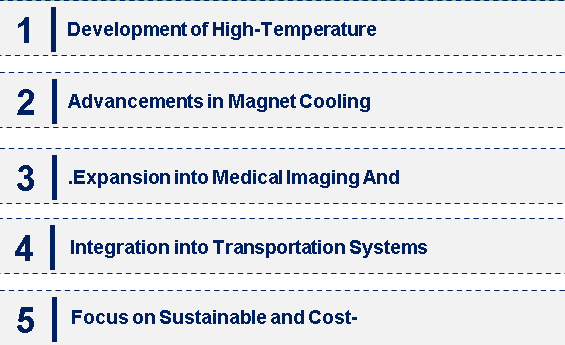
• Advancements in High-Temperature Superconductors (HTS): Recent breakthroughs in high-temperature superconductors (HTS) like YBCO and BSCCO have led to a revolution in the market for superconducting magnets. This allows magnets to operate at higher temperatures than traditional low-temperature superconductors, thus reducing the need for costly and complex cooling management systems. HTS technology improves efficiency and cost-effectiveness in applications such as MRI machines and maglev trains, making them more universal and driving market growth.
• Innovations in Magnet Cooling Technologies: Significant advancements in cooling technologies improve the performance of low-temperature superconductor-based magnets and their operational costs. This lowers cooling requirements through innovative cryocoolers that are more effective or advanced helium management systems. Consequently, these innovations ensure the stability and reliability of superconducting magnets, enabling them to be used for several applications while widening market frontiers.
• Expansion of Superconducting Magnets in Medical Imaging: The use of superconducting magnets for medical imaging is progressing rapidly through new MRI technology that pushes imaging limits. High-field strength superconductive magnets enable clearer detailed images, which enhance diagnostic accuracy and lead to better patient outcomes. The increased demand for high-resolution medical imaging has resulted in advanced development and adoption of these technologies, creating better healthcare services and resulting in market growth within healthcare industries.
• Integration into Transportation Infrastructure: Superconducting magnets are increasingly becoming part of transportation systems, particularly in maglev trains and high-speed rail projects. These magnets achieve frictionless, high-speed transport via magnetic levitation and propulsion. The recent investments in superconducting maglev technology have increased the use of superconducting magnets in transport, promoting innovation and infrastructure development while offering a cleaner and more efficient substitute for traditional railway systems.
• Focus on Sustainable and Cost-Effective Solutions: There is an increasing focus on sustainable, cost-effective solutions regarding superconducting magnets. Efforts are being made to make the production of magnets environmentally friendly by decreasing the use of liquid helium and improving material recycling. This shift towards sustainability and cost reduction makes it easier to access environmentally friendly superconducting magnets, promoting wider adoption across many sectors and leading to long-term market growth.
Recent developments in the superconducting magnet market highlight significant advancements and shifts in the industry. Advances in high-temperature superconductors, cooling technologies, and medical imaging applications are some of the drivers of growth that expand horizons. Integration with mass transportation and commitment to a green environment also make superconducting magnets more applicable and attractive for clients seeking eco-friendly products. Together, all these transformations show how versatile, economical, and aligned with modern technical and environmental needs this industry has become.• Magnetic Resonance Imaging (MRI): Superconducting magnets are vital components of MRI systems, which demand high magnetic fields for advanced imaging techniques. Opportunities lie in creating higher-field magnets for improved imaging resolution and speed. Magnet designs and material innovations are improving the performance and cost-effectiveness of MRI systems. Hence, upgrading imaging capabilities has led to increased demand for superconducting magnets by healthcare facilities, driving growth in the medical imaging industry and advancements in diagnostic accuracy and patient care.
• Particle Accelerators: Utilization of superconducting magnets, such as those used in high-energy physics research particle accelerators, presents an opportunity for rapid expansion. Powerful magnetic fields provided by superconducting magnets are required during the confinement and acceleration of particles. Advances in magnet technology allow building larger, more precise, and powerful accelerators within a given range, fostering global research efforts and collaborations that underscore their indispensable role in scientific discoveries.
• Maglev Transportation: Frictionless, high-speed travel is achievable using superconducting magnets, which are increasingly employed in magnetic levitation (maglev) transportation systems instead of traditional friction-based rail transport networks. Growth opportunities associated with maglev transportation encompass extending maglev infrastructure and developing new urban and intercity transit systems that employ this concept, thus eliminating wheel-rail contact and providing the possibility of higher speeds than traditional rail. Superconducting magnets facilitate efficient and smooth transportation through strong magnetic levitation and propulsion, fostering innovation in high-speed transport through market growth driven by investment in maglev technology as it represents an alternative to conventional rail systems.
• Energy Storage Systems: Superconducting magnets are increasingly used in energy storage systems such as superconducting magnetic energy storage (SMES). SMES provides high-efficiency energy storage with rapid discharge capabilities, which could be useful for grid stabilization and backup power solutions if SMES can be improved in terms of scalability and cost-effectiveness. Advances in superconductive materials and cooling technologies have enhanced the performance and economic viability of these units, thereby supporting a transition towards more stable, reliable, and sustainable energy infrastructures.
• Quantum Computing: There is potential for using superconducting magnets in quantum computing, which could become one of the fastest-growing sectors. Quantum computers’ fundamental building blocks, known as superconducting qubits, require high-performance superconducting magnets for precise control and operation. With advancing quantum computing technology, there is an increasing demand for dedicated superconducting magnets that facilitate reliable, scalable quantum systems. Investments in quantum research are promoting innovation, establishing superconducting magnets as essential components of future computing machinery development when such computers become a reality.
Strategic growth opportunities in the superconducting magnet market are substantial across several key areas such as MRI systems, particle accelerators, maglev transportation, energy storage, and quantum computing. Each of these opportunities has its own innovation and expansion potential supported by technological advances and growing demand patterns. The importance of these opportunities demonstrates how significant superconducting magnets have become in modern technology and infrastructure. Through their continuous transformation, these applications define the future of the superconducting magnet industry, which is expanding into various sectors.• Technological advancements in superconductors: One of the major drivers for the market is the advancement of superconductive materials, mainly high-temperature superconductors (HTS). High-temperature superconducting (HTS) materials, such as YBCO or BSCCO, can operate at higher temperatures than conventional superconductors, which not only reduces cooling costs but also increases efficiency. New materials science discoveries have increased their usefulness across various spheres, while better-performing magnets have been designed that can be applied to several other industries, from medical imaging to energy storage, thus driving this market.
• Increasing demand in medical imaging: The development of advanced MRI systems has spurred the growth of the magnetic resonance system industry. High-field MRI scanners require superconducting magnets for enhanced image resolution and diagnostic capabilities. As patient care improves due to upgrades in healthcare providers’ imaging technologies, the need for high-performance superconducting magnets escalates. It thereby spurs investment into new magnet technologies as well as applications within medicine, hence expanding its markets.
• Growth in particle accelerators and research facilities: Superconducting magnets are among the major drivers behind the proliferation of particle accelerators and research facilities worldwide. High-field magnets used in confining particles during scientific experiments are needed by such facilities, including particle accelerators, that propel particles at high speeds. Recently, there have been advances made by accelerator technologists together with international research alliances, leading to demands for these types of magnetic devices specially built using superconducting materials. This growing technology is an offshoot of magnet technology innovation that has led to new scientific discoveries and market growth.
• Development of maglev transportation: Superconducting magnets are indispensable in maglev transportation systems, which enable high-speed and frictionless movement. Superconducting magnets are used in the development of maglev trains and other advanced rail systems. As a result, infrastructure investments in this transport industry and advancements in technology have led to an expanded use of superconducting magnets, thus becoming a significantly growing industry. The impact of this trend can be witnessed through emerging innovations in transportation technologies and new projects in maglev.
• Advances in energy storage systems: Significant market opportunities present themselves through the use of superconducting magnets for energy storage, such as Superconducting Magnetic Energy Storage (SMES). Grid stabilization and backup power require efficient, high-discharge-speed systems, with SMES being one of them. More scalable energy storage is improving due to advances made in new cooling approaches and superconductive materials. Such growth comes from increased demand for reliable and sustainable energy infrastructures.
Challenges in the superconducting magnet market are:• High production and operational costs: The production cost may lead superconducting magnets to high prices due to expensive raw materials involved as well as complex cooling systems during operations, which make it costly. Consequently, these costs make it difficult for new entrants into the market, thus affecting profitability levels among other companies already operating within this particular field segment. Addressing such costs will require novel material science ideas or manufacturing techniques aimed at reducing expenses associated with producing more affordable superconducting magnets, which would influence its adoption rate and market growth, impacting future marketing trends.
• Regulatory and environmental compliance: The superconducting magnet market faces the difficulties of adhering to regulatory and environmental obligations. Compliance with these laws can be expensive and convoluted, leading to low efficiency in operations as well as hampering entry into the market. This means that companies must keep up with changes in regulations for better sustainable practices that ensure compliance while reducing environmental impacts.
• Technical limitations and scalability issues: The scalability of superconducting magnets is influenced by technical limitations, such as those associated with cooling systems and material performance issues. Problems like keeping magnetic fields stable or managing cooling requirements can impede the development and deployment of superconducting applications. Addressing these technical challenges is vital to enhancing performance and scalability, hence spurring a more diverse market for new application areas.
This sector depends on many factors, including advancements in technology, growth in maglev transportation, increased demand for medical imaging and diagnostics, and energy storage innovations. Nevertheless, market dynamics are affected by challenges that include high production costs, adherence to regulations, and technical constraints. To facilitate the growth of this industry, there is a need to address these drivers alongside their corresponding constraints. While heading towards future developments, it should be noted that their deeper applications are not predetermined.• Agilent Technologies
• Bruker
• Fujikura
• American Magnetics
• ASG Superconductors
• Cryomagnetics
• Elytt Energy
• Cryogenic
• Advanced Magnet
• Bilfinger
• Low-Temperature Superconducting Material
• High-Temperature Superconducting Material
• Medical Devices & Equipments
• Mass Spectrometers
• Transportation
• Others
• North America
• Europe
• Asia Pacific
• The Rest of the World
• United States: In America, high-field magnet technology has made significant progress in developing new technology for superconducting magnets while research initiatives have been ongoing. High-temperature superconductors (HTS) are being developed for use in medical imaging systems and particle accelerators at major institutions such as the National High Magnetic Field Laboratory. Moreover, private sector funding has been used to innovate MRI technology and support fusion research. Additionally, improvements in cryogenics and superconductor materials are aimed at enhancing magnet performance while also reducing costs, thus consolidating the US position as a leading country in magnetic technological advances.
• China: Driven by government backing and large investments in R&D activities, China is advancing its knowledge base towards superconducting magnets. Notable projects include the development of HTS magnets for medical imaging and maglev transportation, which improve its proficiency in high-temperature superconductivity magnetism. This involves partnerships with international research organizations on magnet performance and scalability improvements. The demand for superconducting magnets is stimulated by infrastructure projects like maglev trains, which have made China one of the key players globally.
• Germany: Germany leads in terms of advancements in new techniques for utilizing superconducting magnets in both industrial and scientific applications. German agencies, including the Max Planck Institute, are involved with HTS magnet development programs intended for biomedical studies and scientific applications. As part of its emphasis on innovation, Germany has been enhancing superconducting materials and magnet designs to improve performance and reduce operating costs. It is also working with industry partners in collaborative projects aimed at promoting the development of magnets for energy storage and particle physics.
• India: The Indian superconducting magnet market is growing as it builds capacities for research and expands medical imaging applications. Recent developments include the creation of new research facilities in collaboration with international institutions to further develop high-field magnet technologies. Improving the performance and reducing the cost of superconducting magnets in MRI systems and scientific research are current efforts in India. Government initiatives and infrastructural investments have underpinned the growth of the superconducting magnet industry, positioning India as a potential entrant into this sector.
• Japan: Recent advances in technology within Japan have seen the country remain one of the most important players in the world market for superconducting magnets, especially high-field and high-temperature ones. This includes applications where superconducting magnets have been deployed into advanced medical imaging systems and fusion research work. Innovations in superconductive materials, along with cooling technologies that enhance magnet functionality and reliability, inform much of Japan’s investment today. This indicates that Japan’s commitment to high-tech applications, while maintaining a strong focus on R&D, makes it one of the key contributors to the global superconducting magnet market.


• Agilent Technologies
• Bruker
• Fujikura
• American Magnetics
• ASG Superconductors
• Cryomagnetics
• Elytt Energy
• Cryogenic
• Advanced Magnet
• Bilfinger
Q6. Which superconducting magnet market segment will be the largest in future?

Choose a license that fits your team. Instant PDF delivery.
Prices exclude taxes. Instant delivery. Custom licensing available on request.
Market Report · July 31, 2026
Market Report · July 31, 2026
Market Report · July 31, 2026
Trusted partner for strategic intelligence and business growth


Receive a complimentary market analysis tailored to your industry. Our analysts will identify key growth opportunities and competitive dynamics specific to your business.

Market size, growth rate, and key trend analysis for your specific sector.

Top competitor positioning and market share analysis.

Strategic recommendations backed by data-driven insights.
Get curated market intelligence and competitive moves straight to your inbox.
By subscribing, you agree to receive our monthly insights. Unsubscribe anytime.
Receive a complimentary market analysis tailored to your industry. Our analysts will identify key growth opportunities and competitive dynamics specific to your business.
Market size, growth rate, and key trend analysis for your specific sector.
Top competitor positioning and market share analysis.
Strategic recommendations backed by data-driven insights.
Get curated market intelligence, emerging trends, and competitive moves straight to your inbox each month.
By subscribing, you agree to receive our monthly insights. Unsubscribe anytime.
We'll send your sample report shortly.