
Market Report · July 22, 2026

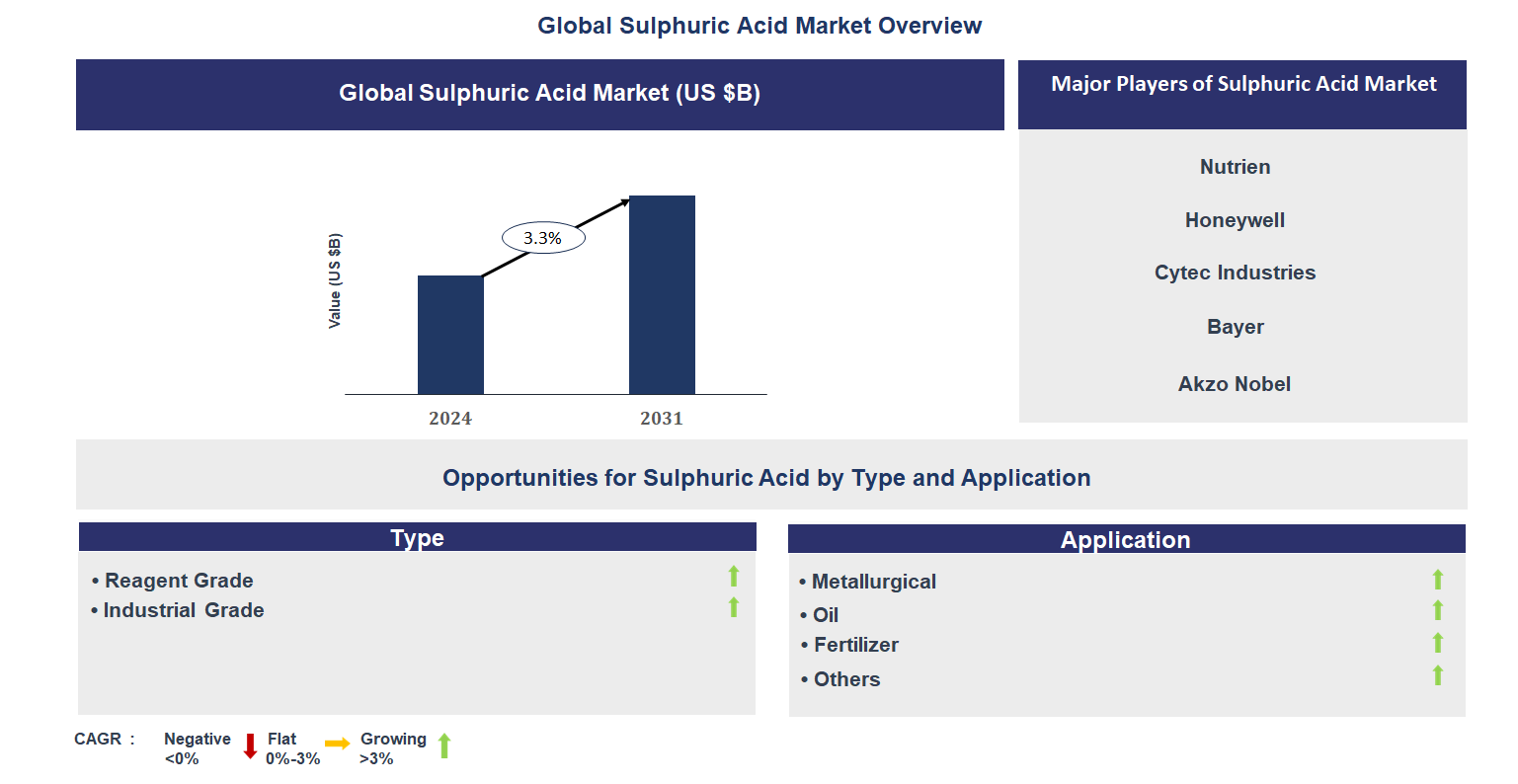
Key data points: The growth forecast = 3.3% annually for the next 7 years. Scroll below to get more insights. This market report covers trends, opportunities and forecasts in sulphuric acid market to 2031 by type (reagent grade and industrial grade), application (metallurgical, oil, fertilizer, and others), and region (North America, Europe, Asia Pacific, and the Rest of the World)
We'll send your sample report shortly.
• Lucintel forecasts that, within the type category, industrial grade is expected to witness higher growth over the forecast period.
• Within the application category, fertilizer is expected to witness the highest growth.
• In terms of region, APAC is expected to witness the highest growth over the forecast period. Gain valuable insights for your business decisions with our comprehensive 150+ page report. Sample figures with some insights are shown below.
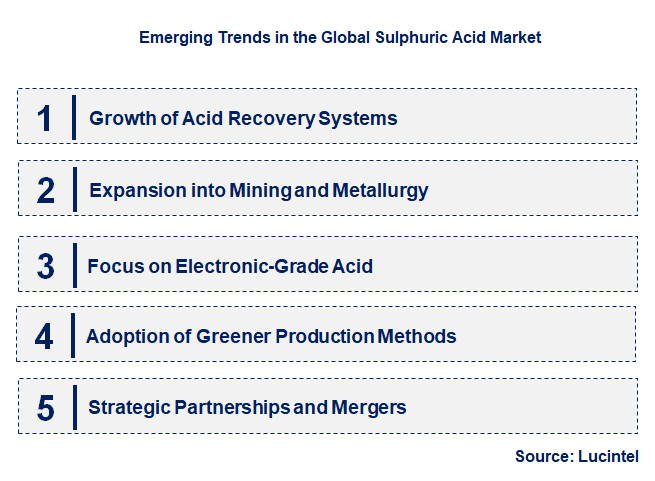
• Growth of Acid Recovery Systems: An emerging trend is the increasing use of spent acid recovery systems to minimize waste and reduce production costs. This is driven by environmental regulations and a desire for greater sustainability. The impact is a more circular economy for sulphuric acid, which is now being produced as a byproduct of other industrial processes, such as metal processing.
• Expansion into Mining and Metallurgy: A significant trend is the growing use of sulphuric acid in the mining and metallurgy industries, particularly for heap leaching and ore processing. Its ability to extract metals like copper and nickel from low-grade ores is a key driver. The impact is a new, high-growth application segment that is diversifying the market beyond its traditional uses.
• Focus on Electronic-Grade Acid: The market is seeing a major trend towards the production of electronic-grade sulphuric acid for the semiconductor industry. This high-purity acid is used for cleaning and etching silicon wafers. The impact is a new, high-value application segment that is creating stable demand and premium pricing for specialized grades.
• Adoption of Greener Production Methods: There is an emerging trend toward adopting more sustainable and energy-efficient production technologies. Companies are investing in new processes to reduce greenhouse gas emissions and improve operational efficiency. The impact is a cleaner manufacturing process, which helps companies comply with stricter environmental regulations and improves their brand image.
• Strategic Partnerships and Mergers: A significant trend is the increasing number of strategic partnerships and mergers among key players in the sulphuric acid market. This is aimed at consolidating market share and expanding production capacity. The impact is a more concentrated market with fewer, but more powerful, companies. These trends are fundamentally reshaping the sulphuric acid market by pushing it towards sustainability, high-tech applications, and greater specialization. The focus on acid recovery and electronic-grade acid highlights the industry’s ability to adapt to new demands, while the expansion into mining and metallurgy is creating new growth opportunities. This evolution is positioning the market as a crucial enabler of the green economy.
• Dominance in Fertilizer Production: The use of sulphuric acid in fertilizer production continues to be the most significant development. Its role as a key raw material for producing phosphate fertilizers is driving market growth. The impact is a robust and growing market segment, particularly as nations invest heavily in agriculture to ensure food security.
• Increased Focus on Spent Acid Recovery: A recent development is the growing adoption of spent acid recovery (SAR) plants. Industries like petroleum refining and chemical manufacturing are recovering and reusing their waste sulphuric acid. The impact is a more circular and sustainable model for the industry, which reduces the need for new production and lowers environmental impact.
• Growth in Metal Processing: The sulphuric acid market has seen a key development with its increasing use in the metal processing industry. Its use in the pickling of steel and in the hydrometallurgical extraction of metals like copper and zinc is growing. The impact is a stable and expanding market segment, driven by global industrialization.
• Advancements in Production Technology: There have been recent developments in improving the efficiency and yield of sulphuric acid production. New catalysts and process innovations are helping to reduce energy consumption and raw material waste. The impact is a more cost-effective and environmentally friendly manufacturing process for sulphuric acid producers.
• Demand from Electric Vehicles: A key development is the growing use of sulphuric acid in the automotive industry for lead-acid batteries, particularly for electric vehicles. As the EV market expands, so does the demand for sulphuric acid. The impact is a new, high-growth application that is diversifying the market. These developments are having a profound impact on the sulphuric acid market. The continued dominance in fertilizer production is assured, while the push for acid recovery and diversification into new applications ensures a stable and greener supply. This evolution is positioning the market to meet the growing demand for a versatile chemical while also addressing critical environmental and economic challenges.
• Phosphate Fertilizers: The largest growth opportunity remains in the phosphate fertilizers sector. The global demand for increased food production is a powerful driver. Companies can focus on developing high-purity grades that meet the stringent quality standards for fertilizer manufacturing, particularly for diammonium phosphate (DAP) and monoammonium phosphate (MAP).
• Metal Processing: The metal processing sector is a significant growth opportunity. Sulphuric acid’s role in the pickling of steel and the leaching of non-ferrous metals is a major driver. The opportunity is in supplying the massive and growing mining and metallurgical industries, which are expanding to meet the demand for raw materials.
• Petroleum Refining: The petroleum refining sector presents a key growth opportunity. Sulphuric acid is used as an alkylation agent to produce high-octane gasoline and to remove impurities from crude oil. The opportunity is in providing a reliable, cost-effective product for these essential refining processes.
• Wastewater Treatment: The wastewater treatment sector offers a promising growth opportunity. Sulphuric acid is used for pH control and neutralization of industrial wastewater before it is discharged. The opportunity is in providing a safe and effective chemical for environmental management and compliance with increasingly strict regulations.
• Chemical Manufacturing: The chemical manufacturing sector offers a significant growth opportunity. Sulphuric acid is used as a raw material in the production of a wide range of chemicals, including hydrochloric acid, nitric acid, and titanium dioxide. The opportunity is in providing a consistent and high-purity product for these diverse applications. These strategic growth opportunities are impacting the sulphuric acid market by driving it toward diversification and higher value-added applications. By focusing on high-growth sectors like mining and electronics, companies can reduce their reliance on commodity sales and command higher prices. This shift is transforming the industry into a more sophisticated and dynamic one, capable of meeting a wide range of industrial needs.
• Nutrien
• Honeywell
• Cytec Industries
• Bayer
• Akzo Nobel
• Evonik Industries
• DowDuPont
• Reagent Grade
• Industrial Grade
• Metallurgical
• Oil
• Fertilizer
• Others
• North America
• Europe
• Asia Pacific
• The Rest of the World
• United States: The U.S. market is maturing, with recent developments focusing on optimizing supply chains and adopting advanced recovery systems. Investments are being made in technologies that allow for the recovery of sulphuric acid from industrial waste streams, particularly from smelters. This is aimed at improving efficiency and sustainability, aligning with stringent environmental regulations and minimizing waste.
• China: China’s market remains the world’s largest consumer and producer. Recent developments include massive production capacity expansion, primarily to support its vast agricultural sector and chemical industries. China is increasingly focused on developing domestic production to reduce reliance on imports and secure its position as a dominant global player in the sulphuric acid market.
• Germany: Germany’s sulphuric acid market is highly specialized, with recent developments focusing on high-purity grades for advanced manufacturing and electronics. German companies are at the forefront of developing new, high-efficiency production processes and low-emission technologies. The market is driven by a strong emphasis on high-end, value-added products that meet stringent EU environmental regulations.
• India: India’s market is a high-growth area, with recent developments focusing on increasing domestic production to support its booming agricultural sector. The government’s push for food security and the expansion of the fertilizer industry are key drivers. Investments in new plants are aimed at reducing import dependency and creating a more stable, self-reliant supply chain to meet growing demand.
• Japan: Japan’s market is technology-driven and mature. Recent developments include the use of sulphuric acid in specialized, high-purity applications for electronics manufacturing, particularly for semiconductor cleaning. Japanese manufacturers are also at the forefront of research into new, more efficient production processes that minimize environmental impact.


• Nutrien
• Honeywell
• Cytec Industries
• Bayer
• Akzo Nobel
• Evonik Industries
• DowDuPont Q5. Which sulphuric acid market segment will be the largest in future? Answer: Lucintel forecasts that, within the type category, industrial grade is expected to witness higher growth over the forecast period. Q6. In sulphuric acid market, which region is expected to be the largest in next 5 years? Answer: In terms of region, APAC is expected to witness the highest growth over the forecast period. Q7. Do we receive customization in this report? Answer: Yes, Lucintel provides 10% customization without any additional cost.


Choose a license that fits your team. Instant PDF delivery.
Prices exclude taxes. Instant delivery. Custom licensing available on request.
Market Report · July 22, 2026
Market Report · July 22, 2026
Market Report · July 22, 2026
Trusted partner for strategic intelligence and business growth


Receive a complimentary market analysis tailored to your industry. Our analysts will identify key growth opportunities and competitive dynamics specific to your business.

Market size, growth rate, and key trend analysis for your specific sector.

Top competitor positioning and market share analysis.

Strategic recommendations backed by data-driven insights.
Get curated market intelligence and competitive moves straight to your inbox.
By subscribing, you agree to receive our monthly insights. Unsubscribe anytime.
Receive a complimentary market analysis tailored to your industry. Our analysts will identify key growth opportunities and competitive dynamics specific to your business.
Market size, growth rate, and key trend analysis for your specific sector.
Top competitor positioning and market share analysis.
Strategic recommendations backed by data-driven insights.
Get curated market intelligence, emerging trends, and competitive moves straight to your inbox each month.
By subscribing, you agree to receive our monthly insights. Unsubscribe anytime.
We'll send your sample report shortly.