
Market Report · May 18, 2026

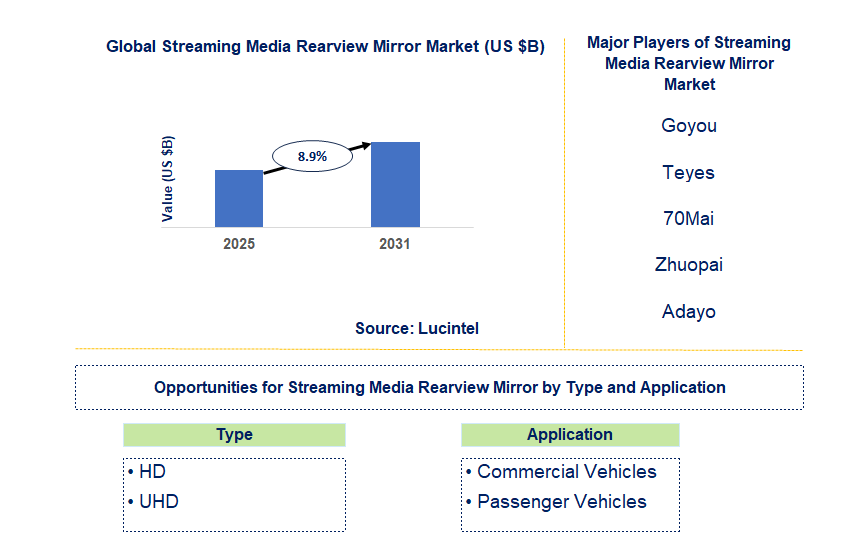
Key data points: The growth forecast = 8.9% annually for the next 7 years. Scroll below to get more insights. This market report covers Trends, opportunities and forecasts in streaming media rearview mirror market to 2031 by type (HD and UHD), application (commercial vehicles and passenger vehicles), and region (North America, Europe, Asia Pacific, and the Rest of the World)
We'll send your sample report shortly.
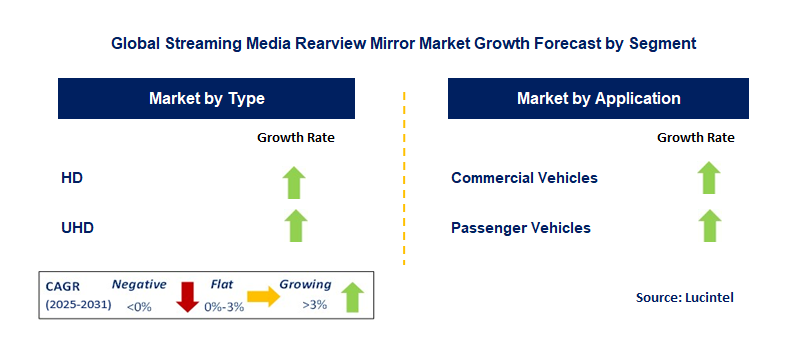
• Lucintel forecasts that, within the type category, uhd is expected to witness higher growth over the forecast period.
• Within the application category, passenger vehicle is expected to witness higher growth.
• In terms of region, APAC is expected to witness the highest growth over the forecast period.
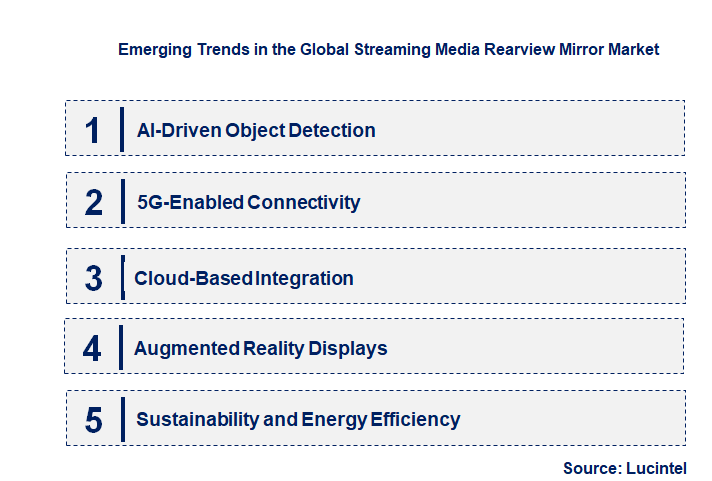
• AI-Driven Object Detection: AI-powered rearview mirrors enhance safety by detecting obstacles, pedestrians, and vehicles in real time, reducing accident risks.
• 5G-Enabled Connectivity: The integration of 5G technology enables seamless data transmission, improves navigation, and provides real-time monitoring features.
• Cloud-Based Integration: Cloud technology is enhancing rearview mirror functionality by offering real-time updates, remote diagnostics, and personalized settings.
• Augmented Reality Displays: AR-enabled rearview mirrors provide enhanced visibility with real-time overlays of traffic information and route guidance.
• Sustainability and Energy Efficiency: Advancements in energy-efficient display technologies are reducing power consumption, making smart mirrors more eco-friendly. Emerging trends such as AI-driven object detection, 5G connectivity, cloud integration, AR displays, and sustainable technologies are revolutionizing the streaming media rearview mirror market. These advancements are improving driver safety, enhancing convenience, and supporting the development of next-generation vehicle technologies.
• Integration of AI and Smart Assistance Features – AI-powered streaming rearview mirrors are enhancing driver safety with real-time object detection, lane departure alerts, and collision warnings. These smart mirrors process data from multiple cameras and provide a wider field of view, reducing blind spots and improving situational awareness. AI algorithms optimize brightness and contrast for better visibility in different lighting conditions. The integration of voice commands and touch-screen controls is also improving user experience, making these mirrors more intuitive. Automakers are incorporating AI-driven features to align with growing consumer expectations for intelligent in-car technology.
• Enhanced Night Vision and Low-Light Performance – Advancements in low-light imaging technology are improving the effectiveness of streaming media rearview mirrors in nighttime and adverse weather conditions. High-sensitivity sensors, infrared illumination, and AI-powered image enhancement ensure clear visibility even in complete darkness. Automakers are integrating these features to enhance safety for night-time driving, reducing accidents caused by poor visibility. The demand for better night vision capabilities is growing, especially in regions with limited street lighting. These developments are making digital rearview mirrors a reliable solution for all driving conditions.
• 4K Ultra-HD and High-Resolution Displays – The introduction of 4K Ultra-HD streaming mirrors is providing sharper and more detailed visuals, significantly improving the driving experience. Higher resolution displays reduce glare, improve clarity, and offer a more accurate representation of the road environment. Automakers are focusing on improving display refresh rates and anti-glare coatings to ensure smooth video output. Consumers are increasingly opting for high-definition mirrors that enhance safety and aesthetics. The shift toward ultra-HD displays is making streaming media rearview mirrors a premium feature in modern vehicles.
• Integration with Cloud and Connected Vehicle Systems – Cloud-connected streaming mirrors are enabling real-time data storage and remote monitoring, offering added security features. These mirrors can sync with vehicle telematics, GPS navigation, and emergency response systems. Fleet operators and ride-sharing companies are adopting cloud-enabled rearview mirrors for enhanced vehicle tracking and driver behavior analysis. The ability to access live and recorded footage from a mobile app is an added benefit, improving theft prevention and post-accident analysis. This development aligns with the growing trend of connected vehicles and IoT-driven automotive solutions.
• Regulatory Push and ADAS Compliance – Governments worldwide are implementing regulations to enhance vehicle safety, driving the adoption of streaming media rearview mirrors. These mirrors are increasingly included in advanced driver assistance systems (ADAS) to comply with safety standards. Automakers are introducing regulatory-compliant digital mirrors to replace traditional side and rearview mirrors, reducing wind resistance and improving fuel efficiency. The regulatory push for enhanced road safety is accelerating market growth, making digital rearview mirrors a key component of modern vehicle designs. The streaming media rearview mirror market is witnessing rapid advancements, driven by AI-powered safety features, night vision improvements, high-resolution displays, and cloud connectivity. These developments are enhancing driver safety, improving visibility, and offering seamless integration with connected vehicle systems. Regulatory support for ADAS and the increasing demand for smart automotive solutions are further propelling market adoption. As technology continues to evolve, streaming media rearview mirrors will become a standard feature in modern vehicles, providing a safer and more intelligent driving experience.
• Expansion in Electric and Autonomous Vehicles: The rise of electric and autonomous vehicles is increasing the demand for advanced digital rearview mirror systems.
• Integration with Advanced Driver Assistance Systems (ADAS): Combining smart rearview mirrors with ADAS features enhances safety, making vehicles smarter and more reliable.
• Adoption in Commercial and Fleet Vehicles: Logistics and ride-hailing companies are deploying streaming media rearview mirrors for better monitoring and fleet management.
• Growing Demand for Luxury and High-Tech Vehicles: Premium car manufacturers are investing in cutting-edge rearview mirror solutions to improve aesthetics and functionality.
• Advancements in Display Technology: The development of OLED and high-definition displays is improving visibility and user experience. The market is expanding through advancements in electric vehicles, ADAS integration, commercial fleet adoption, luxury vehicle innovations, and display technology improvements. These opportunities are shaping the future of streaming media rearview mirrors.
• Goyou
• Teyes
• 70Mai
• Zhuopai
• Adayo
• Baoling Electronics
• Mapgoo
• Gentex
• Valeo
• Magna
• Hd
• Uhd
• Commercial Vehicles
• Passenger Vehicles
• North America
• Europe
• Asia Pacific
• The Rest of the World
• United States: The United States is seeing widespread adoption of digital rearview mirrors in both passenger and commercial vehicles. Automakers are integrating AI-driven object recognition and streaming capabilities to enhance driver awareness and safety. The National Highway Traffic Safety Administration (NHTSA) is promoting advanced mirror technologies to reduce blind spots and improve visibility. Tech firms are collaborating with auto manufacturers to develop smart rearview mirrors with real-time connectivity, enhancing navigation and situational awareness. The growing demand for electric and autonomous vehicles is further accelerating innovations in streaming media rearview mirrors.
• China: China is at the forefront of digital automotive innovation, with a strong emphasis on AI-powered rearview mirror systems. Leading automotive brands are incorporating 5G-enabled streaming media mirrors for seamless real-time data exchange. The Chinese government is promoting smart vehicle technology through supportive regulations, boosting the adoption of intelligent rearview mirrors. Startups and established players are investing in cloud-based rearview mirror solutions that integrate with connected car ecosystems. The expansion of ride-sharing and autonomous vehicle projects is also driving demand for advanced streaming rearview mirror systems.
• Germany: Germany is advancing its automotive industry with the implementation of digital rearview mirrors in luxury and commercial vehicles. Automakers such as BMW and Audi are replacing traditional mirrors with high-resolution camera-based systems, reducing vehicle drag and improving fuel efficiency. The integration of AI-driven hazard detection and streaming capabilities is enhancing driver safety and comfort. The European Union's stringent safety regulations are encouraging the adoption of smart rearview mirrors. Collaborations between automotive manufacturers and tech companies are fostering innovation in digital mirror technology.
• India: India is experiencing growing adoption of streaming media rearview mirrors due to increasing concerns about road safety and vehicle automation. The market is witnessing rising demand for affordable yet advanced digital mirror solutions in passenger cars and commercial vehicles. Automakers are integrating GPS-enabled rearview mirrors to provide navigation assistance and traffic updates. Government initiatives promoting smart mobility and connected vehicles are driving the adoption of digital rearview mirror technologies. Local manufacturers are partnering with global tech firms to develop cost-effective solutions tailored for the Indian automotive market.
• Japan: Japan is leading in the adoption of high-tech automotive solutions, including advanced streaming media rearview mirrors. Automakers such as Toyota and Nissan are developing AI-powered mirror systems with real-time streaming, night vision, and augmented reality features. The use of ultra-clear OLED displays and cloud-based connectivity is enhancing vehicle safety and driving convenience. Japan's focus on autonomous vehicles is further driving investments in smart rearview mirror technology. Regulatory support for replacing traditional mirrors with digital alternatives is accelerating the adoption of these innovations.


• Goyou
• Teyes
• 70Mai
• Zhuopai
• Adayo
• Baoling Electronics
• Mapgoo
• Gentex
• Valeo
• Magna Q5. Which streaming media rearview mirror market segment will be the largest in future? Answer: Lucintel forecasts that, within the type category, uhd is expected to witness higher growth over the forecast period. Q6. In streaming media rearview mirror market, which region is expected to be the largest in next 5 years? Answer: In terms of region, APAC is expected to witness the highest growth over the forecast period. Q7. Do we receive customization in this report? Answer: Yes, Lucintel provides 10% customization without any additional cost.


Choose a license that fits your team. Instant PDF delivery.
Prices exclude taxes. Instant delivery. Custom licensing available on request.
Market Report · May 18, 2026
Market Report · May 18, 2026
Market Report · May 18, 2026
Trusted partner for strategic intelligence and business growth


Receive a complimentary market analysis tailored to your industry. Our analysts will identify key growth opportunities and competitive dynamics specific to your business.

Market size, growth rate, and key trend analysis for your specific sector.

Top competitor positioning and market share analysis.

Strategic recommendations backed by data-driven insights.
Get curated market intelligence and competitive moves straight to your inbox.
By subscribing, you agree to receive our monthly insights. Unsubscribe anytime.
Receive a complimentary market analysis tailored to your industry. Our analysts will identify key growth opportunities and competitive dynamics specific to your business.
Market size, growth rate, and key trend analysis for your specific sector.
Top competitor positioning and market share analysis.
Strategic recommendations backed by data-driven insights.
Get curated market intelligence, emerging trends, and competitive moves straight to your inbox each month.
By subscribing, you agree to receive our monthly insights. Unsubscribe anytime.
We'll send your sample report shortly.