
Market Report · July 29, 2026

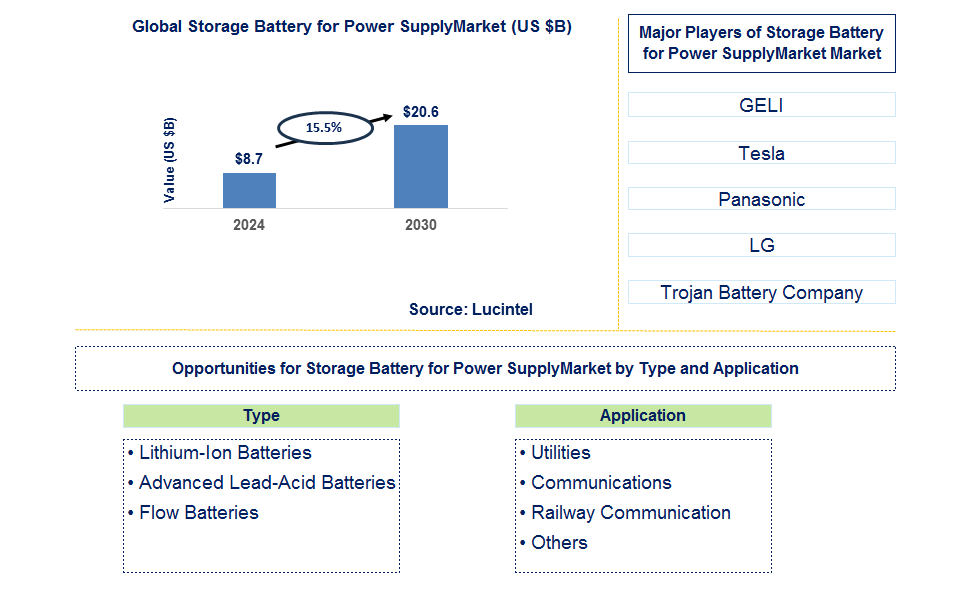
Key data points: The market size in 2030 = $20.6 billion, growth forecast = 15.5% annually for the next 6 years. Scroll below to get more insights. This market report covers trends, opportunities, and forecasts in the global storage battery for power supplymarket to 2030 by type (lithium-ion batteries, advanced lead-acid batteries, and flow batteries), application (utilities, communications, railway communication, and others), and region (North America, Europe, Asia Pacific, and the Rest of the World)
We'll send your sample report shortly.
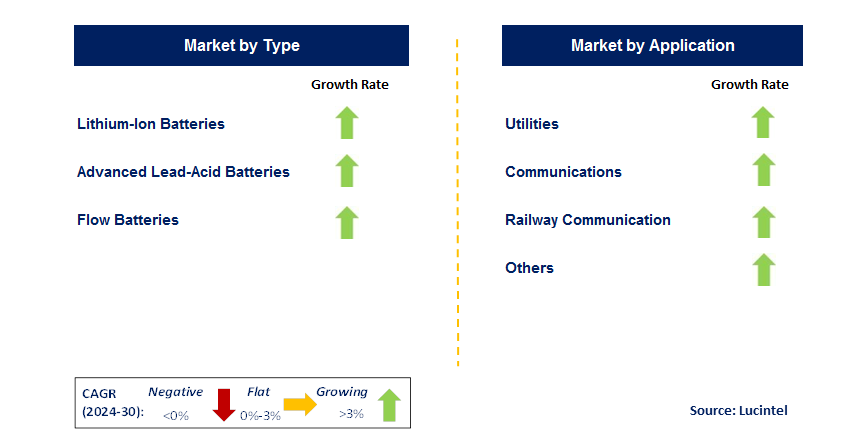
• Lucintel forecasts that, within the type category, lithium-ion battery will remain the largest segment over the forecast period due to the strong demand for li-ion batteries in a variety of applications, including electric vehicles, renewable energy storage, and consumer electronics.
• In terms of regions, APAC is expected to witness highest growth over the forecast period due to growing awareness of the need for energy efficiency and sustainability. A more than 150-page report is developed to help in your business decisions.
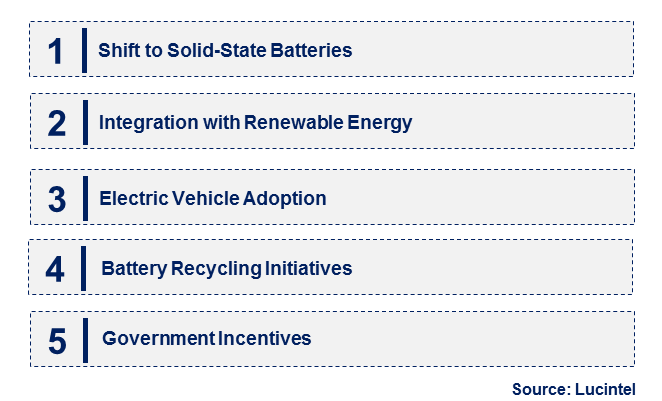
• Shift to Solid-State Batteries: There is increasing interest in solid-state battery technology, which offers higher energy density and safety.
• Integration with Renewable Energy: Storage batteries are increasingly being integrated with solar and wind energy systems, enhancing grid stability.
• Electric Vehicle Adoption: The growth of electric vehicles is driving demand for advanced battery technologies and charging infrastructure.
• Battery Recycling Initiatives: Companies are focusing on recycling programs to manage battery waste and recover valuable materials.
• Government Incentives: Many governments are providing incentives for energy storage solutions, promoting adoption in residential and commercial sectors.
• Digital Management Solutions: Advanced battery management systems are being developed to optimize performance and lifecycle management. These emerging trends illustrate the dynamic nature of the storage battery market, highlighting the shift towards sustainable and efficient energy solutions.
• Technological Innovations: New battery technologies, including lithium-sulfur and flow batteries, are enhancing energy storage capabilities and efficiency.
• Growing Market Demand: The need for reliable energy storage solutions is rising, driven by renewable energy adoption and electric vehicle growth.
• Collaborative Research: Partnerships between academic institutions and industry leaders foster innovation and advance battery technologies.
• Regulatory Support: Government policies and subsidies encourage the development and deployment of battery storage solutions.
• Investment in Manufacturing: Increased investment in battery manufacturing facilities supports the growth of local supply chains and reduces costs.
• Product Diversification: A wider range of storage battery products is emerging, catering to various applications from residential to industrial uses. Recent developments highlight the rapid evolution of the storage battery market, driven by technological innovation and a growing emphasis on sustainable energy solutions.
• Utility-Scale Energy Storage: Large-scale storage solutions are essential for balancing supply and demand in power grids, offering significant growth potential.
• Residential Energy Storage: Increasing interest in solar energy systems is driving demand for home battery storage solutions that provide energy independence.
• Electric Vehicles: The growing adoption of electric vehicles presents opportunities for battery manufacturers to innovate and expand their product offerings.
• Industrial Applications: Energy storage systems are increasingly utilized in industrial settings to enhance efficiency and reduce operational costs.
• Renewable Energy Integration: The need for reliable storage solutions to support wind and solar energy creates new market opportunities.
• Smart Grid Development: The implementation of smart grid technologies enhances the integration and management of storage solutions. The diverse applications of storage batteries reveal significant strategic growth opportunities, ensuring continued innovation and expansion in the market.
• Growing Renewable Energy Sector: The increasing adoption of renewable energy sources drives demand for effective energy storage solutions.
• Technological Advancements: Continuous innovations in battery technology enhance performance and lower costs.
• Government Support: Policies and incentives from governments promote the development and deployment of energy storage systems.
• Rising Electric Vehicle Demand: The expansion of the electric vehicle market boosts the need for advanced battery technologies. Challenges in the storage battery market include:
• High Production Costs: The costs associated with developing and manufacturing advanced battery technologies can be a barrier to entry.
• Supply Chain Constraints: Disruptions in supply chains, particularly for raw materials, can impact production timelines and costs.
• Environmental Concerns: Managing battery waste and ensuring sustainable recycling practices present challenges for the industry.
• Market Competition: Intense competition among battery manufacturers can lead to pricing pressures and affect profit margins. While the storage battery market is propelled by strong drivers such as renewable energy demand and technological advancements, challenges related to costs and environmental impact must be addressed for sustainable growth.
• GELI
• Tesla
• Panasonic
• LG
• Trojan Battery Company
• East Penn Manufacturing Company
• YUASA Battery
• Exide Technologies
• Lithium-Ion Batteries
• Advanced Lead-Acid Batteries
• Flow Batteries
• Utilities
• Communications
• Railway Communication
• Others
• North America
• Europe
• Asia Pacific
• The Rest of the World
• USA: The USA is experiencing significant advancements in the storage battery market, primarily driven by the increasing adoption of renewable energy sources like solar and wind. Major companies are investing in large-scale battery storage projects to stabilize the grid and enhance energy resilience. Recent developments include the deployment of lithium-ion batteries in utility-scale applications, enabling efficient energy storage for peak demand times. Additionally, federal incentives and state policies are promoting the growth of battery storage solutions, encouraging innovation and reducing costs. Research institutions are also collaborating with private companies to develop next-generation battery technologies that enhance capacity and lifespan.
• Germany: Germany continues to be a leader in the storage battery market, with recent developments focusing on energy transition and sustainability goals. The country is investing heavily in battery storage systems to support its ambitious renewable energy targets. Developments include advancements in flow batteries and solid-state batteries, which offer higher energy density and improved safety. Germany’s government is providing subsidies for residential and commercial battery storage systems, driving adoption across various sectors. Additionally, partnerships between automakers and battery manufacturers are enhancing the integration of storage solutions in electric vehicles, further propelling the market forward.
• China: China remains a dominant player in the storage battery market, driven by government initiatives promoting clean energy and electric vehicle adoption. Recent developments include significant investments in battery manufacturing capacity, with a focus on lithium iron phosphate (LFP) and solid-state technologies. The Chinese government is also implementing policies to support the deployment of energy storage systems in both residential and industrial applications. This has led to the rapid scaling of large-scale battery storage projects that help balance supply and demand. Furthermore, Chinese companies are increasingly exporting advanced battery technologies, positioning themselves as global leaders in the storage battery market.
• India: India is witnessing a surge in the storage battery market, fueled by the growing demand for renewable energy and energy security. Recent developments include government initiatives aimed at promoting battery storage technologies, particularly for solar energy integration. The country is focusing on lithium-ion battery production to meet rising domestic needs and reduce import dependency. Additionally, partnerships between Indian startups and established technology firms are fostering innovation in battery management systems and recycling technologies. The push towards electric mobility is also accelerating the adoption of battery storage solutions, creating new opportunities for market growth in India.
• Japan: Japan is advancing in the storage battery market with a focus on high-capacity and efficient energy storage systems. Recent developments include innovations in solid-state battery technology, which promise improved energy density and safety compared to traditional lithium-ion batteries. The Japanese government is promoting energy storage as part of its strategy to enhance energy security and support renewable energy integration. Major corporations are investing in research and development to create next-generation batteries for electric vehicles and grid applications. Collaborations between industry and academia are also driving advancements in battery technologies, ensuring Japan remains competitive in the global market.


• GELI
• Tesla
• Panasonic
• LG
• Trojan Battery Company
• East Penn Manufacturing Company
• YUASA Battery
• Exide Technologies Q6. Which storage battery for power supply market segment will be the largest in future? Answer: Lucintel forecasts that lithium-ion battery will remain the largest segment over the forecast period due to the strong demand for li-ion batteries in a variety of applications, including electric vehicles, renewable energy storage, and consumer electronics. Q.7. What are some of the changing demands of customers in the market? APAC is expected to witness highest growth over the forecast period due to growing awareness of the need for energy efficiency and sustainability. Q.8 Do we receive customization in this report? Answer: Yes, Lucintel provides 10% customization without any additional cost.


Choose a license that fits your team. Instant PDF delivery.
Prices exclude taxes. Instant delivery. Custom licensing available on request.
Market Report · July 29, 2026
Market Report · July 20, 2026
Market Report · July 20, 2026
Trusted partner for strategic intelligence and business growth


Receive a complimentary market analysis tailored to your industry. Our analysts will identify key growth opportunities and competitive dynamics specific to your business.

Market size, growth rate, and key trend analysis for your specific sector.

Top competitor positioning and market share analysis.

Strategic recommendations backed by data-driven insights.
Get curated market intelligence and competitive moves straight to your inbox.
By subscribing, you agree to receive our monthly insights. Unsubscribe anytime.
Receive a complimentary market analysis tailored to your industry. Our analysts will identify key growth opportunities and competitive dynamics specific to your business.
Market size, growth rate, and key trend analysis for your specific sector.
Top competitor positioning and market share analysis.
Strategic recommendations backed by data-driven insights.
Get curated market intelligence, emerging trends, and competitive moves straight to your inbox each month.
By subscribing, you agree to receive our monthly insights. Unsubscribe anytime.
We'll send your sample report shortly.