
Report Feature
Stem Toy Market Trends and Forecast
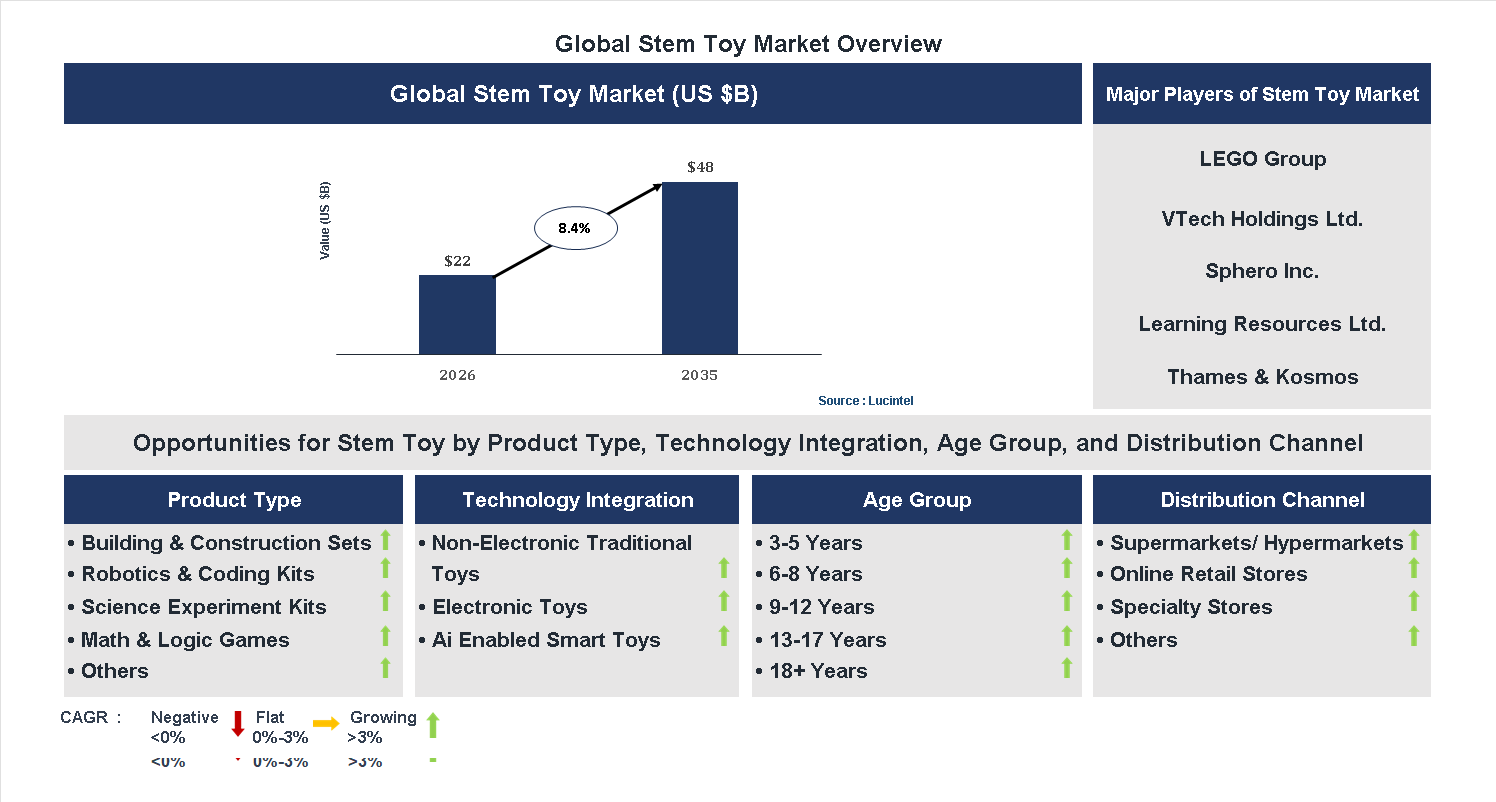
The future of the global stem toy market looks promising with opportunities in the Non-Electronic Traditional Toy, Electronic Toy, and AI Enabled Smart Toy markets. The global stem toy market is expected to reach an estimated $48 billion by 2035 with a CAGR of 8.4% from 2026 to 2035. The major drivers for this market are the increasing demand for educational play products, the rising interest in stem learning kits, and the growing popularity of interactive learning toys.• Lucintel forecasts that, within the product type category, building & construction set is expected to witness higher growth over the forecast period.
• Within the technology integration category, non-electronic traditional toy is expected to witness the highest growth.
• In terms of region, APAC is expected to witness the highest growth over the forecast period. Gain valuable insights for your business decisions with our comprehensive 150+ page report. Sample figures with some insights are shown below.
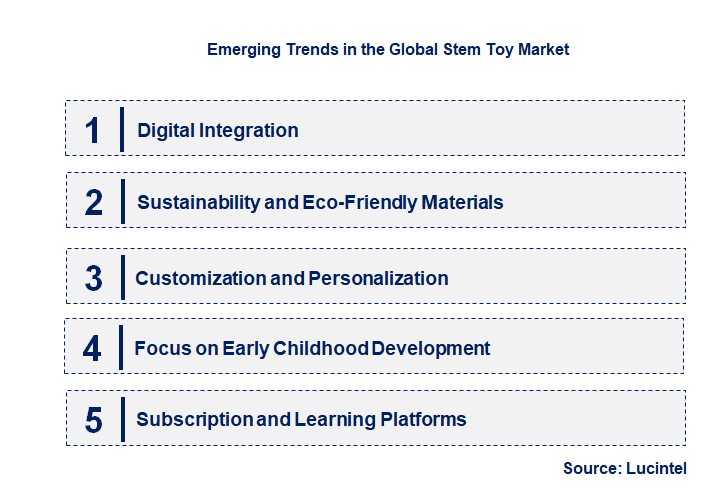
Emerging Trends in the Stem Toy Market
The stem toy market is experiencing rapid growth driven by increasing emphasis on early childhood education, technological advancements, and shifting consumer preferences. As parents and educators recognize the importance of STEM (Science, Technology, Engineering, and Mathematics) skills, the market is evolving with innovative products that foster creativity, problem-solving, and critical thinking. The integration of digital technology, sustainability concerns, and personalized learning experiences are further shaping this landscape. These developments are not only expanding market size but also redefining how children engage with educational toys, making STEM learning more accessible, engaging, and effective.• Digital Integration: The incorporation of digital technology into STEM toys is transforming the market by offering interactive and immersive learning experiences. Smart toys with sensors, augmented reality, and app connectivity enable children to explore complex concepts in a fun and engaging way. This trend enhances engagement, provides real-time feedback, and allows for personalized learning paths. As technology becomes more affordable and accessible, digital-integrated STEM toys are expected to dominate the market, appealing to tech-savvy children and parents seeking innovative educational tools.
• Sustainability and Eco-Friendly Materials: Growing environmental awareness is prompting manufacturers to adopt sustainable practices in the production of STEM toys. Using eco-friendly, biodegradable, and non-toxic materials appeals to environmentally conscious consumers. This trend not only reduces the environmental footprint but also educates children about sustainability from an early age. Companies investing in green manufacturing processes are gaining a competitive edge, and the demand for sustainable STEM toys is expected to increase, influencing product design, packaging, and marketing strategies.
• Customization and Personalization: The market is shifting towards personalized STEM toys that cater to individual learning styles and interests. Customizable kits, modular components, and adaptive learning features allow children to explore topics at their own pace. This trend enhances engagement and motivation by providing tailored educational experiences. Advances in 3D printing and modular design facilitate easy customization, making STEM toys more appealing to a diverse consumer base. Personalized products are likely to foster deeper learning and long-term interest in STEM fields.
• Focus on Early Childhood Development: There is a significant emphasis on developing STEM skills from a young age. Manufacturers are designing age-appropriate, safe, and engaging toys that introduce foundational concepts early on. This focus aims to build critical thinking, creativity, and problem-solving skills during formative years. The market is witnessing a rise in products targeted at preschool and early elementary children, supported by research highlighting the importance of early STEM education. This trend is expected to expand access to STEM learning and prepare children for future academic and career success.
• Subscription and Learning Platforms: Subscription-based STEM toy services and online learning platforms are gaining popularity. These services offer curated kits, ongoing educational content, and interactive experiences that evolve with the childs learning progress. They provide convenience, variety, and continuous engagement, making STEM education more accessible outside traditional classroom settings. The integration of physical toys with digital platforms enhances the learning experience, fostering a community of young learners. This trend is reshaping the market by creating recurring revenue streams and expanding reach to a broader demographic. These trends are collectively transforming the stem toy market by making STEM education more interactive, sustainable, personalized, accessible, and aligned with technological advancements. They are fostering a new generation of learners equipped with essential skills for the future, while also encouraging innovation among manufacturers and educators.
Recent Development in the Stem Toy Market
The stem toy market is experiencing rapid growth driven by increasing interest in STEM education, technological advancements, and a rising focus on early childhood development. Parents and educators are prioritizing engaging, educational toys that foster critical thinking, creativity, and problem-solving skills. Market players are innovating with eco-friendly materials and digital integration to meet evolving consumer demands. These developments are shaping a competitive landscape, expanding market reach, and encouraging global adoption of STEM toys for children of all ages.• Growth in Educational Focus: The market is expanding as parents and schools prioritize STEM education, recognizing its importance for future skills. Innovative toys that promote science, technology, engineering, and math concepts are gaining popularity, leading to increased sales and product diversity. This focus encourages manufacturers to develop more engaging, curriculum-aligned toys, fostering early interest in STEM fields and supporting educational outcomes.
• Technological Integration Enhances Engagement: Incorporating digital elements like augmented reality, coding apps, and robotics into STEM toys is revolutionizing the market. These advancements make learning more interactive and immersive, appealing to tech-savvy children. The integration boosts engagement, improves learning retention, and attracts a broader demographic, including older children and parents seeking high-tech educational tools, thereby expanding market potential and driving innovation.
• Eco-Friendly and Sustainable Materials: The shift towards environmentally conscious products is influencing the market significantly. Manufacturers are adopting sustainable materials such as biodegradable plastics and recycled components to appeal to eco-aware consumers. This trend not only enhances brand reputation but also aligns with global sustainability goals. Eco-friendly STEM toys are gaining traction, encouraging responsible consumption and opening new market segments focused on sustainability.
• Expansion in Digital and Remote Learning: The rise of online education and remote learning has created new opportunities for STEM toy companies. Digital platforms enable virtual demonstrations, tutorials, and interactive experiences, broadening access beyond physical retail. This development supports homeschooling and remote classrooms, increasing demand for versatile, tech-enabled toys. It also fosters partnerships with educational institutions, expanding market reach and reinforcing the role of STEM toys in modern education.
• Global Market Penetration and Localization: Companies are increasingly targeting emerging markets through localization strategies, including language adaptation and culturally relevant content. This expansion broadens the customer base and taps into growing middle-class populations seeking quality educational toys. Market players are establishing regional manufacturing and distribution centers, which reduce costs and improve accessibility, ultimately driving global growth and diversification of the STEM toy market. These developments are significantly transforming the stem toy market by fostering innovation, sustainability, and global expansion. The focus on educational value, technological integration, eco-consciousness, digital learning, and market diversification is creating a dynamic environment. As a result, the market is experiencing increased competitiveness, broader consumer engagement, and sustained growth, positioning STEM toys as essential tools for future-ready education worldwide.
Strategic Growth Opportunities in the Stem Toy Market
The stem toy market is experiencing rapid expansion driven by increasing emphasis on early childhood education, technological integration, and global demand for educational products. As parents and educators seek engaging, skill-enhancing toys, manufacturers are innovating to meet these needs. The markets growth is further supported by rising awareness of STEM skills importance for future careers, along with advancements in digital and interactive toys. These factors collectively create significant opportunities for companies to capture market share and foster educational development through innovative STEM toy offerings.• Expansion into emerging markets: Growing middle-class populations and increased educational investments in regions like Asia-Pacific and Latin America present vast opportunities for market expansion. Localized marketing strategies and affordable product lines can help companies penetrate these markets, boosting sales and brand presence. Additionally, adapting toys to regional educational standards and cultural preferences enhances acceptance and adoption, fostering long-term growth in these high-potential areas.
• Integration of digital and interactive technologies: Incorporating augmented reality, virtual reality, and app-based platforms into STEM toys enhances engagement and learning outcomes. These technologies provide immersive experiences that appeal to tech-savvy children and parents seeking innovative educational tools. Companies investing in digital integration can differentiate their products, increase customer loyalty, and tap into the growing demand for smart, connected toys that combine play with skill development.
• Focus on sustainability and eco-friendly materials: Consumers are increasingly prioritizing environmentally responsible products. Developing STEM toys using biodegradable, recycled, or non-toxic materials can attract eco-conscious buyers. Sustainability initiatives not only improve brand image but also comply with evolving regulations. This opportunity encourages innovation in manufacturing processes and packaging, aligning market growth with environmental stewardship and appealing to a broader customer base.
• Development of curriculum-aligned educational kits: Creating STEM toys that align with school curricula and standards can facilitate adoption by educational institutions and parents. These kits support structured learning, reinforce classroom concepts, and promote hands-on experimentation. Collaborations with educators and curriculum developers can enhance product credibility and market penetration, positioning companies as essential partners in educational development and expanding their reach within formal education sectors.
• Customization and personalized learning experiences: Offering customizable STEM toys tailored to individual learning styles and skill levels can increase engagement and effectiveness. Technologies like AI enable adaptive learning, providing tailored challenges and feedback. Personalized products foster deeper interest and skill mastery, encouraging repeat purchases. This approach caters to diverse learner needs, enhances customer satisfaction, and opens avenues for subscription models and ongoing product updates, driving sustained market growth. The overall impact of these opportunities is poised to significantly accelerate market growth, foster innovation, and deepen educational value. Companies that strategically leverage these avenues can strengthen their market position, meet evolving consumer demands, and contribute to the development of future-ready skills in children worldwide.
Stem Toy Market Driver and Challenges
The stem toy market is influenced by a variety of technological, economic, and regulatory factors that shape its growth and development. Advances in educational technology and increasing digital integration have expanded the scope of STEM toys, making them more interactive and engaging for children. Economic factors such as rising disposable incomes and increased awareness of early childhood development contribute to market expansion. Regulatory standards around safety and educational value also play a crucial role in shaping product offerings and consumer trust. Additionally, societal trends emphasizing STEM education and skill development are driving demand. However, the market faces challenges related to safety regulations, high manufacturing costs, and market saturation, which could hinder growth prospects. The factors responsible for driving the stem toy market include:• Technological Innovation: The integration of augmented reality, robotics, and coding features into STEM toys has revolutionized the market. These innovations make learning more interactive and appealing, attracting both parents and children. As technology advances, manufacturers can develop more sophisticated toys that foster critical thinking, problem-solving, and creativity. This continuous innovation fuels consumer interest and expands market reach, especially among tech-savvy parents seeking educational value. The adoption of smart toys also aligns with digital learning trends, further boosting demand and market growth.
• Rising Awareness of STEM Education: Increasing emphasis on science, technology, engineering, and mathematics education from an early age is a significant driver. Parents and educators recognize the importance of developing STEM skills to prepare children for future careers, leading to higher demand for educational toys that promote these skills. Governments and educational institutions are also promoting STEM initiatives, which indirectly support the market. This heightened awareness encourages investment in quality STEM toys, fostering a competitive environment and expanding market opportunities.
• Growing Disposable Income: As disposable incomes rise globally, parents are more willing to invest in high-quality, educational toys for their children. This economic factor enables consumers to purchase premium STEM toys that offer advanced features and durability. The affordability of such toys, combined with a desire to provide children with educational advantages, results in increased sales. Market players are capitalizing on this trend by offering a range of products across different price points, thus broadening their customer base and stimulating market growth.
• E-commerce Expansion: The proliferation of online retail channels has made STEM toys more accessible to a broader audience. E-commerce platforms provide detailed product information, customer reviews, and convenient purchasing options, which influence buying decisions. This digital shift allows manufacturers to reach global markets efficiently and reduces reliance on traditional brick-and-mortar stores. The ease of online shopping, coupled with targeted marketing and personalized recommendations, significantly boosts sales and market penetration, especially among tech-savvy consumers seeking innovative educational products.
• Strategic Collaborations and Partnerships: Collaborations between toy manufacturers, educational institutions, and technology companies have led to the development of innovative STEM toys. These partnerships facilitate the integration of cutting-edge technology and educational content, enhancing product appeal. Such collaborations also help in gaining credibility and expanding market reach through co-branding and joint marketing efforts. By leveraging each others expertise, companies can accelerate product development and meet evolving consumer demands, thereby driving market growth and establishing a competitive edge. The challenges facing the stem toy market include:
• Stringent Safety Regulations: The market faces strict safety standards and regulatory compliance requirements, which can increase manufacturing costs and extend product development timelines. Ensuring that toys are free from harmful chemicals, small parts, and other hazards is essential but challenging, especially when incorporating advanced electronic components. Non-compliance can lead to recalls, legal issues, and damage to brand reputation. Navigating diverse regulations across different regions adds complexity, potentially limiting market expansion and increasing operational costs for manufacturers.
• High Manufacturing and R&D Costs: Developing innovative STEM toys involves significant investment in research and development, especially when integrating advanced technologies like robotics and AR. Manufacturing these complex products requires specialized materials and processes, which can be costly. These high costs may lead to higher retail prices, potentially limiting affordability for some consumers and affecting sales volume. Small and medium-sized companies may find it difficult to compete with larger firms that have more resources for innovation and production, thereby impacting market competitiveness.
• Market Saturation and Competition: The rapid proliferation of STEM toys has led to a saturated market with numerous players offering similar products. Intense competition can result in price wars, reduced profit margins, and difficulty in differentiating products. New entrants face challenges in establishing brand recognition and gaining consumer trust. Additionally, rapid product obsolescence due to technological advancements pressures companies to continuously innovate, increasing costs and operational risks. Market saturation may also limit growth opportunities in certain regions, requiring companies to explore new markets or diversify their offerings. The stem toy market is driven by technological advancements, increased awareness of STEM education, rising disposable incomes, e-commerce growth, and strategic collaborations. However, it faces challenges such as strict safety regulations, high manufacturing and R&D costs, and intense market competition. These factors collectively influence the markets trajectory, requiring stakeholders to innovate continuously and adapt to regulatory and economic shifts. Overall, the markets future depends on balancing innovation with compliance and competitive strategies to sustain growth and meet evolving consumer demands.
List of Stem Toy Companies
Companies in the market compete on the basis of product quality offered. Major players in this market focus on expanding their manufacturing facilities, R&D investments, infrastructural development, and leverage integration opportunities across the value chain. With these strategies stem toy companies cater increasing demand, ensure competitive effectiveness, develop innovative products & technologies, reduce production costs, and expand their customer base. Some of the stem toy companies profiled in this report include-• LEGO Group
• VTech Holdings Ltd.
• Sphero Inc.
• Learning Resources Ltd.
• Thames & Kosmos
• Mattel Inc. (Mega)
• Hasbro Inc.
• Spin Master Corp.
• Kano Computing Ltd.
• Makeblock Co. Ltd.
Stem Toy Market by Segment
The study includes a forecast for the global stem toy market by product type, technology integration, age group, distribution channel, and region.Stem Toy Market by Product Type [Value from 2019 to 2035]:
• Building & Construction Sets
• Robotics & Coding Kits
• Science Experiment Kits
• Math & Logic Games
• Others
Stem Toy Market by Technology Integration [Value from 2019 to 2035]:
• Non-Electronic Traditional Toys
• Electronic Toys
• Ai Enabled Smart Toys
Stem Toy Market by Age Group [Value from 2019 to 2035]:
• 3-5 Years
• 6-8 Years
• 9-12 Years
• 13-17 Years
• 18+ Years
Stem Toy Market by Distribution Channel [Value from 2019 to 2035]:
• Supermarkets/ Hypermarkets
• Online Retail Stores
• Specialty Stores
• Others
Stem Toy Market by Region [Value from 2019 to 2035]:
• North America
• Europe
• Asia Pacific
• The Rest of the World
Country Wise Outlook for the Stem Toy Market
The stem toy market has experienced significant growth globally, driven by increasing emphasis on early childhood education, technological integration, and innovative product development. Countries are investing in educational tools that foster creativity, problem-solving, and STEM skills among children. Advances in digital technology and a focus on sustainable and inclusive toys are shaping market trends. Governments and private sectors are collaborating to promote STEM learning through various initiatives. As awareness of the importance of STEM education rises, the market is expected to expand further, with countries adopting new strategies to enhance their competitive edge in this sector.• United States: The US market has seen a surge in digital and programmable STEM toys, with major brands integrating coding and robotics into their offerings. There is a growing focus on eco-friendly materials and inclusive designs to cater to diverse children. Educational institutions increasingly incorporate STEM toys into curricula, boosting demand. Startups are innovating with augmented reality (AR) and virtual reality (VR) features, enhancing interactive learning experiences. Government initiatives and private investments are supporting STEM education, further propelling market growth. The US remains a leader in product innovation and market expansion.
• China: Chinas STEM toy market is rapidly expanding, driven by government policies promoting innovation and technological literacy. Local manufacturers are investing heavily in R&D to develop advanced, affordable, and culturally relevant toys. E-commerce platforms facilitate widespread distribution, increasing accessibility. The integration of AI and IoT in toys is becoming prominent, offering personalized learning experiences. The market benefits from a large young population and rising parental awareness of STEM educations importance. Additionally, collaborations between tech firms and toy manufacturers are fostering innovative product development, positioning China as a key player in the global STEM toy industry.
• Germany: Germanys market emphasizes high-quality, sustainable, and educational STEM toys. The country’s focus on environmental sustainability influences product design, with many toys made from eco-friendly materials. German companies prioritize safety standards and educational value, appealing to discerning consumers. There is a notable trend toward modular and open-ended toys that encourage creativity and critical thinking. The integration of digital components is growing, with a focus on STEM skills development. Germany also benefits from strong retail networks and a well-established distribution system, supporting steady market growth and innovation in the sector.
• India: The Indian STEM toy market is witnessing rapid growth due to increasing awareness of STEM educations importance and government initiatives promoting skill development. Local startups and manufacturers are developing affordable, innovative toys tailored to the Indian market. The rise of online retail channels has expanded access to a diverse range of STEM toys across urban and rural areas. There is a growing emphasis on toys that combine traditional Indian culture with modern STEM concepts. Educational institutions and parents are increasingly investing in STEM toys to prepare children for future careers. The market is expected to continue expanding as awareness and disposable incomes rise.
• Japan: Japans market is characterized by a focus on technologically advanced and culturally relevant STEM toys. Companies are integrating robotics, AI, and sensor technology to create engaging learning tools. The emphasis on quality, safety, and educational value remains strong, with many products designed to promote logical thinking and innovation. The popularity of DIY kits and programmable robots is increasing among children and hobbyists. Japan’s strong technological infrastructure and innovation culture support continuous product development. Additionally, collaborations with educational institutions are fostering the integration of STEM toys into formal learning environments, ensuring sustained market growth.

Features of the Global Stem Toy Market
Market Size Estimates: Stem toy market size estimation in terms of value ($B). Trend and Forecast Analysis: Market trends (2019 to 2025) and forecast (2026 to 2035) by various segments and regions. Segmentation Analysis: Stem toy market size by various segments, such as by product type, technology integration, age group, distribution channel, and region in terms of value ($B). Regional Analysis: Stem toy market breakdown by North America, Europe, Asia Pacific, and Rest of the World. Growth Opportunities: Analysis of growth opportunities in different product types, technology integration, age groups, distribution channels, and regions for the stem toy market. Strategic Analysis: This includes M&A, new product development, and competitive landscape of the stem toy market. Analysis of competitive intensity of the industry based on Porter’s Five Forces model.
FAQ
Q1. What is the stem toy market size? Answer: The global stem toy market is expected to reach an estimated $48 billion by 2035. Q2. What is the growth forecast for stem toy market? Answer: The global stem toy market is expected to grow with a CAGR of 8.4% from 2026 to 2035. Q3. What are the major drivers influencing the growth of the stem toy market? Answer: The major drivers for this market are the increasing demand for educational play products, the rising interest in stem learning kits, and the growing popularity of interactive learning toys. Q4. What are the major segments for stem toy market? Answer: The future of the stem toy market looks promising with opportunities in the Non-Electronic Traditional Toy, Electronic Toy, and AI Enabled Smart Toy markets. Q5. Who are the key stem toy market companies? Answer: Some of the key stem toy companies are as follows:• LEGO Group
• VTech Holdings Ltd.
• Sphero Inc.
• Learning Resources Ltd.
• Thames & Kosmos
• Mattel Inc. (Mega)
• Hasbro Inc.
• Spin Master Corp.
• Kano Computing Ltd.
• Makeblock Co. Ltd. Q6. Which stem toy market segment will be the largest in future? Answer: Lucintel forecasts that, within the product type category, building & construction set is expected to witness higher growth over the forecast period. Q7. In stem toy market, which region is expected to be the largest in next 5 years? Answer: In terms of region, APAC is expected to witness the highest growth over the forecast period. Q8. Do we receive customization in this report? Answer: Yes, Lucintel provides 10% customization without any additional cost.
Table of Contents
List of Figures
List of Tables
Methodology
- In-depth interviews of the major players in this market
- Detailed secondary research from competitors’ financial statements and published data
- Extensive searches of published works, market, and database information pertaining to industry news, company press releases, and customer intentions
- A compilation of the experiences, judgments, and insights of Lucintel’s professionals, who have analyzed and tracked this market over the years.


Buy Now
Choose a license that fits your team. Instant PDF delivery.
Prices exclude taxes. Instant delivery. Custom licensing available on request.
Key Questions
- • What are some of the most promising, high-growth opportunities for the stem toy market by product type (building & construction sets, robotics & coding kits, science experiment kits, math & logic games, and others), technology integration (non-electronic traditional toys, electronic toys, and ai enabled smart toys), age group (3-5 years, 6-8 years, 9-12 years, 13-17 years, and 18+ years), distribution channel (supermarkets/ hypermarkets, online retail stores, specialty stores, and others), and region (North America, Europe, Asia Pacific, and the Rest of the World)?
- • Which segments will grow at a faster pace and why?
- • Which region will grow at a faster pace and why?
- • What are the key factors affecting market dynamics? What are the key challenges and business risks in this market?
- • What are the business risks and competitive threats in this market?
- • What are the emerging trends in this market and the reasons behind them?
- • What are some of the changing demands of customers in the market?
- • What are the new developments in the market? Which companies are leading these developments?
- • Who are the major players in this market? What strategic initiatives are key players pursuing for business growth?
- • What are some of the competing products in this market and how big of a threat do they pose for loss of market share by material or product substitution?
- • What M&A activity has occurred in the last 7 years and what has its impact been on the industry? For any questions related to Stem Toy Market, Stem Toy Market Size, Stem Toy Market Growth, Stem Toy Market Analysis, Stem Toy Market Report, Stem Toy Market Share, Stem Toy Market Trends, Stem Toy Market Forecast, Stem Toy Companies, write Lucintel analyst at email: helpdesk@lucintel.com. We will be glad to get back to you soon.


