
Market Report · July 31, 2026

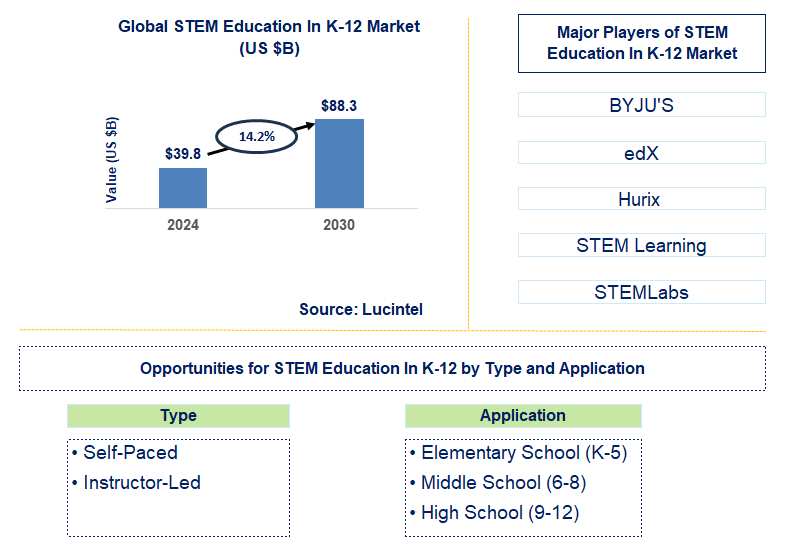
Key data points: The market size in 2030 = $88.3 billion, growth forecast = 14.2% annually next 6 years. Scroll below to get more insights. This market report covers trends, opportunities, and forecast in the global stem education in k-12 market to 2030 by type (self-paced and instructor-led), application (elementary school (k-5), middle school (6-8), and high school (9-12)), and region (North America, Europe, Asia Pacific, and the Rest of the World)
We'll send your sample report shortly.
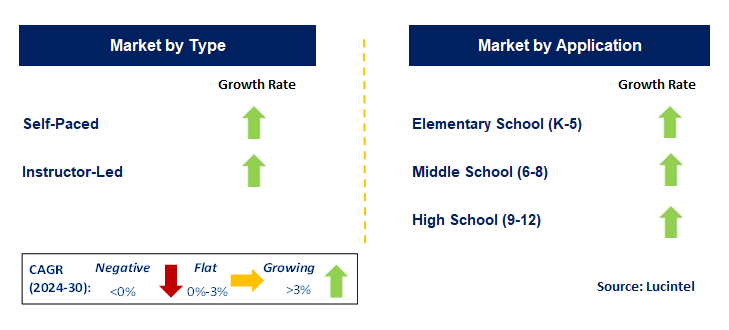
• Lucintel forecasts that self-paced will remain the larger segment over the forecast period.
• Within this market, high school (9-12) will remain the largest segment due to increasing penetration of online education.
• North America will remain the largest region over the forecast period due to stringent government policies. A more than 150-page report is developed to help in your business decisions.
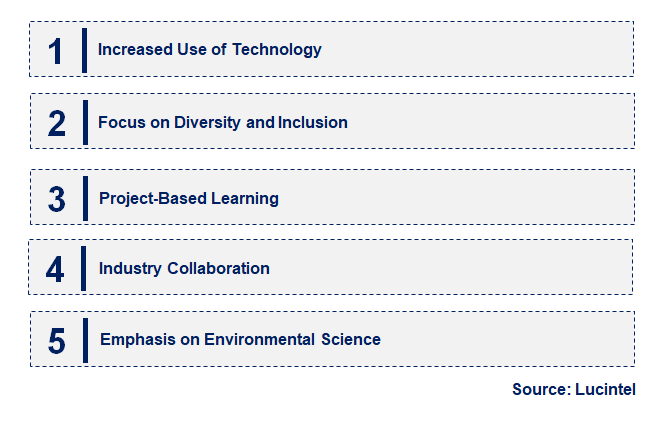
• Increased Use of Technology: AI, AR, and VR technologies are transforming the way STEM is taught in schools. They support a live and interactive learning approach by making visible what was considered impossible concepts. There has been an enormous investment in digital resources that raise engagement and enable school students to select personalized learning pathways, as well as in digital and maker education in general, thus making STEM more accessible and relevant to the modern learner.
• Focus on Diversity and Inclusion: With rising interest in developing the STEM fields for underrepresented groups, female participation is of particular significance in these emerging trends. Programs directed at girls and minority students are being created in attempts to grow the participation of these underrepresented groups in STEM subjects. This presents myriad opportunities for students beyond simply bridging the gap between men and women but rather offers a diverse range of perspectives that would further enhance the sense of innovative and creative appreciation for the field.
• Project-Based Learning: Project-based learning is really finding its place as the method of pedagogy that best works in STEM education. PBL helps produce critical thinking and teamwork by engaging students in solving real-world problems. The hands-on approach increases retention, preparing the student for a future career by simulating work environments and collaboration among students.
• Industry Collaboration: Mostly common, among them are partnerships between educational institutions and industries, by trying to bridge the gap that may exist between education and the job market. These collaborations can contribute to student involvement in mentorship, internships, and real-world projects and align curricula with the need and trend of the industry to make education more relevant and employment fit.
• Emphasis on Environmental Science: With this heightened awareness towards climate change and sustainability, the door to environmental science and integration into STEM education has opened up. The usage of sustainability is increasingly finding a way into curriculums whereby students learn to bring out solutions toward environmental difficulties. Other than scientific literacy, it aligns social responsibility among young students who, after graduation, are better equipped to take on the prevalent issues all over the world. They are transforming the K-12 STEM education of the society, truly engaging and inclusive by putting relevant curricula into the job market. Related to this issue, future generations of students will be more prepared to tackle set challenges that bring the prospect of a more sustainable and innovative society with clear emphasis on diverse skills and perspectives.
• Enhance Digital Learning: Digital learning platforms have revolutionized the playing field for learning and teaching, bringing content and learning resources to the fingertips of learners in an interactive fashion. Such a platform mostly incorporates gamification, hence student engagement while allowing students to learn as they wish and at their speed, simply because they are allowed to pursue whatever interests them.
• Incorporation of AI and Robotics into Curricula: Curriculum frameworks are beginning to incorporate artificial intelligence and robotics, building extracurricular interest and support by encouraging students to consider emerging technologies. School can further offer standalone programs that include coding and robotics competitions, teaching essential skills for future employment that are also intriguing in the STEM fields. It gets them ready for a technology-driven world.
• Teacher Professional Development: There is a steady increase in investments put into teacher training, focusing on arming educators with methodologies to teach STEM at the cutting-edge level. Professional development programs now go heavy on hands-on learning and partnership, ensuring that teachers can best engage students and ensure more effective instruction of STEM overall. Strongly effective learning environments depend entirely on well-trained educators.
• Increased Government Funding: Modern governments in different countries are investing more finances into the development programs of STEM education, as they acknowledge the excellent contributions that this aspect makes to their economic development. The financing is directed to the creation of resources, training programs and facilities developments that can be applied fittingly within schools to promote quality teaching, learning, and assessment in STEM for all students. Increased funding plays out the levers, which even under-resourced schools.
• Community and Industry Partnerships: Involvement from schools, local business, and community organizations is increasingly becoming the norm. Such initiatives become effectively helpful to students to have real-world skills, internships, and mentoring, thus helping in bridging the gap between education and industry. In addition, it is successful for creating a workforce that will respond to the needs of the local economy. Initiatives like these can go a long way in building student engagement and preparation for a career. Such advancements are rewriting the K-12 STEM education landscape, broadening access, fostering engagement, and making learning more relevant. Students will prosper through progressive educational systems in an increasingly complex and high-tech world and have improved economic and social prospects.
• Online Learning Platforms: An Opportunity for Opening Schools to Increased Access to STEM Education The new generation of online learning platforms gives an opportunity to schools to increase access to STEM education. These platforms offer various resources and activities suited to different styles of learning that should, therefore, allow learners to develop at their own pace. Schools can open access to diverse students' ability to learn by including online modules in the traditional curricula, therefore increasing involvement and individualizing instruction.
• After-School Programs in STEM: Prominently gaining popularity, after-school programs in STEM education build onto many formal education settings. Such programs by and large have more value for hands-on projects and collaboration, which may make the students observe and explore STEM subjects in not so formalized environments while drawing their attention toward potential careers. Such programs may stimulate a greater understanding and enthusiasm for STEM areas.
• Coding and Robotics Education: There is a lot of emphasis on coding and robotics education in school because such knowledge is relevant to the job market. Schools should not, in this regard, fail to exploit the new trend where there is an infatuation with more coding and robotics education; hence, it prepares a student for future technology-based careers while developing their critical thinking and problem-solving skills for the complex modern workplace.
• Environmental STEM Initiatives: With the world at the cusp of sustainability, educational programs coupled with environmental science surely present an enormous expansion opportunity. Environmental topics can easily be infused within the curricula of schools, within the STEM framework. This encourages students to build solutions to critical environmental problems with a greater sense of stewardship and responsibility.
• Collaborative STEM Projects: Encouraging cooperative ventures among students in different schools or communities may be added to any form of STEM education. Such programs encourage teamwork and problem-solving among other skills greatly required for meaningful communication. Schools may collaborate with other organizations in the locality to provide interdisciplinary-based activities that address some of the real issues facing the contemporary world, using the complexity of these challenges to make the learning meaningful for the students. These strategic growth opportunities establish innovation and improvement potential in K-12 STEM education. Through these opportunities, educational institutions will better prepare students to deal with challenges ahead and, in turn, create a robust adaptable workforce to address the most pertinent matters of tomorrow.
• BYJU'S
• edX
• Hurix
• STEM Learning
• STEMLabs
• Stride
• Edutech
• Self-Paced
• Instructor-Led
• Elementary School (K-5)
• Middle School (6-8)
• High School (9-12)
• North America
• Europe
• Asia Pacific
• The Rest of the World
• USA: The US set a higher bar on embedding STEM into early education by increasing the allocation of funds and initiating programs like "Computer Science for All." Schools embrace innovating curricula in coding, robotics, and hands-on projects that appeal to students to pursue STEM fields. More collaboration between schools and tech companies helps narrow the gap between learning and the needs of the industry.
• China: China is committed to its national curriculum reform when lessons on critical thinking and creativity happen to be seen as key skills. It has initiated drives to enhance the capacity of teachers plus activities concerning STEM outside the school. It also invested more in educational technology, with high-class equipment for the students so that students can remain relevant in a competitive workforce.
• Germany: This country is keen on dual systems of education in theory as well as in practice for its citizens, especially in the areas of STEM. The latest initiatives have been school-industry partnerships for the alignment of curricula toward market needs. Teacher training programs have remained among governmental investment in equipping the teachers with the tools required for teaching the subject, thus not only studying but also acquiring applicable knowledge.
• India: India increasingly is witnessing a more involved private sector in educational groups on the edge of science, technology, engineering, and mathematics-the disciplines that ignite innovation on learning platforms. In this regard, the National Education Policy depicts education taking root through mixed approaches in STEM learning from early ages so that education converges to an interdisciplinary practice. Initiatives to embrace coding and robotics in schools are experiencing tremendous momentum in yielding inspiration to create a work force that is both savvy and prepared to truck through the furrowed paths as challenges are presented to keep moving forward economic growth.
• Japan: Japan maintains its imagination and innovation with creativity and problem-solving in STEM education. Related to which, the government has announced reforms of the guidelines of the STEM curriculum for elementary and secondary schools. Rise in robotics competitions and maker spaces, where students apply their theoretical understanding to practical practice and meet the requirement of an essential element of actual teamwork as well in the adult career .


• BYJU'S
• edX
• Hurix
• STEM Learning
• STEMLabs
• Stride
• Edutech Q6. Which STEM education in K-12 market segment will be the largest in future? Answer: Lucintel forecasts that self-paced will remain the larger segment over the forecast period. Q7. In STEM education in K-12 market, which region is expected to be the largest in next 5 years? Answer: North America will remain the largest region over the forecast period due to stringent government policies. Q8. Do we receive customization in this report? Answer: Yes, Lucintel provides 10% customization without any additional cost.


Choose a license that fits your team. Instant PDF delivery.
Prices exclude taxes. Instant delivery. Custom licensing available on request.
Market Report · July 31, 2026
Market Report · July 31, 2026
Market Report · July 31, 2026
Trusted partner for strategic intelligence and business growth


Receive a complimentary market analysis tailored to your industry. Our analysts will identify key growth opportunities and competitive dynamics specific to your business.

Market size, growth rate, and key trend analysis for your specific sector.

Top competitor positioning and market share analysis.

Strategic recommendations backed by data-driven insights.
Get curated market intelligence and competitive moves straight to your inbox.
By subscribing, you agree to receive our monthly insights. Unsubscribe anytime.
Receive a complimentary market analysis tailored to your industry. Our analysts will identify key growth opportunities and competitive dynamics specific to your business.
Market size, growth rate, and key trend analysis for your specific sector.
Top competitor positioning and market share analysis.
Strategic recommendations backed by data-driven insights.
Get curated market intelligence, emerging trends, and competitive moves straight to your inbox each month.
By subscribing, you agree to receive our monthly insights. Unsubscribe anytime.
We'll send your sample report shortly.