
Market Report · July 31, 2026

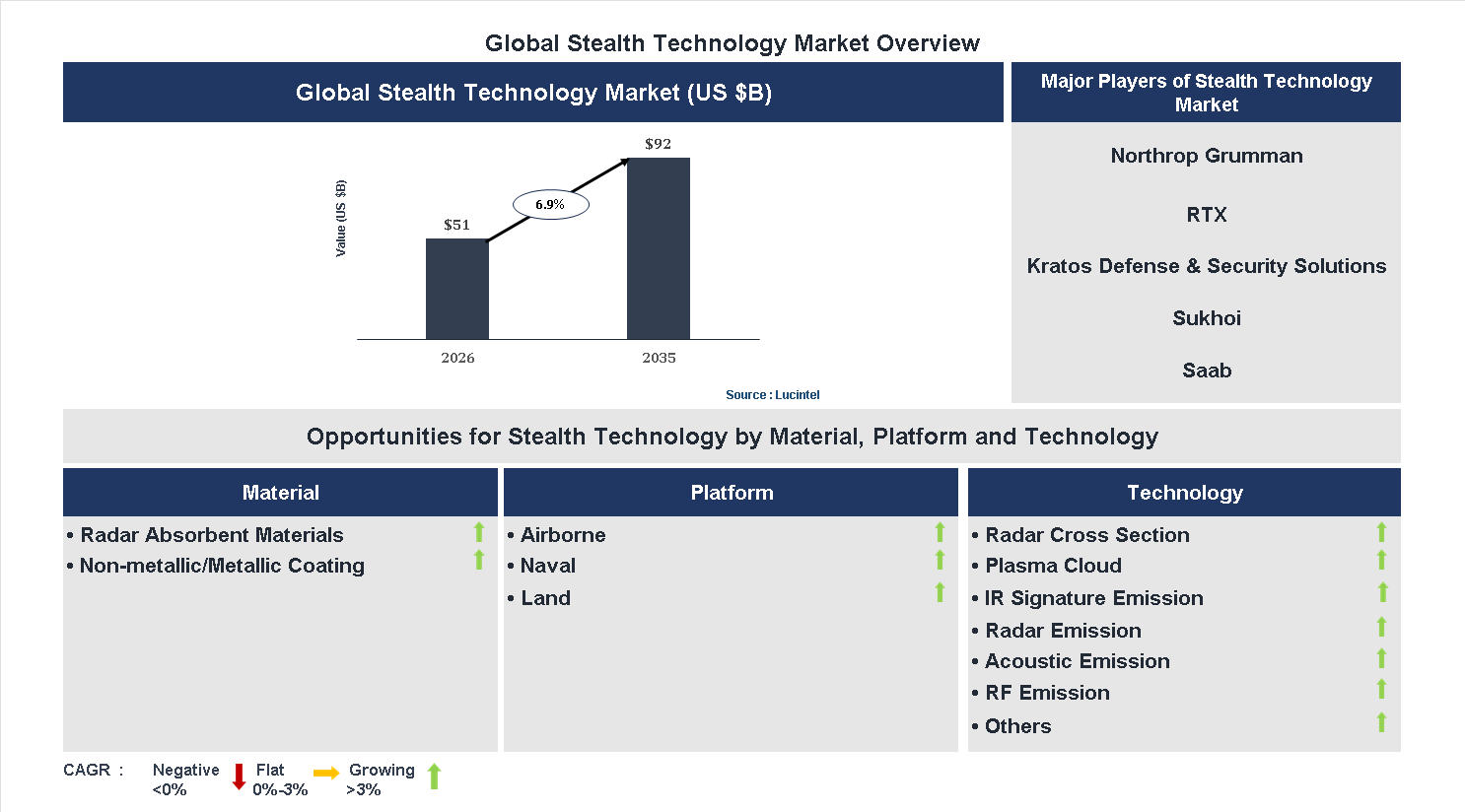
Key data points: The market size in 2035 = $92 billion, growth forecast = 6.9% annually for the next 8 years. Scroll below to get more insights. This market report covers trends, opportunities and forecasts in stealth technology market to 2035 by material (radar absorbent materials and non-metallic/metallic coating), platform (airborne, naval, and land), technology (radar cross section, plasma cloud, IR signature emission, radar emission, acoustic emission, RF emission, and others), and region (North America, Europe, Asia Pacific, and the Rest of the World)
We'll send your sample report shortly.
• Lucintel forecasts that, within the material category, radar absorbent material and non-metallic/metallic coating is expected to witness higher growth over the forecast period.
• Within the technology category, radar cross section, plasma cloud, IR signature emission, radar emission, acoustic emission, and RF emission is expected to witness the highest growth.
• In terms of region, APAC is expected to witness the highest growth over the forecast period. Gain valuable insights for your business decisions with our comprehensive 150+ page report. Sample figures with some insights are shown below.
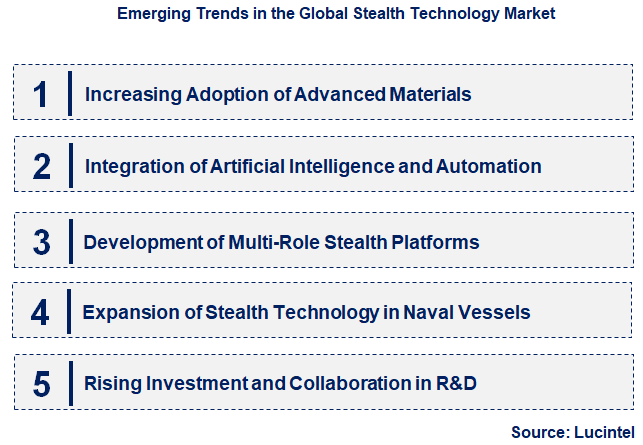
• Increasing Adoption of Advanced Materials: The market is witnessing a shift towards the use of innovative materials such as radar-absorbing composites and meta-materials. These materials significantly reduce the radar cross-section of military assets, enhancing their stealth capabilities. The adoption of lightweight, durable, and cost-effective materials is enabling the development of more sophisticated stealth platforms. This trend is driven by ongoing research and development efforts aimed at overcoming limitations of traditional materials, leading to more effective and versatile stealth solutions across aircraft, ships, and ground vehicles.
• Integration of Artificial Intelligence and Automation: AI and automation are transforming stealth technology by enabling smarter, more adaptive systems. These technologies facilitate real-time threat detection, dynamic camouflage, and autonomous navigation, which enhance the survivability of stealth platforms. AI-driven analytics improve the design and testing processes, reducing development time and costs. The integration of these technologies is also enabling stealth systems to adapt to evolving radar and sensor threats, making them more resilient. This trend is set to redefine operational strategies and increase the effectiveness of stealth assets in complex combat environments.
• Development of Multi-Role Stealth Platforms: There is a growing focus on creating versatile stealth platforms capable of performing multiple roles, such as reconnaissance, strike, and electronic warfare. These multi-role systems maximize operational flexibility and cost-efficiency by reducing the need for separate specialized assets. Advances in modular design and technology integration are facilitating the development of adaptable platforms that can be quickly reconfigured for different missions. This trend is driven by the need for rapid deployment and operational versatility in modern warfare, influencing procurement strategies and defense planning worldwide.
• Expansion of Stealth Technology in Naval Vessels: Traditionally dominated by aircraft, stealth technology is increasingly being incorporated into naval vessels. Stealthy ships with reduced radar and infrared signatures improve survivability and tactical advantage in maritime operations. Innovations include stealthy hull designs, radar-absorbing coatings, and integrated electronic warfare systems. The growing importance of naval power projection and maritime security is fueling this trend. As geopolitical tensions rise, navies worldwide are investing in stealth-enabled vessels to enhance their strategic capabilities and ensure dominance in contested waters.
• Rising Investment and Collaboration in R&D: Governments and private companies are increasing investments in stealth technology research and development. Collaborative efforts between defense agencies, aerospace firms, and academic institutions are accelerating innovation. Funding is directed towards developing next-generation stealth systems, including adaptive camouflage and low-observable sensors. This trend is driven by the need to stay ahead of adversaries and maintain technological superiority. Enhanced R&D activities are fostering breakthroughs that will lead to more effective, affordable, and versatile stealth solutions, shaping the future landscape of the market. These emerging trends are fundamentally transforming the stealth technology market by making stealth assets more adaptable, resilient, and effective. The integration of advanced materials, AI, multi-role platforms, naval applications, and increased R&D investments are collectively driving innovation. These developments are not only enhancing military capabilities but also redefining strategic paradigms, ensuring that stealth technology remains a critical component of modern defense strategies worldwide.
• Growing Military Demand: The increasing need for advanced stealth capabilities in defense systems is propelling market growth. Countries are investing in stealth aircraft, ships, and submarines to maintain strategic superiority. This demand is driven by geopolitical tensions and the desire for technological dominance, leading to heightened R&D activities and procurement of cutting-edge stealth solutions. The market is expected to expand significantly as nations prioritize modernizing their defense arsenals with stealth technology.
• Innovations in Material Science: Advances in radar-absorbing materials and composites are revolutionizing stealth design. These materials reduce radar cross-section and enhance durability, enabling more effective concealment from detection systems. The development of lightweight, cost-effective materials is making stealth technology more accessible across various platforms. This progress is fostering new opportunities for manufacturers to produce versatile stealth components, thereby broadening the application scope and increasing market competitiveness.
• Integration of AI and Automation: Incorporating artificial intelligence and automation into stealth systems is enhancing operational efficiency and detection avoidance. AI-driven algorithms improve target detection, threat assessment, and system responsiveness, making stealth platforms more adaptive and resilient. Automation reduces human error and operational costs, enabling real-time decision-making in complex environments. This integration is transforming stealth technology into smarter, more autonomous systems, which is expected to significantly influence future market growth and technological standards.
• Development of Next-Generation Platforms: The focus on developing advanced stealth aircraft, drones, and naval vessels is creating new market opportunities. These platforms incorporate cutting-edge stealth features, enhanced maneuverability, and integrated sensor systems. Governments are prioritizing the procurement of these next-generation platforms to maintain strategic advantages. The continuous evolution of stealth-enabled platforms is driving innovation, increasing competition among manufacturers, and expanding the market’s scope across defense and commercial sectors.
• Regulatory and Export Controls: Stringent regulations and export controls are shaping the market landscape by restricting technology transfer and international sales. Countries are implementing policies to safeguard their stealth technologies from unauthorized access, impacting global trade dynamics. These controls influence market entry strategies and collaboration opportunities, encouraging domestic innovation. While creating barriers, they also stimulate local industry growth and technological self-reliance, ultimately affecting the pace and direction of market development. The overall impact of these developments is a dynamic, rapidly evolving stealth technology market characterized by innovation, strategic competition, and expanding application areas. Enhanced capabilities and technological advancements are driving increased investments and global interest, positioning the market for sustained growth and strategic importance in defense and aerospace sectors.
• Increasing Demand for Stealth Aircraft and Drones: The rising need for advanced aircraft and unmanned aerial vehicles with stealth capabilities is a significant growth driver. Countries aim to enhance their aerial combat and surveillance capabilities while minimizing detection risks. Innovations in radar-absorbing materials and aerodynamic designs are enabling the development of more effective stealth platforms. This demand is further fueled by geopolitical tensions and the need for superior defense systems, creating substantial opportunities for manufacturers to innovate and expand their product portfolios.
• Advancements in Radar-Absorbing Materials and Coatings: The development of new radar-absorbing materials (RAM) and coatings is crucial for improving stealth effectiveness. These materials reduce radar cross-section (RCS) and enhance survivability of military assets. Ongoing research into nanomaterials and composite coatings is leading to lighter, more durable, and more effective stealth solutions. The growing focus on material innovation offers opportunities for research institutions and companies to collaborate and commercialize next-generation stealth coatings for various platforms.
• Integration of Stealth Technology in Naval and Submarine Platforms: The application of stealth technology in naval vessels and submarines is expanding to improve underwater and surface combat capabilities. Reducing acoustic signatures and radar visibility enhances strategic deterrence and survivability. Advances in hull design, quiet propulsion systems, and stealth coatings are driving this growth. As maritime security concerns increase globally, defense agencies are investing in stealth-enabled naval assets, opening avenues for industry players to develop specialized solutions for underwater and surface stealth applications.
• Growing Adoption of Electronic Warfare and Signal-Jamming Systems: Electronic warfare (EW) and signal-jamming are integral to modern stealth strategies, disrupting enemy radar and communication systems. The integration of advanced EW systems with stealth platforms enhances their survivability and operational effectiveness. Innovations in frequency agility, power management, and miniaturization are expanding the capabilities of these systems. The increasing sophistication of adversary detection methods creates a demand for cutting-edge EW solutions, offering significant growth opportunities for defense contractors and technology providers.
• Expansion of Stealth Technology in Space and Satellite Applications: The use of stealth technology in space assets is emerging to protect satellites from detection and anti-satellite weapons. Developing low-observable satellite designs and stealthy launch methods enhances national security and space dominance. As space becomes a strategic domain, governments are investing in stealth-enabled space systems for reconnaissance, communication, and navigation. This niche market offers opportunities for innovation in materials, design, and electronic countermeasures, shaping the future of space-based stealth solutions. These growth opportunities are transforming the stealth technology market by fostering innovation across multiple domains. The increasing integration of stealth solutions in aircraft, naval, electronic warfare, and space applications will significantly enhance military capabilities. Industry players that capitalize on these opportunities through technological advancements and strategic collaborations will be well-positioned to lead in this evolving defense landscape, ultimately driving market expansion and technological progress.
• Technological Innovation: The rapid development of advanced materials, such as radar-absorbing composites and low-observable coatings, enhances stealth capabilities. Innovations in aircraft design, including shaping and engine placement, reduce radar cross-section and infrared signatures, making targets less detectable. These technological advancements are crucial for maintaining a competitive edge in modern warfare, leading to increased demand from defense agencies worldwide. Continuous research and development efforts are expected to further improve stealth features, expanding the market scope.
• Defense Budget Allocations: Growing defense budgets in countries like the U.S., China, and Russia are fueling investments in stealth technology. Governments prioritize modernizing their military fleets with stealth aircraft, ships, and submarines to ensure strategic superiority. Increased funding enables manufacturers to develop more sophisticated stealth systems, leading to a broader market reach. Additionally, geopolitical tensions and regional conflicts drive the need for advanced stealth solutions, further boosting market growth.
• Geopolitical Tensions and Security Concerns: Rising geopolitical tensions and regional conflicts compel nations to enhance their military capabilities, including stealth technology. Countries seek to develop or acquire stealth platforms to gain tactical advantages and ensure national security. This heightened demand encourages innovation and procurement of stealth systems, creating a competitive market environment. The ongoing arms race among nations underscores the importance of stealth technology as a critical component of modern defense strategies.
• Regulatory and International Agreements: International treaties and export controls influence the development and dissemination of stealth technology. Regulations such as the Missile Technology Control Regime (MTCR) restrict the transfer of sensitive stealth-related materials and technologies, impacting market dynamics. Compliance with these regulations ensures geopolitical stability but may also limit market expansion in certain regions. Conversely, regulatory support for innovation can foster research collaborations and technological advancements within compliant frameworks.
• Strategic Military Modernization: Countries focusing on modernizing their armed forces are investing heavily in stealth technology to replace aging fleets and enhance operational capabilities. The integration of stealth features into new aircraft, naval vessels, and ground systems aligns with broader military modernization programs. This strategic focus drives demand for cutting-edge stealth solutions, encouraging manufacturers to innovate and expand their product offerings to meet evolving military requirements. The challenges facing the stealth technology market include:
• High Development and Production Costs: Developing advanced stealth systems involves significant investment in research, specialized materials, and manufacturing processes. These costs can be prohibitive, especially for emerging market players, limiting market entry and expansion. Additionally, the complexity of stealth technology leads to longer development cycles, increasing financial risks. Budget constraints within defense agencies may also restrict procurement, impacting overall market growth and innovation.
• Technological Obsolescence: Rapid advancements in detection and tracking technologies, such as active electronically scanned array (AESA) radars and infrared sensors, threaten the effectiveness of existing stealth systems. As adversaries develop counter-stealth measures, the need for continuous upgrades becomes essential, increasing costs and operational complexity. This technological arms race challenges manufacturers to innovate constantly, risking obsolescence of earlier stealth designs and creating uncertainty in long-term market stability.
• Regulatory and Export Restrictions: Stringent export controls and international regulations can hinder the global dissemination of stealth technology. Countries may face restrictions when attempting to acquire or share sensitive systems, limiting market growth opportunities. These restrictions can also slow down collaborative research and development efforts, delaying technological advancements. Navigating complex regulatory landscapes requires significant legal expertise and strategic planning, which can pose barriers for smaller firms and emerging markets. The stealth technology market is shaped by rapid technological innovations, substantial defense investments, geopolitical tensions, and regulatory frameworks. While these drivers promote growth and technological progress, challenges such as high costs, technological obsolescence, and export restrictions pose significant hurdles. The markets future depends on balancing innovation with regulatory compliance and cost management, ensuring that nations can maintain strategic advantages in modern warfare. Continuous advancements and strategic collaborations will be essential for overcoming challenges and capitalizing on emerging opportunities in this dynamic sector.
• Northrop Grumman
• RTX
• Kratos Defense & Security Solutions
• Sukhoi
• Saab
• Lockheed Martin Corporation
• BAYKAR TECH
• General Dynamics Corporation
• Boeing
• BAE Systems
• Radar Absorbent Materials
• Non-metallic/Metallic Coating
• Airborne
• Naval
• Land
• Radar Cross Section
• Plasma Cloud
• IR signature emission
• Radar Emission
• Acoustic Emission
• RF emission
• Others
• North America
• Europe
• Asia Pacific
• The Rest of the World
• United States: The US continues to lead in stealth technology development, with advancements in fifth-generation fighter jets like the F-35 and F-22. The focus is on integrating cutting-edge materials and electronic warfare systems to enhance survivability and combat effectiveness. The US defense agencies are investing in next-generation stealth platforms, including unmanned aerial vehicles (UAVs) and naval vessels, to maintain strategic dominance. Recent innovations include improved radar-absorbing materials and active stealth systems that adapt to enemy radar signals, ensuring superior battlefield performance.
• China: China has made rapid progress in stealth technology, emphasizing indigenous development to reduce reliance on foreign systems. The country has introduced stealth fighters such as the J-20 and J-31, showcasing advancements in radar-evading designs and electronic countermeasures. China is also developing stealthy naval vessels and submarines, aiming to expand its maritime influence. The government’s focus on integrating stealth features with advanced weapon systems has strengthened its regional military presence. Ongoing research aims to improve stealth capabilities against modern radar and detection systems, positioning China as a formidable player in this market.
• Germany: Germany is focusing on enhancing stealth features in its military aircraft and naval vessels, primarily through collaborations within NATO. The country is investing in upgrading existing platforms with stealth coatings and radar-absorbing materials. Germany is also exploring stealth technology for future drone and missile systems, aiming to improve survivability and operational range. The emphasis is on integrating stealth with advanced sensor and communication systems to support joint NATO operations. Recent developments include the development of stealthy unmanned systems and improvements in electronic warfare capabilities to complement stealth features.
• India: India is actively developing stealth technology to modernize its defense forces amid regional security challenges. The country has introduced stealth features in its indigenous fighter aircraft, such as the Tejas Mark 2, and is working on stealth frigates and submarines. India’s focus is on reducing radar cross-section and infrared signatures to improve survivability in contested environments. The government is investing in research and development to incorporate stealth technology into future military platforms, aiming for self-reliance. Recent initiatives include collaborations with foreign partners and indigenous innovation to accelerate stealth capabilities across land, sea, and air domains.
• Japan: Japan is advancing stealth technology primarily for its naval and air forces, driven by regional security concerns. The country is developing stealthy fighter jets and submarines with reduced radar and infrared signatures. Japan is also investing in stealth coatings and electronic countermeasures to enhance the survivability of its military assets. The emphasis is on integrating stealth features with advanced sensor systems for improved detection and engagement. Recent developments include the modernization of existing platforms with stealth enhancements and the exploration of unmanned stealth vehicles to strengthen its defense posture in the Asia-Pacific region.


• Northrop Grumman
• RTX
• Kratos Defense & Security Solutions
• Sukhoi
• Saab
• Lockheed Martin Corporation
• BAYKAR TECH
• General Dynamics Corporation
• Boeing
• BAE Systems Q6. Which stealth technology market segment will be the largest in future? Answer: Lucintel forecasts that, within the material category, radar absorbent material and non-metallic/metallic coating is expected to witness higher growth over the forecast period. Q7. In stealth technology market, which region is expected to be the largest in next 8 years? Answer: In terms of region, APAC is expected to witness the highest growth over the forecast period. Q8. Do we receive customization in this report? Answer: Yes, Lucintel provides 10% customization without any additional cost.


Choose a license that fits your team. Instant PDF delivery.
Prices exclude taxes. Instant delivery. Custom licensing available on request.
Market Report · July 31, 2026
Market Report · July 31, 2026
Market Report · July 22, 2026
Trusted partner for strategic intelligence and business growth


Receive a complimentary market analysis tailored to your industry. Our analysts will identify key growth opportunities and competitive dynamics specific to your business.

Market size, growth rate, and key trend analysis for your specific sector.

Top competitor positioning and market share analysis.

Strategic recommendations backed by data-driven insights.
Get curated market intelligence and competitive moves straight to your inbox.
By subscribing, you agree to receive our monthly insights. Unsubscribe anytime.
Receive a complimentary market analysis tailored to your industry. Our analysts will identify key growth opportunities and competitive dynamics specific to your business.
Market size, growth rate, and key trend analysis for your specific sector.
Top competitor positioning and market share analysis.
Strategic recommendations backed by data-driven insights.
Get curated market intelligence, emerging trends, and competitive moves straight to your inbox each month.
By subscribing, you agree to receive our monthly insights. Unsubscribe anytime.
We'll send your sample report shortly.