
Market Report · July 29, 2026

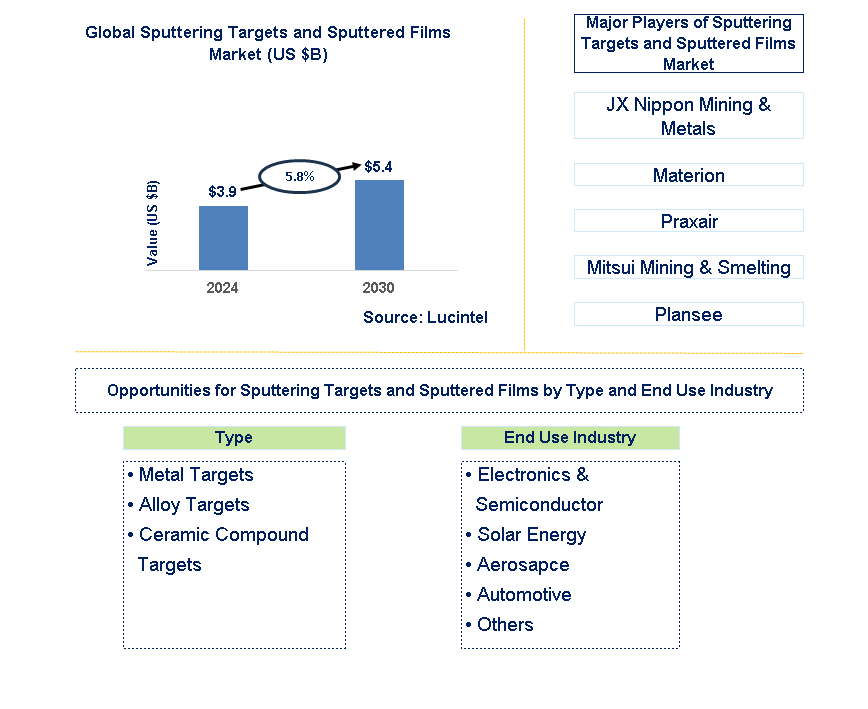
Key data points: The market size in 2030 = $5.4 billion, growth forecast = 5.8% annually for the next 6 years. Scroll below to get more insights. This market report covers trends, opportunities, and forecasts in the global sputtering targets and sputtered films market to 2030 by type (metal targets, alloy targets, and ceramic compound targets), end use industry (electronics & semiconductor, solar energy, aerospace, automotive, and others), and region (North America, Europe, Asia Pacific, and the Rest of the World)
We'll send your sample report shortly.
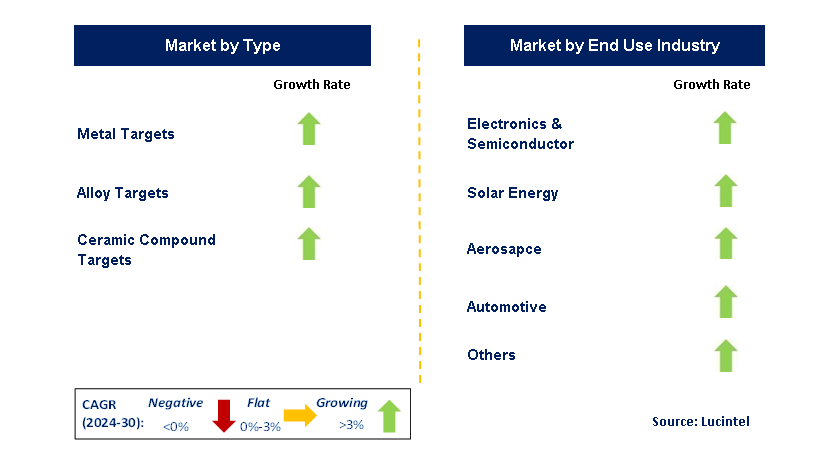
• Lucintel forecasts that, within the type category, metal targets will remain the largest segment over the forecast period as it is widely used for thin films application, such as conductors, resistors, and optical coatings.
• Within the end use category, electronics & semiconductor will remain the largest segment due to increasing demand from electronics and semiconductor devices, such as integrated circuits (ICS), transistors, and memory chips.
• In terms of regions, APAC will remain the largest region due to rising urbanization and population along with increasing consumption of electronic devices and growing semiconductor industry in the region. Gain valuable insights for your business decisions with our comprehensive 150+ page report.
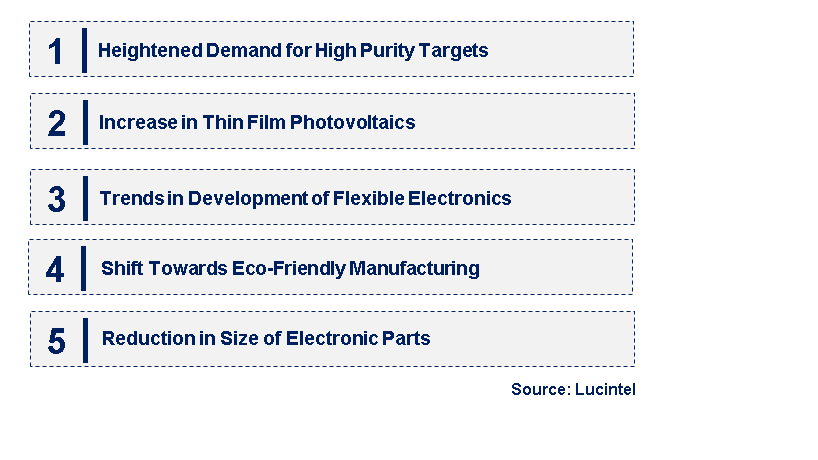
• Heightened Demand for High Purity Targets: With growing industries such as the semiconductor and aerospace industries requiring more accurate and reliable parts, the market for high-quality sputtering targets is expanding. There is a trend toward the production of such materials, which reduce the deterioration of intermediate and kitchen films as well as extend their lifetime. This trend is spurring the development of material refining processes and science to ensure that sputtering technologies meet the advanced regional application requirements.
• Increase in Thin Film Photovoltaics: The market for sputtering targets used in thin film photovoltaic cells is growing due to the increased generation of renewable energy sources. These solar cells are becoming more attractive owing to their effectiveness in generating energy and, moreover, their versatility in installation and usage, including building-integrated photovoltaic systems (BIPV). With governments and industries driving the need for greener energy options, the market for sputtered films in photovoltaic applications is set to expand, and in turn, innovations in sputtering practices will scale up.
• Trends in Development of Flexible Electronics: Flexible electronics, such as wearable and foldable devices, are opening up new markets for sputtering targets and films. As a result of these new requirements, novel sputtering techniques have been developed to coat non-conventional surfaces with high-quality thin films. This trend is especially emphasized in the consumer electronics market, which focuses on creativity in product construction.
• Shift Towards Eco-Friendly Manufacturing: Eco-friendliness is emerging as a critical concern in the market for sputtering targets and films. Companies are minimizing waste during manufacturing processes, adopting cleaner technologies, and using recyclable materials. This trend is driven by both regulators and customers demanding safer products. The focus on green solutions is likely to affect material sourcing, process design, and industrial relations practices across the sector.
• Reduction in Size of Electronic Parts: The continuing miniaturization of electronic devices has created a need for further development of sputtering technology. The smaller and more sophisticated devices become, the tighter the requirements for the precision of sputtered films. This trend is pushing the development of new materials and deposition techniques capable of producing high-quality ultrathin films, which are necessary for next-generation electronic components. These new trends are changing the sputtering targets and sputtered films market, bringing novel solutions and creating new growth opportunities. With new materials, technologies, and practices likely in demand from various industries, it is evident that notable changes in the market will occur, which will be pertinent to both producers and end users.
• Expansion of Semiconductor Manufacturing: The semiconductor industry is witnessing rapid growth, particularly in the U.S. and China. New target production facilities are being built by companies to address the increasing semiconductor market, driven by advances in 5G, AI, and IoT. This expansion will help resolve supply chain constraints and provide enough high-quality sputtered films, which are important for high-end electronic devices.
• Development of Ultra-High-Purity Targets: With such applications, manufacturers are focusing more on developing ultra-high structural purity sputtering targets, especially for aerospace and military applications. Such high-purity targets are essential, as they provide the required grade of purity for these industries, which demand high precision. The composition and structure of these materials are designed to improve sputtered films and increase reliability for applications where quality is a prerequisite.
• Improvement in Sputtering Technology for Flexible Electronics: There has been considerable progress in sputtering technology as the industry calls for more flexible electronics. Companies are developing sputtering systems that will enable them to deposit films on flexible substrates without compromising film quality. This is important because it will enable the manufacturing of wearable devices, foldable smartphones, and other new technologies that require flexibility and strength.
• Move to More Sustainable Production Factors: Companies are adopting more sustainable processes, making investments to improve production. This includes minimizing waste, utilizing alternative energy sources, and using recyclable materials to make sputtering targets. These environmentally friendly activities also satisfy the growing customer interest in such products, helping companies stay aligned with current trends.
• Strategic Collaborations and Mergers: There has been an increasing trend of strategic collaborations and mergers among key players in the market. The purpose of these collaborations is to improve technological development, expand product lines, and access new markets. These partnerships have fostered innovation, as companies can do more together than they could on their own, providing advanced and improved sputtering targets and films. The developments in these areas are essential to the growth of the sputtering targets and sputtered films market. These initiatives are addressing key growth factors within the industry and spearheading technologies that are facilitating further market expansion and innovation.
• Semiconductors: The semiconductor sector holds the largest potential for growth in the sputtering targets market. Due to the increasing shrinkage of chips and the rise in their functionality, there is a higher requirement for high-purity sputtering targets for semiconductor production. This also presents an opportunity for market players to focus on creating new materials that enhance the productivity and efficiency of chips.
• Thin-Film Solar Cells: Sputtering targets for thin-film solar cells are in demand due to the need for renewable energy. These cells are increasingly popular due to their efficiency and flexibility across different applications. As the market shifts toward this direction, players can develop sputtering targets that improve the performance and cost-effectiveness of solar cells, contributing to global energy reforms.
• Display Technologies: There have been new developments in the display market, especially with OLED and QLED technologies, which broaden the landscape for sputtering targets. These displays require the use of high-quality thin films to achieve the desired results. Focusing on the development of sputtering targets for these applications allows companies to gain a competitive advantage while offering the growing display market high-quality materials that enhance brightness, contrast, and energy efficiency.
• Automotive Electronics: High technological advancements have led to greater electronic integration in vehicles, making the automotive industry an important target market for sputtering targets. Sputtered films are required for advanced driver-assistance systems (ADAS), electric vehicles, and in-car displays. As more sophisticated electronic devices are integrated into automobiles, this sector will grow, and companies supplying sputtering systems can benefit from this booming market for automotive electronics.
• Data Storage: The rising demand for more data storage capacity is driving the expansion of sputtering targets, particularly for hard disk drives and magnetic storage devices. These sputtering targets must provide accuracy and resilience. By developing targets that enhance storage capacities and performance, companies can capitalize on the growing demand for high-density data storage. There are ample opportunities for the growth of the sputtering targets and sputtered films market in various applications. Market participants can enhance their portfolio, enter new market segments, and continue to grow within a competitive environment by focusing on these high-potential opportunities.
• Technological Advancements: Rapid growth in semiconductors and other electronics, especially in displays, is the driving force behind the sputtering targets market. Advances in this field are crucial for improving the performance of sputtering target materials, which are essential for the production of high-quality sputtered films in high-tech industries.
• Growth in Renewable Energy: The rising use of renewable energy sources, particularly thin-film solar cells, is driving the market for sputtering targets. As the world shifts toward green energy, the demand for high-quality and affordable solar products and photovoltaic systems continues to rise. This trend offers enormous growth opportunities for manufacturers who can provide the right type of targets to meet the evolving needs of the energy market.
• Expanding Consumer Electronics Market: The consumer electronics market is expanding globally due to the increased demand for mobile phones, wearable technologies, and smart home devices, thereby increasing the need for advanced sputtering films. These devices require high-performance thin films for displays, sensors, and other components. The expanding consumer electronics market presents a significant opportunity for growth in the consumption of sputtering targets, especially in regions with strong manufacturing bases.
• Automotive Industry Innovations: Factors such as the growing trend of electrification and automation in vehicles are driving the demand for sputtered films in advanced driver-assistance systems (ADAS) and electric vehicles (EV). Modern vehicles contain several components, such as sensors, batteries, and displays, that require sputtering targets used to produce thin films. As automotive technology continues to evolve, this sector will remain a key driver of growth in the sputtering market.
• Increase in Demand for Data Storage: The rising volumes of digital content and cloud computing have led to a growing need for sputtering targets in hard disk drives and other storage devices. These sputtering targets need to provide accuracy and resilience to meet the demand for high-performance storage solutions. Thus, the data storage device market remains critical to the growth of the sputtering targets market. Challenges in the sputtering targets and sputtered films market are:
• High Production Costs: Producing high-purity sputtering targets is expensive due to the nature of the processes and materials involved. These costs may hinder some manufacturers, particularly those in price-sensitive industries. The pursuit of better quality while economizing on costs presents a major challenge that can affect profitability and competitiveness in the sputtering targets industry.
• Supply Chain Disruptions: There are inherent risks in the global supply chain for sputtering targets, particularly in sourcing raw materials such as rare earth metals, which are highly volatile. Such disruptions can cause delays, increase costs, and create production bottlenecks, making it difficult for manufacturers to meet demand. To ensure development and maintain market position, companies need a reliable and consistent supply chain. The sputtering targets and sputtered films market is influenced by rapid technological changes and growing demand in key industries. However, challenges such as production costs, supply chain risks, and strict regulatory tariffs require strategic oversight. The decisions made to address these challenges will shape the future of the market, and companies must take advantage of both opportunities and challenges to grow.
• JX Nippon Mining & Metals
• Materion
• Praxair
• Mitsui Mining & Smelting
• Plansee
• Konfoong Materials International
• Sumitomo Chemical
• Hitachi Metals
• ULVAC
• TOSOH
• Metal Targets
• Alloy Targets
• Ceramic Compound Targets
• Electronics & Semiconductor
• Solar Energy
• Aerospace
• Automotive
• Others
• North America
• Europe
• Asia Pacific
• The Rest of the World
• United States: In the U.S., there has been a substantial increase in the demand for sputtering targets in semiconductor and photovoltaic applications. More companies are investing in research and development to create high-purity materials for advanced manufacturing processes. This trend is driven by the rapid adoption of consumer electronics and the need for renewable energy systems, positioning the U.S. at the forefront of developing cutting-edge sputtering technologies and market opportunities.
• China: China’s sputtering targets market is growing rapidly, particularly in localizing production to reduce imports. State investments have stimulated growth in the semiconductor and electronics industries, leading to the establishment of new factories. This has elevated China’s status as a dominant market for sputtered films, particularly in response to the booming consumer electronics industry.
• Germany: Germany has placed significant emphasis on sustaining production processes and designing eco-friendly sputtering materials. The country's focus on environmental advancements has resulted in the development of thin-film solar cells and energy-efficient coating technologies. The German industry and academia are collaborating on sputtering process development to meet the country’s stringent environmental regulations.
• India: There is growing demand for sputtering targets and films in India, particularly in the automotive and electronics sectors. The "Make in India" initiative is encouraging foreign investments, leading to the establishment of new industries. This has increased the supply of locally manufactured sputtering materials, reducing costs and intensifying competition for Indian manufacturers in the global market.
• Japan: Japan remains a key country for research and development of materials, particularly in the sputtering targets market. The country's focus on miniaturization and high-performance electronic devices has increased the demand for advanced sputtering processes. Japanese manufacturers lead the market in supplying specialized targets used in semiconductor and display manufacturing to sustain global competition.


• JX Nippon Mining & Metals
• Materion
• Praxair
• Mitsui Mining & Smelting
• Plansee
• Konfoong Materials International
• Sumitomo Chemical
• Hitachi Metals
• ULVAC
• TOSOH Q6. Which sputtering targets and sputtered films market segment will be the largest in future? Answer: Lucintel forecasts that metal targets will remain the largest segment over the forecast period as it is widely used for thin films application, such as conductors, resistors, and optical coatings. Q7. In sputtering targets and sputtered films market, which region is expected to be the largest in next 5 years? Answer: APAC will remain the largest region due to rising urbanization and population along with increasing consumption of electronic devices and growing semiconductor industry in the region. Q.8 Do we receive customization in this report? Answer: Yes, Lucintel provides 10% customization without any additional cost.


Choose a license that fits your team. Instant PDF delivery.
Prices exclude taxes. Instant delivery. Custom licensing available on request.
Market Report · July 29, 2026
Market Report · July 20, 2026
Market Report · July 20, 2026
Trusted partner for strategic intelligence and business growth


Receive a complimentary market analysis tailored to your industry. Our analysts will identify key growth opportunities and competitive dynamics specific to your business.

Market size, growth rate, and key trend analysis for your specific sector.

Top competitor positioning and market share analysis.

Strategic recommendations backed by data-driven insights.
Get curated market intelligence and competitive moves straight to your inbox.
By subscribing, you agree to receive our monthly insights. Unsubscribe anytime.
Receive a complimentary market analysis tailored to your industry. Our analysts will identify key growth opportunities and competitive dynamics specific to your business.
Market size, growth rate, and key trend analysis for your specific sector.
Top competitor positioning and market share analysis.
Strategic recommendations backed by data-driven insights.
Get curated market intelligence, emerging trends, and competitive moves straight to your inbox each month.
By subscribing, you agree to receive our monthly insights. Unsubscribe anytime.
We'll send your sample report shortly.