
'
...

The Impact of COVID-19 is included in Spirulina Food Market Report. Buy it today to get an advantage.

Request the impact of COVID-19 on your product or industry


Spirulina Food Market Trends and Forecast

The future of the global spirulina food market looks promising with opportunities in the online sale and offline sale markets. The global spirulina food market is expected to reach an estimated $1,442 million by 2035 with a CAGR of 6.6% from 2026 to 2035. The major drivers for this market are the increasing demand for nutrient dense superfood ingredients, the rising awareness of plant based protein sources, and the growing adoption of natural functional food supplements.

• Lucintel forecasts that, within the type category, supplement is expected to witness the highest growth over the forecast period.
• Within the application category, online sale is expected to witness higher growth.
• In terms of region, APAC is expected to witness the highest growth over the forecast period.
Gain valuable insights for your business decisions with our comprehensive 150+ page report. Sample figures with some insights are shown below.

Spirulina Food Market Trends and Forecast

Emerging Trends in the Spirulina Food Market

The spirulina food market is experiencing rapid growth driven by increasing consumer awareness of health and wellness, environmental sustainability, and the demand for plant-based protein sources. As consumers seek nutritious, sustainable, and functional foods, the market is evolving with innovative products and expanding distribution channels. Technological advancements in cultivation and processing are also contributing to the markets expansion. These developments are not only broadening the consumer base but also encouraging new product formulations and marketing strategies. The following key trends highlight the major shifts shaping the future of the spirulina food market and its trajectory toward a more sustainable and health-conscious food industry.

• Growing Consumer Awareness of Health Benefits: Consumers are increasingly recognizing spirulinas nutritional value, including its high protein, vitamin, and antioxidant content. This awareness is driven by health trends emphasizing superfoods and functional foods that promote immunity, energy, and overall wellness. As a result, demand for spirulina-based products such as powders, tablets, and beverages is rising, encouraging manufacturers to develop innovative, health-focused offerings. This trend is expanding the market beyond niche health stores to mainstream retail outlets, making spirulina more accessible to a broader audience.
• Expansion of Plant-Based and Vegan Diets: The rising adoption of plant-based and vegan lifestyles is significantly impacting the spirulina market. Spirulina, being a complete plant-based protein source, aligns perfectly with these dietary preferences. Food companies are incorporating spirulina into vegan-friendly products like snacks, smoothies, and meal replacements to meet consumer demand for sustainable, cruelty-free options. This trend is driving product innovation and increasing market penetration, especially among younger consumers seeking ethical and environmentally friendly food choices. Consequently, spirulina is becoming a staple ingredient in the plant-based food industry.
• Technological Advancements in Cultivation and Processing: Innovations in cultivation techniques, such as open-pond and closed bioreactor systems, are improving spirulina yield, quality, and cost-efficiency. Advanced processing methods, including freeze-drying and encapsulation, help preserve nutrients and enhance product stability. These technological improvements enable large-scale production, reduce costs, and ensure consistent quality, making spirulina more affordable and appealing to consumers. As a result, manufacturers can meet growing demand while maintaining high standards, further fueling market growth and product diversification.
• Rising Focus on Sustainability and Eco-Friendly Production: Consumers and companies are increasingly prioritizing sustainability, prompting a shift toward eco-friendly cultivation and processing methods for spirulina. Spirulinas minimal land and water requirements, along with its ability to absorb CO2, position it as an environmentally sustainable superfood. Companies are adopting renewable energy sources and sustainable packaging to reduce environmental impact. This trend enhances the markets appeal to environmentally conscious consumers and aligns with global sustainability goals, fostering a positive brand image and encouraging investment in sustainable practices within the industry.
• Diversification of Product Offerings and Innovative Formats: The market is witnessing a surge in diverse spirulina-based products, including snacks, beverages, supplements, and functional foods. Innovative formats such as spirulina-infused energy drinks, protein bars, and beauty products are emerging to cater to various consumer preferences. This diversification broadens the market reach and creates new revenue streams for manufacturers. It also helps overcome taste and texture barriers associated with spirulina, making it more palatable and convenient. This trend is crucial for attracting a wider consumer base and sustaining long-term market growth.

These trends are collectively transforming the spirulina food market into a more dynamic, sustainable, and health-oriented industry. They are expanding consumer access, fostering innovation, and emphasizing environmental responsibility, ultimately reshaping how spirulina is produced, marketed, and consumed worldwide.
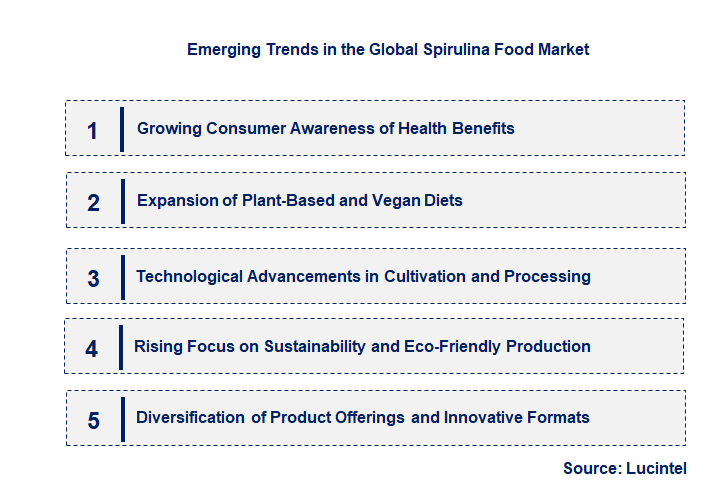
Emerging Trends in the Spirulina Food Market

Recent Development in the Spirulina Food Market

The spirulina food market has experienced significant growth driven by increasing consumer awareness of health benefits, rising demand for plant-based proteins, and expanding product innovation. As consumers seek nutritious, sustainable, and functional foods, the market is evolving rapidly. Technological advancements and strategic partnerships are further fueling this expansion. These developments are shaping a dynamic landscape, offering new opportunities for manufacturers and investors alike, while also addressing global health and environmental concerns.

• Growing consumer awareness of health benefits: The increasing recognition of spirulinas nutritional value, including high protein, vitamins, and antioxidants, is boosting demand. Consumers are actively seeking natural superfoods to improve immunity and overall wellness, leading to expanded product offerings and market penetration. This trend is encouraging manufacturers to innovate and promote spirulina-based products, thereby increasing market size and consumer engagement.
• Rising demand for plant-based proteins: As the shift towards vegetarian and vegan diets accelerates, spirulina emerges as a sustainable, high-quality protein source. Its versatility in various food applications, such as smoothies, snacks, and supplements, makes it attractive to health-conscious consumers. This demand is prompting companies to develop new formulations, expand distribution channels, and invest in marketing strategies to capture a broader customer base.
• Product innovation and diversification: Companies are introducing novel spirulina products, including flavored powders, capsules, and ready-to-eat snacks, to cater to diverse consumer preferences. Innovations focus on taste, convenience, and functional benefits, enhancing consumer appeal. This diversification is expanding market reach, attracting new demographics, and increasing overall sales, while also encouraging research into new applications and formulations.
• Expansion of distribution channels: The market is witnessing increased availability of spirulina products through online platforms, health stores, and supermarkets. Strategic partnerships with retailers and e-commerce giants are improving accessibility and visibility. This expansion is facilitating wider consumer adoption, reducing barriers to purchase, and driving sales growth across regions, especially in emerging markets where health food awareness is rising.
• Technological advancements in cultivation and processing: Innovations in cultivation techniques, such as open-pond and closed bioreactor systems, are improving yield and quality. Advanced processing methods enhance product stability, flavor, and nutrient retention. These technological improvements reduce costs, ensure consistent supply, and meet regulatory standards, thereby strengthening market competitiveness and enabling large-scale commercialization of spirulina-based foods.

The overall impact of these developments is significantly expanding the spirulina food market, making it more accessible, diverse, and aligned with consumer health trends. Increased innovation, distribution, and awareness are driving growth, attracting new players, and fostering sustainable practices. This evolution is positioning spirulina as a mainstream superfood, promising continued market expansion and innovation in the coming years.

Strategic Growth Opportunities in the Spirulina Food Market

The spirulina food market is experiencing rapid growth driven by increasing consumer awareness of health benefits, rising demand for plant-based proteins, and expanding applications in functional foods and beverages. Innovations in cultivation and processing techniques are enhancing product quality and affordability. Market players are focusing on strategic partnerships and product diversification to capture new customer segments. The evolving regulatory landscape and sustainability concerns also influence market dynamics, creating numerous opportunities for growth and expansion across various regions and applications.

• Growing consumer demand for plant-based, nutrient-rich foods: The increasing awareness of spirulina’s health benefits, including high protein, antioxidants, and vitamins, is driving consumer preference for plant-based superfoods. This trend is supported by a shift towards healthier lifestyles and vegetarian or vegan diets, boosting demand for spirulina in dietary supplements, smoothies, and snack products. Manufacturers are capitalizing on this by developing innovative, convenient spirulina-based products to meet consumer needs and expand market reach.
• Expansion of functional foods and beverages incorporating spirulina: The rising popularity of functional foods and beverages presents significant growth opportunities for spirulina. Food and beverage companies are integrating spirulina into products like energy drinks, protein bars, and dairy alternatives to enhance nutritional profiles. This integration caters to health-conscious consumers seeking convenient, nutrient-dense options. The development of appealing flavors and formulations is further driving adoption, making spirulina a key ingredient in the functional food segment.
• Advancements in cultivation and processing technologies: Innovations in spirulina cultivation, such as open-pond and closed bioreactor systems, are improving yield, quality, and sustainability. Enhanced processing techniques, including freeze-drying and encapsulation, preserve nutrients and improve product stability. These technological advancements reduce production costs and enable large-scale commercialization. As a result, more affordable, high-quality spirulina products are entering the market, supporting increased consumer adoption and expanding application possibilities.
• Rising focus on sustainability and eco-friendly production methods: Consumers and regulators are increasingly emphasizing sustainable practices, prompting producers to adopt eco-friendly cultivation and harvesting methods. Spirulina’s minimal land and water requirements make it an attractive sustainable crop. Companies are investing in renewable energy sources and waste reduction strategies to lower environmental impact. These efforts enhance brand reputation, meet regulatory standards, and appeal to environmentally conscious consumers, thereby fostering market growth and encouraging responsible production practices.
• Strategic collaborations and product innovation to capture new markets: Market players are forming partnerships with research institutions and food companies to develop innovative spirulina products tailored to diverse consumer preferences. These collaborations facilitate product diversification, such as flavored powders, capsules, and ready-to-eat snacks. Expanding distribution channels through online platforms and retail outlets also broadens market access. Such strategic initiatives enable companies to penetrate emerging markets, increase brand visibility, and capitalize on the growing demand for natural, health-promoting foods.

The overall impact of these opportunities is a robust expansion of the spirulina food market, driven by innovation, sustainability, and consumer health consciousness. Companies that leverage these growth avenues can enhance their market share, improve product offerings, and meet the evolving demands of health-focused consumers worldwide. This dynamic environment promises sustained growth and diversification in the spirulina food industry.

Spirulina Food Market Driver and Challenges

The spirulina food market is influenced by a variety of technological, economic, and regulatory factors that shape its growth trajectory. Advances in cultivation and processing technologies have made spirulina more accessible and affordable, while increasing consumer awareness of health benefits has driven demand. Economic factors such as rising disposable incomes and a growing focus on organic and plant-based foods further propel the market. However, regulatory challenges related to food safety standards and labeling requirements pose hurdles. Additionally, environmental concerns about sustainable cultivation practices and supply chain logistics impact market stability. Understanding these drivers and challenges is essential for stakeholders aiming to capitalize on emerging opportunities and navigate potential risks in this dynamic industry.

The factors responsible for driving the spirulina food market include:
• Increasing Health Consciousness: Consumers are becoming more aware of the health benefits associated with spirulina, such as high protein content, antioxidants, and anti-inflammatory properties. This awareness, coupled with a rising trend toward organic and superfood consumption, has significantly boosted demand. Spirulinas versatility in various food products, including smoothies, snacks, and supplements, makes it an attractive option for health-conscious consumers. The growing prevalence of lifestyle-related health issues further accelerates this trend, encouraging both manufacturers and consumers to seek natural, nutrient-dense foods like spirulina.
• Technological Advancements in Cultivation: Innovations in algae cultivation techniques, such as photobioreactors and optimized open pond systems, have enhanced spirulina production efficiency. These technological improvements reduce costs, increase yield, and ensure consistent quality, making spirulina more commercially viable. Additionally, advancements in harvesting and processing technologies help preserve nutritional content and extend shelf life. These developments enable producers to meet rising demand while maintaining product standards, thereby expanding market reach and fostering industry growth.
• Rising Adoption in Food and Beverage Industry: Spirulinas incorporation into a wide range of food and beverage products, including energy bars, smoothies, pasta, and beverages, has broadened its market appeal. Food manufacturers are leveraging spirulinas natural color and nutritional profile to develop innovative products that cater to health-conscious consumers. This trend is supported by increasing product launches and collaborations between spirulina producers and food brands. The integration of spirulina into mainstream food items not only enhances nutritional value but also boosts market visibility and consumer acceptance.
• Growing Preference for Plant-Based and Organic Products: The shift towards plant-based diets and organic foods is a significant driver for the spirulina market. As consumers seek sustainable, non-GMO, and chemical-free options, spirulina emerges as an ideal ingredient due to its natural origin and rich nutrient profile. Organic certification and eco-friendly cultivation practices further enhance its appeal. This trend aligns with global efforts to reduce environmental impact and promote health, thereby expanding the consumer base and encouraging product innovation within the market.
• Expansion of E-commerce and Retail Channels: The proliferation of online retail platforms and health-focused stores has increased accessibility to spirulina products. E-commerce enables consumers to easily compare brands, access a wider variety of products, and receive detailed information about health benefits. Retail channels such as organic supermarkets and specialty stores also contribute to market growth by providing direct access to quality products. This expansion enhances brand visibility, drives sales, and supports market penetration in both developed and emerging regions.

The challenges facing the spirulina food market include:
• Regulatory and Quality Standards: The spirulina market faces stringent regulatory frameworks related to food safety, labeling, and health claims. Variations across regions create compliance complexities for manufacturers, potentially delaying product launches and increasing costs. Ensuring consistent quality and safety standards is critical, especially given concerns about contamination with heavy metals or toxins. Non-compliance can lead to legal issues, recalls, and damage to brand reputation, hindering market growth and consumer trust.
• Environmental Sustainability Concerns: While spirulina cultivation is considered eco-friendly, issues such as water usage, energy consumption, and waste management pose sustainability challenges. Unsustainable practices can lead to environmental degradation, affecting the long-term viability of production. Additionally, climate change impacts, such as water scarcity and temperature fluctuations, threaten consistent supply. Addressing these concerns requires investment in sustainable cultivation methods, which may increase operational costs and complicate supply chain logistics.
• Supply Chain and Raw Material Availability: The production of spirulina depends heavily on the availability of suitable water sources and controlled environments. Disruptions in raw material supply, such as water shortages or contamination, can hamper production capacity. Logistics issues, including transportation and storage, further complicate distribution, especially in remote or developing regions. These challenges can lead to inconsistent product availability, price volatility, and hindered market expansion efforts.

The spirulina food market is driven by increasing health awareness, technological innovations, product diversification, and consumer preferences for plant-based and organic foods. However, regulatory hurdles, environmental sustainability issues, and supply chain complexities pose significant challenges. These factors collectively influence market stability, growth potential, and competitive dynamics. Stakeholders must navigate these drivers and challenges strategically to capitalize on emerging opportunities while mitigating risks, ensuring sustainable development and long-term success in this evolving industry.

List of Spirulina Food Companies

Companies in the market compete on the basis of product quality offered. Major players in this market focus on expanding their manufacturing facilities, R&D investments, infrastructural development, and leverage integration opportunities across the value chain. With these strategies spirulina food companies cater increasing demand, ensure competitive effectiveness, develop innovative products & technologies, reduce production costs, and expand their customer base. Some of the spirulina food companies profiled in this report include-
• Aztec Spirulina
• Cyanotech Corporation
• BATA Food
• Spiform
• Clos Sainte Aurore
• RKS Health Care
• Aurospirul
• Now Foods
• Earthrise Nutritionals
• Nutrex Hawaii

Spirulina Food Market by Segment

The study includes a forecast for the global spirulina food market by type, application, and region.

Spirulina Food Market by Type [Value from 2019 to 2035]:


• Supplements
• Bakery Products
• Dairy
• Others

Spirulina Food Market by Application [Value from 2019 to 2035]:


• Online Sales
• Offline Sales

Spirulina Food Market by Region [Value from 2019 to 2035]:


• North America
• Europe
• Asia Pacific
• The Rest of the World

Country Wise Outlook for the Spirulina Food Market

The spirulina food market has experienced significant growth globally, driven by increasing consumer awareness of health benefits, rising demand for plant-based proteins, and innovations in sustainable food sources. Countries are adopting new technologies, expanding production capacities, and developing innovative products to meet the rising demand. Regulatory frameworks are evolving to ensure safety and quality, while marketing strategies focus on health benefits and environmental sustainability. This dynamic landscape reflects a broader shift towards functional foods and alternative protein sources, positioning spirulina as a key player in future food security and nutrition strategies across major economies.

• United States: The US market for spirulina food has seen rapid expansion, driven by health-conscious consumers and the plant-based movement. Major brands are launching new spirulina-based products such as smoothies, snacks, and supplements. Innovations in cultivation techniques have improved yield and quality, while regulatory agencies are establishing clearer guidelines for safety and labeling. E-commerce platforms are significantly boosting accessibility and sales. Additionally, research institutions are exploring new applications, including functional foods and beverages, further fueling market growth.
• China: China has become a leading producer and consumer of spirulina, with government initiatives supporting sustainable aquaculture and bio-farming. The market is characterized by increasing domestic demand for health supplements and functional foods. Local companies are investing in large-scale cultivation facilities, reducing costs and improving product quality. The government’s focus on green and organic products has also propelled spirulina’s popularity. Moreover, collaborations with international firms are enhancing technological capabilities, and new product launches are targeting health-conscious urban populations.
• Germany: The German spirulina food market is marked by a strong emphasis on organic and sustainable products. Consumers are increasingly seeking clean-label, plant-based options, which has boosted spirulina’s popularity. Several startups and established companies are developing innovative products such as spirulina-enriched snacks, drinks, and dietary supplements. Germany’s strict regulatory environment ensures high safety standards, fostering consumer trust. The market is also supported by research institutions exploring health benefits and sustainable cultivation methods, contributing to product innovation and market expansion.
• India: India’s spirulina market is rapidly growing, driven by rising awareness of nutritional deficiencies and the need for affordable, sustainable protein sources. Local farmers and entrepreneurs are adopting small-scale cultivation practices, making spirulina accessible in rural areas. Government schemes promoting organic farming and health supplements are further supporting growth. The market is witnessing increased demand for spirulina-based health products, including powders and capsules. Additionally, collaborations with international companies are facilitating technology transfer and quality improvement, positioning India as a significant emerging market for spirulina foods.
• Japan: Japan’s market for spirulina foods is characterized by a focus on health, wellness, and functional foods. Consumers prefer high-quality, organic, and minimally processed products. Japanese companies are innovating with spirulina-infused beverages, supplements, and functional foods targeting aging populations and health-conscious consumers. Regulatory standards are stringent, ensuring product safety and efficacy. The market benefits from strong research backing and consumer trust in natural health products. Additionally, Japan’s emphasis on sustainability and eco-friendly cultivation practices aligns with global trends, supporting continued growth and innovation in the spirulina food sector.

Lucintel Analytics Dashboard

Features of the Global Spirulina Food Market

Market Size Estimates: Spirulina food market size estimation in terms of value ($M).
Trend and Forecast Analysis: Market trends (2019 to 2025) and forecast (2026 to 2035) by various segments and regions.
Segmentation Analysis: Spirulina food market size by type, application, and region in terms of value ($M).
Regional Analysis: Spirulina food market breakdown by North America, Europe, Asia Pacific, and Rest of the World.
Growth Opportunities: Analysis of growth opportunities in different types, applications, and regions for the spirulina food market.
Strategic Analysis: This includes M&A, new product development, and competitive landscape of the spirulina food market.
Analysis of competitive intensity of the industry based on Porter’s Five Forces model.

Lucintel Consulting Services

FAQ

Q1. What is the spirulina food market size?
Answer: The global spirulina food market is expected to reach an estimated $1,442 million by 2035.
Q2. What is the growth forecast for spirulina food market?
Answer: The global spirulina food market is expected to grow with a CAGR of 6.6% from 2026 to 2035.
Q3. What are the major drivers influencing the growth of the spirulina food market?
Answer: The major drivers for this market are the increasing demand for nutrient dense superfood ingredients, the rising awareness of plant based protein sources, and the growing adoption of natural functional food supplements.
Q4. What are the major segments for spirulina food market?
Answer: The future of the spirulina food market looks promising with opportunities in the online sale and offline sale markets.
Q5. Who are the key spirulina food market companies?
Answer: Some of the key spirulina food companies are as follows:
• Aztec Spirulina
• Cyanotech Corporation
• BATA Food
• Spiform
• Clos Sainte Aurore
• RKS Health Care
• Aurospirul
• Now Foods
• Earthrise Nutritionals
• Nutrex Hawaii
Q6. Which spirulina food market segment will be the largest in future?
Answer: Lucintel forecasts that, within the type category, supplement is expected to witness the highest growth over the forecast period.
Q7. In spirulina food market, which region is expected to be the largest in next 5 years?
Answer: In terms of region, APAC is expected to witness the highest growth over the forecast period.
Q8. Do we receive customization in this report?
Answer: Yes, Lucintel provides 10% customization without any additional cost.

This report answers following 11 key questions:

Q.1. What are some of the most promising, high-growth opportunities for the spirulina food market by type (supplements, bakery products, dairy, and others), application (online sales and offline sales), and region (North America, Europe, Asia Pacific, and the Rest of the World)?
Q.2. Which segments will grow at a faster pace and why?
Q.3. Which region will grow at a faster pace and why?
Q.4. What are the key factors affecting market dynamics? What are the key challenges and business risks in this market?
Q.5. What are the business risks and competitive threats in this market?
Q.6. What are the emerging trends in this market and the reasons behind them?
Q.7. What are some of the changing demands of customers in the market?
Q.8. What are the new developments in the market? Which companies are leading these developments?
Q.9. Who are the major players in this market? What strategic initiatives are key players pursuing for business growth?
Q.10. What are some of the competing products in this market and how big of a threat do they pose for loss of market share by material or product substitution?
Q.11. What M&A activity has occurred in the last 7 years and what has its impact been on the industry?

For any questions related to Spirulina Food Market, Spirulina Food Market Size, Spirulina Food Market Growth, Spirulina Food Market Analysis, Spirulina Food Market Report, Spirulina Food Market Share, Spirulina Food Market Trends, Spirulina Food Market Forecast, Spirulina Food Companies, write Lucintel analyst at email: helpdesk@lucintel.com. We will be glad to get back to you soon.
                                           Table of Contents

            1. Executive Summary

            2. Market Overview

                        2.1 Background and Classifications
                        2.2 Supply Chain

            3. Market Trends & Forecast Analysis

                        3.1 Macroeconomic Trends and Forecasts
                        3.2 Industry Drivers and Challenges
                        3.3 PESTLE Analysis
                        3.4 Patent Analysis
                        3.5 Regulatory Environment
                        3.6 Global Spirulina Food Market Trends and Forecast

            4. Global Spirulina Food Market by Type

                        4.1 Overview
                        4.2 Attractiveness Analysis by Type
                        4.3 Supplements : Trends and Forecast (2019 to 2035)
                        4.4 Bakery Products : Trends and Forecast (2019 to 2035)
                        4.5 Dairy : Trends and Forecast (2019 to 2035)
                        4.6 Others : Trends and Forecast (2019 to 2035)

            5. Global Spirulina Food Market by Application

                        5.1 Overview
                        5.2 Attractiveness Analysis by Application
                        5.3 Online Sales : Trends and Forecast (2019 to 2035)
                        5.4 Offline Sales : Trends and Forecast (2019 to 2035)

            6. Regional Analysis

                        6.1 Overview
                        6.2 Global Spirulina Food Market by Region

            7. North American Spirulina Food Market

                        7.1 Overview
                        7.2 North American Spirulina Food Market by Type
                        7.3 North American Spirulina Food Market by Application
                        7.4 The United States Spirulina Food Market
                        7.5 Canadian Spirulina Food Market
                        7.6 Mexican Spirulina Food Market

            8. European Spirulina Food Market

                        8.1 Overview
                        8.2 European Spirulina Food Market by Type
                        8.3 European Spirulina Food Market by Application
                        8.4 German Spirulina Food Market
                        8.5 French Spirulina Food Market
                        8.6 Italian Spirulina Food Market
                        8.7 Spanish Spirulina Food Market
                        8.8 The United Kingdom Spirulina Food Market

            9. APAC Spirulina Food Market

                        9.1 Overview
                        9.2 APAC Spirulina Food Market by Type
                        9.3 APAC Spirulina Food Market by Application
                        9.4 Chinese Spirulina Food Market
                        9.5 Indian Spirulina Food Market
                        9.6 Japanese Spirulina Food Market
                        9.7 South Korean Spirulina Food Market
                        9.8 Indonesian Spirulina Food Market

            10. ROW Spirulina Food Market

                        10.1 Overview
                        10.2 ROW Spirulina Food Market by Type
                        10.3 ROW Spirulina Food Market by Application
                        10.4 Middle Eastern Spirulina Food Market
                        10.5 South American Spirulina Food Market
                        10.6 African Spirulina Food Market

            11. Competitor Analysis

                        11.1 Product Portfolio Analysis
                        11.2 Operational Integration
                        11.3 Porter’s Five Forces Analysis
                                    • Competitive Rivalry
                                    • Bargaining Power of Buyers
                                    • Bargaining Power of Suppliers
                                    • Threat of Substitutes
                                    • Threat of New Entrants
                        11.4 Market Share Analysis

            12. Opportunities & Strategic Analysis

                        12.1 Value Chain Analysis
                        12.2 Growth Opportunity Analysis
                                    12.2.1 Growth Opportunity by Type
                                    12.2.2 Growth Opportunity by Application
                        12.3 Emerging Trends in the Global Spirulina Food Market
                        12.4 Strategic Analysis
                                    12.4.1 New Product Development
                                    12.4.2 Certification and Licensing
                                    12.4.3 Mergers, Acquisitions, Agreements, Collaborations, and Joint Ventures

            13. Company Profiles of the Leading Players Across the Value Chain

                        13.1 Competitive Analysis Overview
                        13.2 Aztec Spirulina
                                    • Company Overview
                                    • Spirulina Food Market Business Overview
                                    • New Product Development
                                    • Merger, Acquisition, and Collaboration
                                    • Certification and Licensing
                        13.3 Cyanotech Corporation
                                    • Company Overview
                                    • Spirulina Food Market Business Overview
                                    • New Product Development
                                    • Merger, Acquisition, and Collaboration
                                    • Certification and Licensing
                        13.4 BATA Food
                                    • Company Overview
                                    • Spirulina Food Market Business Overview
                                    • New Product Development
                                    • Merger, Acquisition, and Collaboration
                                    • Certification and Licensing
                        13.5 Spiform
                                    • Company Overview
                                    • Spirulina Food Market Business Overview
                                    • New Product Development
                                    • Merger, Acquisition, and Collaboration
                                    • Certification and Licensing
                        13.6 Clos Sainte Aurore
                                    • Company Overview
                                    • Spirulina Food Market Business Overview
                                    • New Product Development
                                    • Merger, Acquisition, and Collaboration
                                    • Certification and Licensing
                        13.7 RKS Health Care
                                    • Company Overview
                                    • Spirulina Food Market Business Overview
                                    • New Product Development
                                    • Merger, Acquisition, and Collaboration
                                    • Certification and Licensing
                        13.8 Aurospirul
                                    • Company Overview
                                    • Spirulina Food Market Business Overview
                                    • New Product Development
                                    • Merger, Acquisition, and Collaboration
                                    • Certification and Licensing
                        13.9 Now Foods
                                    • Company Overview
                                    • Spirulina Food Market Business Overview
                                    • New Product Development
                                    • Merger, Acquisition, and Collaboration
                                    • Certification and Licensing
                        13.10 Earthrise Nutritionals
                                    • Company Overview
                                    • Spirulina Food Market Business Overview
                                    • New Product Development
                                    • Merger, Acquisition, and Collaboration
                                    • Certification and Licensing
                        13.11 Nutrex Hawaii
                                    • Company Overview
                                    • Spirulina Food Market Business Overview
                                    • New Product Development
                                    • Merger, Acquisition, and Collaboration
                                    • Certification and Licensing

            14. Appendix

                        14.1 List of Figures
                        14.2 List of Tables
                        14.3 Research Methodology
                        14.4 Disclaimer
                        14.5 Copyright
                        14.6 Abbreviations and Technical Units
                        14.7 About Us
                        14.8 Contact Us

                                               List of Figures


            Chapter 1

                        Figure 1.1: Trends and Forecast for the Global Spirulina Food Market

            Chapter 2

                        Figure 2.1: Usage of Spirulina Food Market
                        Figure 2.2: Classification of the Global Spirulina Food Market
                        Figure 2.3: Supply Chain of the Global Spirulina Food Market

            Chapter 3

                        Figure 3.1: Trends of the Global GDP Growth Rate
                        Figure 3.2: Trends of the Global Population Growth Rate
                        Figure 3.3: Trends of the Global Inflation Rate
                        Figure 3.4: Trends of the Global Unemployment Rate
                        Figure 3.5: Trends of the Regional GDP Growth Rate
                        Figure 3.6: Trends of the Regional Population Growth Rate
                        Figure 3.7: Trends of the Regional Inflation Rate
                        Figure 3.8: Trends of the Regional Unemployment Rate
                        Figure 3.9: Trends of Regional Per Capita Income
                        Figure 3.10: Forecast for the Global GDP Growth Rate
                        Figure 3.11: Forecast for the Global Population Growth Rate
                        Figure 3.12: Forecast for the Global Inflation Rate
                        Figure 3.13: Forecast for the Global Unemployment Rate
                        Figure 3.14: Forecast for the Regional GDP Growth Rate
                        Figure 3.15: Forecast for the Regional Population Growth Rate
                        Figure 3.16: Forecast for the Regional Inflation Rate
                        Figure 3.17: Forecast for the Regional Unemployment Rate
                        Figure 3.18: Forecast for Regional Per Capita Income
                        Figure 3.19: Driver and Challenges of the Spirulina Food Market

            Chapter 4

                        Figure 4.1: Global Spirulina Food Market by Type in 2019, 2025, and 2035
                        Figure 4.2: Trends of the Global Spirulina Food Market ($M) by Type
                        Figure 4.3: Forecast for the Global Spirulina Food Market ($M) by Type
                        Figure 4.4: Trends and Forecast for Supplements in the Global Spirulina Food Market (2019-2035)
                        Figure 4.5: Trends and Forecast for Bakery Products in the Global Spirulina Food Market (2019-2035)
                        Figure 4.6: Trends and Forecast for Dairy in the Global Spirulina Food Market (2019-2035)
                        Figure 4.7: Trends and Forecast for Others in the Global Spirulina Food Market (2019-2035)

            Chapter 5

                        Figure 5.1: Global Spirulina Food Market by Application in 2019, 2025, and 2035
                        Figure 5.2: Trends of the Global Spirulina Food Market ($M) by Application
                        Figure 5.3: Forecast for the Global Spirulina Food Market ($M) by Application
                        Figure 5.4: Trends and Forecast for Online Sales in the Global Spirulina Food Market (2019-2035)
                        Figure 5.5: Trends and Forecast for Offline Sales in the Global Spirulina Food Market (2019-2035)

            Chapter 6

                        Figure 6.1: Trends of the Global Spirulina Food Market ($M) by Region (2019-2025)
                        Figure 6.2: Forecast for the Global Spirulina Food Market ($M) by Region (2026-2035)

            Chapter 7

                        Figure 7.1: Trends and Forecast for the North American Spirulina Food Market (2019-2035)
                        Figure 7.2: North American Spirulina Food Market by Type in 2019, 2025, and 2035
                        Figure 7.3: Trends of the North American Spirulina Food Market ($M) by Type (2019-2025)
                        Figure 7.4: Forecast for the North American Spirulina Food Market ($M) by Type (2026-2035)
                        Figure 7.5: North American Spirulina Food Market by Application in 2019, 2025, and 2035
                        Figure 7.6: Trends of the North American Spirulina Food Market ($M) by Application (2019-2025)
                        Figure 7.7: Forecast for the North American Spirulina Food Market ($M) by Application (2026-2035)
                        Figure 7.8: Trends and Forecast for the United States Spirulina Food Market ($M) (2019-2035)
                        Figure 7.9: Trends and Forecast for the Mexican Spirulina Food Market ($M) (2019-2035)
                        Figure 7.10: Trends and Forecast for the Canadian Spirulina Food Market ($M) (2019-2035)

            Chapter 8

                        Figure 8.1: Trends and Forecast for the European Spirulina Food Market (2019-2035)
                        Figure 8.2: European Spirulina Food Market by Type in 2019, 2025, and 2035
                        Figure 8.3: Trends of the European Spirulina Food Market ($M) by Type (2019-2025)
                        Figure 8.4: Forecast for the European Spirulina Food Market ($M) by Type (2026-2035)
                        Figure 8.5: European Spirulina Food Market by Application in 2019, 2025, and 2035
                        Figure 8.6: Trends of the European Spirulina Food Market ($M) by Application (2019-2025)
                        Figure 8.7: Forecast for the European Spirulina Food Market ($M) by Application (2026-2035)
                        Figure 8.8: Trends and Forecast for the German Spirulina Food Market ($M) (2019-2035)
                        Figure 8.9: Trends and Forecast for the French Spirulina Food Market ($M) (2019-2035)
                        Figure 8.10: Trends and Forecast for the Spanish Spirulina Food Market ($M) (2019-2035)
                        Figure 8.11: Trends and Forecast for the Italian Spirulina Food Market ($M) (2019-2035)
                        Figure 8.12: Trends and Forecast for the United Kingdom Spirulina Food Market ($M) (2019-2035)

            Chapter 9

                        Figure 9.1: Trends and Forecast for the APAC Spirulina Food Market (2019-2035)
                        Figure 9.2: APAC Spirulina Food Market by Type in 2019, 2025, and 2035
                        Figure 9.3: Trends of the APAC Spirulina Food Market ($M) by Type (2019-2025)
                        Figure 9.4: Forecast for the APAC Spirulina Food Market ($M) by Type (2026-2035)
                        Figure 9.5: APAC Spirulina Food Market by Application in 2019, 2025, and 2035
                        Figure 9.6: Trends of the APAC Spirulina Food Market ($M) by Application (2019-2025)
                        Figure 9.7: Forecast for the APAC Spirulina Food Market ($M) by Application (2026-2035)
                        Figure 9.8: Trends and Forecast for the Japanese Spirulina Food Market ($M) (2019-2035)
                        Figure 9.9: Trends and Forecast for the Indian Spirulina Food Market ($M) (2019-2035)
                        Figure 9.10: Trends and Forecast for the Chinese Spirulina Food Market ($M) (2019-2035)
                        Figure 9.11: Trends and Forecast for the South Korean Spirulina Food Market ($M) (2019-2035)
                        Figure 9.12: Trends and Forecast for the Indonesian Spirulina Food Market ($M) (2019-2035)

            Chapter 10

                        Figure 10.1: Trends and Forecast for the ROW Spirulina Food Market (2019-2035)
                        Figure 10.2: ROW Spirulina Food Market by Type in 2019, 2025, and 2035
                        Figure 10.3: Trends of the ROW Spirulina Food Market ($M) by Type (2019-2025)
                        Figure 10.4: Forecast for the ROW Spirulina Food Market ($M) by Type (2026-2035)
                        Figure 10.5: ROW Spirulina Food Market by Application in 2019, 2025, and 2035
                        Figure 10.6: Trends of the ROW Spirulina Food Market ($M) by Application (2019-2025)
                        Figure 10.7: Forecast for the ROW Spirulina Food Market ($M) by Application (2026-2035)
                        Figure 10.8: Trends and Forecast for the Middle Eastern Spirulina Food Market ($M) (2019-2035)
                        Figure 10.9: Trends and Forecast for the South American Spirulina Food Market ($M) (2019-2035)
                        Figure 10.10: Trends and Forecast for the African Spirulina Food Market ($M) (2019-2035)

            Chapter 11

                        Figure 11.1: Porter’s Five Forces Analysis of the Global Spirulina Food Market
                        Figure 11.2: Market Share (%) of Top Players in the Global Spirulina Food Market (2025)

            Chapter 12

                        Figure 12.1: Growth Opportunities for the Global Spirulina Food Market by Type
                        Figure 12.2: Growth Opportunities for the Global Spirulina Food Market by Application
                        Figure 12.3: Growth Opportunities for the Global Spirulina Food Market by Region
                        Figure 12.4: Emerging Trends in the Global Spirulina Food Market

                                               List of Tables


            Chapter 1

                        Table 1.1: Growth Rate (%, 2024-2025) and CAGR (%, 2026-2035) of the Spirulina Food Market by Type and Application
                        Table 1.2: Attractiveness Analysis for the Spirulina Food Market by Region
                        Table 1.3: Global Spirulina Food Market Parameters and Attributes

            Chapter 3

                        Table 3.1: Trends of the Global Spirulina Food Market (2019-2025)
                        Table 3.2: Forecast for the Global Spirulina Food Market (2026-2035)

            Chapter 4

                        Table 4.1: Attractiveness Analysis for the Global Spirulina Food Market by Type
                        Table 4.2: Market Size and CAGR of Various Type in the Global Spirulina Food Market (2019-2025)
                        Table 4.3: Market Size and CAGR of Various Type in the Global Spirulina Food Market (2026-2035)
                        Table 4.4: Trends of Supplements in the Global Spirulina Food Market (2019-2025)
                        Table 4.5: Forecast for Supplements in the Global Spirulina Food Market (2026-2035)
                        Table 4.6: Trends of Bakery Products in the Global Spirulina Food Market (2019-2025)
                        Table 4.7: Forecast for Bakery Products in the Global Spirulina Food Market (2026-2035)
                        Table 4.8: Trends of Dairy in the Global Spirulina Food Market (2019-2025)
                        Table 4.9: Forecast for Dairy in the Global Spirulina Food Market (2026-2035)
                        Table 4.10: Trends of Others in the Global Spirulina Food Market (2019-2025)
                        Table 4.11: Forecast for Others in the Global Spirulina Food Market (2026-2035)

            Chapter 5

                        Table 5.1: Attractiveness Analysis for the Global Spirulina Food Market by Application
                        Table 5.2: Market Size and CAGR of Various Application in the Global Spirulina Food Market (2019-2025)
                        Table 5.3: Market Size and CAGR of Various Application in the Global Spirulina Food Market (2026-2035)
                        Table 5.4: Trends of Online Sales in the Global Spirulina Food Market (2019-2025)
                        Table 5.5: Forecast for Online Sales in the Global Spirulina Food Market (2026-2035)
                        Table 5.6: Trends of Offline Sales in the Global Spirulina Food Market (2019-2025)
                        Table 5.7: Forecast for Offline Sales in the Global Spirulina Food Market (2026-2035)

            Chapter 6

                        Table 6.1: Market Size and CAGR of Various Regions in the Global Spirulina Food Market (2019-2025)
                        Table 6.2: Market Size and CAGR of Various Regions in the Global Spirulina Food Market (2026-2035)

            Chapter 7

                        Table 7.1: Trends of the North American Spirulina Food Market (2019-2025)
                        Table 7.2: Forecast for the North American Spirulina Food Market (2026-2035)
                        Table 7.3: Market Size and CAGR of Various Type in the North American Spirulina Food Market (2019-2025)
                        Table 7.4: Market Size and CAGR of Various Type in the North American Spirulina Food Market (2026-2035)
                        Table 7.5: Market Size and CAGR of Various Application in the North American Spirulina Food Market (2019-2025)
                        Table 7.6: Market Size and CAGR of Various Application in the North American Spirulina Food Market (2026-2035)
                        Table 7.7: Trends and Forecast for the United States Spirulina Food Market (2019-2035)
                        Table 7.8: Trends and Forecast for the Mexican Spirulina Food Market (2019-2035)
                        Table 7.9: Trends and Forecast for the Canadian Spirulina Food Market (2019-2035)

            Chapter 8

                        Table 8.1: Trends of the European Spirulina Food Market (2019-2025)
                        Table 8.2: Forecast for the European Spirulina Food Market (2026-2035)
                        Table 8.3: Market Size and CAGR of Various Type in the European Spirulina Food Market (2019-2025)
                        Table 8.4: Market Size and CAGR of Various Type in the European Spirulina Food Market (2026-2035)
                        Table 8.5: Market Size and CAGR of Various Application in the European Spirulina Food Market (2019-2025)
                        Table 8.6: Market Size and CAGR of Various Application in the European Spirulina Food Market (2026-2035)
                        Table 8.7: Trends and Forecast for the German Spirulina Food Market (2019-2035)
                        Table 8.8: Trends and Forecast for the French Spirulina Food Market (2019-2035)
                        Table 8.9: Trends and Forecast for the Spanish Spirulina Food Market (2019-2035)
                        Table 8.10: Trends and Forecast for the Italian Spirulina Food Market (2019-2035)
                        Table 8.11: Trends and Forecast for the United Kingdom Spirulina Food Market (2019-2035)

            Chapter 9

                        Table 9.1: Trends of the APAC Spirulina Food Market (2019-2025)
                        Table 9.2: Forecast for the APAC Spirulina Food Market (2026-2035)
                        Table 9.3: Market Size and CAGR of Various Type in the APAC Spirulina Food Market (2019-2025)
                        Table 9.4: Market Size and CAGR of Various Type in the APAC Spirulina Food Market (2026-2035)
                        Table 9.5: Market Size and CAGR of Various Application in the APAC Spirulina Food Market (2019-2025)
                        Table 9.6: Market Size and CAGR of Various Application in the APAC Spirulina Food Market (2026-2035)
                        Table 9.7: Trends and Forecast for the Japanese Spirulina Food Market (2019-2035)
                        Table 9.8: Trends and Forecast for the Indian Spirulina Food Market (2019-2035)
                        Table 9.9: Trends and Forecast for the Chinese Spirulina Food Market (2019-2035)
                        Table 9.10: Trends and Forecast for the South Korean Spirulina Food Market (2019-2035)
                        Table 9.11: Trends and Forecast for the Indonesian Spirulina Food Market (2019-2035)

            Chapter 10

                        Table 10.1: Trends of the ROW Spirulina Food Market (2019-2025)
                        Table 10.2: Forecast for the ROW Spirulina Food Market (2026-2035)
                        Table 10.3: Market Size and CAGR of Various Type in the ROW Spirulina Food Market (2019-2025)
                        Table 10.4: Market Size and CAGR of Various Type in the ROW Spirulina Food Market (2026-2035)
                        Table 10.5: Market Size and CAGR of Various Application in the ROW Spirulina Food Market (2019-2025)
                        Table 10.6: Market Size and CAGR of Various Application in the ROW Spirulina Food Market (2026-2035)
                        Table 10.7: Trends and Forecast for the Middle Eastern Spirulina Food Market (2019-2035)
                        Table 10.8: Trends and Forecast for the South American Spirulina Food Market (2019-2035)
                        Table 10.9: Trends and Forecast for the African Spirulina Food Market (2019-2035)

            Chapter 11

                        Table 11.1: Product Mapping of Spirulina Food Suppliers Based on Segments
                        Table 11.2: Operational Integration of Spirulina Food Manufacturers
                        Table 11.3: Rankings of Suppliers Based on Spirulina Food Revenue

            Chapter 12

                        Table 12.1: New Product Launches by Major Spirulina Food Producers (2019-2025)
                        Table 12.2: Certification Acquired by Major Competitor in the Global Spirulina Food Market

.

Buy full report or by chapter as follows

Price by License Type:
[-] Hide Chapter Details
[Chapter Number] [Chapter Name] [Chapter Number Of Pages] [Chapter Price]
Title/Chapter Name Pages Price
Full Report: Spirulina Food Market Report: Trends, Forecast and Competitive Analysis to 2035 Full Report $ 4,850
A 150 Page Report
Lucintel has been in the business of market research and management consulting since 2000 and has published over 1000 market intelligence reports in various markets / applications and served over 1,000 clients worldwide. This study is a culmination of four months of full-time effort performed by Lucintel's analyst team. The analysts used the following sources for the creation and completion of this valuable report:
  • In-depth interviews of the major players in this market
  • Detailed secondary research from competitors’ financial statements and published data 
  • Extensive searches of published works, market, and database information pertaining to industry news, company press releases, and customer intentions
  • A compilation of the experiences, judgments, and insights of Lucintel’s professionals, who have analyzed and tracked this market over the years.
Extensive research and interviews are conducted across the supply chain of this market to estimate market share, market size, trends, drivers, challenges, and forecasts. Below is a brief summary of the primary interviews that were conducted by job function for this report.
 
Thus, Lucintel compiles vast amounts of data from numerous sources, validates the integrity of that data, and performs a comprehensive analysis. Lucintel then organizes the data, its findings, and insights into a concise report designed to support the strategic decision-making process. The figure below is a graphical representation of Lucintel’s research process. 
 

Please sign in below to get report brochure - Spirulina Food Market Report.

At Lucintel, we respect your privacy and maintain the confidentiality of information / data provided by you
(Please enter your corporate email. * These fields are mandatory )

Follow us on

