
Report Feature
Spine Board Market Trends and Forecast
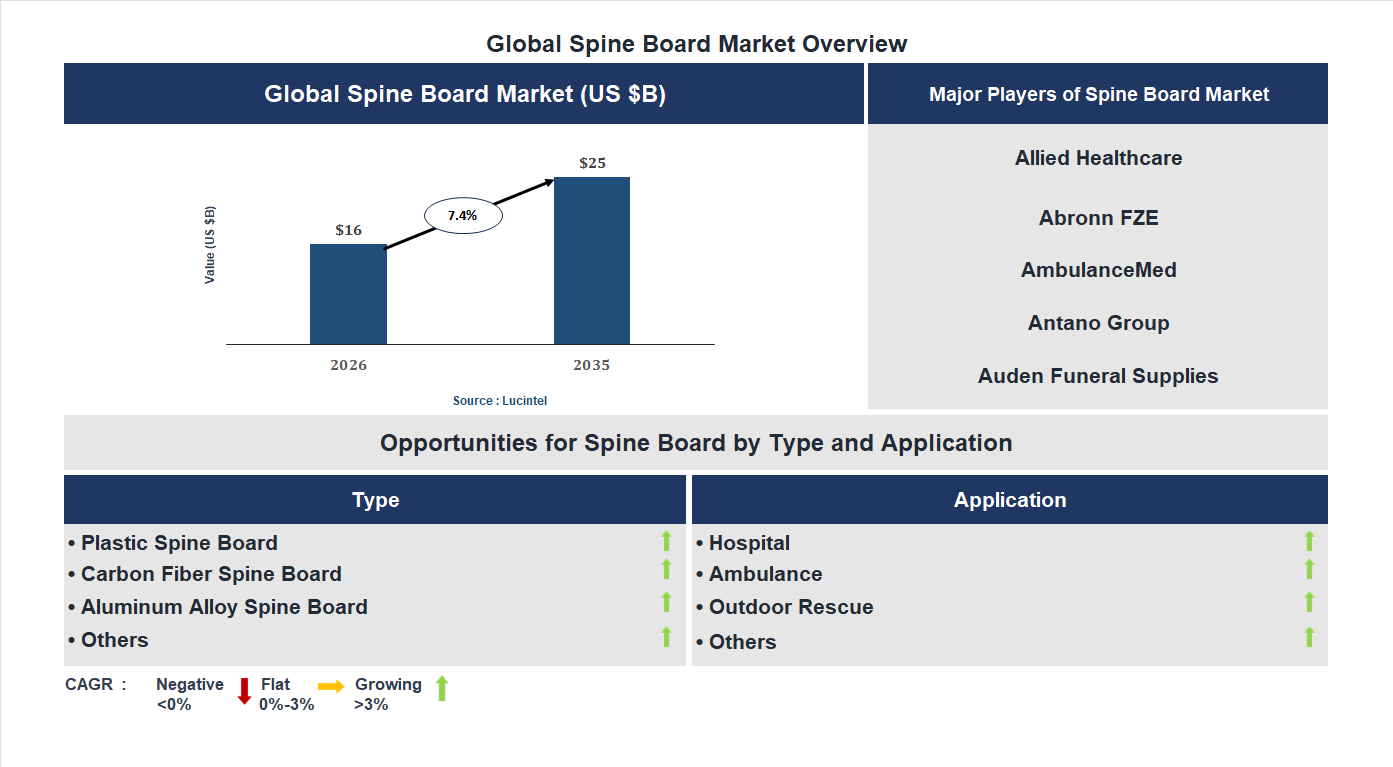
The future of the global spine board market looks promising with opportunities in the hospital, ambulance, and outdoor rescue markets. The global spine board market is expected to reach an estimated $25 billion by 2035 with a CAGR of 7.4% from 2026 to 2035. The major drivers for this market are the increasing incidence of traumatic injuries, the rising demand for emergency medical services, and the growing adoption of advanced immobilization devices.• Lucintel forecasts that, within the type category, carbon fiber spine board is expected to witness the highest growth over the forecast period.
• Within the application category, ambulance is expected to witness the highest growth.
• In terms of region, APAC is expected to witness the highest growth over the forecast period. Gain valuable insights for your business decisions with our comprehensive 150+ page report. Sample figures with some insights are shown below.
Emerging Trends in the Spine Board Market
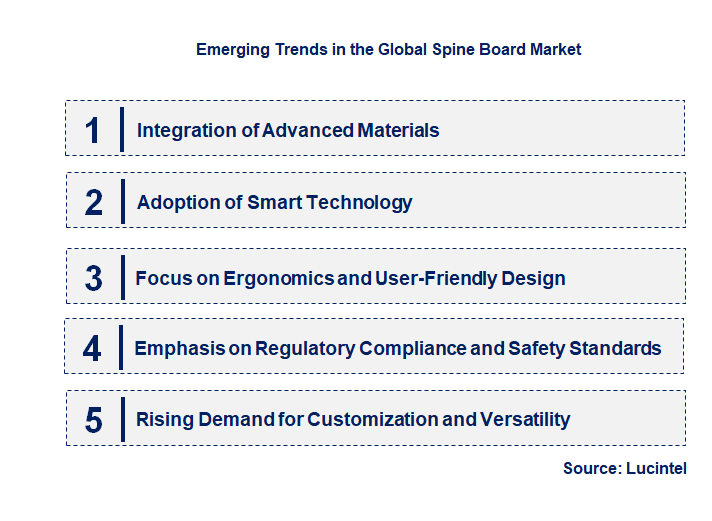
The spine board market is experiencing rapid evolution driven by technological advancements, increasing safety regulations, and a growing emphasis on patient care. As emergency response and medical transportation become more sophisticated, stakeholders are seeking innovative solutions to improve patient outcomes. These developments are reshaping the landscape, creating new opportunities and challenges for manufacturers, healthcare providers, and emergency services. The following key trends highlight the major shifts influencing this market, reflecting a move towards smarter, safer, and more efficient spine board solutions that cater to the needs of modern healthcare systems.• Integration of Advanced Materials: The use of lightweight, durable materials such as carbon fiber and high-strength plastics is increasing. These materials enhance portability and ease of handling without compromising strength or safety. This trend improves patient comfort and reduces transportation fatigue for responders, while also enabling the design of more ergonomic and versatile spine boards. As material science advances, manufacturers can produce products that meet stringent safety standards while being easier to deploy in emergencies.
• Adoption of Smart Technology: Incorporating sensors and IoT connectivity into spine boards is gaining traction. These smart devices can monitor patient vitals, detect movement, and transmit real-time data to medical teams. This integration enhances patient safety by providing continuous monitoring during transport and allows for quicker decision-making upon arrival at medical facilities. The adoption of smart technology is transforming traditional spine boards into intelligent medical devices, improving overall emergency response efficiency.
• Focus on Ergonomics and User-Friendly Design: Manufacturers are prioritizing ergonomic features to facilitate easier handling and immobilization. Features such as adjustable straps, cushioned surfaces, and intuitive locking mechanisms are becoming standard. These improvements reduce injury risk for both patients and responders, streamline the immobilization process, and enhance overall safety. User-friendly designs also minimize training requirements, enabling quicker deployment in high-pressure situations, which is critical in emergency medical services.
• Emphasis on Regulatory Compliance and Safety Standards: Increasingly stringent safety regulations and standards are shaping product development. Manufacturers are investing in rigorous testing and certification processes to ensure compliance with international safety norms. This focus ensures that spine boards are reliable, safe, and effective, fostering greater trust among healthcare providers and emergency responders. Compliance also helps companies access global markets and meet the demands of diverse regulatory environments, driving innovation aligned with safety.
• Rising Demand For Customization And Versatility: The market is witnessing a shift towards customizable spine boards tailored to specific patient needs, environments, or medical procedures. Modular designs and adaptable features allow for use in various scenarios, from sports injuries to disaster response. This versatility enhances the utility of spine boards, making them suitable for a broader range of applications. Customization also enables healthcare providers to optimize patient care and response times, thereby expanding market opportunities for manufacturers. These trends are fundamentally reshaping the spine board market by fostering innovation, improving safety, and enhancing usability. The integration of advanced materials and smart technology, combined with ergonomic design and regulatory compliance, is leading to more effective and reliable solutions. As customization becomes more prevalent, the market is poised for continued growth, driven by the need for safer, smarter, and more adaptable spine board products that meet the evolving demands of emergency and healthcare services worldwide.
Recent Development in the Spine Board Market
The spine board market is experiencing rapid growth driven by increasing demand for emergency medical equipment, technological advancements, and expanding healthcare infrastructure worldwide. As the need for efficient patient immobilization and transportation rises, manufacturers are innovating to meet safety standards and improve patient outcomes. This evolving landscape presents significant opportunities for market players to expand their product portfolios and enhance distribution channels, ultimately shaping the future of emergency medical response and trauma care.• Growing Demand for Emergency Medical Equipment: The rising incidence of accidents and trauma cases globally has heightened the need for reliable spine immobilization devices. Hospitals, ambulances, and rescue teams are investing heavily in advanced spine boards to ensure patient safety during transport. This surge in demand is fueling market growth, encouraging manufacturers to develop innovative, lightweight, and durable spine boards that meet strict safety standards. The increasing awareness of trauma management protocols further supports this expanding market.
• Technological Innovations in Spine Board Design: Advances in materials and design are transforming the spine board market. Manufacturers are integrating features such as adjustable head immobilizers, ergonomic handles, and lightweight composites to improve usability and patient comfort. These innovations enhance safety and efficiency during patient handling, reducing injury risks for both patients and responders. The adoption of such technologies is expected to drive market growth, as healthcare providers seek more effective and user-friendly solutions.
• Expansion of Healthcare Infrastructure in Emerging Markets: Rapid urbanization and government initiatives are boosting healthcare infrastructure development in emerging economies. This expansion increases the availability of emergency services and trauma care facilities, creating a higher demand for spine boards. Local manufacturers are entering these markets, offering cost-effective and adaptable products. The growth of healthcare facilities and emergency response systems in these regions significantly contributes to the global market expansion.
• Increasing Focus on Patient Safety and Comfort: The market is witnessing a shift towards spine boards that prioritize patient safety and comfort. Features such as padded surfaces, quick-release straps, and easy-to-clean materials are becoming standard. These enhancements reduce the risk of secondary injuries and improve patient experience during transport. As healthcare providers emphasize quality care, the demand for advanced spine boards with safety features is expected to rise, positively impacting market growth.
• Regulatory Standards and Certification Requirements: Stringent safety and quality standards imposed by regulatory bodies are shaping product development and market dynamics. Manufacturers must ensure compliance with certifications such as ISO and ASTM to access various markets. These regulations drive innovation, quality assurance, and product differentiation. Meeting certification requirements enhances market credibility and expands global reach, fostering trust among healthcare providers and patients, and ultimately propelling market growth. The recent developments in the spine board market, driven by technological innovations, expanding healthcare infrastructure, and regulatory compliance, are significantly impacting the industry. These opportunities are leading to the production of safer, more efficient, and user-friendly devices, thereby improving trauma care and patient outcomes. As the market continues to evolve, these advancements will foster increased adoption, global expansion, and competitive innovation, shaping a robust future for emergency medical response and trauma management sectors.
Strategic Growth Opportunities in the Spine Board Market
The spine board market is experiencing significant growth driven by increasing demand for emergency medical equipment, advancements in safety standards, and rising awareness of trauma management. Key applications such as emergency response, hospitals, and military operations are expanding rapidly. Innovations in materials and design are enhancing product effectiveness and user safety. Market players are focusing on strategic collaborations and geographic expansion to capitalize on emerging opportunities. This dynamic environment offers substantial potential for stakeholders to innovate and capture new customer segments, ultimately improving patient outcomes and operational efficiency.• Emergency Response and Rescue Operations: The demand for spine boards in emergency response is growing due to increasing accidents, natural disasters, and trauma cases. Rapid response teams require reliable, lightweight, and durable spine boards to immobilize and transport patients safely. Technological advancements, such as quick-application designs and improved immobilization features, are enhancing effectiveness. Governments and organizations are investing in training and equipment upgrades, further fueling market growth. The focus on improving emergency medical services globally presents a significant opportunity for market expansion.
• Hospital and Trauma Center Adoption: Hospitals and trauma centers are key consumers of spine boards for patient stabilization during initial assessment and treatment. The rising incidence of accidents and trauma cases worldwide is driving demand. Innovations like antimicrobial coatings and ergonomic designs are improving patient comfort and safety. Additionally, increasing healthcare infrastructure investments in emerging economies are expanding access to advanced trauma care. The integration of spine boards into comprehensive trauma management protocols is expected to boost sales and market penetration.
• Military and Defense Applications: The military sector requires specialized spine boards for battlefield trauma management and rescue missions. The need for rugged, portable, and easy-to-use devices is critical in combat zones. Advances in lightweight materials and quick-application features are making spine boards more suitable for military use. Growing defense budgets and strategic collaborations are facilitating product development tailored for military needs. The expanding scope of military medical services globally presents a lucrative opportunity for market players to innovate and supply specialized solutions.
• Technological Innovations and Material Advancements: The development of new materials such as lightweight composites and antimicrobial surfaces is transforming spine board design. These innovations improve durability, ease of handling, and infection control. Smart spine boards with integrated sensors for patient monitoring are emerging, offering real-time data during transport. Such technological advancements enhance safety and operational efficiency, attracting healthcare providers seeking cutting-edge solutions. Continuous R&D investments are expected to drive product differentiation and market growth.
• Geographic Expansion into Emerging Markets: Rapid urbanization and increasing healthcare infrastructure investments in regions like Asia-Pacific, Latin America, and Africa are creating new growth avenues. These markets are witnessing rising trauma cases and demand for affordable, effective spine immobilization devices. Local manufacturing, strategic partnerships, and regulatory compliance are key to capturing market share. Expanding distribution networks and training programs will further boost adoption. The growing focus on improving emergency and trauma care in these regions offers substantial long-term growth potential for market stakeholders. The spine board market is poised for substantial growth driven by technological innovations, expanding applications across emergency, hospital, military, and emerging markets. Strategic investments and product development tailored to specific needs will enhance market competitiveness. As healthcare infrastructure improves globally, the demand for advanced, reliable spine immobilization solutions will continue to rise, ultimately improving trauma management and patient outcomes worldwide.
Spine Board Market Driver and Challenges
The spine board market is influenced by a variety of technological, economic, and regulatory factors that shape its growth and development. Advances in medical technology, increasing awareness of trauma management, and evolving safety regulations are key drivers. Economic factors such as healthcare expenditure and the rising prevalence of accidents also play significant roles. However, the market faces challenges, including high product costs, regulatory hurdles, and competition from alternative immobilization devices. Understanding these drivers and challenges is essential for stakeholders to navigate the market effectively and capitalize on emerging opportunities while addressing potential barriers. The factors responsible for driving the spine board market include:-• Technological Innovations: The development of advanced spine boards with improved materials, lightweight designs, and enhanced safety features has significantly contributed to market growth. These innovations improve patient comfort, ease of use for medical personnel, and overall safety during transportation and treatment. As technology continues to evolve, manufacturers are investing in research to create more effective and user-friendly products, which in turn boosts market demand. The integration of features like antimicrobial coatings and modular designs further enhances the appeal of modern spine boards, making them indispensable in emergency medical services and hospitals.
• Increasing Trauma Incidents: The rising incidence of road accidents, falls, and sports injuries globally has led to a higher demand for effective immobilization devices such as spine boards. Governments and healthcare providers are emphasizing rapid response and trauma management, which directly impacts the market. The growing awareness about the importance of early immobilization to prevent spinal cord injuries has driven hospitals and emergency services to adopt advanced spine board solutions. This trend is expected to continue as urbanization and motorization increase worldwide, fueling sustained market growth.
• Regulatory Support and Standards: Stringent safety regulations and standards set by health authorities and organizations like the American College of Surgeons influence the adoption of spine boards. Compliance with these standards ensures product safety and efficacy, encouraging manufacturers to innovate and improve their offerings. Regulatory frameworks also facilitate market entry for new players and promote quality assurance, which boosts consumer confidence. As regulatory bodies update guidelines to incorporate new research findings, the market benefits from the continuous development of safer, more reliable spine immobilization devices.
• Growing Healthcare Expenditure: Increasing healthcare spending across developed and developing countries has expanded access to advanced trauma care equipment, including spine boards. Governments and private healthcare providers are investing more in emergency medical infrastructure, training, and equipment upgrades. This financial commitment enhances the availability and quality of spine board products, driving market expansion. Additionally, the rising adoption of emergency response systems and trauma centers further propels demand, making spine boards a critical component of modern emergency care. The challenges facing the spine board market include:-
• High Product Costs: The advanced features and materials used in modern spine boards often result in higher manufacturing costs, which translate into elevated prices for end-users. This can limit adoption, especially in resource-constrained settings or developing countries where budget constraints are significant. The cost barrier may hinder widespread implementation in smaller healthcare facilities and emergency services, thereby restricting market growth. Manufacturers need to balance innovation with affordability to expand their customer base and ensure broader access to essential trauma management tools.
• Regulatory Hurdles: Navigating complex regulatory approval processes can delay product launches and increase costs for manufacturers. Different countries have varying standards and certification requirements, creating barriers to international market entry. These regulatory challenges can slow down innovation and limit the availability of new products in certain regions. Companies must invest considerable time and resources to ensure compliance, which can impact overall market growth and product diversification efforts.
• Competition from Alternative Devices: The market faces competition from other immobilization and trauma management devices such as vacuum splints, cervical collars, and soft immobilizers. These alternatives may offer advantages like lower costs, ease of use, or better patient comfort, challenging the dominance of traditional spine boards. The emergence of innovative, non-traditional devices can disrupt the market dynamics, forcing manufacturers to continuously innovate and differentiate their products. This competitive landscape necessitates ongoing research and marketing efforts to maintain market share. The spine board market is driven by technological advancements, increasing trauma cases, supportive regulations, and rising healthcare investments. However, high costs, regulatory complexities, and competition from alternative devices pose significant challenges. These factors collectively influence market growth, requiring stakeholders to innovate, adapt, and strategize effectively. The overall impact is a dynamic market with substantial growth potential, provided that companies can navigate the regulatory environment and address cost concerns while leveraging technological progress and increasing demand for trauma management solutions.
List of Spine Board Companies
Companies in the market compete on the basis of product quality offered. Major players in this market focus on expanding their manufacturing facilities, R&D investments, infrastructural development, and leverage integration opportunities across the value chain. With these strategies spine board companies cater increasing demand, ensure competitive effectiveness, develop innovative products & technologies, reduce production costs, and expand their customer base. Some of the spine board companies profiled in this report include-• Allied Healthcare
• Abronn FZE
• AmbulanceMed
• Antano Group
• Auden Funeral Supplies
• EGO Zlín
• Genstartech
• Hebei Pukang Medical Instruments
• Meber
• Mobi Medical
Spine Board Market by Segment
The study includes a forecast for the global spine board market by type, application, and region.Spine Board Market by Type [Value from 2019 to 2035]:
• Plastic Spine Board
• Carbon Fiber Spine Board
• Aluminum Alloy Spine Board
• Others
Spine Board Market by Application [Value from 2019 to 2035]:
• Hospital
• Ambulance
• Outdoor Rescue
• Others
Spine Board Market by Region [Value from 2019 to 2035]:
• North America
• Europe
• Asia Pacific
• The Rest of the World
Country Wise Outlook for the Spine Board Market
The spine board market has experienced significant growth driven by increasing awareness of emergency medical response, technological advancements, and expanding healthcare infrastructure worldwide. Countries are investing in innovative products to improve patient outcomes during trauma and emergencies. Regulatory approvals and partnerships with healthcare providers are also shaping market dynamics. As the demand for advanced spinal immobilization devices rises, key players are focusing on product development and market expansion. The following summaries highlight recent developments in the United States, China, Germany, India, and Japan, reflecting their unique contributions and market trends in this sector.• United States: The US market has seen substantial growth due to rising trauma cases and stringent emergency response protocols. Innovations include lightweight, portable spine boards with enhanced immobilization features. Major hospitals and EMS providers are adopting advanced materials and designs to improve patient safety and comfort. Regulatory agencies like the FDA are approving new products, boosting market confidence. Additionally, increased training programs for emergency responders are promoting the use of modern spine boards, further expanding market reach.
• China: China’s spine board market is rapidly expanding, driven by government initiatives to improve emergency medical services and healthcare infrastructure. Local manufacturers are investing in R&D to develop cost-effective, durable spine boards suitable for diverse environments. The rising incidence of road accidents and trauma cases has increased demand. The government’s focus on urbanization and healthcare reforms is facilitating market growth. International companies are entering the Chinese market through partnerships, bringing innovative products and technology transfer.
• Germany: Germany’s market is characterized by high-quality standards and technological innovation. The country emphasizes safety and ergonomic design in spine board development. Increasing adoption of advanced materials like carbon fiber enhances durability and reduces weight. Germany’s strong healthcare system and strict regulatory environment ensure the availability of reliable products. The focus on training emergency personnel and integrating new devices into existing protocols is driving market expansion. Additionally, sustainability considerations are influencing product design, with eco-friendly materials gaining popularity.
• India: The Indian spine board market is witnessing rapid growth due to increasing trauma cases from road accidents and industrial injuries. The government’s initiatives to improve emergency medical services and rural healthcare are boosting demand. Local manufacturers are offering affordable, durable spine boards tailored to the Indian market. There is a rising trend of public-private partnerships to enhance trauma care infrastructure. Awareness campaigns and training programs are promoting the use of spine boards among first responders. The market is also seeing a surge in imports of advanced devices from international players.
• Japan: Japan’s market is driven by an aging population and a high prevalence of trauma-related injuries. The focus is on developing lightweight, ergonomic spine boards that facilitate quick application and removal. Technological innovations include integration with digital monitoring systems for better patient assessment. Japan’s strict regulatory standards ensure high product quality and safety. The healthcare system’s emphasis on disaster preparedness and emergency response training is supporting market growth. Additionally, collaborations between medical device companies and research institutions are fostering the development of next-generation spine immobilization solutions.

Features of the Global Spine Board Market
Market Size Estimates: Spine board market size estimation in terms of value ($B). Trend and Forecast Analysis: Market trends (2019 to 2025) and forecast (2026 to 2035) by various segments and regions. Segmentation Analysis: Spine board market size by type, application, and region in terms of value ($B). Regional Analysis: Spine board market breakdown by North America, Europe, Asia Pacific, and Rest of the World. Growth Opportunities: Analysis of growth opportunities in different types, applications, and regions for the spine board market. Strategic Analysis: This includes M&A, new product development, and competitive landscape of the spine board market. Analysis of competitive intensity of the industry based on Porter’s Five Forces model.
FAQ
Q1. What is the market size and growth forecast for spine board market? Answer: The global spine board market is expected to reach an estimated $25 billion by 2035 and grow with a CAGR of 7.4% from 2026 to 2035. Q2. What are the major drivers influencing the growth of the spine board market? Answer: The major drivers for this market are the increasing incidence of traumatic injuries, the rising demand for emergency medical services, and the growing adoption of advanced immobilization devices. Q3. What are the major segments for spine board market? Answer: The future of the spine board market looks promising with opportunities in the hospital, ambulance, and outdoor rescue markets. Q4. Who are the key spine board market companies? Answer: Some of the key spine board companies are as follows:• Allied Healthcare
• Abronn FZE
• AmbulanceMed
• Antano Group
• Auden Funeral Supplies
• EGO Zlín
• Genstartech
• Hebei Pukang Medical Instruments
• Meber
• Mobi Medical Q5. Which spine board market segment will be the largest in future? Answer: Lucintel forecasts that, within the type category, carbon fiber spine board is expected to witness the highest growth over the forecast period. Q6. In spine board market, which region is expected to be the largest in next 5 years? Answer: In terms of region, APAC is expected to witness the highest growth over the forecast period. Q7. Do we receive customization in this report? Answer: Yes, Lucintel provides 10% customization without any additional cost.
Table of Contents
List of Figures
List of Tables
Methodology
- In-depth interviews of the major players in this market
- Detailed secondary research from competitors’ financial statements and published data
- Extensive searches of published works, market, and database information pertaining to industry news, company press releases, and customer intentions
- A compilation of the experiences, judgments, and insights of Lucintel’s professionals, who have analyzed and tracked this market over the years.


Buy Now
Choose a license that fits your team. Instant PDF delivery.
Prices exclude taxes. Instant delivery. Custom licensing available on request.
Key Questions
- • What are some of the most promising, high-growth opportunities for the spine board market by type (plastic spine board, carbon fiber spine board, aluminum alloy spine board, and others), application (hospital, ambulance, outdoor rescue, and others), and region (North America, Europe, Asia Pacific, and the Rest of the World)?
- • Which segments will grow at a faster pace and why?
- • Which region will grow at a faster pace and why?
- • What are the key factors affecting market dynamics? What are the key challenges and business risks in this market?
- • What are the business risks and competitive threats in this market?
- • What are the emerging trends in this market and the reasons behind them?
- • What are some of the changing demands of customers in the market?
- • What are the new developments in the market? Which companies are leading these developments?
- • Who are the major players in this market? What strategic initiatives are key players pursuing for business growth?
- • What are some of the competing products in this market and how big of a threat do they pose for loss of market share by material or product substitution?
- • What M&A activity has occurred in the last 7 years and what has its impact been on the industry? For any questions related to Spine Board Market, Spine Board Market Size, Spine Board Market Growth, Spine Board Market Analysis, Spine Board Market Report, Spine Board Market Share, Spine Board Market Trends, Spine Board Market Forecast, Spine Board Companies, write Lucintel analyst at email: helpdesk@lucintel.com. We will be glad to get back to you soon.


